

What Sound Actually Is: The Science Every Musician Should Understand




Making a Scene Presents – What Sound Actually Is: The Science Every Musician Should Understand
Listen to the Podcast Discussion
Before the Microphone, Something Has to Move
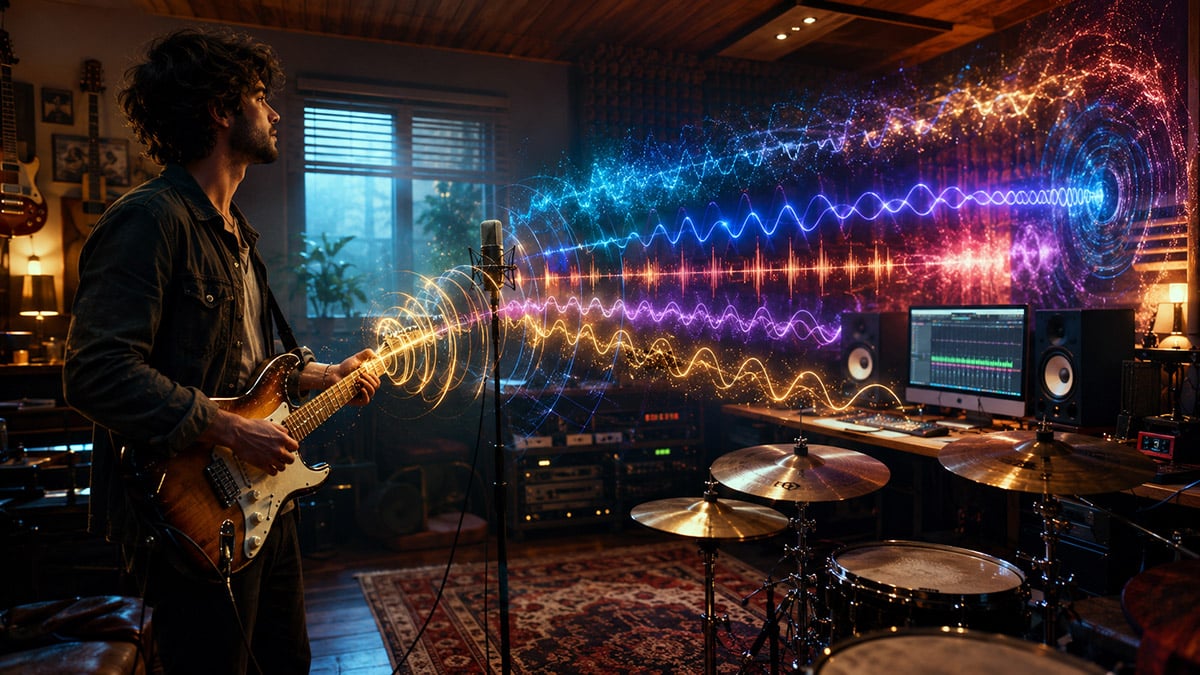
Every recording begins with movement.
Before the microphone, the preamp, the audio interface, the computer, the waveform, the compressor, and the plugin with the picture of a rusty spaceship, something must vibrate.
A singer pushes air from the lungs past the vocal folds. Those folds open and close rapidly. A guitarist plucks a string, causing it to move back and forth. A drummer strikes a drumhead, which bends inward and springs back. A cymbal flexes in many directions at once. A piano hammer hits a string. A loudspeaker cone moves forward and backward.
That movement pushes and pulls on the air around it.
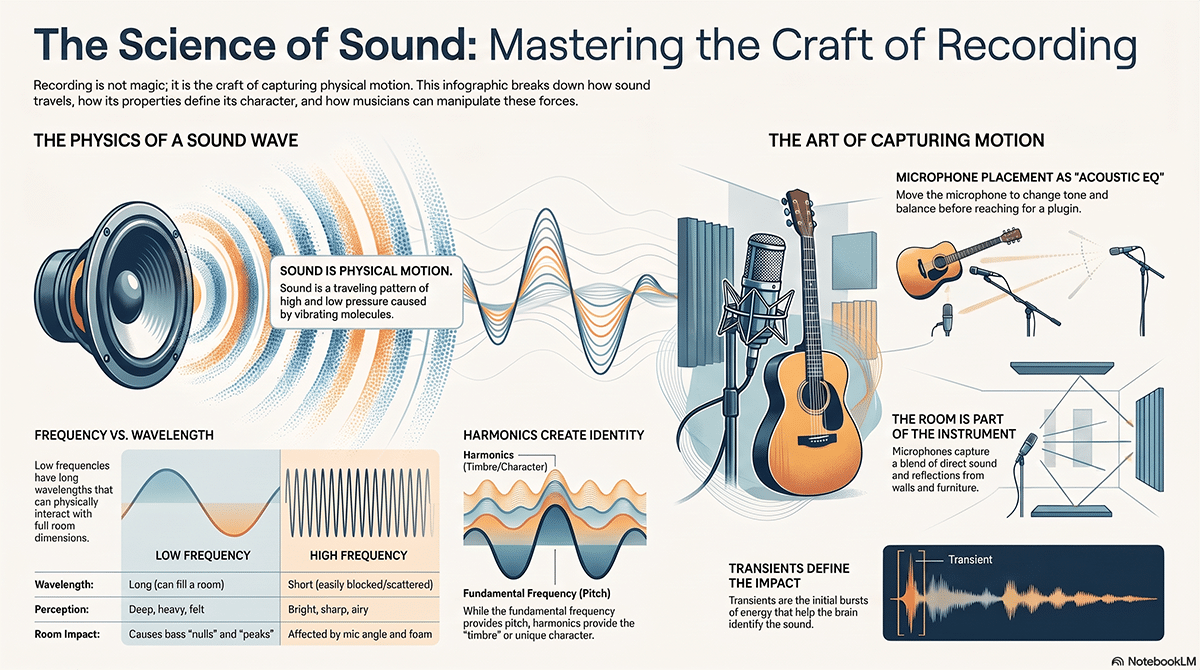
Air may look like empty space, but it is filled with tiny molecules. When a guitar string moves, it pushes nearby air molecules closer together. Those molecules bump into the next group, which bumps into another group. When the string moves back, it leaves a slightly less crowded area behind it. The result is a traveling pattern of higher and lower pressure.
That traveling pressure pattern is a sound wave.
The air itself does not race from the guitar all the way to your ear like water coming from a hose. The nearby molecules mostly move back and forth, passing the disturbance along. Think of people doing “the wave” in a stadium. The people do not run around the stadium. Each person moves in place while the pattern travels through the crowd.
When that pressure pattern reaches a microphone, it moves the microphone’s diaphragm. The microphone turns that movement into an electrical signal. When the pattern reaches your ear, it moves the eardrum. The hearing system then changes those vibrations into nerve signals that the brain understands as sound. The National Institute on Deafness and Other Communication Disorders explains this chain from sound wave to eardrum, middle ear, cochlea, and brain at https://www.nidcd.nih.gov/health/how-do-we-hear.
Sound is not a mysterious substance sprinkled over a performance. It is physical motion.
That simple fact changes how you record. You are not merely aiming a microphone at a singer, guitar, or drum. You are placing a sensitive device inside a moving field of pressure, reflections, resonances, and changing energy.
Once you understand that, recording stops looking like magic and starts looking like a craft.
Vibration Is the Beginning, Not the Whole Sound
A vibration is repeated movement around a resting point. A guitar string moves one way, passes through the middle, moves the other way, and returns. A drumhead moves inward and outward. Vocal folds come together and separate as air passes through them.
But musical vibrations are rarely simple.
A tuning fork can create something fairly close to a basic, smooth vibration. A real musical instrument is much messier, which is good news because mess is where personality lives.
When you pluck an acoustic guitar string, the string does not vibrate in only one way. The whole string moves, but smaller sections of the string also vibrate. The bridge carries that motion into the guitar’s top. The top bends and flexes. The air inside the body responds. The back and sides respond. The pick creates a quick scraping sound. Your fingers add their own noise. The room begins reflecting all of it.
That is one guitar note.
A singer’s vocal folds create the starting vibration, but the throat, mouth, tongue, teeth, lips, nasal passages, and chest help shape the result. The National Institute on Deafness and Other Communication Disorders describes the vocal folds as the vibrating source while the throat, nose, and mouth act as resonating spaces that shape the voice. Its explanation can be found at https://www.nidcd.nih.gov/news/multimedia/how-does-human-body-produce-voice-and-speech-text-version.
This is why moving a microphone can change a sound so much. You are not recording one vibration from one point. You are capturing a blend of direct sound, body resonance, mechanical noise, reflected sound, and room decay.
The microphone does not know which part you meant to record. It faithfully collects whatever reaches it.
Sometimes a little too faithfully.
Frequency Is How Fast the Vibration Repeats
Frequency describes how many times a repeating vibration completes its cycle during one second.
The unit used to describe frequency is the hertz, usually shortened to Hz. One hertz means one complete cycle per second. One hundred hertz means one hundred cycles per second.
You do not need to carry a calculator around the studio. You only need to understand what the number is telling you.
A slow vibration creates a low frequency. A fast vibration creates a high frequency.
A low bass note causes the string and nearby air pressure to change relatively slowly. A cymbal creates much faster changes along with a complicated mix of frequencies. That is why the bass feels deep and heavy while the cymbal sounds bright, sharp, and airy.
Frequency is closely connected to pitch. As frequency rises, we usually hear the pitch moving upward. As frequency falls, we hear the pitch moving downward.
Pitch, however, is the way the brain understands frequency. Frequency is a physical measurement. Pitch is a human perception. They are closely related, but they are not quite the same thing.
A bass player and a pianist can play what musicians call the same note in different octaves. The notes share a musical relationship, but the lower note vibrates more slowly. A singer can slide upward in pitch because the vocal folds are changing the rate of vibration.
Most musical sounds are not made from one frequency. A bass note may have a powerful low fundamental, but it also contains higher-frequency information from the string, fingers, fret noise, pickups, amplifier, speaker, and room. A kick drum can contain deep low-frequency energy along with a higher-frequency click from the beater. A vocal can have body in the lower range, character in the middle, and consonants and breath in the upper range.
This matters because a sound can remain recognizable even when its deepest frequency is weak. On small speakers, you may not hear the lowest part of an electric bass clearly, but you can still follow the bass line because the harmonics give your brain clues.
Frequency is not just a number on an EQ. It is one way of describing the many parts that make up a sound.
Amplitude Is the Strength of the Movement
Amplitude describes the size or strength of a vibration.
Imagine lightly touching a snare drum with a stick. The drumhead moves a little. Now hit it hard. The drumhead moves farther, pushes the surrounding air more strongly, and creates larger changes in air pressure.
That larger movement has greater amplitude.
Amplitude is connected to sound pressure, but amplitude is not exactly the same thing as loudness. Loudness is the way a listener experiences sound. That experience depends on the frequency, duration, environment, hearing system, and what other sounds are happening at the same time.
Two sounds can produce similar readings on a meter but not seem equally loud. A bright guitar may appear to jump out of a mix while a low bass sound with similar measured energy seems less obvious. A sharp snare transient can feel very loud for a moment, even when its average level is not especially high.
This is one reason meters are helpful but cannot mix your song for you.
A meter can tell you about signal level. It cannot fully tell you how forward, aggressive, soft, painful, distant, warm, or exciting the sound will feel to a person.
The word “volume” also creates confusion. Musicians often use volume to mean loudness, electrical signal level, amplifier output, or the position of a knob. Those ideas are related, but they are not identical.
Turning up a volume control raises the signal feeding the next part of the system. That often makes the result louder, but the listener’s experience still depends on the speakers, room, distance, frequency balance, and other sounds.
This becomes important when recording. A waveform that looks large is not automatically better. A vocal that nearly fills the screen may still feel dull or buried. A smaller waveform with clear consonants, useful harmonics, and a strong performance may sound much more present.
Do not record with your eyes.
Your eyes are invited to the session, but your ears are still running the meeting.
Wavelength Explains Why Bass Owns the Room
Frequency tells us how fast a wave repeats. Wavelength describes the physical distance covered by one complete cycle of that wave.
Low frequencies have long wavelengths. High frequencies have short wavelengths.
A very low bass wave can be long enough to interact with the full dimensions of a bedroom or project studio. A high-frequency wave may be small enough to be strongly affected by a microphone angle, a desk edge, a person’s head, or a piece of thin acoustic material.
This difference is one reason bass causes so many problems in small rooms.
A low-frequency wave travels from the speaker, hits walls, and reflects. The reflected wave meets new waves coming from the speaker. At some places, the waves add together. At other places, they partly cancel.
That can create areas where one bass note sounds huge and nearby areas where the same note nearly disappears.
You may sit at your desk and decide the bass is too weak. You add more bass with EQ. Then you play the mix in a car and discover that you have apparently recorded an earthquake.
The real problem may not have been the bass track. The problem may have been your listening position.
Room modes are patterns of resonance connected to the room’s dimensions. Standing waves are stable patterns created when waves and reflections interact. At certain spots, pressure may be stronger. At other spots, it may be weaker. Research published through the Acoustical Society of America notes that low-frequency wavelengths can be similar to room dimensions, producing clear pressure peaks and nulls in listening spaces.
This is also why bass can sound strong near walls or corners. Boundaries affect the pressure pattern, and corners bring several boundaries together. That does not mean every corner contains an evil bass creature waiting to ruin your album. It means corner listening can give you a misleading picture of the low end.
Play a steady bass note through your monitors and slowly walk around the room. You will probably hear the note change in level. In some spots it may grow. In others it may shrink. Nothing changed in the track. Your position inside the wave pattern changed.
That little experiment teaches more about room acoustics than staring at a fancy plugin while nodding thoughtfully.
Harmonics Are the Family Living Inside a Note
When a musical instrument plays a note, the lowest main vibration is often called the fundamental frequency. That fundamental gives the ear its strongest clue about the basic pitch.
But the instrument also produces higher-frequency components.
Many of these components occur at whole-number multiples of the fundamental. Those are called harmonics. Musical instruments commonly vibrate at a fundamental and a family of higher modes, which helps create their recognizable sound. The University of New South Wales music-acoustics resources and Georgia State University’s HyperPhysics project explain these relationships in detail at https://www.phys.unsw.edu.au/jw/strings.html and https://hyperphysics.phy-astr.gsu.edu/hbase/Waves/funhar.html.
Suppose a guitar, piano, saxophone, and singer all perform the same note. They do not sound alike because each creates a different balance of fundamental energy, harmonics, noise, attack, resonance, and decay.
The guitar may have a sharp pick attack followed by a warm wooden body. The piano may begin with a hard hammer strike and then fade. The saxophone may carry strong upper harmonics and breath noise. The voice may include vowel resonances, consonants, air, and tiny changes in pitch.
That full identity is called timbre.
Timbre is why you can recognize your favorite singer after hearing one line. It is why a cheap acoustic guitar does not suddenly become a grand piano when both instruments play an A. It is why two singers with similar ranges can still sound completely different.
The fundamental tells you much of the note’s pitch. The harmonic balance tells you who is speaking.
Harmonics and Overtones Are Related, but Not Identical
Musicians often use the words harmonics and overtones as though they mean the same thing. In everyday studio talk, that usually causes no trouble.
Technically, there is a small difference.
The fundamental is the first harmonic. The first overtone is the next component above the fundamental, which is usually the second harmonic in a harmonic sound. Not every overtone has to fit perfectly into a whole-number harmonic pattern. Cymbals, bells, drumheads, and many struck objects can create complex components that are not arranged as neatly as the harmonics of an ideal vibrating string.
You do not need to turn this into a dinner-table argument.
The practical lesson is that real sounds contain layers above the fundamental. Some layers fit an orderly harmonic series. Others are more irregular. Together, they create color, brightness, warmth, bite, metallic character, woodiness, breath, rasp, and identity.
Performance changes those layers.
Pick an acoustic guitar near the bridge and the tone becomes brighter and more pointed. Pick closer to the neck and it usually becomes rounder. Strike a snare near the center and then near the rim. Change the drumstick. Change the pick. Sing a vowel and then shape your mouth differently.
The pitch may stay similar while the tone changes greatly.
Microphone placement also changes the harmonic balance. Pointing a microphone toward a bright part of an instrument can collect more upper detail. Moving it away from the sound hole of an acoustic guitar can reduce boom. Turning it slightly off-axis may soften high-frequency energy, depending on the microphone.
Saturation and distortion can create additional harmonic content. That can make a sound seem thicker, brighter, more aggressive, or easier to hear on small speakers. But more harmonics are not automatically better. Too much added grit can flatten the emotional detail of a voice, crowd the mix, or turn a warm guitar into an angry kitchen appliance.
Harmonics are part of the arrangement. Treat them with musical judgment, not plugin fever.
Transients Are the Front Edge of the Sound
A transient is a fast change in energy, usually found near the beginning of a sound.
The crack of a snare is a transient. The click of a kick-drum beater is a transient. The first scrape of a pick across a guitar string is a transient. The hard consonant at the beginning of a sung word can be a transient. The hammer hitting a piano string creates a transient.
Transients help the brain identify sounds.
Imagine removing the first instant from a snare hit. The remaining ring may sound more like a strange tone than a drum. Remove the pick attack from an acoustic guitar and the performance may feel soft or distant. Reduce the consonants in a vocal too much and the words become harder to understand.
The beginning of a sound often tells us what caused it.
Microphones differ in how accurately they follow fast changes. Designs with very light moving parts can often track rapid movement with great detail. Neumann’s educational material describes transients as fast bursts of energy, such as a drum attack or guitar pick, and explains how low-mass condenser diaphragms can respond closely to those changes at https://www.neumann.com/en-us/knowledge-base/neumann-im-homestudio/homestudio-academy/what-is-a-condenser-microphone.
That does not mean condenser microphones are always better. A dynamic microphone may soften or shape the attack in a way that works beautifully on a harsh source. A ribbon microphone may capture detail while presenting the top end differently. The correct choice depends on the performance and the tone you need.
Compression can also change transients. A compressor with very fast attack behavior may reduce the opening hit. A slower attack may allow more of the transient through before controlling the body of the sound.
Neither choice is automatically right.
A softened transient can help a vocal sit smoothly. A stronger transient can help a snare punch through. A rounded bass attack may feel warm. A clear bass attack may help the notes remain readable.
The mistake is not changing the transient. The mistake is changing it without listening to what the song needs.
Resonance Is the Sound of Something Joining In
Resonance happens when an object or space responds strongly to certain frequencies.
Every instrument depends on resonance.
A vibrating acoustic guitar string alone does not move much air. The guitar body receives the string’s energy and helps project the sound. A drum shell and enclosed air work with the heads. A piano soundboard helps the strings speak. The spaces in a singer’s throat and mouth shape the voice.
Without resonance, many instruments would sound weak, thin, or nearly inaudible.
The problem begins when resonance becomes uncontrolled.
A snare may ring strongly at one annoying pitch. An acoustic guitar may boom on one note. A vocal recorded near a wall may develop a boxy tone. A desk may vibrate when the monitors play a certain bass note. A loose music stand may buzz only when the bass player hits E.
That last example has ruined more takes than some producers are willing to admit.
Resonance can happen in instruments, rooms, microphones, speaker cabinets, furniture, floors, windows, and microphone stands. A strong frequency excites the object, and the object begins contributing its own sound.
The easiest way to find a physical resonance is often to listen while touching or damping objects. Play the problem note and place a hand on the desk, stand, door, guitar body, or nearby panel. When the ringing changes, you have learned something useful.
Do not reach for a narrow EQ cut before checking the room.
The ringing may not be in the instrument at all.
Attack, Sustain, and Decay Tell the Story Over Time
Sound does not only have pitch and tone. It also has a shape through time.
Attack is the beginning. It describes how the sound rises from silence.
A snare has a fast attack. A bowed string may have a slower attack. A cymbal begins with the stick impact and then blooms. A singer can begin a word gently or hit it with a sharp consonant.
Sustain is the continuing part of the sound.
An organ can hold a fairly steady tone while a key remains pressed. A bowed violin can continue while the player keeps moving the bow. A distorted electric guitar may sustain for a long time. A piano cannot maintain its energy in the same way because the hammer strikes and moves away, leaving the strings to fade.
Decay is the way the sound loses energy.
A muted guitar note decays quickly. A large cymbal may continue shimmering. A floor tom may ring long after the strike. A piano note fades. A room also adds its own decay because reflections continue arriving after the original sound.
This time shape is one reason a sound can occupy too much space in a mix without being extremely loud. A long cymbal wash, ringing guitar chord, sustained keyboard pad, and large room reverb may overlap until the song feels crowded.
The solution may not be EQ.
The solution may be shorter parts, different voicings, damping, muting, tighter playing, a drier room, or fewer instruments sustaining at once.
Arrangement is acoustic problem-solving with better clothes.
The Room Becomes Part of Every Recording
The microphone hears the source and the room.
When sound leaves an instrument or voice, some of it travels directly to the microphone. Some hits the floor, ceiling, walls, desk, windows, doors, and furniture. Those surfaces reflect part of the sound back into the room.
The microphone receives a mixture of direct sound and reflections.
When the microphone is close to the source, the direct sound is usually stronger compared with the room. Move the microphone farther away and the room becomes a larger part of the recording.
This can be beautiful.
A good room can give drums size, vocals depth, acoustic guitar space, and piano a sense of reality. A poor room can add fluttering echoes, boxy reflections, sharp high-frequency splashes, and uneven bass.
Flutter echo often happens between hard, parallel surfaces. Clap your hands in an empty room. A quick metallic or chirping repeat suggests that sound is bouncing rapidly between surfaces.
Absorption reduces reflected energy by turning some of the sound’s movement into tiny amounts of heat. Thick, porous absorbers can work across a broader frequency range than thin foam. Thin foam may reduce some high-frequency reflections while doing little to control deep bass.
This can create a strange room that sounds dull when you clap but still lies to you about the low end.
Diffusion scatters reflected sound in different directions rather than simply soaking it up. A diffuser can help preserve some sense of life while reducing strong, focused reflections. In small home studios, diffusion must be used thoughtfully because distance matters. A bookshelf filled with uneven objects may scatter some sound, but it is not automatically a carefully designed acoustic diffuser just because it contains three biographies and a lava lamp.
Bass trapping uses thick or specially designed treatment to reduce low-frequency problems. Because low-frequency wavelengths are long, bass control usually requires more depth and material than high-frequency control.
Room acoustics is connected to the room’s size, shape, materials, source position, microphone position, speaker position, and listening position. The Acoustical Society of America describes room acoustics as the relationship between a room’s physical properties and sound-field qualities that matter to listeners.
You cannot buy one square of foam, place it behind the computer, and declare victory over physics.
Physics has lawyers.
Improve the Room Before Buying Another Plugin
The cheapest acoustic tool is movement.
Move the singer. Move the microphone. Move the amplifier. Move your listening chair. Move the speakers away from the wall and test the result. Rotate the recording setup so the microphone faces a different direction.
A position that sounds bad may be only two feet away from one that works.
Record a singer in several parts of the room while keeping the microphone distance similar. Listen for boxiness, flutter, low-frequency buildup, and harsh reflections. Do not choose the position that looks best on camera. Choose the one that sounds best in the recording.
Try placing the singer away from the exact center of the room. Avoid crowding a bass-heavy instrument into a corner unless you are using that reinforcement on purpose. Listen near walls and then farther away.
For early reflections, thick movable absorption placed near the singer or instrument can help. A heavy absorber behind the singer may reduce reflections that would otherwise travel past the singer and enter the front of a cardioid microphone. Depending on the setup, treatment behind or beside the microphone can also reduce reflections.
Blankets can help with some middle and upper frequencies, especially when used with air space, but they are not full-range bass traps. Mattresses may help in some situations, although turning the bedroom into an acoustic fort can make normal family life slightly complicated.
The main lesson is to test before buying.
A microphone moved six inches may solve what you were preparing to attack with six plugins.
Choosing a Microphone Means Choosing What to Notice
A microphone is a transducer. It changes acoustic energy into an electrical signal.
Microphones do not all notice sound in the same way.
They differ in frequency response, directionality, sensitivity, self-noise, maximum sound-pressure handling, transient response, and off-axis behavior. Their physical design also affects how they react to handling noise, wind, breath, room sound, and close placement.
This is why there is no universal best microphone.
A microphone that sounds exciting on one singer may sound sharp on another. A microphone that captures every detail of an acoustic guitar may also capture every ugly reflection in the room. A microphone that smooths a bright amplifier may make a dark vocal feel buried.
Dynamic microphones are often rugged and useful around loud sources. Condenser microphones often offer high sensitivity and detailed response. Ribbon microphones can provide a different high-frequency character and may have strong proximity effect when used close because many use a figure-eight directional pattern.
Those are broad tendencies, not laws carved into a studio wall.
You choose a microphone by deciding what the recording needs.
Does the singer have sharp consonants? Does the room sound bad? Is the guitar too bright? Is the snare missing attack? Is the amplifier extremely loud? Does the artist move while singing? Do you want intimacy or distance? Do you want the room included or controlled?
Shure’s recording guide at https://www.shure.com/en-US/docs/education/Microphone-Techniques-for-Recording explains how microphone type, placement, frequency response, polar pattern, distance, and proximity effect influence recorded sound. DPA Microphones also provides a detailed guide to reading microphone specifications at https://www.dpamicrophones.com/mic-university/technology/how-to-read-microphone-specifications/.
A microphone specification sheet can help narrow the choices. Your ears must make the final decision.
Microphone Placement Is Acoustic EQ
Moving a microphone changes the sound before it reaches a plugin.
That makes microphone placement a form of acoustic EQ.
Place a microphone directly in front of an acoustic guitar’s sound hole and you may capture strong low-frequency body along with bursts of moving air. Move toward the neck joint and the sound may become more balanced. Move farther toward the neck and you may hear more string detail and less body.
Move the microphone closer and you capture a more focused section of the instrument. Move it farther back and the separate parts blend together, but the room becomes more important.
There is no single correct acoustic-guitar position because guitars, players, rooms, songs, and microphones differ. Shure’s recording guide offers common starting points, but it also treats placement as something that must be adjusted by listening.
The same principle applies to drums.
Place a kick-drum microphone inside the shell and point it toward the beater to collect more attack. Move it toward the outside head and you may capture more low-frequency body and resonance. Shure’s drum-recording guidance describes this attack-versus-body tradeoff at https://www.shure.com/en-us/insights/recording-drums-part-1-setting-up-and-microphone-technique.
Overhead microphones are not merely cymbal microphones. Their height, spacing, and angle affect the balance of the full kit, the stereo image, the room, and the arrival time of each drum.
Move an overhead closer to the ride cymbal and the ride may dominate. Raise it and the kit may blend more naturally, but the room may become stronger. Change the angle and the cymbal brightness can change.
On a guitar amplifier, the center of the speaker cone often sounds brighter and more direct than positions toward the edge. Angling the microphone can soften the top end. Moving it away allows the speaker sound to develop but invites more room.
Do not begin with “Which EQ frequency should I cut?”
Begin with “Where should the microphone be?”
Distance Changes Tone, Intimacy, and Room Sound
A close vocal microphone can create a direct and intimate recording. It can also exaggerate breath, mouth noise, plosives, and low-frequency buildup.
A distant microphone can sound natural and open. It can also collect more room reflections, background noise, and computer-fan gossip.
Distance changes the balance between direct and reflected sound.
Ask a singer to record the same line at several distances. Keep the gain adjusted so the playback levels are reasonably similar. Listen past the simple difference in volume.
The close version may sound larger and more immediate. The distant version may sound smaller but more natural. The room may become increasingly obvious as the singer moves away.
Now ask the singer to turn slightly to the side rather than sending every breath directly toward the microphone. A small angle can reduce some plosive and breath problems while preserving clarity. DPA’s home-recording guidance notes that slight off-axis placement can reduce breath noise at https://www.dpamicrophones.com/mic-university/audio-production/10-tips-for-content-creators-working-from-home/.
This does not mean everyone should sing sideways.
It means microphone angle is another tool.
Distance is not just a technical setting. It affects emotion. Close placement can feel private, detailed, and vulnerable. Greater distance can feel open, natural, lonely, powerful, or cinematic.
Choose distance for the song, not merely for the waveform.
Proximity Effect Can Be a Tool or a Trap
Directional pressure-gradient microphones usually increase their low-frequency response as they move closer to a sound source. This is called proximity effect.
Cardioid, supercardioid, hypercardioid, and figure-eight microphones can display different amounts of it. True pressure-operated omnidirectional microphones generally do not produce the same proximity effect.
DPA describes proximity effect as an inherent quality of pressure-gradient microphones and explains that close placement creates a low-frequency rise. Its detailed explanation appears at https://www.dpamicrophones.com/mic-university/background-knowledge/proximity-effect-in-microphones-explained/.
A singer can use this effect intentionally.
Move closer for a fuller, warmer, more intimate tone. Move back to reduce the added bass. Experienced singers may “work the microphone” by changing distance as their volume and tone change.
The danger is inconsistency.
A singer who moves from two inches away to ten inches away may create large changes in level, room sound, and bass response. The engineer may spend the entire mix trying to make one performance sound as if it came from the same person standing in the same county.
You can reduce that problem with coaching, a pop filter placed at a useful distance, careful microphone choice, or a microphone with less proximity effect.
Do not treat proximity effect as a defect that must always be removed with EQ. Sometimes it is exactly what gives a close vocal its size.
The goal is control.
EQ Changes Relationships, Not Just Frequencies
An equalizer raises or lowers parts of the frequency range.
That sounds simple, but the musical result can be complicated.
Boosting low frequencies can add body, size, warmth, mud, or boom. Cutting them can create clarity, thinness, distance, or weakness. Boosting upper frequencies can add presence, detail, attack, air, harshness, or hiss.
The same EQ move can help one recording and damage another.
A frequency chart may tell you that a certain area is often connected to “warmth” or “presence.” That does not mean every singer stores warmth in the same numbered drawer.
The singer, microphone, room, distance, arrangement, and performance all change the result.
When you boost part of a vocal, you also change its relationship with the guitar, snare, cymbals, keyboards, and room. When you cut the bass guitar’s middle frequencies, you may remove the harmonics that allowed it to remain audible on small speakers.
EQ can change how close a sound feels. It can change the apparent size, texture, attack, and emotion. It can move a vocal forward or make it feel farther away.
This is why EQ should follow listening.
Ask what is wrong in musical language before translating it into frequency language.
Is the vocal hard to understand? Is the guitar covering the singer? Is the snare too sharp? Is the bass powerful but unclear? Is the room making the acoustic guitar sound boxy?
The frequency number comes after the problem is understood.
Masking Happens When Sounds Compete for Attention
Frequency masking occurs when one sound makes another sound harder to hear.
A loud guitar can cover parts of a vocal if both contain strong energy in similar ranges. A bass guitar and kick drum can blur together. Cymbals can crowd the upper detail that helps listeners understand vocal consonants.
Masking is not always solved by boosting the hidden sound.
Suppose the vocal is buried behind two electric guitars. Raising the vocal may make the whole mix louder without making it clearer. Cutting some competing guitar energy, changing the guitar tone, moving the guitar parts to different octaves, or simplifying the arrangement may work better.
The bass and kick do not have to be separated by law. They can work together. The problem occurs when their attacks, sustain, rhythms, and frequency balance create a blurry pile.
One solution is to let the kick own more of the deepest weight while allowing the bass to speak through its harmonics. Another is to give the bass the deeper role while shaping the kick for a shorter punch.
The correct choice depends on the music.
Cymbals can also mask vocals. A drummer striking bright cymbals during every word may create a problem that no de-esser can politely solve. The arrangement, performance, cymbal choice, microphone placement, and room all matter.
Sometimes the boldest mix move is asking someone to play less.
That can be awkward, but it is cheaper than buying another plugin bundle.
Capture Stronger Sounds Before Mixing
The best time to improve a recording is before recording it.
Tune the drums. Replace damaged strings. Check the guitar’s intonation. Tighten loose hardware. Find the buzzing object. Adjust the amplifier. Choose a pick that produces the right attack. Move the cymbal. Ask the singer to step away from the wall.
These actions are not separate from audio engineering. They are audio engineering.
A drum’s tuning changes its fundamental, overtones, resonance, attack, and decay. Damping can shorten the ring, but too much damping can remove life. Record the drum open, then add a small amount of damping and compare.
Do not damp the drum merely because someone on the internet owns tape.
Choose strings and picks for the song. New acoustic-guitar strings may sound bright and detailed. Older strings may sound softer. A thick pick and thin pick create different attacks. Fingerstyle changes the transient and harmonic balance again.
Move the guitar amplifier instead of automatically adding EQ. Raise it from the floor. Turn it away from a reflective wall. Listen to the speaker from the microphone’s position rather than from where your head happens to be.
Record a short sample after every meaningful change.
Small tests cost minutes. Bad decisions can cost days.
Learn to Hear by Running Simple Experiments
Audio improves when curiosity replaces guessing.
Play a steady bass note and walk around the room. Notice where it grows and fades. Sit at the mixing position, then move forward and backward. The change reveals how strongly the room and position affect your judgment.
Record a singer at several distances. Match the playback levels and compare the tone, room, breath, bass, and intimacy.
Tap different areas of an acoustic guitar. The bridge, top, sides, neck joint, and back produce different sounds. Those differences help reveal where the instrument is active and where a microphone may capture useful character.
Record a snare with no damping. Add a small gel, cloth, ring, or piece of tape and record it again. Listen to what happens to the attack, resonance, sustain, and decay.
Strike a cymbal and lightly touch it after the hit. You will hear the decay shorten. That shows how much space the cymbal was occupying after the transient.
Point a microphone directly at an acoustic guitar or amplifier, then turn it slightly away. Compare the brightness and body. Move it a few inches and repeat.
These tests do more than teach facts. They train your ears to connect cause and effect.
That skill is worth more than memorizing a list of frequencies.
Better Sound Knowledge Creates Better Business
Understanding sound is not an academic hobby for independent artists.
It can protect time, money, and ownership.
A strong recording can support direct music sales because fans are more likely to value a recording that feels clear, emotional, and professional. It can improve merchandise bundles that include vinyl, CDs, downloads, or special editions.
It can strengthen a crowdfunding campaign because supporters can hear that the artist is capable of delivering quality work.
It can improve licensing opportunities. Music placed in film, television, games, advertisements, and online media must serve a professional production. A powerful song can lose an opportunity if the vocal is buried, the room sounds amateur, the low end is uncontrolled, or the master cannot translate across playback systems.
Better recording skills can also lead to session work, production services, engineering work, teaching, sample creation, editing, and artist development.
An independent artist may begin by learning how to record one vocal. That skill can grow into recording background vocals for other artists, producing demos, teaching home-studio workshops, selling recording templates, or building a local creative service.
Your catalog is also a long-term business asset.
A recording can keep earning through direct sales, publishing, licensing, fan memberships, special releases, and future uses. A weak recording may limit those possibilities. A strong recording can remain valuable long after the original social-media post has vanished beneath videos of dancing pets and people arguing about sandwiches.
Better sound does not guarantee income. It increases the usefulness of the work you own.
That matters.
Expensive Gear Cannot Negotiate With Physics
The recording industry has spent decades teaching musicians to feel one purchase away from legitimacy.
Buy the expensive microphone. Buy the vintage-style preamp. Buy the plugin that copies the expensive preamp. Buy the update to the plugin that copied the preamp you still do not own.
Good equipment can help. Reliable microphones, quiet preamps, accurate monitors, solid stands, useful acoustic treatment, and well-designed software are real tools.
But tools cannot replace understanding.
An expensive microphone in a bad position still records the bad position in impressive detail. A powerful EQ cannot remove a room reflection cleanly after it has blended into the vocal. A premium compressor cannot restore a transient that was never captured well.
An artist with modest gear who understands the source, room, wavelength, resonance, transients, and microphone placement can often make stronger choices than someone with expensive equipment and no listening process.
That is not an argument against buying gear.
It is an argument for knowing why you are buying it.
Purchase equipment to solve a problem you can hear and describe. Do not purchase it because a sponsored video made your current microphone seem emotionally unavailable.
Sound Knowledge Is Creative Independence
The old music business often divided people into separate camps.
Artists created. Engineers understood the machines. Producers made the important decisions. Labels paid the bills and owned the results.
Independent artists do not have to accept that arrangement.
You do not need to become a physicist, electrical engineer, or full-time studio technician. You do need enough understanding to make informed choices about your own work.
When you understand frequency, you can recognize why sounds compete. When you understand amplitude, you can separate meter level from perceived loudness. When you understand wavelength, you stop blaming every bass problem on the mix.
When you understand harmonics, you hear why instruments have identity. When you understand transients, you protect the opening energy that gives sounds impact. When you understand resonance, you can decide what to celebrate and what to control.
When you understand decay, you can shape space. When you understand microphone placement, you can create tone before opening an EQ.
That knowledge gives you control over the recordings you own.
Ownership without understanding can still leave an artist dependent on gatekeepers. Understanding without ownership can leave the artist doing excellent work for someone else’s catalog.
The goal is both.
Own the music. Own the files. Own the rights. Own the fan relationships. Understand the process that creates the asset.
That is how independent artists build careers instead of waiting for permission.
Every Recording Begins With Moving Air
Sound begins before the microphone.
It begins before the preamp, the interface, the recording software, and the plugin.
Something vibrates.
That vibration moves air. The moving pressure interacts with an instrument, a performer, a microphone, a room, and a listener. The frequency helps create pitch. The amplitude helps determine strength. The wavelength shapes how the sound behaves in the room.
Harmonics create identity. Transients create impact. Resonance adds life or trouble. Decay creates space and time.
A recording is the result of all those forces working together.
You do not need to calculate them. You need to hear them.
Move the microphone. Listen again. Change the room position. Listen again. Tune the drum. Change the pick. Move the amplifier. Ask the singer to step back. Remove the unnecessary guitar part.
Listen again.
That is the real science of recording. It is not about proving how clever you are. It is about understanding enough to make the song feel the way it is supposed to feel.
When independent artists understand sound, they waste less time repairing weak recordings. They make better choices with the gear they already own. They communicate more clearly with engineers, musicians, producers, and clients.
Most importantly, they create stronger work that can live inside an artist-owned catalog, attract fans, earn income, and keep creating value for years.
Every recording begins with a vibration.
What happens after that is where the artist takes control.
 |  Spotify |  Deezer |  Breaker |
 Pocket Cast |  Radio Public |  Stitcher |  TuneIn |
 IHeart Radio |  Mixcloud |  PlayerFM |  Amazon |
 Jiosaavn |  Gaana |  Vurbl |  Audius |
 Reason.Fm | |||
Find our Podcasts on these outlets

Subscribe to Our Newsletter
Discover more from Making A Scene!
Subscribe to get the latest posts sent to your email.


