The Return Of The Regional Music Economy




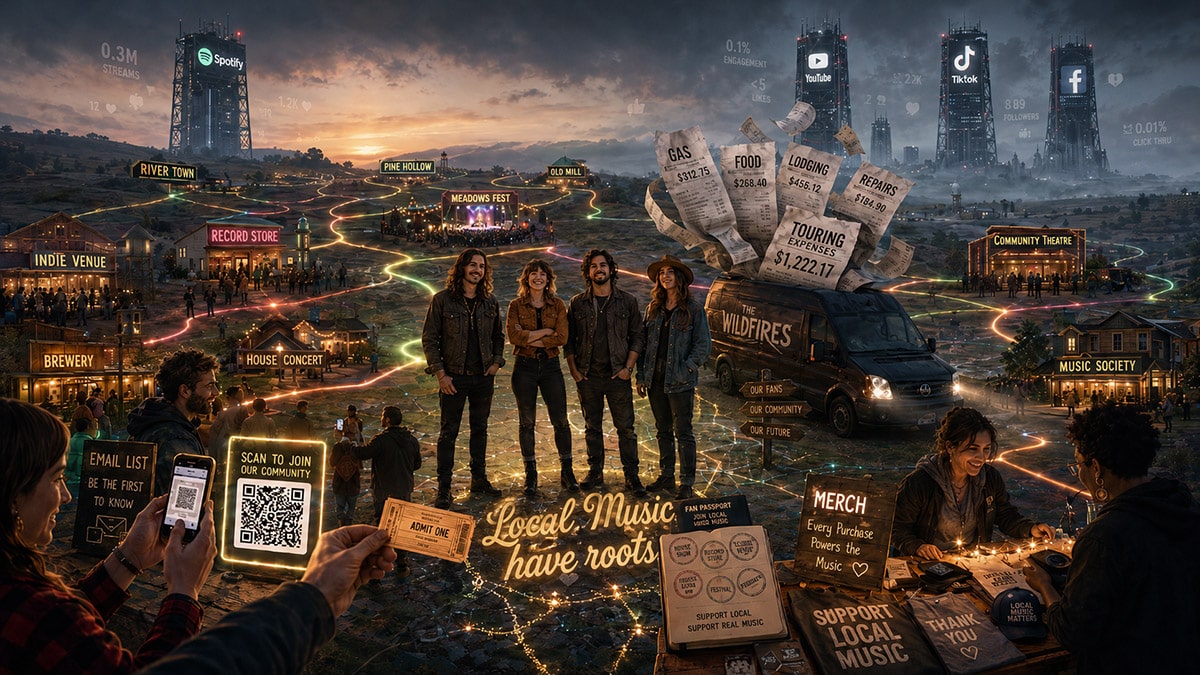
Making a Scene Presents – The Return Of The Regional Music Economy
Listen to the Podcast Discussion
Why the Future of Independent Music May Be Closer to Home Than We Think
There was a time when every serious artist was told the same story.
Get out of town. Get in the van. Hit the road. Go national. Chase the playlist. Chase the press. Chase the algorithm. Chase the booking agent. Chase the big festival slot. Chase anything that looked bigger than the town you came from.
The dream was always somewhere else.
It was in another city. Another state. Another market. Another platform. Another gatekeeper’s office. Another playlist editor’s inbox. Another social media feed where the numbers looked big enough to feel like momentum.
But the road has changed.
Today, an indie artist can wake up with a song that has reached people in five countries and still not have enough money to fill the tank. A band can have thousands of followers on Instagram (https://www.instagram.com), clips on TikTok (https://www.tiktok.com), videos on YouTube (https://www.youtube.com), songs on Spotify (https://www.spotify.com), tour dates listed on Bandsintown (https://www.bandsintown.com), and still lose money driving four hours to play for a room that does not know them yet.
That is not failure. That is math. And the math is getting harder.
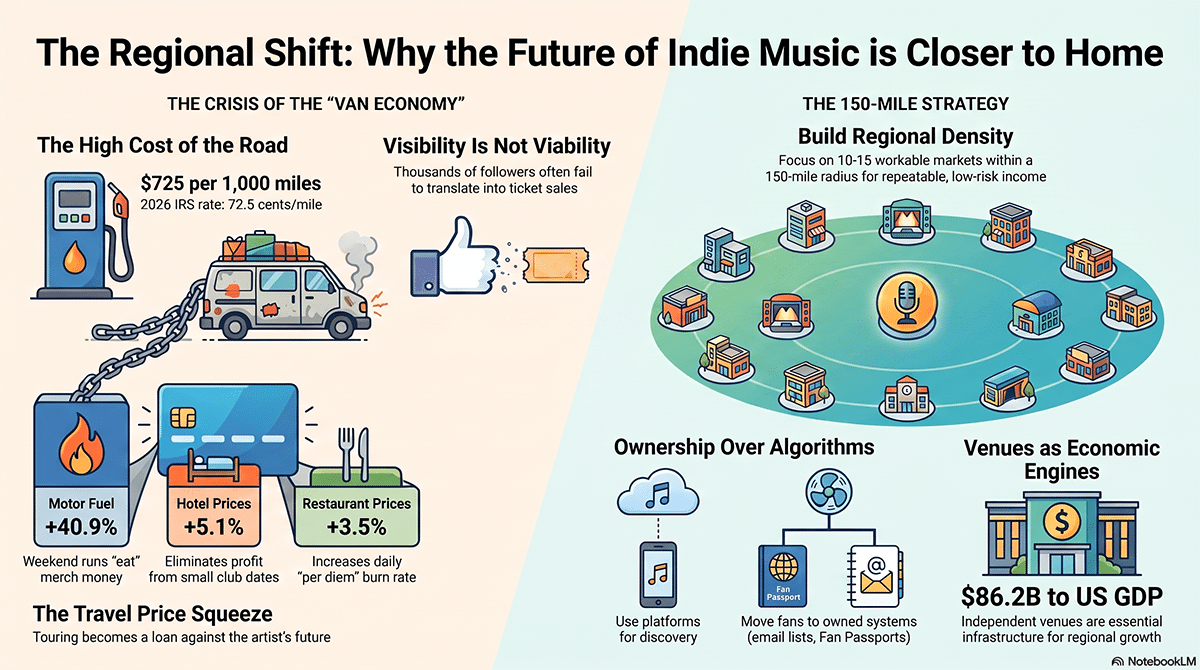
As of June 29, 2026, AAA listed the national average for regular gas at $3.86 per gallon. Diesel was even higher. A week before that, gas was $3.929. A month before that, it was $4.391. That is not a small detail for an artist in a van. That is the difference between a weekend run that barely works and a weekend run that quietly eats the merch money.
The IRS set the 2026 business mileage rate at 72.5 cents per mile for cars, vans, pickups, and panel trucks. That number matters because it is a plain reminder that a mile is not free. It includes more than fuel. It points toward tires, oil, maintenance, depreciation, repairs, insurance, and the real cost of keeping a vehicle on the road. A 1,000-mile run is not just “a tank or two of gas.” At the IRS business rate, it represents $725 in vehicle cost before a band buys one meal, books one room, pays one toll, or replaces one busted alternator in a town where nobody knows their name.
Then comes the rest of the trip.
Hotels are not cheap. Food is not cheap. The U.S. Travel Association’s June 2026 Travel Price Index reported that hotel prices were up 5.1% year over year, restaurant prices were up 3.5% year over year, and motor fuel prices were up 40.9% year over year. Those are not abstract numbers for musicians. That is the cost of the sandwich after soundcheck. That is the price of the room when the venue’s crash pad disappeared during the pandemic. That is the extra $20 here, $60 there, $150 there, until the band gets home and realizes the show that looked like progress was actually a loan taken out against their own future.
This is why the future of independent music may not begin with a national tour. It may begin with a 75-mile radius. It may begin with five towns that talk to each other.
It may begin with an indie venue that remembers your name, a local music society that knows how to organize people, a regional festival that cares about discovery, a coffeehouse that treats songwriters like workers instead of background noise, a house concert host with a real email list, a sponsor who wants to support culture in their own backyard, and an artist-owned system that turns every show into a relationship instead of a one-night transaction.
In other words, the future may belong to the regional music economy.
The Old Road Myth Is Breaking
Touring used to be sold to artists as the great equalizer.
If the label would not call, tour. If the radio station would not play the single, tour. If the press ignored the record, tour. If the streaming numbers were weak, tour. If the home scene felt too small, tour. The road was supposed to prove the artist was serious.
There is truth in that. Playing live still matters. Nothing replaces the moment when a room becomes part of a song. Nothing replaces the handshake at the merch table. Nothing replaces the fan who hears a chorus in a small venue and walks out feeling like they discovered something before the rest of the world caught up.
But the romance of touring has always hidden the ledger.
The old myth says the artist gets in the van and builds a career one town at a time. The modern reality says the artist gets in the van and enters a moving cost center. Every mile has a price. Every meal has a price. Every night away has a price. Every empty seat has a price. Every weak local promotion campaign has a price. Every poorly routed date has a price.
For national acts with real guarantees, crew support, sponsorship, agents, press, playlist momentum, and ticket demand, the road can still be a powerful machine. Live Nation (https://www.livenationentertainment.com) reported $3.8 billion in revenue for the first quarter of 2026, with 24 million fans attending concerts and 81 million fee-bearing tickets in its ticketing segment. The top end of live music is not dead. It is enormous.
But that is not the same economy most indie artists live in.
The stadium economy can grow while the van economy gets squeezed. The festival headline economy can look healthy while the 150-cap club economy struggles. The national platform economy can create global attention while the working artist still has to ask, “Can we afford the next three shows?”
This is where the industry keeps confusing visibility with viability.
A song can travel farther than an artist can afford to. A reel can reach a market where the artist has no local partner. A playlist can create listeners who do not know a show is coming. A YouTube clip can create attention but not a room. An Instagram follower can like a post and still never buy a ticket. A Spotify listener can stream a song for months and still remain invisible to the artist.
That does not mean these platforms are useless. They are not. Spotify, YouTube, TikTok, Instagram, Facebook (https://www.facebook.com), and other discovery platforms can help an artist reach people they never could have reached through old media alone. The problem starts when the artist builds the whole business around platforms they do not own.
Platforms are doorways. They are not home.
The Regional Scene Is Not Small. It Is Dense.
The national music business loves scale. It loves big numbers because big numbers are easy to sell. A million streams. A hundred thousand followers. Ten thousand monthly listeners. Viral reach. Engagement rate. Impressions. Views.
But the regional music economy runs on a different kind of power.
It runs on density.
Density means enough real fans in a reachable area to create repeatable income. It means the artist can play within a few hours of home and see familiar faces in different rooms. It means fans bring friends. It means venues trust the draw. It means the local press pays attention. It means the music society shares the date. It means the brewery wants to sponsor the series. It means the regional festival books the artist because they know the artist can move people, not just post graphics.
A national following that is spread too thin can look impressive and still be useless at the door. A regional following that is concentrated can pay rent.
That is the shift.
The future may not favor the artist with the largest cloud of passive followers. It may favor the artist with the strongest local and regional network of actual supporters.
A thousand casual listeners scattered across the country may not fill one room. But two hundred committed fans spread across five nearby towns can become a working circuit. They can buy tickets. They can buy shirts. They can join memberships. They can support crowdfunding. They can host house concerts. They can share local posts. They can bring coworkers. They can become part of the story.
That is how a regional economy forms. It is not just a map. It is a relationship web.
Independent Venues Are Economic Engines, Not Charity Cases
One of the biggest lies told about local music is that it is a soft community issue. Nice to have. Cute. Cultural. Sentimental. Good for the vibe of a town, maybe, but not serious economics.
That lie needs to be dragged outside and left in the rain.
The National Independent Venue Association’s State of Live research found that independent venues, festivals, and promoters contributed $86.2 billion to U.S. GDP in 2024, generated $153.1 billion in total economic output, and supported more than 900,000 jobs. The same research also found that 64% of independent stages were not profitable in 2024, squeezed by rising costs, predatory resale, and monopolistic pressure.
That is the whole story in one ugly, beautiful contradiction. Independent venues create real economic value, but many of them are fighting for survival.
They bring people downtown. They fill restaurants. They help bars sell drinks. They create work for sound engineers, lighting techs, door staff, bartenders, poster designers, photographers, videographers, local hotels, food trucks, parking lots, print shops, and musicians. They make neighborhoods more interesting. They make cities more livable. They give young artists a place to fail, learn, grow, and become worth hearing.
Yet too often, they are treated like disposable nightlife boxes.
If a community loses its small venues, it does not just lose entertainment. It loses the entry point of its music economy. It loses the place where artists become local assets. It loses the room where fans move from passive listening into active support.
The regional music economy depends on these rooms.
Not just the famous rooms. Not just the historic rooms with framed posters and old stories. The 80-cap listening room matters. The 120-cap club matters. The arts center matters. The brewery stage matters. The outdoor concert series matters. The local festival stage at 2 p.m. matters. The house concert matters. The songwriter round matters. The blues society, folk society, jazz society, Americana series, hip-hop collective, punk house, church hall, record store, library stage, and community theater all matter.
These are not side quests. These are the infrastructure.
The Local Scene Can Become the Artist’s Base of Operations
For too long, artists have treated the local scene as something to escape.
That made sense in the old business. If the label was in New York, Los Angeles, Nashville, London, or Atlanta, then the local scene felt like a waiting room. You built enough buzz to get noticed by someone somewhere else. The local scene was proof of concept for the national industry.
But the independent artist economy changes that. Now the local scene can be the business base.
The artist’s home region can become the place where songs are tested, fans are gathered, merch is sold, memberships are launched, video is captured, live recordings are created, sponsors are found, volunteers are organized, local media stories are written, and repeat customers are developed.
A regional base gives the artist a lower-risk way to build income before taking on the full cost of national expansion.
This matters because most artists do not fail from lack of talent. They fail from undercapitalized ambition. They try to act national before their revenue can support national activity. They take long drives for weak guarantees. They play cities where they have no fan data. They sleep badly, eat badly, promote under pressure, and return home exhausted with no real system for following up with the people who did show up.
A regional model slows that down in the best possible way. It says: build the home base first. Not forever. Not as a cage. Not as an excuse to avoid ambition. Build it as a launchpad.
An artist who can reliably draw 75 people in their hometown, 50 people in the next town, 40 people two hours away, and 100 people at a regional festival is not trapped. That artist is building leverage. That artist can go to venues with proof. That artist can go to sponsors with proof. That artist can go to press with proof. That artist can go to a booking agent with proof.
And most importantly, that artist can go to fans directly.
The 150-Mile Strategy
Imagine a four-piece band based in a mid-sized city.
They want to tour. Of course they do. They want to play everywhere. They want to wake up in strange towns, load into rooms they have only seen on Instagram, and watch strangers sing back songs that started in a garage, bedroom, basement, church, studio, or borrowed rehearsal space.
That dream is not wrong. But the first serious move may not be a national tour. It may be a 150-mile strategy.
Within 150 miles, the band may find ten to fifteen workable markets. Not all glamorous. Not all obvious. Some might be small cities. Some might be college towns. Some might be arts districts. Some might be suburbs with good listening rooms. Some might be rural communities with loyal music societies. Some might be brewery circuits, blues clubs, folk halls, jazz rooms, indie rock spaces, songwriter nights, or community festivals.
The band’s job is not to “tour” those markets once. The job is to connect them. That is the part most artists miss. A single show in a nearby town is just a gig. A repeated, connected, data-driven, fan-supported route is a regional economy.
The band starts by treating every show as a fan capture event. The QR code at the merch table is not decoration. It is the door into the band’s world. The email list is not an afterthought. It is the bridge to the next show. The merch table is not just shirts. It is a point-of-sale conversation. The post-show message is not spam. It is the beginning of a relationship. The local opener is not filler. They are a scene partner. The venue is not a landlord with a stage. It is a community node.
Now the band plays a Friday night hometown show and gathers 38 new local contacts. Two weeks later, they play a town 90 minutes away and gather 24 more. The next month, they return to the first room with a better bill, a stronger story, and a reason for fans to bring someone new. They use Bandsintown (https://www.bandsintown.com) for discovery, Eventbrite (https://www.eventbrite.com) or the venue’s ticketing system for ticket sales, Bandcamp (https://bandcamp.com) for direct music and merch sales, Mailchimp (https://mailchimp.com) for email, Square (https://squareup.com) at the merch table, Shopify (https://www.shopify.com) for online merch, Patreon (https://www.patreon.com) or Substack (https://substack.com) for deeper fan support, and their own website as the center of the whole system.
But the key word is “own.” The artist cannot let the tools become the business. The business is the fan relationship.
Bandcamp’s artist page, for example, says artist accounts are free and lists its revenue share for merch and digital music, with the remaining money going to the artist’s PayPal account on average within 24 to 48 hours. Patreon describes itself as a place for creators to build community with fans and turn creative work into a lasting business. Bandsintown says more than 90 million fans use the platform to discover live music and follow artists. These tools can help, but only when they feed a system the artist controls.
That is the 150-mile strategy.
Stay close enough to reduce risk. Build deep enough to create repeat business. Use platforms for discovery. Use owned systems for retention. Then expand only when the numbers say the next ring can support the cost.
The Cost of Distance
Distance is not romantic when the room is empty.
A 325-mile one-way trip sounds doable when the artist is hungry. That is one long afternoon in the van. It feels like movement. It feels like commitment. It feels like what serious bands do.
But round trip, that is 650 miles.
At the IRS 2026 business mileage rate of 72.5 cents per mile, that trip represents $471.25 in vehicle cost. If the van gets 15 miles per gallon and gas is $3.86, fuel alone is about $167. Then add food. Add lodging. Add parking. Add tolls. Add the extra strings, drumsticks, batteries, cables, and emergency pharmacy run. Add the fact that someone took off work. Add the emotional cost of coming home at 4 a.m. and unloading in the rain.
Now ask the real question. What did the artist bring home? Not gross. Net.
A $600 guarantee can disappear fast when distance is ignored. A $1,000 gross night can become thin when four people need to eat and sleep. A “great opportunity” can be a bad business decision if there is no follow-up system, no merch plan, no fan capture, and no return date.
This is not about telling artists to stay home. It is about telling artists to stop confusing motion with growth. The road should be an investment, not a leak.
A regional base helps artists make that distinction. It lets them test markets without betting the van. It lets them build repeat rooms before chasing distant rooms. It lets them learn which towns respond, which venues promote, which bills work, which fans buy, which sponsors care, and which routes make financial sense.
The goal is not less ambition. The goal is smarter ambition.
Music Societies May Become More Important Than Algorithms
One of the most overlooked parts of the future music economy may be the local music society.
Blues societies. Folk societies. Jazz societies. Songwriter circles. Local arts councils. Regional music nonprofits. Community radio networks. Genre collectives. Cultural associations. DIY promoter groups. College music clubs. Record store communities. Festival volunteer teams.
These groups already understand something the platforms do not.
Music is not just content. It is belonging.
An algorithm can recommend a song, but it cannot create civic pride. It cannot walk a new fan into a room and say, “You need to hear this artist.” It cannot build a tradition. It cannot convince a local restaurant to sponsor a series because the owner cares about the town. It cannot organize volunteers. It cannot keep a listening room alive through a rough season. It cannot connect a touring songwriter to three house concerts, a radio appearance, and a Sunday afternoon workshop.
Local music societies can.
They are the human middleware of the regional economy.
That may sound unsexy in a business obsessed with dashboards, but it is powerful. A good local society knows who actually comes out. It knows which artists fit which rooms. It knows which fans buy tickets early, which ones volunteer, which ones host, which ones donate, and which ones bring friends. It knows the venues that treat artists well. It knows the festivals that pay on time. It knows the sponsor who loves guitar music, the teacher who can organize a student workshop, and the local writer who will actually show up.
That knowledge is gold.
But it often lives in scattered notebooks, old email lists, Facebook groups, volunteer memory, and half-broken spreadsheets.
The future regional music economy will need to organize that knowledge without killing the human spirit behind it. This is where artist-owned and scene-owned systems become important. A music society should not be forced to depend entirely on Facebook Groups (https://www.facebook.com/groups), Instagram posts, or rented attention. It should have its own member list, event calendar, sponsor database, artist directory, fan communication system, and permission-based data practices.
The society becomes more than a club. It becomes infrastructure.
Artist-Owned Community Systems Are the Missing Piece
The old local scene had community but not always systems. The modern platform economy has systems but not always community. The future needs both.
That is where artist-owned community systems come in. The artist needs a home base that connects the website, shows, fan signups, QR codes, merch, direct sales, memberships, rewards, email, text updates, and fan history. The fan needs a simple way to follow the artist, receive updates, collect rewards, and control what information they share. The venue needs tools that help shows perform better. The society needs ways to coordinate members, artists, sponsors, and events. The scene needs shared visibility without giving all of its power to national platforms.
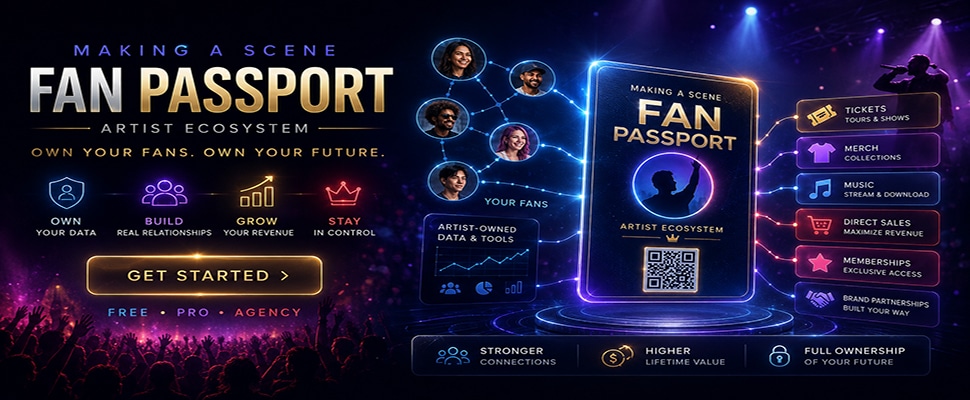
This is exactly the kind of problem the Making a Scene Artist Fan Passport OS (https://www.makingascene.org/making-a-scene-artist-fan-passport-os-the-free-gateway-to-an-artist-owned-music-economy/) and Fan Passport system (https://masfanpassport.com/) are built to address. The system is described as a connected business structure for independent artists, touring acts, music societies, agencies, festivals, and local scenes, with the artist website acting as a command center and the fan side giving supporters a place to follow artists, collect passport stamps, control what they share, receive updates, and participate in rewards.
The important word there is permission.
The future cannot be built on scraping fans, trapping fans, or treating fans like raw data. That is the same old gatekeeper thinking with a new coat of paint. A healthier regional economy needs trust at the center. Fans should know what they are joining. They should know what they are sharing. They should be able to support artists without feeling hunted.
When a fan scans a QR code at a show and joins an artist’s world, that moment should feel like entering a community, not being swallowed by a sales funnel.
That is the difference. The old industry captured rights. The platform industry captured attention. The new regional music economy has to earn relationships.
The Venue, the Artist, and the Fan Need to Stop Working in Separate Silos
Most local shows are promoted like disconnected events.
The venue makes a post. The artist makes a post. The opener makes a post. A few fans share it. Maybe it gets listed on Bandsintown. Maybe it gets listed on Eventbrite. Maybe someone sends an email. Maybe a local paper includes it. Maybe the algorithm shows it to the right people. Maybe it does not.
Then the show happens. Then everyone moves on. That is not a system. That is a hope ritual.
A regional music economy requires a different mindset. Every show should build the next show. Every fan interaction should strengthen the artist’s map. Every venue date should feed the local scene calendar. Every merch buyer should have a path into the artist’s community. Every new fan should receive a thank-you. Every repeat fan should be recognized. Every local partner should know how the show helped the room, the artist, and the community.
This does not need to be complicated. It needs to be intentional.
An artist walks into a regional venue with a show kit. The kit includes a clean event page, a QR code, a short local press blurb, social graphics, an email announcement, a merch plan, a fan reward, and a post-show follow-up. The venue has its own list. The artist has their own list. The local society has its members. The opener has their people. The sponsor has a reason to share. The show is not one lonely post floating in the feed. It is a coordinated local campaign.
Then, at the show, fans are not just asked to “follow us on Instagram.” They are invited into the artist’s world.
Scan the code. Collect a stamp. Get the live track. Join the regional fan list. Bring a friend next time. Unlock a merch discount. Vote on the next cover. Get early access to the next house concert. Join the street team. Support the record. Become part of the scene.
That is how local attention becomes local power.
Regional Scenes Can Protect Artists From Platform Whiplash
The platform era has trained artists to build on unstable ground.
One year, Facebook pages mattered. Then reach dropped. Then Instagram mattered. Then Reels mattered. Then TikTok mattered. Then YouTube Shorts mattered. Then Spotify playlists mattered. Then pre-save campaigns mattered. Then short-form content mattered more than the song. Then everyone started talking about AI-generated music, synthetic content, and algorithmic flooding.
The artist kept adjusting. Post more. Film more. Edit more. Engage more. Go live more. Optimize more. Feed the machine more. And yes, some artists broke through. But many just became unpaid content workers for platforms that kept the fan relationship at arm’s length. A strong regional economy gives artists a place to stand when the platform winds change.
If Instagram reach drops, the artist still has an email list. If TikTok changes its algorithm, the artist still has a regional fan network. If Spotify playlist traffic fades, the artist still has shows where people buy tickets. If YouTube views slow down, the artist still has a local society pushing the next event. If a platform account gets hacked, suspended, throttled, or buried, the artist still has a home base.
This is not anti-platform. It is anti-dependence.
Use Spotify for discovery. Use YouTube for storytelling. Use TikTok and Instagram for reach. Use Bandsintown for show visibility. Use Eventbrite when it makes sense for ticketing. Use Bandcamp for direct sales. Use Patreon or Substack when the fanbase is ready for deeper support. Use Mailchimp or other email tools to communicate. Use Shopify or Square to sell.
But do not confuse access with ownership. The artist’s own website, list, fan system, and regional relationships are the business spine. Everything else is traffic.
Local Sponsors May Be the New Indie Patrons
There is another reason regional scenes matter. Local businesses need culture.
A restaurant near a venue benefits when people come downtown. A brewery benefits from a concert series. A music store benefits when a guitar scene grows. A coffeehouse benefits from songwriter nights. A hotel benefits from festivals. A print shop benefits from posters and merch. A local radio station benefits from fresh stories. A city benefits when young people feel like something is happening where they live.
The regional music economy gives those businesses a way to participate. Not as charity. As alignment.
A local sponsor may not care about an artist’s national streaming numbers. But they may care that the artist can bring 80 people into a neighborhood on a Thursday night. They may care that the artist’s fans match their customers. They may care that a monthly concert series makes their town more alive. They may care that supporting music makes their brand feel human.
This is where artists need to think beyond the gig guarantee.
A regional artist can build sponsorship around a live session series, a local tour route, a community festival stage, a songwriter workshop, a fan passport reward, a merch bundle, a release party, or a neighborhood music weekend. The money may not come all at once. It may not look like the old record deal fantasy. But it can become one more leg of the stool.
And the indie artist needs many legs.
Tickets. Merch. Direct sales. Memberships. House concerts. Lessons. Workshops. Sync licensing. Publishing. Local sponsorship. Fan support. Regional festivals. Private events. Limited-edition releases. Live recordings. VIP experiences. Community partnerships.
That is how the music industry middle class gets built. Not from one magic platform. From many direct revenue streams that keep more money closer to the artist.
The Regional Artist Journey
Let’s make this real.
An indie artist starts in their hometown. They have good songs, a small but loyal crowd, and a scattered online presence. They have songs on Spotify, videos on YouTube, posts on Instagram and TikTok, a Bandcamp page, and a mailing list they barely use. They have played locally, but every show feels like starting over.
The first move is not to book a national tour.
The first move is to turn the home market into a base of operations.
They rebuild their website so it becomes the center of the artist business. They create a clear show calendar, a fan signup, a merch page, a music page, and a simple story that tells fans what world they are entering. They set up QR codes for shows and merch. They create a Fan Passport reward for local supporters. They make the first reward simple: scan at the show, join the list, get a live acoustic track or early demo. Nothing fancy. Just a reason to connect.
Then they build a three-town loop.
Town one is home. Town two is 70 miles away. Town three is 110 miles away. They do not play every week. They route carefully. They partner with local openers. They trade audiences. They send short personal notes to local media. They ask the venue what kind of promo works in that room. They give fans a reason to bring a friend. They track who signs up, who buys, who returns, and which songs move the room.
After three months, the artist knows more than they ever learned from staring at a follower count.
They know the home crowd buys vinyl. They know the 70-mile town buys shirts. They know the 110-mile town loves the ballads. They know one opener brings people and another does not. They know the brewery show is good for discovery but bad for listening. They know the small theater has older fans who buy tickets early. They know the house concert host can move 35 seats with one email. They know which fans drove to more than one show.
That is business intelligence. Not creepy data. Not surveillance. Not platform vanity metrics. Useful, permission-based knowledge that helps the artist serve the people who already care.
Now the artist expands to five towns. Then eight. Then a 300-mile weekend. Then a regional festival. Then a neighboring state. By the time they take on a 700-mile run, they are not guessing. They have fans to contact, partners to call, data to study, and merch history to guide inventory.
That is how an artist grows beyond the region without abandoning the region.
The Region Is Not the Ceiling
Some artists will hear this argument and think it sounds like settling. It is not. A strong regional economy is not the opposite of national success. It is the foundation that makes national success less fragile.
The goal is not to become the biggest band in a small pond and stop there. The goal is to build a working base that can support risk. The region gives the artist cash flow, confidence, proof, content, community, and leverage. It gives the artist a place to return to after longer runs. It gives the artist a fan base that actually cares when the new record drops. It gives the artist a story that booking agents, managers, sponsors, and press can understand.
National attention without a base is a spotlight. A regional economy is a fire. Spotlights move. Fires spread.
The artist who owns a strong regional network can use national platforms from a position of strength. A viral clip can bring new people into a system that already works. A playlist bump can be directed toward tour dates that already have partners. A press feature can lead readers to a website built to capture fans. A festival slot can send people into an artist-owned community instead of letting the moment vanish into the social media fog.
That is the difference between exposure and infrastructure. Exposure says, “Look at me.” Infrastructure says, “Come with me.”
The Local Fan Is the Most Underrated Asset in Music
The industry loves the idea of the superfan, but it often talks about superfans like they are rare magical creatures hiding inside streaming data. In the regional economy, superfans are easier to see.
They are the people who show up early. They buy the shirt. They ask when the next show is. They bring a friend. They comment with actual sentences. They know the deep cut. They ask if the record is available on vinyl. They volunteer at the festival. They host the house concert. They post the flyer without being asked. They drive 90 minutes. They tell the bartender the band is worth booking again.
These fans are not just consumers. They are scene builders.
A local fan can do something a national passive listener cannot do. They can create gravity. They can help make a room feel alive. They can create social proof in the real world. They can pull other people into the artist’s orbit.
That is why artists need to stop treating the live show as the end of the transaction. The show is the beginning.
After the show, the artist should thank fans. Send the photo. Share the live recording. Offer the next date. Invite them to vote on a setlist. Give them a reason to come back. Give them a reason to bring somebody. Let them feel like they are part of building something.
That is not manipulation. That is community. The old industry made fans wait outside the velvet rope. The new regional economy invites them to help build the room.
What Venues Need From Artists Now
This shift also requires artists to become better partners.
Venues are under pressure. The NIVA data makes that clear. Independent stages can generate massive economic value and still struggle to stay profitable. That means artists cannot walk into a room expecting the venue to carry the whole show. A serious regional artist needs to show up with more than songs.
They need clean assets. They need a promo plan. They need local targeting. They need to communicate. They need to understand the room. They need to know whether the show is seated or standing, listening or drinking, ticketed or free, early or late, original music or mixed format. They need to help the venue sell the night.
This does not mean artists should accept bad deals or play for exposure. Absolutely not. Exposure does not pay for gas, food, lodging, strings, rent, health insurance, or the next record.
It means the artist and venue should stop acting like separate businesses when they are actually part of the same regional ecosystem. The artist needs the venue to survive. The venue needs artists who can develop audiences. The fans need both.
When the artist brings a fan capture system, a merch plan, a strong opener, and a post-show follow-up, the venue benefits. When the venue shares useful data, promotes consistently, treats artists well, and helps build repeat nights, the artist benefits. When both sides work with local societies, sponsors, media, and fans, the scene benefits.
That is the regional economy in motion.
Why This Is Bigger Than Touring
The return of the regional music economy is not only about saving money on gas. It is about rebuilding the middle layer of the music business.
The music industry has become dangerously top-heavy. At the top, global tours, major festivals, superstar catalogs, and platform-scale entertainment generate huge numbers. At the bottom, millions of creators upload music into a digital ocean and hope to be found. The middle is where things get harder.
That middle is where working artists should live. Not rich. Not famous. Not dependent on fantasy.
Working.
Able to pay musicians. Able to make records. Able to tour intelligently. Able to sell merch. Able to own fan relationships. Able to build predictable income. Able to serve a community. Able to grow.
That is the music industry middle class.
And it will not be built by waiting for Spotify to pay more, TikTok to be fairer, Instagram to show posts to every follower, YouTube to recommend the right video, or some label executive to rediscover artist development out of pure kindness.
It will be built by artists, fans, venues, societies, local businesses, technologists, and community builders who decide that music needs local roots again. Not instead of global reach. Before global reach. Roots first. Reach second.
The New Map
The new map of independent music may look different from the old one. It may not start with “How do we get famous?” It may start with “Where can we profitably matter?” That is a better question.
Where can this artist draw 50 people? Where can they draw 100? Where can they return three times a year without burning out the room? Where can they build a fan club? Where can they sell enough merch to make the trip work? Where can they partner with a local opener? Where can they do a workshop the next afternoon? Where can they turn one show into three revenue moments? Where can they sleep at home? Where can they reduce cost without reducing ambition?
The map is no longer just cities and highways. It is relationships.
A venue is a node. A fan is a node. A society is a node. A festival is a node. A sponsor is a node. A local journalist is a node. A radio host is a node. A record store is a node. A house concert host is a node. A teacher is a node. A photographer is a node. A merch buyer is a node.
The artist’s job is to connect the nodes. That is how scenes become economies.
The Rebellion Is Local
There is something quietly rebellious about this. The old gatekeepers wanted artists to wait. The platform gatekeepers want artists to feed the machine. The regional music economy says something else. Build where you stand.
Do not abandon the platforms. Use them. Do not ignore streaming. Use it. Do not stop making content. Make it with purpose. But stop sending every fan back into someone else’s system. Stop acting like a follower count is a business. Stop pretending that national attention matters if you cannot turn it into local, regional, and direct support.
Bring the fan home.
Bring them to the website. Bring them to the show. Bring them to the merch table. Bring them to the email list. Bring them to the Fan Passport. Bring them to the membership. Bring them to the local scene. Bring them to the next room.
That is the real work.
It is not glamorous in the old industry sense. It does not always look like a viral moment. It does not always impress people who only understand big numbers. But it creates something far more useful than hype.
It creates continuity.
A fan comes to one show, then another. A venue books the artist again. A local sponsor helps underwrite a series. A society adds the artist to a festival. A regional press outlet tells the story. A merch buyer joins the list. A listener becomes a supporter. A supporter becomes a scene builder.
That is how the flywheel starts.
The Future May Be Regional First
The return of the regional music economy is not nostalgia.
It is not about going backward to some imagined golden age where every town had a perfect scene and every club paid fairly. That world never existed as neatly as people pretend. This is about building a better forward path.
The cost of touring demands it. The instability of platforms demands it. The pressure on independent venues demands it. The need for artist-owned fan relationships demands it. The hunger for real community demands it.
Indie artists do not need to give up national dreams. They need to stop funding those dreams with bad math.
Build the region. Build the scene. Build the fan network. Build the society partnerships. Build the venue relationships. Build the local sponsor base. Build the direct sales system. Build the Fan Passport. Build the owned website. Build the list. Build the repeatable route. Build the proof.
Then expand.
The artist who can make money within 150 miles has something to build on. The artist who can turn five towns into a circuit has leverage. The artist who can gather fans directly has protection. The artist who can help venues win becomes valuable. The artist who can activate a regional community is no longer just chasing the industry. They are building one. That may be the real return of the regional music economy. Not a retreat from the world. A stronger way to enter it.
 |  Spotify |  Deezer |  Breaker |
 Pocket Cast |  Radio Public |  Stitcher |  TuneIn |
 IHeart Radio |  Mixcloud |  PlayerFM |  Amazon |
 Jiosaavn |  Gaana |  Vurbl |  Audius |
 Reason.Fm | |||
Find our Podcasts on these outlets
Subscribe to Our Newsletter
Discover more from Making A Scene!
Subscribe to get the latest posts sent to your email.


