
Why Direct-to-Fan SMS Marketing Is Beating the Algorithm




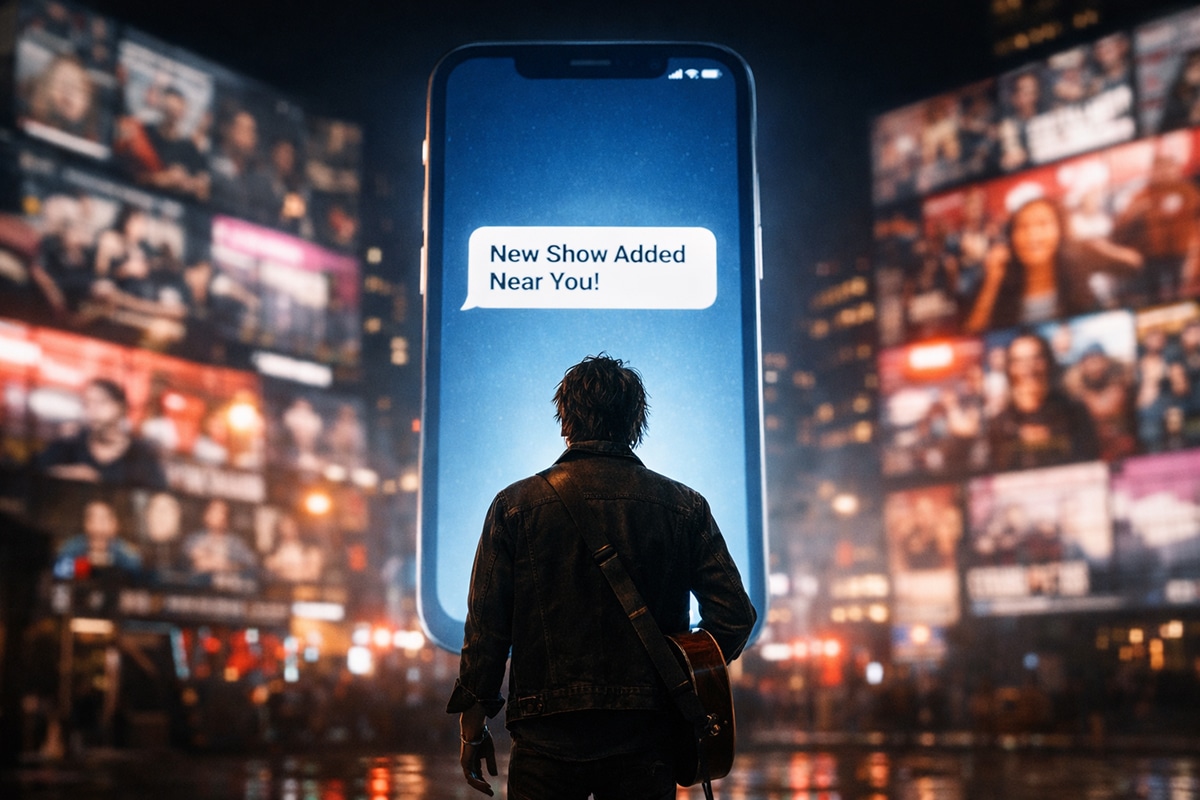
Making a Scene Presents – Why Direct-to-Fan SMS Marketing Is Beating the Algorithm
Listen to the Podcast Discussion and Gain More Insight into SMS Marketing!
Your followers are not your audience until you can reach them without asking a platform for permission.
There was a time when building a following on social media felt like building a community. You posted. Your fans saw it. They liked it, shared it, showed up, bought a shirt, streamed the new single, and maybe brought a friend to the next gig. It was never perfect, but it felt like the work and the reward were connected.
That deal is dead.
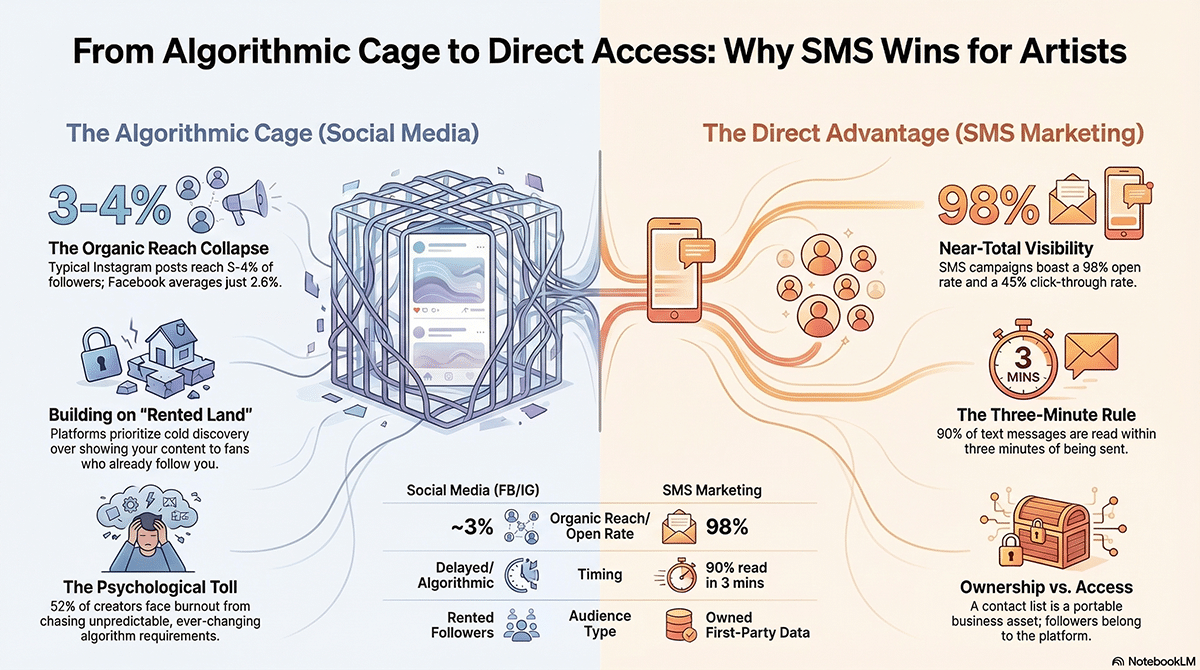
In 2026, the big feeds are no longer built mainly to help you reach the people who already chose you. They are built to keep users scrolling through an endless stream of AI-ranked recommendations, trend tests, cold discovery, and behavior-driven guesses. Meta says Facebook Feed Recommendations are selected, ranked, and delivered by AI, TikTok says its For You feed is built to help users discover new interests and creators, and Meta has expanded personalization of content and ads using interactions with its AI features. Meanwhile, organic reach keeps sliding into low single digits. Sprout Social says typical Instagram posts now reach roughly 3 to 4 percent of followers, and WordStream says Facebook page posts average about 2.6 percent organic reach. That means the audience you worked to earn can be standing right there and still not see what you made.
For independent artists, that is not just annoying. It is a business problem. If your next house concert date, vinyl drop, ticket presale, Patreon push, or direct merch offer depends on an algorithm deciding whether your own fans deserve to see it, then your business is sitting on rented land. And rented land is fine for discovery, but it is a terrible place to build a future.
That is why SMS is winning.
Text messaging is not magic. It is not glamorous. It is not trendy. It is just direct. And right now, direct beats clever. Industry benchmarks still commonly put SMS open rates around 98 percent, with roughly 90 percent of messages read within three minutes. Community, one of the major platforms in the space, says 2025 SMS campaigns averaged around a 98 percent open rate and around a 45 percent click-through rate. In plain English, the phone lock screen has become more valuable than the social feed, because the lock screen is where attention actually lands.
This matters even more in music, where timing is everything. A ticket link sent two hours too late is not the same as a ticket link sent the second presale opens. A merch drop buried by the feed is not the same as a text that hits a fan while they are already holding the phone in their hand. A new single announcement that reaches 3 percent of followers is not the same as a message read in three minutes by someone who already said, “Yes, I want to hear from you.”
That is the shift. Social media is becoming the billboard. SMS is becoming the front door.
The Algorithmic Cage
Let’s stop pretending the problem is just “reach is down.” Reach is down because the structure changed.
The biggest platforms are now openly telling us that discovery is the point. TikTok says the For You feed exists so users can discover new interests and creators, and its recommendation systems weigh user interactions heavily when deciding what to show. Meta says Feed Recommendations are handled by AI systems, and Instagram has increasingly tied visibility to recommendation eligibility and originality rather than simply showing followers what a creator posts. Put bluntly, the platforms are no longer loyalty machines. They are sorting machines. They sort attention, test content, and decide who gets a shot at distribution in the moment.
That can be useful for finding new fans. It is terrible for reliably reaching existing ones. You can spend years teaching yourself the rhythm of Instagram, Facebook, TikTock, only to wake up and find that the rulebook moved again. One week the platform wants short video. Then it wants originality signals. Then it wants higher watch time. Then it wants comments. Then it wants saves. Then it wants paid support. Then it wants you to behave like a full-time media company with the resources of a label and the stamina of a machine.
That is the rental trap. Artists build audience value on land they do not own, and then the landlord starts charging extra for visibility. Even when you are not literally buying ads, you are still paying in labor. You pay with extra posts, extra clips, extra edits, extra trend chasing, extra emotional energy, and extra hours trying to decode what the feed wants this week. The platform owns the pipe. You supply the water. Then it sells you a cup to drink it back.
The toll is not just financial. It is psychological. A 2025 study covered by Harvard T.H. Chan School of Public Health found creators face high rates of anxiety, depression, and burnout, with 10 percent reporting suicidal thoughts tied to their work. A separate 2025 survey from Billion Dollar Boy found 52 percent of creators had experienced burnout, and 37 percent had considered leaving the profession. Creative fatigue, workload, screen time, and unstable income all feed the same monster: a career built on unpredictable visibility.
For indie artists, that constant treadmill has a hidden cost. Every hour spent feeding the machine is an hour not spent writing, rehearsing, mixing, booking, licensing, building a house-concert route, improving the live show, or strengthening the fan experience that actually generates money. The old game trained artists to think exposure was the asset. It is not. Access is the asset.
The Unfiltered Power of the Inbox
Texting works because it does not pretend to be entertainment first.
Social media messages fight for oxygen inside a feed that was designed to distract. SMS lands in a place people already treat as personal. YouGov found that 85 percent of U.S. adults use text messaging or messaging apps multiple times per week, making messaging the most widely used communication method across every generation and gender group in the United States. It also found that 29 percent say they are messaging more than a year ago, the strongest growth of the major communication methods it measured.
That matters because a text does not feel like a post. It feels like a tap on the shoulder.
When artists use SMS well, it reads less like “content” and more like an invitation. “Hey, presale starts at noon.” “I added a second show.” “I made 100 signed copies.” “I’m testing a stripped-down version of this song tonight.” “You’re within driving distance, so here’s a last-minute ticket link.” That tone is powerful because it feels human, and the best platforms are leaning into that. Community says the next wave of SMS is less about campaigns and more about conversations, while the strongest programs rely on consent, relevance, and two-way engagement instead of generic blasts.
The speed is the other superpower. If around 90 percent of texts are read within three minutes, then SMS creates something social media rarely can: a synchronized moment. Everyone on the list can get the same message at roughly the same time and act while the opportunity is still hot. That is perfect for on-sales, surprise drops, release-day pushes, limited-run merch, route fills, low-ticket warnings, backstage upgrades, pop-up appearances, crowdfunding deadlines, fan-club invites, and direct sales. When timing matters, the feed is a gamble. The inbox is a lever.
There is also a trust advantage. Vibes found that 78 percent of consumers say they have made a direct purchase from a brand’s SMS or MMS message, with 65 percent having done so within the past year. It also found consumers now prefer redeeming offers through text more than email and apps. That is not because text is inherently cooler. It is because text is simple. A clean message, one clear offer, one link, one action. No scrolling. No fighting the feed. No hoping a fan remembers to circle back later.
Owning the Asset
Here is the real dividing line in modern music marketing: followers are attention, but first-party data is infrastructure.
Shopify defines first-party data as data collected directly from customers, and says it helps brands build direct relationships, generate value, and improve marketing performance. That sounds like corporate language until you translate it into artist language. A first-party SMS list is not just a place to announce stuff. It is a map of actual fan intent. It tells you who clicked, who bought, who showed up, who wants vinyl, who lives near Chicago, who buys tickets, who only streams, who responds to acoustic offers, who likes limited editions, and who keeps showing up when you ask them to.
That is a very different asset from a pile of platform followers. Followers belong to the platform’s distribution system. Your list belongs to your business. That makes it portable. If Instagram changes the feed again, your list still exists. If TikTock gets messier, your list still exists. If a platform throttles links, buries posts, flags your account, or pivots toward whatever shiny thing it wants next, your list still exists. That is not a small distinction. That is career insurance.
It is also valuation. The long-term value of an independent artist is not just streams or followers. It is the strength of owned relationships that can produce repeat revenue without begging a third party for permission. A clean, consent-based list can drive direct ticket sales, recurring merch sales, VIP upgrades, presaves, subscriptions, fan-club programs, crowdfunding, courses, sample packs, songwriting workshops, sync-ready catalog announcements, and limited offers. That is the stuff a middle class in music is made of. Not “going viral.” Not “being discovered.” Not “posting consistently.” Ownership.
This is why platforms built for direct fan capture are getting traction. Laylo pitches itself around drops, fan-list growth, and owned fan data for artists and events. Community pitches two-way SMS at scale. Klaviyo comes more from commerce, but it shows what happens when messaging is tied to behavior, segmentation, and purchase data. Different tools, same lesson: the contact list is the real asset.
Hyper-Personalization and Conversion
The old fear around text marketing was simple: “Won’t fans think this is spam?” They will, if you use it like spam.
The reason modern SMS converts is not just because texts get opened. It is because modern platforms let you segment with scary precision. Not creepy precision. Useful precision. Geography. Purchase history. Signup source. Ticket buyer versus merch buyer. New fan versus repeat fan. Local market versus national market. Last-click behavior. Presave status. Even likely buyer types in some systems. That means the fan in Raleigh does not need to get hammered with six Los Angeles show alerts, and the fan who just bought a hoodie does not need the same pitch as the fan who has never spent a dollar but always opens your messages.
That is where AI actually helps without taking over the relationship. Community says AI-powered SMS work in 2025 and 2026 is helping marketers spend less time writing and more time refining what works, while conversational SMS and deeper integrations are pushing messaging toward more relevant, more human flows. Klaviyo’s 2026 SMS benchmarks highlight case studies with 15x and 30x ROI in broader commerce when brands unify SMS with email, forms, automation, and customer data. The exact number will vary by audience and offer, but the pattern is obvious: relevance crushes blasting.
Music gives us cleaner real-world examples of behavior-based texting in action. Laylo’s 2026 case study on sombr says a simple Instagram story signup captured more than 45,000 new fans in one moment, then another 15,000-plus fans during the first 12 hours of EU and UK tour promotion. Across that cycle, Laylo says the campaign captured 58,000 new fan-list signups, fueled instant sellouts, led to added London dates, and drove venue upgrades in Paris, Manchester, Zurich, Berlin, and Barcelona. That is not “engagement.” That is owned demand converted into ticket movement.
Laylo’s case study on Hailey Whitters says geo-segmented texts to fans within 100 miles of each show helped turn proximity into last-minute ticket sales, while her list grew 32 percent in four months. Its Shambhala Music Festival case study says an Instagram giveaway flow converted 30 percent or more of commenters into SMS subscribers and built a new list from scratch in 48 hours. Its Zac Brown Band study says the band used geo-targeted email and text to reach more than 5,000 local fans around a Boston activation, while more than half of its 500,000-plus fan list could be identified as likely merch buyers through enriched segments. Its Cooper Alan study says a targeted CD drop sold the first run out in 30 minutes and eventually moved more than 1,500 CDs through Laylo campaigns. Those are not vanity metrics. Those are revenue paths.
That is the big conversion lesson social commerce keeps missing. The fewer steps between interest and action, the better the result. A social post asks the fan to stop scrolling, notice the post, care about it, click a profile, click a link in bio, find the right page, and finish the purchase. A text can do it in one motion. One message. One link. One tap. In a world where everyone is distracted, reducing friction is not a trick. It is respect.
The Strategy for Digital Sovereignty
So what does an indie artist actually do with this?
First, stop treating social media as home base. Use it for discovery. Use it for top-of-funnel attention. Use it for proof of life, short-form storytelling, collaboration clips, behind-the-scenes hooks, audience testing, and light cultural presence. But stop expecting it to be your reliable delivery system. It is the billboard on the highway, not the box office, not the merch table, and definitely not the fan database.
Second, build a clean bridge from rented attention to owned access. Your bio links, story links, pinned posts, stage banter, QR cards at the merch table, livestream callouts, website popups, and giveaway mechanics should all point toward opt-in. Not just “follow me somewhere else.” Give fans a real reason. Early ticket access. one-song demos. local show alerts. secret acoustic sets. limited merch windows. signed copies. first listen clubs. voting access on set lists. route updates. private notes from the road. Anything that makes the text feel like membership, not marketing.
Third, follow the value-first rule like your career depends on it, because it does. Do not text just because you can. Text because there is a useful reason the fan would be glad to get it. A rule of thumb is simple: every message should either save the fan time, make the fan money, give the fan access, deepen the fan’s connection, or help the fan make a decision. If the message does none of those things, it probably belongs on social, not in a text.
Fourth, segment early. Even a small list gets smarter fast when you ask the right questions and tag the right behaviors. Artists do not need enterprise software to start doing this. At the basic level, you want hometown or region, ticket interest, merch interest, superfans versus casuals, and where the fan came from. If you sell merch through Shopify, or a similar storefront, and connect it to your messaging stack, you can start seeing who buys what and when. That is where SMS stops being a megaphone and starts being a business system.
Fifth, let AI do the boring part, not the human part. Let it help you draft variants, group fans by behavior, recommend send times, or flag who clicked but did not buy. Do not let it flatten your voice into generic “Hey friend!” sludge. Fans signed up because they wanted more of you, not more of an assistant pretending to be you. The best use of AI inside direct-to-fan marketing is to make your communication more relevant and less noisy, not more robotic. Community’s 2026 trend report makes this exact point: the winners are not the flashiest senders but the most thoughtful and authentic ones.
Sixth, do this legally and with respect. In the United States, marketing texts require real consent. The FCC says people can revoke consent in any reasonable manner, marketers must honor revocation requests within no more than 10 business days, and senders are generally limited to one confirmation text after opt-out. CTIA guidance also says consumers must be able to opt out at any time and that opt-out requests should be acknowledged and respected. This is not optional. It is not red tape. It is the price of being invited into the most personal inbox people have.
That last part matters because SMS is powerful precisely because it is intimate. Abuse that intimacy and the list rots. Respect it and the list compounds.
The New Balanced Ecosystem
The smartest artists in 2026 are not abandoning social media. They are demoting it.
That is the real move.
You still use Instagram, Facebook, Tiktock to get found. You still cut clips. You still tell the story. You still show the process, the tour, the studio, the mistakes, the wins, the mess, the human being behind the music. But the goal is no longer to “grow a following” as if followers themselves are the prize. The goal is to identify the people who care enough to step off the feed and into your world.
Once they do, SMS becomes the engine for the things that actually pay. Ticket alerts. routing gigs. house concerts. listening parties. vinyl drops. signed merch. fan-club access. meet-and-greet upgrades. presaves. crowdfunding. workshops. sample packs. direct digital sales. subscription communities. You can even connect it to wallet-based or membership-based systems later if you want to layer in Web3 or token-gated access. The point is not the technology brand name. The point is ownership.
That is the Making a Scene lesson hidden inside the texting trend. The middle class in music is not built by praying for reach from gatekeepers that keep moving the gate. It is built by owning the relationship. Social gives you a chance to be seen. SMS gives you a chance to be remembered, acted on, and paid.
And that is why direct-to-fan SMS is outperforming modern social media algorithms. Not because texting is newer. Not because it is prettier. Not because the numbers sound sexy in a keynote. Because when the platforms turned community into cold discovery, texting stayed personal. Because when the feed became a casino, the inbox stayed a room with a door.
Because borrowed attention is fragile, but owned access is a business.
 |  Spotify |  Deezer |  Breaker |
 Pocket Cast |  Radio Public |  Stitcher |  TuneIn |
 IHeart Radio |  Mixcloud |  PlayerFM |  Amazon |
 Jiosaavn |  Gaana |  Vurbl |  Audius |
 Reason.Fm | |||
Find our Podcasts on these outlets
Subscribe to Our Newsletter
Discover more from Making A Scene!
Subscribe to get the latest posts sent to your email.


