
Why Micro-Sync Licensing Should Be Part of Every Independent Songwriter’s Business Plan





Making a Scene Presents – Why Micro-Sync Licensing Should Be Part of Every Independent Songwriter’s Business Plan
Listen to the Podcast Discussion to gain More Insight into Micro Sync for Songwriters!
There was a time when independent songwriters were told to build a career around a miracle.
Write the great song. Record the great track. Get it in the right room. Hope the right person hears it. Maybe a publisher. Maybe a supervisor. Maybe a label-connected gatekeeper who still pretends the industry runs on taste instead of leverage. Then, if the stars line up, maybe that song lands in a TV show, a commercial, a trailer, a game, or a film, and suddenly everybody acts like the system worked because one person got through the wall.
That story still gets told because it sounds romantic. It also keeps a lot of songwriters broke.
For most U.S.-based independent writers, composers, producers, and beat makers, the old sync dream was never much of a business plan. It was a lottery ticket. It was a beautiful fantasy built on delay, approval, and somebody else’s contact list. BMI’s own guidance says synchronization licenses are a separate income source tied to music used with visual images, that BMI does not issue sync licenses, and that the producer usually requests the sync license from the song publisher. That one detail tells you almost everything you need to know about the old model: if the rights are split up, hard to clear, or sitting in the hands of other people, the song moves slowly. Slow is where gatekeepers live.
Micro-sync matters because it breaks that rhythm.
It does not replace traditional sync. It does not make a big film or TV placement worthless. It does something more useful for working artists. It creates a lane where speed, clarity, ownership, and usefulness can matter more than prestige. It lets you stop treating every song like one fragile masterpiece waiting for one giant break, and start treating your catalog like a stack of rights-bearing assets that can solve lots of small problems for lots of buyers over a long period of time. That is not less ambitious. It is more adult.
And that is why micro-sync licensing should be part of a good business plan.
Not the whole plan. Not the magic plan. Not the “upload three loops and retire by Christmas” scam plan. A real plan. The kind of plan that says your songs are not just culture. They are inventory. They are intellectual property. They are a body of work that can be organized, tagged, versioned, cleared, archived, and deployed in ways that create more than one revenue path. If independent artists are serious about building a music industry middle class, this is exactly how they have to start thinking.
The business plan nobody taught songwriters to write
Most songwriters were taught to think like applicants.
How do I get noticed? How do I get picked? How do I get into the room? How do I get approved? How do I get the publisher, the manager, the supervisor, the label, the curator, the playlist editor, the person with the clipboard and the smug smile to say yes?
That mindset might get you a meeting. It will not build you a middle-class career.
A business plan asks different questions. What do I own? What rights sit inside what I own? How many ways can those rights make money? How easy is it for a buyer to find what I control? How fast can I clear it? What happens if streams flatten, algorithms shift, or one platform decides I do not exist anymore? Those are owner questions, not applicant questions. The U.S. Copyright Office’s educational materials for musicians make clear that music income already comes from different rights tied to musical works and sound recordings, and that licensing, data, and registration affect who gets paid and how. That is exactly why the songwriter who understands the rights stack has an edge over the songwriter who is still only thinking in release dates.
This is the part the old business rarely explained clearly, because confusion is profitable for the middlemen. A song is not just a song. In the U.S., you are often dealing with at least two core copyrighted things: the musical work and the sound recording. Copyright protection exists once the work is fixed, but registration with the Copyright Office adds concrete benefits, including a public record of ownership and, for U.S. works, a path into federal court. The Office also says registration helps the licensing marketplace by making ownership information easier to find. In plain English, organized ownership is not paperwork for paperwork’s sake. It is what helps money move toward you instead of around you.
That is why micro-sync fits so cleanly into a business-plan mindset. It pushes you to stop asking whether a song is “done” and start asking what that song can still do. Can it stream? Sure. Can it drive fans to shows? Good. Can it support merch, sync pitching, direct sales, and publishing value? Even better. Can it be cut into multiple assets that serve creator markets, podcast markets, app markets, ad markets, internal video markets, and short-form content markets? Now you are thinking like an owner.
What micro-sync actually is
The phrase sounds small, and that can make people underestimate it.
Micro-sync is not fake sync. It is not “cute little sync.” It is still licensing music for use with visual or digital media. What changes is the size of the buyer, the speed of the sale, the kind of project, the budget, and the way the music is searched, cleared, and delivered. Musicbed explains the difference in simple terms: traditional licensing is usually the larger, more negotiated side of sync, while micro licensing is a smaller and more accessible option often used for things like personal projects, indie films, and smaller businesses. That distinction matters because it shows that micro-sync is not about lowering the value of music. It is about reducing friction for buyers who need music quickly and legally.
Look at the actual markets around it. Artlist says its licensing covers projects from social media to commercial use worldwide. Motion Array tells creators they can join a non-exclusive marketplace, reach an audience of 8 million-plus subscribers, and earn royalties on every download. AudioJungle says buyers can choose from more than 41,900 royalty-free music kits created by independent musicians and audio engineers. Those are not tiny signals. They are giant neon signs telling songwriters that the market is already organized around digital-first, high-volume, modular music use.
And that market is hungry for function.
A wedding filmmaker needs a soft instrumental lift. A YouTube creator needs a clean intro bed. A local brand needs a bright fifteen-second cue under a product reveal. A podcaster needs something that will not fight the voice. A fitness app needs a loop that motivates without becoming annoying. A documentary editor needs tension without melodrama. A small agency needs something rights-cleared that can go live now, not after two weeks of chasing approvals. This is why the micro-sync world rewards music that is emotionally specific, easy to search, easy to cut, and easy to clear.
That last part is where independent artists can finally stop playing defense. If you own the master, control the publishing, know the splits, and have clean metadata, you are not waiting for the old machine to bless you. You are building a faster one.
Why the market now rewards useful music
The streaming era trained a lot of artists to think in public-facing terms only. Release. Promote. Pitch. Post. Chase. Repeat. Everything had to point toward a moment of attention.
Micro-sync shifts the focus from attention to utility.
That does not mean the art becomes soulless. It means the song is allowed to have more than one job. Background music for video is not an afterthought in the creator economy. Artlist’s own guidance says background music helps set tone, guide emotion, build tension, and support pacing. That is the key word right there: support. A lot of music used in digital media is valuable because it supports the content around it without demanding the spotlight. Songwriters who understand that are not making lesser work. They are meeting a different need.
The same thing shows up on the seller side. Pond5 tells contributors that keywords are what help buyers find and purchase their work, and that better descriptive keywords make items easier to discover. It also sets clear file standards for music uploads, asking for high-quality WAV or AIFF files, stereo only, and broadcast-ready audio. That is the market speaking plainly. The writer who thinks “my song is good, that should be enough” is competing against the writer who thinks “my song is good, my files are clean, my versions are organized, and my metadata tells the buyer exactly why it fits.” Guess who gets found first.
This is where the old gatekeeper model starts to crack. In the prestige-sync world, the right room matters. In the micro-sync world, the right file structure matters. The right metadata matters. The right mood tags matter. The right cut lengths matter. The right contact info matters. That is a much more democratic problem. It is still work, but it is work independent songwriters can actually do.
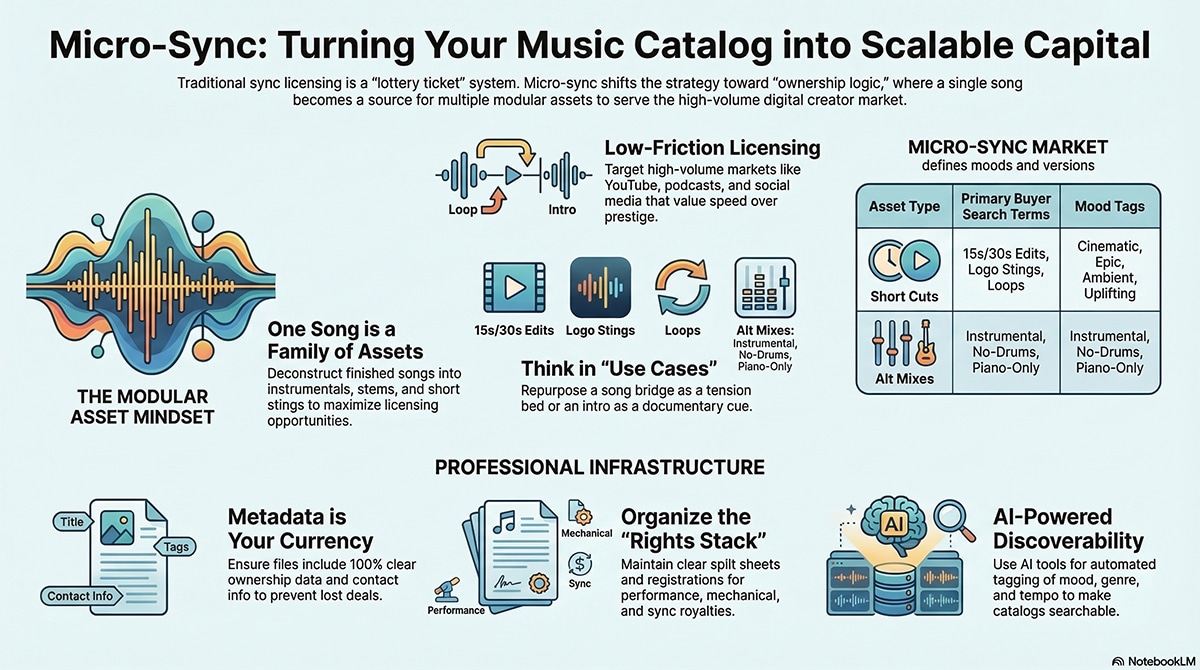
A song is not one product anymore
This is the mental shift that changes everything.
One song is not one product anymore. It is a parent asset.
Inside that parent asset are child assets waiting to be pulled out and put to work. The full mix. The instrumental. The no-drums version. The no-vocal version. The stripped piano version. The atmospheric intro. The tension stem. The chorus lift. The end sting. The fifteen-second cut. The thirty-second cut. The seamless loop. The clean button. The alternate energy mix. The voiceover-friendly bed.
AudioJungle’s music-kit category is one of the clearest public signs of this shift. Buyers are not only looking for finished songs. They are actively shopping for modular music kits that let them build around the needs of an edit. Pond5’s contributor system also supports multiple versions of tracks and is explicit about the importance of preparation and discoverability. These are not edge cases. This is the architecture of the digital licensing market.
Once you understand that, your back catalog stops looking like a graveyard.
That track that never took off on Spotify may have a perfect intro for a product video. That bridge you always loved may work as a tension cue. That instrumental pass might be more valuable than the original vocal version in a licensing context. That delicate guitar figure could live under a travel video, a tutorial, a brand story, or a documentary montage. The market does not care that the track “underperformed” as a release. It cares whether the asset solves a problem.
That is the big unlock. A song can fail in one lane and still earn in five others.
Your back catalog is not dead weight
The music business loves the idea of newness because newness keeps artists hustling. New release, new campaign, new panic, new hope, new disappointment, new cycle. It is a treadmill.
Ownership thinking breaks the treadmill by asking what old work can still do.
The U.S. Copyright Office points musicians toward understanding song data and how music rights information helps identify songs and distribute money more accurately. That is a strong reminder that a catalog does not stop mattering when the promo cycle ends. If the work is still owned, still clear, and still usable, it can keep generating value. Registration and public records help make that value legible to the market.
Pond5’s contributor portal makes this practical. It gives sellers briefs, trends, guides, keyword advice, and upload standards. That is effectively a map for turning old files into market-facing inventory. If an indie songwriter has fifty unreworked songs sitting in folders, that is not just a pile of memories. It is a pile of under-processed assets. And in a world where streaming income is volatile and platform reach can vanish overnight, under-processed assets are a business-plan problem.
This is where the Making a Scene angle gets sharp. Building a music industry middle class means refusing to leave money locked in the masters and compositions you already own. It means looking at the catalog and seeing raw material for direct revenue, licensing, publishing leverage, fan experiences, educational content, stems, sample packs, alternate mixes, and micro-sync assets. The artist who only sees “old songs” leaves value on the table. The artist who sees “rights-ready inventory” starts building a real business.
The rights stack that keeps money from leaking
Here is where people get confused, and confusion is expensive.
A sync fee is not the same thing as a performance royalty. A mechanical royalty is not the same thing as a digital performance royalty for the sound recording. And none of those buckets magically fix bad metadata, unclear ownership, or uncleared samples.
The MLC says it administers blanket mechanical licenses for eligible streaming and download services in the United States. SoundExchange says it is the sole organization that collects digital performance royalties for sound recordings in the United States and that it administers the Section 114 sound recording license. ASCAP says it pays royalties for public performances of music and specifically explains that YouTube pays ASCAP licensing fees for performances of member music in videos. BMI separately explains that it handles public performance and that sync licenses themselves come from publishers or rightsholders, not BMI. Those are different lanes, and if you treat them like one big blob called “royalties,” you will miss money or misunderstand what a license is really doing.
This is why micro-sync belongs inside a larger business plan instead of being sold as some fake passive-income trick. License structures vary. Some marketplaces pay per download. Some operate by subscription. Some deals are purely upfront. Some uses may also generate public performance income depending on the platform, territory, and how the content is used. Some will not. The point is not that every three-second cue throws off every kind of royalty. The point is that a well-managed catalog can produce many small, legitimate income events across multiple systems if the rights are clean and the data is right.
So the boring parts matter. Split sheets matter. Registration matters. Publishing administration matters. Sample clearance matters. Writer and publisher shares matter. Contact information matters. Copyright Office guidance says registration provides a public record and can provide contact information to prospective licensees. That is not sexy, but it is one of the most practical things a songwriter can hear: if nobody can easily tell who owns what, the path of least resistance is for the buyer to use somebody else’s track.
Metadata is now part of the songwriting business
There was a time when metadata felt like office work. Now it feels a lot more like survival.
DISCO says you should keep your catalog fully searchable with AI tagging and similarity search, apply sync-specific tags, and make tracks easy to find fast. Its sync guidance also points to rights ownership and clearance contact information as core metadata for sync. SourceAudio says its AI-powered metadata can accurately tag songs in seconds and streamline categorization across catalogs of any size. Cyanite says its tagging includes genre, mood, instruments, lyric theme, and tempo, plus natural-language descriptions that help place music more effectively. That is three different companies telling you the same thing: discoverability is not optional anymore.
Think about how buyers search. They do not usually type in your artist bio. They type “uplifting acoustic morning,” “dark tension pulse no vocals,” “calm piano reflective,” “corporate motivational soft build,” or “driving indie rock female attitude.” Metadata is the bridge between your work and that search behavior. If your files still live under names like “mix5finalnew” and your tags say nothing useful, you are not being mysterious. You are being invisible.
This is also why mood-based stems matter so much. Hyper-specific, mood-based assets are exactly what digital catalogs are built to surface. A short stem labeled clearly for mood, energy, instrumentation, and use case can be easier to place than a great full song with no map attached to it. That is not depressing. It is liberating. It means a songwriter can create leverage by getting organized instead of waiting to be discovered.
AI turns catalog chaos into usable inventory
This is the part where AI becomes practical instead of theatrical.
The best use of AI here is not letting a machine replace your creative identity. The best use is letting AI help you process, sort, describe, and deploy the work you already made. SourceAudio, Cyanite, and DISCO are all selling some version of the same promise: AI can make large catalogs more searchable, more taggable, and more useful. That matters because most independent artists do not have staff. They do not have a catalog department. They do not have a metadata team. They have songs, hard drives, and too much to do.
ChatGPT from OpenAI fits into that workflow in a more general way. It can help a songwriter draft first-pass metadata, write alternate descriptions, cluster tracks by mood, generate naming systems, suggest version ideas, organize spreadsheets, and turn a messy back catalog into a plan. It is not a rights organization. It is not a PRO. It is not a publisher. But it can save a lot of time on the language and sorting work that usually keeps artists from ever finishing the catalog side of the business.
There is one hard line that matters, though. The U.S. Copyright Office’s January 2025 AI report says human authors are entitled to copyright in their own contributions and that prompts alone do not provide enough control by themselves for copyright in AI-generated outputs. The Office’s AI guidance keeps returning to the human-authorship requirement. That means the safest, smartest role for AI in a songwriter business plan is as an assistant for organization, enhancement, and workflow, not as a fog machine around who actually authored the work.
Use AI to make the catalog legible. Keep authorship clear. That is how you get the benefit without turning your rights chain into soup.
Web3 works best as plumbing, not pitch
A lot of artists still hear “Web3” and think of two bad extremes. Either they picture some doomed speculative circus, or they imagine a miracle machine that fixes ownership by magic. Both are wrong.
For independent songwriters building a licensing business, Web3 is most useful when it is invisible to the buyer. The point is not to force a wedding filmmaker or a YouTube editor into a crypto lesson. The point is to make the ownership layer stronger underneath the sale.
WIPO’s work on blockchain and IP says blockchain has transformative effects on commercial and innovation processes and is affecting creative ecosystems. The joint USPTO and U.S. Copyright Office report on NFTs says tokens can create confusion and raise enforcement issues, but also recognizes that NFTs and blockchain can be useful in the context of IP rights and monetization. That is the right balanced view. Web3 is not the license itself. It is infrastructure that can support provenance, timestamps, splits, recordkeeping, and portability if used carefully.
That is especially relevant for indie artists who are tired of letting every important record live inside somebody else’s dashboard. If your agreements, ownership notes, timestamps, and supporting files are all trapped inside a single centralized system, you are one policy change away from a bad day. Arweave positions itself as permanent decentralized storage. Whether an artist uses Arweave itself or another long-term archival strategy, the larger idea matters: your rights memory should outlast the platform du jour.
This is why Web3 belongs in a good business plan even when the fan never sees it. Used well, it helps the artist own the rails. Used badly, it becomes a gimmick. Making a Scene has always leaned toward tools that make the artist stronger, not tools that make the marketing copy louder. Keep Web3 in the plumbing. That is where it helps.
What a practical micro-sync workflow looks like
Now let’s bring this down to the floor.
Take one finished song. Not your biggest song. Not your favorite song. Just one solid, fully owned, rights-clean piece of work.
First, listen for function. Not only emotion. Function. Where does it lift? Where does it calm down? Where does it create tension? What part could sit under voiceover? What section works as a loop? What sound could end a reel or transition a scene? This step is about hearing your own music like an editor hears it.
Then export intelligently. Full mix. Instrumental. No-vocal version. Short edit. Fifteen-second edit. Thirty-second edit. Loop if it makes sense. Stem groups if they are useful. You do not need fifty random files. You need a family of intentional assets.
Then label everything like money depends on it, because it does. Add mood, feel, instrumentation, tempo, lyric theme if relevant, ownership info, writer and publisher shares, and one-stop clearance status if you have it. DISCO, SourceAudio, Pond5, and Cyanite all point in the same direction here: clean, descriptive, searchable metadata wins.
Then distribute with purpose. Maybe that means placing tracks into marketplaces like Motion Array, Pond5, or AudioJungle. Maybe it means using catalog platforms like DISCO or SourceAudio to organize and pitch. Maybe it means building a direct licensing page off your own site while still using marketplaces for discovery. The point is not to marry one platform. The point is to create multiple doors while keeping the catalog portable. Motion Array’s non-exclusive pitch is useful here because it reminds artists that you do not always have to hand over the whole farm to access a marketplace.
Then repeat.
That is the part people do not want to hear because it sounds like work. It is work. But it is the kind of work that builds assets instead of burning energy on endless content churn. A songwriter who processes twenty songs into clean licensing families is building a machine. Not a fantasy. A machine.
The traps that wreck the plan
This strategy is powerful, but it is not idiot-proof.
The first trap is unclear ownership. If you do not know who owns the publishing, who owns the master, or whether every co-writer agreed to the split, the asset is weaker than you think. Traditional and micro-sync buyers both hate uncertainty. BMI’s older sync guidance is blunt that if one publisher says no, the remaining publishers cannot issue the sync license. That is exactly why one-stop or clearly controlled works move faster.
The second trap is bad metadata. Pond5’s contributor guidance and DISCO’s sync-metadata guidance both make it obvious that descriptive keywords, ownership information, and organized track data are central to discoverability and clearance. If your catalog is messy, you are not building a business plan. You are building delays.
The third trap is royalty confusion. The MLC does mechanicals for eligible U.S. streaming and downloads. SoundExchange handles digital performance royalties for sound recordings under the statutory framework it administers. ASCAP and BMI handle public performance for musical works. Sync licenses come from rightsholders. These are different doors. If you do not know which door you are knocking on, you will either miss income or believe in income that was never coming.
The fourth trap is tech hype. AI can save time, but it cannot replace authorship. Web3 can strengthen records, but it cannot replace legal clarity. The Copyright Office’s AI guidance keeps the focus on human authorship, and the USPTO/Copyright Office NFT report warns that the claimed benefits of NFTs can be overstated. Good. Artists need that warning. The point is not to sound futuristic. The point is to get paid.
The fifth trap is platform dependency. Marketplaces are useful, but they are not your home. If all your catalog logic lives inside one vendor, you are renting your own future. The middle-class version of this business is always going to require some level of artist-owned infrastructure, even if you still use marketplaces and third-party tools.
The Making a Scene bottom line
Here is the truth that still makes gatekeepers uncomfortable: independent songwriters do not have to build their whole future around being chosen.
They can build around ownership.
They can build around catalogs instead of crumbs. They can turn back catalogs into working assets instead of digital attics. They can use AI to do the sorting labor they never had time to do. They can use Web3 where it actually helps, as quiet infrastructure instead of loud nonsense. They can clean up their rights, export their versions, organize their metadata, and place their work where buyers are already searching.
That is what micro-sync becomes when you stop treating it like a side hustle and start treating it like part of a business plan.
It is not the entire answer. You still need fan relationships. You still need live performance. You still need direct sales, merch, publishing discipline, community, and a website or home base you control. But micro-sync belongs in that larger ecosystem because it makes the catalog work harder. It gives every composition, every recording, every stem, every alternate mix, and every short edit a chance to become a little economic engine inside an artist-owned system.
And that is the bigger point.
The music industry middle class is not going to be rebuilt by asking the old machine to be nicer. It is going to be rebuilt by artists who understand that their masters, publishing, data, and derivative assets are capital. Not abstract capital. Not Wall Street capital. Working capital. The kind you build with songs, sessions, stems, files, metadata, and the stubborn refusal to let your catalog die after release week.
That is why micro-sync licensing should be part of every independent songwriter’s business plan.
Because the future is not going to belong to the songwriter who waits the best.
It is going to belong to the songwriter who owns, organizes, and deploys.
Official URLs for the services and platforms mentioned
U.S. Copyright Office
https://www.copyright.gov/
Copyright registration portal
https://www.copyright.gov/registration/
What musicians should know about copyright
https://www.copyright.gov/engage/musicians/
How songwriters, composers, and performers get paid
https://www.copyright.gov/music-modernization/educational-materials/musicians-income.pdf
BMI and performing rights
https://www.bmi.com/digital_licensing/more-information/business_using_music_bmi_and_performing_rights
ASCAP royalties and payment
https://www.ascap.com/help/royalties-and-payment
ASCAP YouTube royalties
https://www.ascap.com/help/royalties-and-payment/make-money-youtube
The MLC
https://www.themlc.com/
The MLC how it works
https://www.themlc.com/how-it-works
SoundExchange
https://www.soundexchange.com/
SoundExchange FAQs
https://www.soundexchange.com/frequently-asked-questions/
Artlist
https://artlist.io/
Artlist royalty-free music
https://artlist.io/royalty-free-music
Motion Array contributor page
https://motionarray.com/become-a-producer/
Pond5 contributor portal
https://contributor.pond5.com/
Pond5 music preparation guide
https://contributor.pond5.com/getting-started/preparing-your-files-2/music/
Pond5 keyword guidance
https://contributor.pond5.com/getting-started/preparing-your-files/
AudioJungle music kits
https://audiojungle.net/category/music-kits
DISCO
https://disco.ac/
DISCO file management
https://disco.ac/platform/file-management
DISCO AI auto-tagging
https://school.disco.ac/article/disco-ai-auto-tagging
DISCO sync metadata guide
https://blog.disco.ac/your-guide-to-metadata-for-sync-34cc825d3e46
SourceAudio
https://www.sourceaudio.com/
SourceAudio AI metadata
https://www.sourceaudio.com/ai-metadata/
Cyanite
https://cyanite.ai/
U.S. Copyright Office AI initiative
https://www.copyright.gov/ai/
Copyright and Artificial Intelligence Part 2
https://www.copyright.gov/ai/Copyright-and-Artificial-Intelligence-Part-2-Copyrightability-Report.pdf
OpenAI ChatGPT
https://openai.com/chatgpt/
WIPO blockchain and IP white paper
https://www.wipo.int/documents/d/cws/docs-en-blockchain-for-ip-ecosystem-whitepaper.pdf
USPTO and U.S. Copyright Office NFT report
https://www.uspto.gov/sites/default/files/documents/Joint-USPTO-USCO-Report-on-NFTs-and-Intellectual-Property.pdf
Arweave
https://www.arweave.org/
 |  Spotify |  Deezer |  Breaker |
 Pocket Cast |  Radio Public |  Stitcher |  TuneIn |
 IHeart Radio |  Mixcloud |  PlayerFM |  Amazon |
 Jiosaavn |  Gaana |  Vurbl |  Audius |
 Reason.Fm | |||
Find our Podcasts on these outlets
Subscribe to Our Newsletter
Discover more from Making A Scene!
Subscribe to get the latest posts sent to your email.


