Booking the Festival Circuit Isn’t About “Buzz.” It’s About Proof.




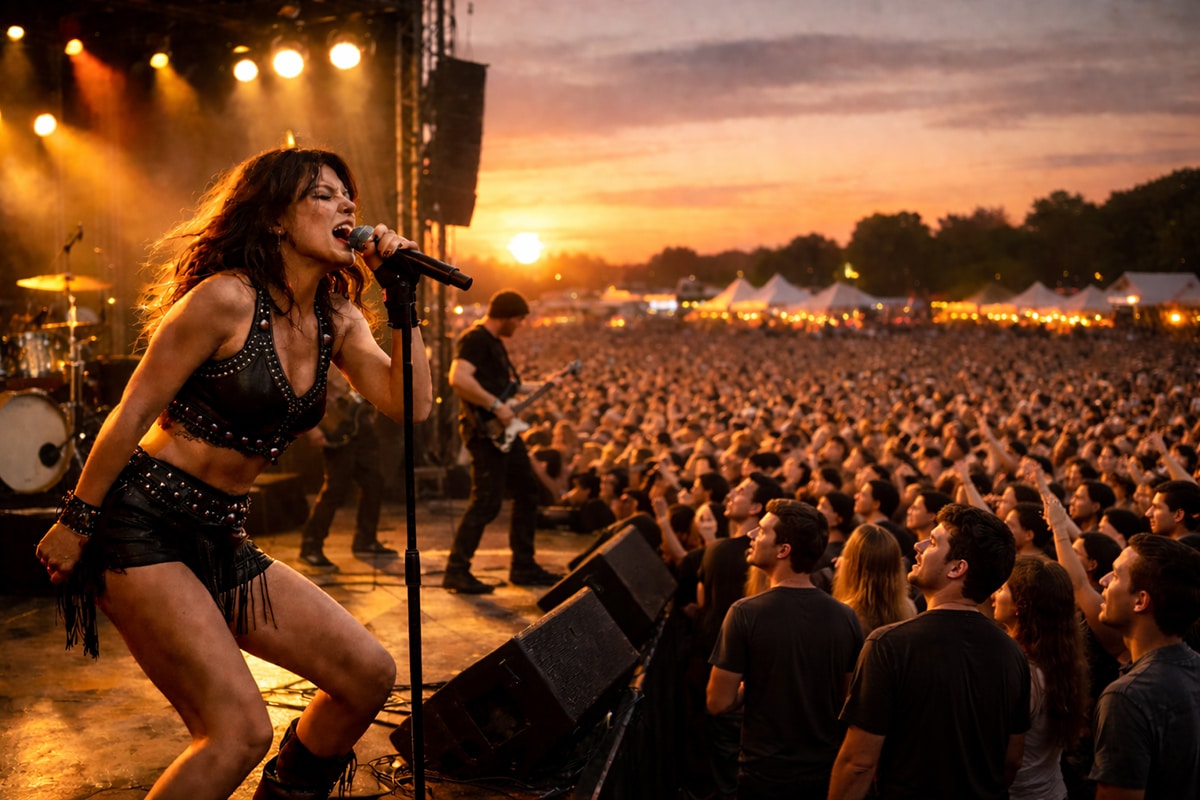
Making a Scene Presents – Booking the Festival Circuit Isn’t About “Buzz.” It’s About Proof
Listen to the Podcast Discussion on how to book your Festival Tour using Fan Data!
For a long time, getting booked on a festival felt like being chosen. You got the email, you posted the graphic, you told your friends, and you hoped the weekend would change everything. That feeling still matters, because it means you care. But the festival world has changed, and the artists who keep winning in it have stopped treating festivals like a lottery and started treating them like a system.
In the U.S., festivals are big, risky businesses with a short window to make their money. They pay for staging, lighting, sound, security, permits, insurance, staff, marketing, fencing, vendors, water, bathrooms, and a hundred other things most artists never see. They do it months before the gates open. That means booking is not just about taste. It’s about risk, proof, and outcomes.
This is why so many great artists never get a response. A festival can love your music and still pass if they can’t see how you help them sell tickets, keep people happy, and keep the weekend running clean. That’s not a judgment on your talent. It’s a reality of how the event economy works.
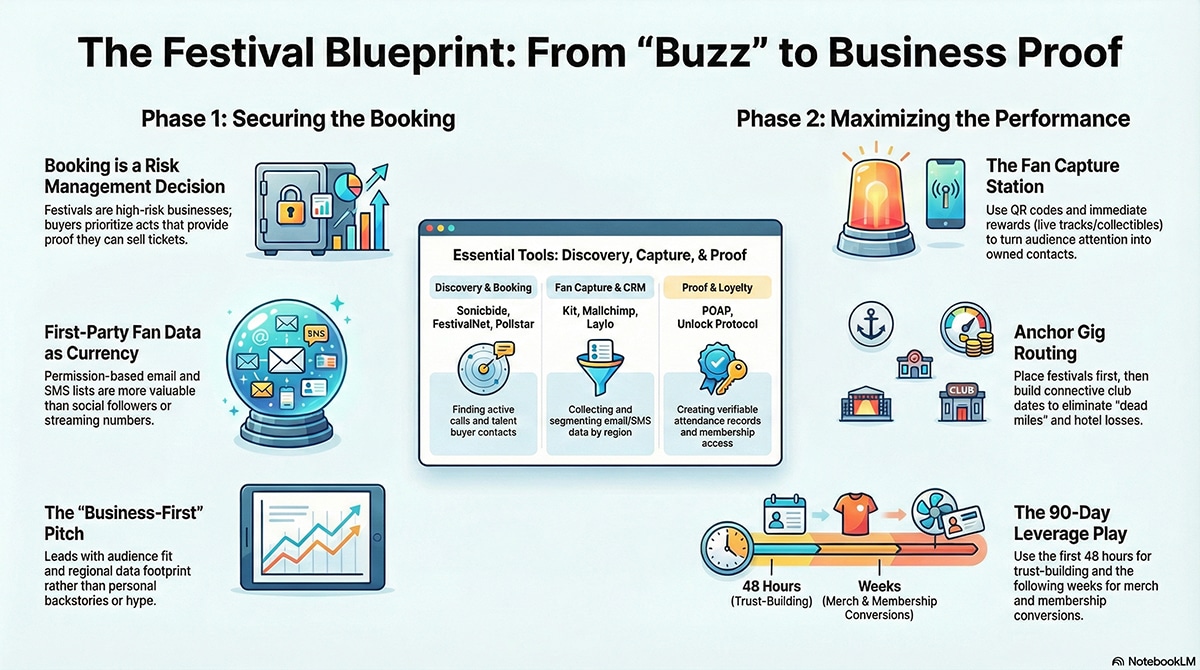
The biggest shift right now is simple and kind of brutal: capturing fan data is the new measure of success. Not followers. Not monthly listeners. Not a viral moment. Festivals have been burned too many times by “big numbers” that did not turn into real people showing up. A buyer wants to know if you can activate an audience in their region, on their dates, with direct reach that is not controlled by an algorithm.
That’s where AI and Web3 stop being buzzwords and start being leverage. AI helps you find real booking opportunities, research the right contacts, tailor a professional pitch, and plan routing so the economics work. Web3, when used the right way, helps you prove real engagement, reward attendance, and build loyalty records that aren’t trapped inside a platform you don’t own.
This is a guide for U.S.-based indie artists in every genre and every level, from brand new to veteran touring acts. The whole thing is built around one mission: festivals should not be a trophy. They should be a profit move, a fan capture move, and a long-term independence move.
How Festivals Really Book Artists, and Why “Good Music” Isn’t Enough
Every festival has its own vibe, but the booking pressure is almost always the same. They need a lineup that fits the audience, keeps the day flowing, and makes money without chaos. They have to balance stages, time slots, production demands, sponsor expectations, local politics, and sometimes even contracts that limit who can play nearby. A lot of festivals also book earlier than artists expect, because they need time to market and plan.
That means your pitch is not being judged like a talent contest. It’s being judged like a business proposal. A buyer is asking, “Is this act a safe bet, and does this act help the weekend succeed?”
This is why structure matters. Many festivals use structured submission platforms to manage volume. Sonicbids is one of the best-known examples in the U.S. live music ecosystem, built around booking opportunities and EPK-style presentation. https://sonicbids.com/
Discovery tools matter too, because festivals don’t always advertise “we are booking musicians” in a clean way. FestivalNet runs a large directory and publishes a “Calls for Artists” section that signals open calls and active recruiting behavior. https://festivalnet.com/calls-for-artists
If you want a more industry-facing shortcut for contacts, Pollstar’s Talent Buyer Directory is sold as a reference that includes festivals, fairs, and other buyers who book touring artists. https://store.pollstar.com/shop/directories/talent-buyer-directory-2026/
None of these tools are a guarantee. They are just doors. Your leverage comes from what you bring through the door, and the strongest thing you can bring in 2026 is proof that you can activate real fans by location.
Fan Data Is the New Booking Currency
Streaming can be useful, but it’s not the proof festivals trust most anymore. Social can be useful, but reach is inconsistent and often pay-to-play. Festivals want to see something that feels closer to a sales engine than a popularity contest.
That engine is first-party fan data. It’s permission-based email and SMS contacts you own, tagged by city or region, so you can tell a buyer, with confidence, that you can reach people in their area and move them to action. When you can do that, you stop sounding like an artist asking for a chance. You start sounding like a partner who can help sell tickets.
Bandsintown for Artists leans directly into this idea with its Signup Form, which is designed to help artists collect first-party fan contact info. https://www.artist.bandsintown.com/signup-form
That matters because it changes the entire tone of your festival pitch. You’re no longer saying, “I hope people come.” You’re saying, “I can contact my fans near your event and encourage them to attend, and I can show you the footprint.”
Now here is where Web3 becomes useful in a grounded way. Web3 is not the point. Ownership is the point. The best Web3 use in festival booking is anything that helps you capture and prove real participation and loyalty in a way that is durable and portable.
POAP, short for Proof of Attendance Protocol, is built around turning shared moments into digital collectibles tied to attendance. https://poap.xyz/ That’s useful because it turns “someone watched my set” into “someone claimed a memory,” which can become a loyalty marker you can build on.
Unlock Protocol is another tool artists should understand because it supports membership and access control, and it also describes a way to airdrop NFTs using only an email address, including cases where the recipient doesn’t already have a wallet. https://unlock-protocol.com/blog/email-airdrop-nft That matters because festivals are loud, busy, and chaotic. Lower friction is everything.
When you use these tools well, you are not pitching “crypto.” You are pitching a fan relationship system that makes engagement measurable and repeatable. That’s leverage.
How to Find U.S. Festivals That Are Actively Booking Right Now
A lot of artists waste months chasing festivals that already booked their lineup or never book outside their network. The fix is to treat festival booking like a pipeline, not a wish.
Start with sources that clearly signal open calls and submissions. FestivalNet’s Calls for Artists page is one place where open calls are visible. https://festivalnet.com/calls-for-artists Sonicbids is another place where structured booking opportunities and submissions are part of the workflow. https://sonicbids.com/
Then add a professional contact layer, because not every festival wants public submissions. Pollstar’s Talent Buyer Directory is explicitly positioned as listing festivals, fairs, and other buyers. https://store.pollstar.com/shop/directories/talent-buyer-directory-2026/
Now bring in AI, but do it the smart way. Do not ask AI to invent festival lists out of thin air. That’s how you end up chasing ghosts. Instead, feed AI real pages and real directories, and ask it to extract deadlines, contacts, submission requirements, and fit notes into a clean structure.
ChatGPT at https://chatgpt.com/ is useful for this because it can turn messy web pages into organized fields you can track, and it can help you write outreach that sounds calm and professional instead of desperate. https://chatgpt.com/
To track it all, you need a basic CRM-style system. Airtable is a strong fit because it blends spreadsheet simplicity with database power and can handle a booking pipeline cleanly. https://www.airtable.com/
When you do this right, you end up with a living list that you refresh every week. You know who is booking, what they need, when deadlines hit, and what your next follow-up should be. That’s how artists quietly become “always booked,” even without a label.
The Festival Pitch That Works Now: Fit, Proof, and Safety
A festival email is not the place for a long life story. It’s not a place for hype. It’s not a place to beg. It’s a business message that makes a buyer’s job easier.
A buyer wants to know, fast, whether you fit the event’s audience, whether you can deliver live, whether you can operate professionally, and whether you add marketing lift. The biggest mistake artists make is leading with vanity stats instead of action stats.
A modern pitch leads with fit. You say why your sound and your show match their crowd in plain language. Then you show proof. One strong live video link that proves you can deliver on stage. One clean EPK link that includes photos, a short bio, and tech needs. Then you show safety. You mention that you understand festival schedules, you can provide stage plots and inputs, and you are easy to work with.
Then you add the piece that changes everything: your fan data footprint. You summarize, briefly, how many opted-in contacts you have near their region and how you plan to activate them. You don’t need to dump a spreadsheet. You just need to show that you own a channel you can turn on.
This is where tools matter. If you’re building email and SMS lists, the point is not “marketing.” The point is control. Platforms can throttle your reach. An email list is a direct line. For email marketing infrastructure, artists often use platforms like Kit, which positions itself as a creator-first email marketing platform. https://kit.com/ Mailchimp is another mainstream option that includes email and SMS marketing. https://mailchimp.com/ If you want more developer-style control or you’re running systems through your own site, Twilio SendGrid provides email API and marketing campaign tools. https://sendgrid.com/en-us
For SMS and “drop” style messaging, Laylo is worth understanding because it’s built around texting fans and building a list that can be segmented and activated. https://laylo.com/ and https://laylo.com/features/text-messages
Again, the point is not the tool. The point is the leverage the tool gives you. When you can say, “I can reach my fans near you directly,” you are talking like a professional.
Three Artist Levels, One Core Strategy: Capture Fans Like It’s the Job
If you’re starting out, festivals can feel out of reach because you don’t have big numbers. The truth is that many U.S. festivals book emerging artists, especially community events, city-sponsored weekends, college festivals, and regional gatherings that want discovery as part of the identity. What you need is not a miracle. You need proof that you are organized and that you convert attention into real fans.
For a new artist, a festival is not “the tour.” It’s an audience capture opportunity. Your win is walking away with opt-ins you own. Your win is being able to show, after a season, that your local and regional fan list grew because of live performance, not because of luck.
If you’re a building artist, the job is regional proof. You are showing you can activate pockets of fans across multiple nearby cities, and that you can route your festival weekend into a run that actually makes money. This is where segmentation matters. This is where email plus SMS becomes a real engine.
If you’re a veteran touring act, the leverage is stability and upside. You’re not just saying you draw. You’re showing you convert. You’re showing you can help a festival sell tickets and leave behind engaged fans who will come back next year. Buyers like artists who make the weekend stronger, because festivals want repeat customers as much as you do.
At every level, fan data capture is the measure of success because it’s the only metric that translates into future revenue you control.
Festival Routing: The Difference Between “We Played” and “We Profited”
Festivals are often anchor gigs. They can pay better than clubs, expose you to new fans, and raise your perceived value. The trap is treating the festival as the whole trip.
The route is where you make or lose money. Drive days are where your budget gets eaten. Random hotel nights are where your profit disappears. If you want a festival season that builds a middle-class career, you have to route like a business.
That means you place your anchor festivals first, then you build connective shows around them. You look for club dates, smaller events, colleges, and well-paying community gigs that fit the travel days before and after. The goal is to avoid dead miles and dead nights, because those are the silent killers.
This is where tour management tools can help, even for indie artists. Eventric’s Master Tour is positioned as tour management software for the live music and event industry, built to organize schedules, logistics, and communication. https://www.eventric.com/master-tour-management-software/
You do not need a big team to think like a tour manager. You need a plan, a schedule, and the discipline to treat every day like it has a cost.
Hotels, Meals, and Hospitality: The Unsexy Details That Decide If You Won
A festival can look great on paper and still be a financial loss once you pay for lodging, food, and travel. That’s why hospitality is not a side detail. It’s part of the deal. Professional artists ask clear questions early. They don’t act entitled, but they also don’t pretend costs don’t exist. You want to know what the festival covers, what it doesn’t, and what your band needs to budget.
Hotels are a major swing factor. Sometimes festivals provide rooms or a buyout. Sometimes they provide nothing. Either way, you plan based on reality, not hope. Food is another swing factor. A band that eats like tourists spends like tourists. A band with a simple per diem plan protects the budget and avoids surprise stress.
These details also affect your performance. Hungry, exhausted bands play worse. That’s not moral failure. That’s biology. If you want to win at festivals, you want to show up rested enough to be great and organized enough to be easy.
That “easy” factor is part of what festivals are buying.
The Festival Tour Business Plan: The Only Way the Season Makes Sense
If you want festivals to be more than a poster credit, you need a business plan for your festival season. Not a corporate document. A working plan that answers one question: does this run make money and build long-term value?
The plan starts with revenue. Your guarantee matters, but it’s not the whole story. Your merch matters because it’s direct income you control. Your direct-to-fan sales matter because they can continue after the weekend. Fan support matters because festivals can be a top-of-funnel moment that leads to memberships, subscriptions, and recurring support. Publishing and licensing matter too, because festival visibility can create unexpected opportunities, especially when you’re operating like a serious business with clean metadata and professional presentation.
Then the plan includes costs you cannot ignore. Fuel. Van costs. Repairs. Tolls. Parking. Hotels. Meals. Crew, if you have it. The cost of time. The cost of turning down other gigs. When you write this down, you stop lying to yourself about whether the trip “was worth it.”
Now bring the most important multiplier back into the plan: fan data capture. If you play a festival and collect zero new contacts, you rented attention for one day and gave it back. If you play a festival and capture 150 emails and 60 SMS opt-ins, you built an asset you can monetize for months through shows, merch drops, direct sales, and fan support.
This is the middle-class path. Not superstardom. Systems.
The Fan Passport Play: Turning One Festival Weekend Into 90 Days of Leverage
Now we get practical, because this is the part that turns festivals into a compounding engine. Before the festival, your goal is to create one simple opt-in flow that a fan can complete in ten seconds. It has to work on a phone. It has to feel worth it. It has to give the reward fast, because trust is everything.
You set up a landing page that collects email and optionally SMS, and it delivers something instantly. That “something” should match the festival moment. A private live track. A behind-the-scenes clip. A festival photo pack. A merch discount that expires quickly. A “memory collectible” tied to attendance. The content does not need to be expensive. It needs to feel personal and immediate.
Email platforms like Kit, Mailchimp, and SendGrid can support this, depending on how much control you want and how you run your stack. https://kit.com/ https://mailchimp.com/ https://sendgrid.com/en-us
For SMS, Laylo is built around texting fans and driving drops and conversions. https://laylo.com/
On the Web3 side, you keep the tech invisible and the meaning obvious. POAP is built around minting attendance memories as collectibles. https://poap.xyz/ Unlock Protocol describes email-based airdrops, including cases where the recipient doesn’t have a wallet, which is exactly the kind of friction reduction festivals need. https://unlock-protocol.com/blog/email-airdrop-nft
At the festival, your merch table becomes your fan capture station, but it cannot feel like a timeshare pitch. You don’t pressure. You invite. You make it feel like belonging. You keep one QR code visible and consistent. You train your band to treat opt-ins as part of the show’s ecosystem, not an afterthought. You keep a backup short link in case reception is bad. You deliver the reward immediately so fans feel the payoff.
This is also where Web3 can become “proof,” not “promotion.” A proof-of-attendance collectible is a clean way to reward fans for showing up, and it gives you a durable engagement marker you can build on later. After the festival, the next 90 days are where the real money and leverage appear.
In the first 48 hours, you send a thank-you message that feels human, not automated. You deliver the promised reward immediately. You say one real thing about the weekend. You do not flood them with ten links. You earn trust.
In the next two weeks, you deepen the relationship. You share one behind-the-scenes moment and one strong live clip. Then you make one fair offer. A merch drop, a signed item, a direct album sale, or a ticket offer if you’re routing back through their area. You’re not squeezing fans. You’re giving them a clear way to support.
From days 15 to 45, you activate. If you have a show in their region, you announce it with enough lead time and a message that feels personal. If you don’t, you keep the relationship warm with value and story so you don’t disappear until you need money again. From days 45 to 90, you build repeatable revenue. That might be a fan club, a membership, recurring drops, or limited editions that fit your audience. The specifics change by genre, but the engine stays the same. Own the relationship. Use the relationship to drive revenue you control.
Now here’s the festival booking payoff. At the end of that 90-day window, you have proof you can show a buyer. You can say how many opt-ins you captured at the festival. You can say how many engaged afterward. You can say how many bought merch. You can say how many showed up at the next show. You can say which cities they came from.
That turns your next festival pitch into a business case.
Talking Like a Professional Without Sounding Like a Robot
A lot of artists either come in too soft or too aggressive. Too soft feels like desperation. Too aggressive feels like entitlement. Professional is neither. Professional is calm, clear, specific, and respectful. You are not asking for a favor. You are offering value.
Your email should be short enough to read quickly and structured enough to trust. You should include one clean EPK link, one live video link, and a short proof statement about your regional fan footprint and how you will activate it. Then you should close with clarity about availability, routing, and next steps.
This is also where AI can protect you from your own emotions. When you’re stressed, it’s easy to write a rambling email or a defensive email. AI can help you keep the tone steady and businesslike, as long as you feed it the festival context and your real proof points instead of asking it to “write something cool.”
Festivals don’t need cool emails. They need safe emails.
The Hard Truth
A festival can be a turning point, but only if you treat it like a business moment, not a photo op. The artists who build sustainable careers are not always the loudest. They’re the most organized. They capture fans. They follow up. They route smart. They budget real. They speak professionally. They show up prepared. They use AI to scale their effort. They use Web3 where it strengthens ownership and reduces dependency. They stop renting audiences and start building assets.
That’s how indie artists build a music industry middle class. Not by waiting for permission, but by building proof they can’t be ignored.
 |  Spotify |  Deezer |  Breaker |
 Pocket Cast |  Radio Public |  Stitcher |  TuneIn |
 IHeart Radio |  Mixcloud |  PlayerFM |  Amazon |
 Jiosaavn |  Gaana |  Vurbl |  Audius |
 Reason.Fm | |||
Find our Podcasts on these outlets
Subscribe to Our Newsletter
Discover more from Making A Scene!
Subscribe to get the latest posts sent to your email.


