


Why Monitoring Is the Most Important Part of Your Home Studio (And the Most Ignored)



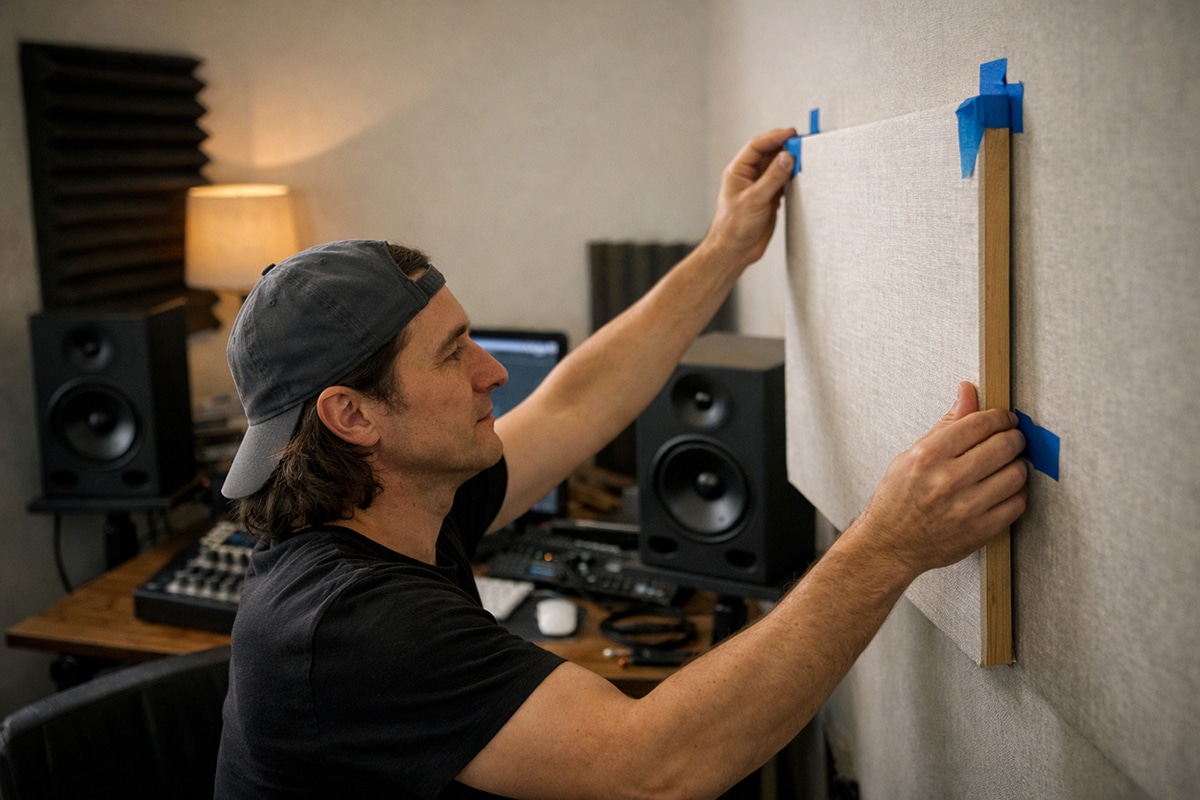
Making a Scene Presents – Why Monitoring Is the Most Important Part of Your Home Studio (And the Most Ignored)
Listen to the Podcast Discussion – Don’t buy gear, learn your room and monitors!
There’s a specific kind of heartbreak that only home studio people understand. You finish a mix at 1:30 a.m., tired but proud, because in your room it finally sounds like a record. The vocal is sitting right where you wanted it. The drums feel tight. The chorus lifts. You do that little head nod like, “Okay… I’m getting good at this.”
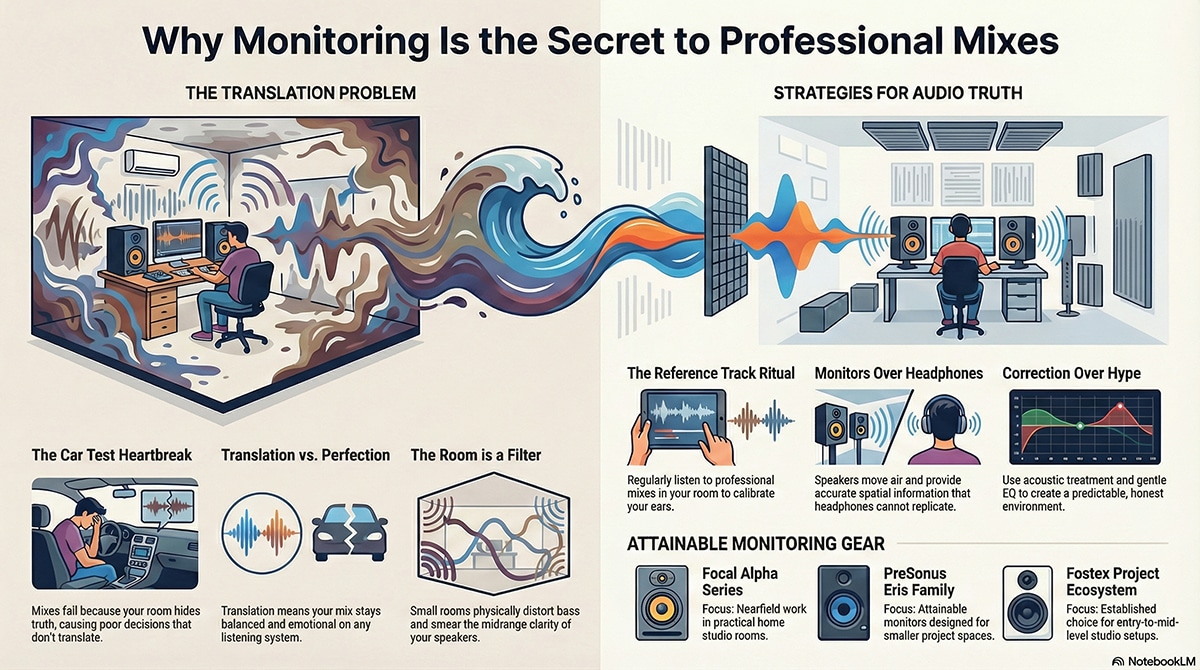
Then you play it in the car the next morning and it’s like somebody swapped your song with a knockoff version. The bass is either missing or bullying everything. The vocal is suddenly too loud, or weirdly buried. The cymbals have that brittle, “why does this hurt?” thing. The whole mix feels smaller, flatter, less alive. You don’t even know what to fix first, because you don’t know which version is real.
That moment is when most indie artists get tricked into buying the wrong solution. They start chasing plugins, thinking the missing ingredient is some special EQ or some magic compressor that “pros use.” Or they buy a better mic, because surely the problem is the recording quality. Or they blame mastering, like mastering is a rescue helicopter that’s supposed to swoop in and save a mix that doesn’t translate.
But translation problems almost never start at the microphone. They start at the speaker.
If your monitoring is lying to you, you can’t make honest decisions. If you can’t make honest decisions, you can’t make a mix that holds up when it leaves your room. That’s why monitoring matters more than plugins, more than expensive microphones, and honestly more than most people want to admit. Monitoring isn’t the glamorous part of the studio, but it’s the part that tells you the truth. And truth is what makes your music feel professional everywhere, not just at your desk.
Translation Is the Real Definition of “Pro”
When engineers say a mix “translates,” they’re not saying it sounds identical on every system. That’s not even the goal, because no two listening setups are the same. Translation is simpler than that, and way more important: it means your mix stays balanced in the real world.
If the vocal feels right in your room, it should still feel right on earbuds. If the kick and bass relationship feels controlled in your room, it should still feel controlled in the car. If the chorus feels bigger than the verse at your desk, it should still feel bigger when someone plays it on a cheap Bluetooth speaker while they’re cooking dinner.
Translation is what keeps listeners inside the song. People don’t listen with a spreadsheet. They listen with emotion. When a mix is harsh, muddy, thin, or chaotic, it breaks the spell. They don’t write you a polite note about “3 kHz fatigue.” They just skip. They just don’t replay it. They don’t share it. They don’t add it to their “play this again” mental list.
So yes, translation is craft. But it’s also momentum. It’s also trust. It’s also the difference between a release that feels solid and a release that feels like you’re still learning in public.
And if you’re an indie artist building a catalog you actually own, translation is not some nerd bonus feature. Your masters are assets. Your catalog is an asset. The better those assets hold up in the world, the more your work can earn over time through direct sales, merch bundles, fan support, licensing, publishing opportunities, and all the long-tail ways music pays the people who own it.
This is why monitoring is not a “studio upgrade.” It’s a career upgrade.
Plugins Can’t Fix What You Can’t Hear
Mixing is decision-making. That sounds obvious, but sit with it for a second. Every move you make is a decision about reality. Is the vocal too loud? Is the bass too thick? Are the guitars too sharp? Is the reverb too long? Is the chorus actually lifting, or is it just louder?
Now here’s the hard part: if your monitoring is inaccurate, reality is distorted. That means your decisions are distorted, too.
This is the trap that creates endless revision loops. You tweak an EQ because the bass feels big. You compress the vocal because it feels jumpy. You tame the cymbals because they feel harsh. You feel productive because you hear “change.” But hearing change isn’t the same thing as hearing truth. A room can trick you into cutting the exact frequency you actually needed, and it can make that wrong move feel correct while you’re sitting there doing it.
That’s why “more plugins” doesn’t fix translation. It often makes it worse, because you’re stacking decisions on top of an inaccurate picture. You can own the best plugin bundle on earth and still make mixes that don’t translate if your listening environment is lying to you.
A great mix is not the result of more tools. It’s the result of better decisions. Better decisions come from better monitoring.
The Room Is Part of Your Monitoring Chain, Whether You Like It or Not
A lot of people talk about monitors like they’re the whole story. They’re not. Your room is the other half of the system, and it’s usually the half doing the most damage.
Home studios are small rooms with hard boundaries. Sound bounces. Low frequencies build up in corners. Some bass notes get exaggerated. Other bass notes get canceled. Reflections from walls, floors, ceilings, and even the desk smear what you hear, especially in the midrange where vocals, guitars, and snare “meaning” live.
Low end is the biggest liar, because bass waves are long and they don’t behave politely in small spaces. You can sit in one spot and hear huge bass. Move your head a foot and hear less bass. Walk two steps back and the kick suddenly changes personality. That means you might be mixing a bass problem that doesn’t exist in the track. It exists in the room.
So when someone says, “My mix sounded great at my desk and terrible everywhere else,” the blunt answer is usually this: your desk is the only place where that version of reality exists.
This is also where the gatekeeper mythology sneaks in. People act like you need a perfect room to make a professional mix. That’s convenient for anyone who wants you to stay dependent. The truth is you don’t need perfection. You need consistency and understanding. You need a room you can learn, and a monitoring setup that gives you repeatable information.
You’re not trying to create a fantasy space. You’re trying to reduce the biggest lies so you can work with the truth.
Why Headphones Don’t Count as a “Proper Mixing Environment”
Headphones are useful. They can reveal edits, noise, clicks, bad fades, and subtle distortion. They can help you check reverb tails and stereo effects. They can be a powerful second opinion.
But they are not a proper mixing environment by themselves, because they are not a room. They don’t move air the same way speakers do. They don’t show you how the low end behaves in space. They don’t give you the same stereo presentation your listeners experience on speakers. They can make panning feel wider than it really is, and they can hide how a mix collapses when it hits a small speaker.
If your goal is translation, you need monitors. Period.
That doesn’t mean you need expensive monitors, and it doesn’t mean you need a massive studio. It means you need a consistent speaker-based listening environment that you can learn deeply over time. That learning is where your “trust” comes from.
Your Mixing Space Has to Be a Listening Space
Here’s the habit that separates artists who finish mixes from artists who spiral forever: they listen to professionally mixed and mastered music in their mixing position, on their monitors, on purpose.
Not casually. Not as background noise while checking email. They listen with attention, because they’re training their ears to understand what “good” sounds like in their specific room.
If you only listen to your own work in your room, your brain has nothing solid to anchor to. Your ears drift. Your “normal” becomes whatever you’ve been doing lately. Mud starts sounding normal. Harshness starts sounding normal. Too much reverb starts sounding normal. Then you wonder why your mix feels weird next to a commercial track, even if you’re doing “all the right moves.”
When you regularly listen to great mixes in your space, something powerful happens. Your room stops being mysterious. You start noticing patterns. You learn how much bass is supposed to exist in your genre. You learn how bright a finished vocal feels in your room. You learn how a pro mix’s snare sits against the vocal. You learn what “wide” means without turning the center hollow.
You’re not memorizing frequencies. You’re building a sense of balance that’s tied to your actual environment. That’s what it means to “trust your ears.” It’s not confidence as a personality trait. It’s confidence earned through repetition in a consistent space.
Reference Tracks: The Least Sexy Thing That Fixes the Most Problems
Reference tracks are not a trick. They’re not cheating. They’re not something you do only when you’re insecure.
They are your reality check.
A reference track is a professionally mixed and mastered song you know well, ideally in the genre you’re working in. That last part matters because genre is not just a vibe—it’s a set of expectations. The low end balance of modern hip-hop is different from indie rock. The vocal brightness in pop is different from singer-songwriter. The amount of sub and the amount of air are not universal rules. They’re style choices that become consistent within a lane.
When you use reference tracks, you stop mixing in isolation. You stop relying on memory. You stop trusting tired ears at midnight. You keep your brain calibrated to what “finished” sounds like.
And here’s the sneaky part: references don’t just teach you your mix. They teach you your room.
If your reference track sounds a little bass-heavy at your desk, you learn something about your desk. If it sounds slightly bright in your room, you learn something about your room. Over time you stop reacting emotionally to those differences and you start compensating accurately. Your decisions become faster and more stable, because you’re not guessing what your room is doing.
The Daily Reference Habit That Actually Works
A lot of advice on the internet turns into homework. This doesn’t need to.
The routine that works is simple, and it feels like a ritual more than a system. Before you start mixing, you play one or two reference tracks at a consistent volume and you sit in your mix position. You listen for vocal level, bass weight, and brightness. You’re not analyzing like a scientist. You’re just resetting your ears so “good” is in the room with you.
Then you start mixing your song. When you feel lost, you don’t panic and start twisting knobs. You pause, play the reference again for a minute, and let it pull you back to center. When you think you’re done, you play the reference again. If the reference still sounds great and your mix still feels balanced next to it, you’re probably close. If the reference sounds clear and your mix sounds cloudy, you’re not done. If the reference feels tight and your mix feels flabby, you know where to look.
This is not about copying. It’s about staying honest.
It also works for both beginners and seasoned engineers, because both groups have the same enemy: ear drift. Everybody gets used to whatever they’ve been hearing. Reference tracks prevent you from slowly walking your mix off a cliff while telling yourself you’re “improving it.”
Monitor Choices That Make Sense for Indie Artists
Let’s talk monitors in the real world, because yes, monitors matter. Not because expensive monitors are magical, but because better monitors usually give you a clearer, more consistent midrange and a tighter, more controlled picture of the low end. That makes your decisions easier, which makes your mixes translate better.
If you’re stepping into serious nearfield monitoring, the Focal pro monitor lineup is a solid place to look. Within that world, the Alpha series is a common home-studio choice because it’s designed for nearfield work in practical rooms.
On the accessible, widely used side, PreSonus has the Eris monitor family, which is popular in home studios because it’s attainable and built for smaller spaces.
Fostex is also part of the long-running project-studio ecosystem.
Now here’s the truth that matters more than any brand name: a monitor doesn’t give you good mixes. A relationship with your monitors gives you good mixes. The habit of listening to great music on them in your room is what turns “speakers” into “a trustworthy system.”
You can absolutely do real work on budget monitors if you learn them deeply, keep your setup consistent, and stay anchored with references. You can also buy great monitors and still struggle if you never train your ears in that space.
The purchase is never the finish line. The learning is.
Using a Hardware Graphic EQ Between Your Interface and Monitors
A hardware graphic EQ in your monitoring chain is not “mix processing.” It’s not something you print. It’s not something you export. It’s a correction tool that sits between your audio output and your monitors to help compensate for obvious room problems at your listening position.
Think of it like adjusting your glasses so you can see straight. You’re not changing the painting. You’re changing your view of the painting.
The key is how you tune it. You don’t tune it with your own unfinished mix, because your mix is the thing you’re trying to judge. You tune it with reference tracks you know well in the genre you’re working in. You sit in your mix position, play the reference at your normal listening level, and make small, careful adjustments only when something consistently feels wrong.
If your room makes bass feel bloated and thick on every pro reference you play, you don’t need a philosophy debate—you need a gentle low-band cut in the monitoring chain. If your room makes the top end feel sharp on every reference, you might need a small trim up top. If the midrange always feels honky on finished music, you tame it slightly. Then you stop and listen again.
This process is slow on purpose. You make a small move and you live with it for a minute, because the danger with graphic EQ is turning correction into “flavor.” The second you start boosting lows because it feels fun, you’re not correcting anymore. You’re hyping. Hype feels great at midnight and it destroys translation the next day.
A good correction curve is usually boring. It makes your reference tracks sound more natural and less “roomy.” It doesn’t make them sound more exciting. Exciting is not the goal. Honest is the goal.
There’s also a hard limit you should accept: EQ can help smooth some frequency problems, but it can’t fix time problems. If your room rings in the low end, EQ might reduce how loud that ring is, but it won’t stop the room from holding onto bass. That’s where basic acoustic treatment still matters, because treatment reduces the problem at the source instead of trying to patch it after the fact.
The healthiest mindset is this: use treatment and placement to reduce the worst lies, then use gentle monitoring EQ to polish the picture, and use reference tracks to keep your ears anchored the whole time.
Acoustic Treatment Without the Foam-Cave Nonsense
A lot of artists avoid treatment because they think it means turning their room into a weird padded prison. That’s not the goal, and most of the time it’s not even the right move.
What you actually want is clarity. You want fewer reflections smearing the midrange. You want less bass buildup and less bass decay. You want your speakers to tell you one consistent story, not ten different stories depending on where you lean.
Even modest treatment can be a game-changer because it reduces the amount of “room” you’re hearing and increases the amount of “speaker” you’re hearing. That helps your stereo image lock in. It helps you place vocals and guitars more confidently. It helps you hear compression choices without the room blurring them. It helps your low end decisions become less like gambling.
And again, the biggest win isn’t that your room becomes perfect. The biggest win is that your room becomes predictable. Predictable is mixable.
Stop Buying Magic and Start Building Truth
If your mixes don’t translate, don’t take it as proof you’re not good enough. Take it as a signal that your monitoring system is lying to you.
The fix isn’t glamorous, and that’s why it works. You build a listening environment you can learn. You treat your mixing space as a listening space. You train your ears on professionally mixed and mastered references so you know what “good” sounds like in your room. You get serious about monitor placement and consistency. If you use a hardware graphic EQ to compensate for the room, you do it with humility and references, not with hype and guesswork.
Once your monitoring is honest, everything else gets easier. You stop chasing plugins like lottery tickets. You make fewer moves and they matter more. You finish mixes faster because you trust what you’re hearing. You release music that holds up everywhere, which builds the only kind of reputation that actually matters for indie artists: the kind that makes fans hit play again.
 |  Spotify |  Deezer |  Breaker |
 Pocket Cast |  Radio Public |  Stitcher |  TuneIn |
 IHeart Radio |  Mixcloud |  PlayerFM |  Amazon |
 Jiosaavn |  Gaana |  Vurbl |  Audius |
 Reason.Fm | |||
Find our Podcasts on these outlets
Buy Us a Cup of Coffee!
Join the movement in supporting Making a Scene, the premier independent resource for both emerging musicians and the dedicated fans who champion them.
We showcase this vibrant community that celebrates the raw talent and creative spirit driving the music industry forward. From insightful articles and in-depth interviews to exclusive content and insider tips, Making a Scene empowers artists to thrive and fans to discover their next favorite sound.
Together, let’s amplify the voices of independent musicians and forge unforgettable connections through the power of music
Make a one-time donation
Make a monthly donation
Make a yearly donation
Buy us a cup of Coffee!
Or enter a custom amount
Your contribution is appreciated.
Your contribution is appreciated.
Your contribution is appreciated.
DonateDonate monthlyDonate yearlyYou can donate directly through Paypal!
Subscribe to Our Newsletter
Order the New Book From Making a Scene
Breaking Chains – Navigating the Decentralized Music Industry

Breaking Chains is a groundbreaking guide for independent musicians ready to take control of their careers in the rapidly evolving world of decentralized music. From blockchain-powered royalties to NFTs, DAOs, and smart contracts, this book breaks down complex Web3 concepts into practical strategies that help artists earn more, connect directly with fans, and retain creative freedom. With real-world examples, platform recommendations, and step-by-step guidance, it empowers musicians to bypass traditional gatekeepers and build sustainable careers on their own terms.
More than just a tech manual, Breaking Chains explores the bigger picture—how decentralization can rebuild the music industry’s middle class, strengthen local economies, and transform fans into stakeholders in an artist’s journey. Whether you’re an emerging musician, a veteran indie artist, or a curious fan of the next music revolution, this book is your roadmap to the future of fair, transparent, and community-driven music.
Get your Limited Edition Signed and Numbered (Only 50 copies Available) Free Shipping Included
Discover more from Making A Scene!
Subscribe to get the latest posts sent to your email.


