The Weekend Build: How to Set Up an Owned-Fan Machine in 48 Hours



Making a Scene Presents – The Weekend Build: How to Set Up an Owned-Fan Machine in 48 Hours
Listen to the Podcast Discussion to Gain insight into creating your Owned Fan Machine!
If you want Spotify to be the top of your funnel instead of the end of your funnel, you don’t start by chasing more streams. You start by building a place for listeners to land, a reason for them to stay, and a system that remembers them when they do.
This is the part the industry skips past because it’s not sexy. Infrastructure rarely is. But infrastructure is what turns a “pretty good” release into a career that compounds. It’s also what makes the Making a Scene philosophy real in practice: indie artists build a music industry middle class by owning the relationship, owning the data, and turning attention into direct revenue—over and over again.
The goal of this weekend build is simple. By Sunday night, you should have a working pipeline that takes a listener from Spotify discovery to your owned channels, then nudges them toward deeper engagement and direct support. Not by manipulating anyone. By giving them something worth opting into.
What you’re building and why it works
Spotify is not evil. It’s just not your business partner. It’s a discovery platform with incentives that keep people inside Spotify. Spotify for Artists gives you useful signals that help you understand where listeners are and what’s working, but those signals are not leverage unless you convert them into owned relationships you can reach without permission.
That’s also why paying for playlist placement is strategically backwards if your mission is ownership. You’re spending money on rented attention you don’t get to keep. You don’t get an email address, you don’t get permission, you don’t get a durable relationship—just a spike that fades and teaches you to keep feeding somebody else’s system.
So this weekend, you’re building your system.
You’re building a home base, a bridge, a conversion page, a welcome sequence, a Web3 passport layer, and a set of “next steps” that lead to direct revenue. That combination is how you stop being disposable in a platform economy.
Day 1, Morning: Claim your Home Base and Make it “Fan-Ready”
Start with your domain and your website, because that’s the foundation of “owned space.”
You can be platform-neutral and still win here. Squarespace, Wix, Ghost, Webflow, whatever—if you control the domain and you control the pages, you’re already ahead of the average indie release plan. But WordPress is still the most common “home base” for indie artists for one simple reason: it can run your content, your store, and your email capture systems from the same property, and it’s widely supported by themes, plugins, and developers. That makes it a practical choice when you’re trying to build a long-term business, not just ship a single release.
If you’re going WordPress-first, you need two things immediately: a fast way to create landing pages, and a newsletter system that you control.
The landing pages matter because you’re going to create focused “doors” for fans to walk through. These are not your homepage. These are single-purpose pages designed to convert a Spotify listener into an owned contact. If it takes too long to build a landing page, you won’t build them consistently—and your funnel won’t compound.
The newsletter system matters because your email list is the core asset you’re trying to build. Email is still the most portable direct channel you can own, and it doesn’t vanish when a platform changes its algorithm. If you treat your email list like a serious business asset, you start building leverage.
On WordPress, two common email marketing plugin options are MailPoet and The Newsletter Plugin. MailPoet is built to create and send newsletters and automations from inside WordPress, and it’s commonly used alongside WooCommerce if you sell merch on-site. (mailpoet.com ) The Newsletter Plugin is another WordPress-based newsletter system that runs directly from your dashboard. (thenewsletterplugin.com )
Now here’s the part a lot of artists don’t learn until they get burned: even if you’re running the newsletter software inside WordPress, you still need a reliable email delivery service so your messages actually reach inboxes. That’s where a service like Twilio SendGrid comes in. SendGrid provides email infrastructure for sending at scale, and it can be used as the “engine” that delivers the emails your WordPress system creates. (sendgrid.com )
This is an important distinction for clarity: the plugin is your control panel and list manager, and the sending service is your delivery truck. The plugin helps you build forms, store subscribers, and run automations. The sending service helps your emails land in inboxes instead of spam folders.
One big advantage of a WordPress-first setup is that your list can live on your own property. That’s what you mean by keeping it “local and under your control.” You’re not just renting access to your own subscribers.
If you prefer an external email platform like Mailchimp, that’s still a valid route—but it changes the power dynamic. You’re placing your list inside a third-party system, and while reputable platforms let you export lists, you are still operating under their terms, their compliance decisions, and their account controls. If they decide you violated their rules, they can suspend your account and you could temporarily lose access to your list and your ability to communicate. That risk is exactly why “owned space” matters in the first place. The principle stays the same either way: your list must be permission-based, portable, and backed up.
Once your website and email system are ready, create two pages on your site that you can reuse forever.
The first is your “start here” page. This is not your bio. It’s your best doorway for curious listeners who just discovered you and want a quick, satisfying “what’s next?” moment. Keep it tight: your best three tracks (or three best entry points), your best live video, and one clear invitation to join your world off-platform—usually an email opt-in with a real reason to subscribe. This page becomes your evergreen destination for new fans, press, collaborators, and anyone who lands on you cold.
The second is your campaign landing page. This is the page you use when you’re actively moving Spotify listeners into your funnel. It’s the page you point your Spotify bio link to when you’re pushing a specific release, a tour run, a merch drop, or a fan passport rollout. This page has one job: convert interest into permission. That means it should focus on a single offer and a single action—usually “enter your email and get something meaningful right now.”
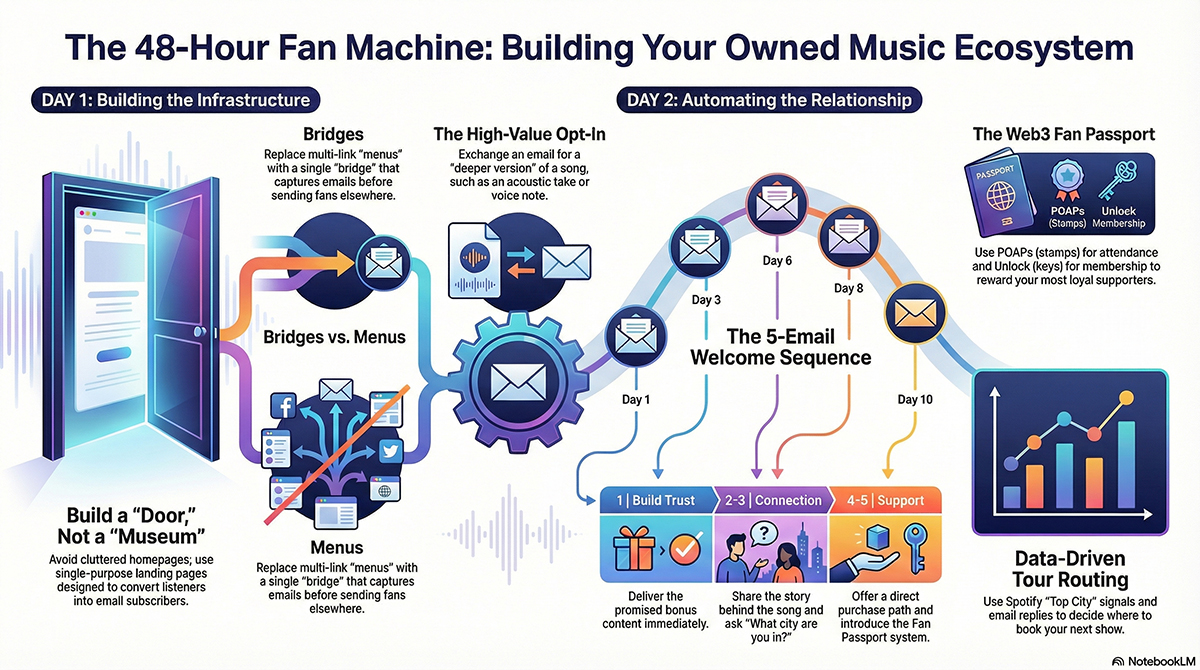
This is where most artists accidentally sabotage themselves. They build a homepage that tries to do everything—music, videos, press quotes, gear lists, tour dates, bios, socials, stores, and every link imaginable—and it ends up doing nothing well. A homepage that acts like a museum forces fans to wander. A campaign landing page acts like a door: clear, simple, and easy to walk through.
You’re not building a museum. You’re building a door. And that door is how you stop sending fans to rented space and start bringing them into a world you actually own.
Day 1, Afternoon: Build the Bridge that Catches Spotify Curiosity
Your Spotify profile link is prime real estate because it’s the exact moment a listener stops being passive and leans in. They just heard the song, they clicked your name, and now they’re asking the most important question in modern music: “Okay… who is this, and where do I go next?”
That moment is not the time to hand them a menu.
A Linktree-style page is basically a traffic splitter. It takes a fan who is already curious, then immediately offers them ten exits—Spotify, Apple Music, YouTube, Instagram, TikTok—most of which send them straight back into rented platforms. Even when you add “newsletter” to the list, it’s usually buried among the streaming buttons. So what happens? The fan taps the most familiar option, which is usually “Spotify,” and you’ve just sent them right back to the place you were trying to pull them out of.
That’s why Linktree systems are counterintuitive if your goal is ownership. They’re built to distribute clicks, not to capture permission. Click distribution feels like marketing, but it doesn’t reliably create assets. Your owned funnel needs the opposite behavior: fewer choices, one clear next step, and a frictionless way to convert interest into a relationship you control.
So your Spotify link shouldn’t be a list. It should be a bridge.
A bridge has one job: move someone from discovery into your ecosystem with as little friction as possible. One tap, one promise, one opt-in. The listener shouldn’t have to think. They should feel like they’re stepping through a backstage door, not filling out a form.
You can build that bridge with a page on your own website, which is the cleanest “owned space” move. Or you can use a smart link tool that centralizes your destinations while capturing emails inside the same flow. Or you can do both: use the smart link as the top layer, but make sure the primary call-to-action leads to your owned landing page and your owned list.
Smart link tools are popular because they can do email capture in a way that feels natural to music fans. Linkfire documents how to capture emails on its landing pages by adding an “Email sign-up” service to a link, and it also documents adding email capture to bio links with an “Email Sign Up” block. Feature.fm documents an email collection feature where you add an “Email Subscribe” option to a Smart Link or Pre-Save link, letting fans enter their email directly.
The second half of the ownership equation is what happens after you collect those emails. It’s not enough to “have” them inside a tool—you need to be able to move them into your system, tag them, and use them in your funnel. Feature.fm’s help documentation describes accessing your audience emails and exporting them as a CSV, which is exactly what you need if your goal is to upload them into your newsletter system and keep the list portable.
Now here’s the key: even if you use Linkfire or Feature.fm, your bridge still has to be designed like an ownership tool, not a streaming tool.
That means your bridge copy and structure should lead with your owned destination first, not your streaming services. Your first, biggest button should not say “Spotify.” Your first, biggest button should say something like, “Get the unreleased version + the story behind the song,” or “Join the fan passport and get early access in your city.” Streaming links can still exist, but they belong lower on the page as optional exits—not as the main pathway.
When you do this right, the listener’s journey changes. Instead of “Spotify to Spotify,” the flow becomes “Spotify to you.” They discover you on Spotify, then your profile link pulls them into your landing page where they trade an email for something meaningful and immediate. That’s the moment you stop renting your fanbase. Because instead of pushing people deeper into Spotify’s environment, you’re converting Spotify’s discovery into your owned relationship—your email list, your website, and your Web3 fan passport layer.
In other words, your Spotify profile link isn’t a directory. It’s a decision point. And if you treat it like a Linktree menu, you’ll keep sending fans back into rented space. If you treat it like a bridge, you’ll start building assets that compound—fans you can reach, supporters you can recognize, and a real path toward the music industry middle class.
Day 1, Evening: Create the Opt-in Offer that Doesn’t Feel like Homework
Nobody wakes up thinking, “Man, I really hope I can join a newsletter today.”
That’s not how fans think. Fans don’t subscribe because they love email. They subscribe because they want something that feels like access, meaning, and belonging. They want to get closer to the music, closer to the artist, and closer to a story they already started feeling the moment they hit play.
So when you ask for an email, you have to stop treating it like a boring marketing transaction. It has to feel like the next chapter of the song.
Think about what just happened on Spotify. A listener heard a track, felt something, and took an extra step to click your profile link. That’s intent. That’s curiosity. That’s the moment where they’re basically saying, “Show me more.”
Your job is to reward that moment with something that feels personal and worth it.
That’s why your opt-in offer should be tied directly to the track they just heard. Not a generic “sign up for updates,” but an extension of the experience. If they arrived because of one specific song, give them a deeper version of that same moment.
That deeper version can take a lot of forms, and it doesn’t need to be expensive or complicated. It just needs to feel real.
It could be an alternate mix that hits differently than the streaming version. It could be a stripped acoustic take that reveals the song’s bones. It could be a live room performance that feels like they’re standing three feet away from you. It could be a short audio note where you explain why you wrote it, what you were going through, or what the lyric actually meant to you at the time. It could be a mini “liner notes” page that lives on your website—something simple and human that turns the track into a story instead of a file.
This is the part that matters most: the deeper experience has to live with you, not on rented platforms.
When the deeper experience lives on your site, in your email sequence, in your membership area, or inside your fan passport perks, you’re training the fan to treat your home base as the real venue. Spotify becomes what it actually is: a street sign that points toward something better. Discovery happens there. Belonging happens with you.
That’s how you stop being dependent on algorithms. You’re not fighting Spotify. You’re using it correctly—top of funnel, not the destination.
Now let’s talk about how to present this on the landing page so it converts without feeling like a scam.
Ask for the email first. Keep it clean. One offer. One form. Instant delivery.
This keeps friction low, especially for new listeners. They don’t have to make ten decisions. They just take one step: “I want the deeper version.”
Then—because Web3 is a core tenant in your system—you introduce the fan passport layer right there, but in a way that feels optional, not intimidating.
This is a critical point. You’re not asking casual listeners to become crypto natives. You’re not forcing them to create wallets or learn a new language just to get a bonus track. That’s how you kill the conversion.
Instead, you frame Web3 the way it should be framed: as a recognition system for supporters. A way to remember them. A way to reward them. A way to give them status based on real participation, not platform vanity metrics.
That’s why a simple, low-pressure line works so well:
“Optional: claim your fan passport stamp so you get early access when I’m in your city.”
That one sentence does a lot of heavy lifting. It tells the fan that there’s a deeper layer available, but it doesn’t make it a requirement. It signals that your world has structure and perks. It introduces the idea of “stamps” and “early access” in plain language. And it sets up the long-term relationship—because now the fan passport is connected to something real: shows, access, and recognition.
And that’s the whole strategy in miniature.
Email capture is the first door. Fan passport is the second door.
Most fans will walk through the first door because it’s simple. Some fans will walk through the second door because they want to belong. Over time, the second-door fans become your foundation—the people who show up, support, buy, and spread the word because they feel like insiders, not just listeners.
That’s enough to plant the flag. You’re telling the market, “Streaming is discovery. Ownership is the relationship.” And once you start training fans to experience the deeper story on your owned resources, you’re no longer chasing attention. You’re building a community that compounds.
Day 2, Morning: Write the Welcome Sequence that Turns a Listener into a Relationship
This is where careers get built or lost, and most indie artists don’t realize it until it’s too late.
Capturing an email is not the win. Capturing an email and then going silent is actually worse than never capturing it at all. Because silence teaches the fan a brutal lesson: “Stepping off Spotify didn’t matter. This was just another link.”
And once a fan learns that lesson, they don’t come back. They stop clicking. They stop trusting. They unsubscribe, or they ghost you quietly and your list turns into a graveyard of dead contacts.
You want the opposite outcome. You want a new fan to feel, immediately, that stepping off Spotify was a smart move. That joining your world gives them something they can’t get from a stream: access, meaning, and a sense of belonging.
That’s why you need a welcome sequence, and you need it to run automatically.
Not because you’re trying to “automate relationships,” but because you’re trying to prevent the most common indie failure: inconsistent follow-up. Your job is to write it once, set it up once, and let it work every time a new listener raises their hand.
The simplest structure that consistently works is a five-email welcome sequence delivered over seven to ten days. It’s long enough to build a relationship, short enough that people actually read it, and tight enough that you can execute without turning into a full-time email marketer.
Keep it human. Keep it readable. Keep it consistent. Write like you talk. No corporate energy.
Here’s the sequence and why each piece matters.
Email one delivers the promised bonus immediately. Not later. Not after three “just checking in” messages. Immediately. This is trust. You promised them something for opting in, and you deliver right now. That single moment trains the fan that you keep your word, which is rare online and incredibly valuable.
Email two tells the story behind the track. The streaming version is the surface. This is where you give them depth. What sparked the song, what it was trying to say, what it cost you emotionally, what you hope it does for the listener. This isn’t “content.” This is meaning. You’re giving them something they can’t get from Spotify: context and connection.
Email three invites participation with a question they can answer in one sentence. This is a secret weapon. When someone replies to you, they stop being an anonymous listener and become a person in a relationship. The best question is “What city are you in?” because it does two jobs at once. It creates engagement, and it gives you touring leverage. Touring isn’t a vibe, it’s a revenue stream. If you know where real fans live, you route smarter, book smarter, and sell tickets without begging algorithms.
Email four offers a direct support path that fits your world. Not a desperate pitch. A clean option. If they want to support, here’s how. If you sell direct music, Bandcamp positions itself around fans directly supporting artists, which aligns with the ownership model. https://bandcamp.com/ If you sell merch from your own site, WooCommerce is the common WordPress layer that makes that direct sale possible without a third-party marketplace owning the customer relationship. https://woocommerce.com/ If you play shows, this is where you offer early ticket access to your list before you post publicly. That single shift flips the power dynamic. Your list becomes first, not last.
Email five introduces your fan passport system as a real thing with real benefits. Not a tech demo. Not a crypto flex. A recognition system. This is where Web3 becomes a core tenant in a way fans can understand: “I remember supporters, and I reward them.” The message is simple. Show up, get a stamp, unlock access. Participation becomes visible. Support becomes something you can honor over time.
The tone that works is grounded and practical, like this: if you come to a show, you’ll be able to claim a stamp. Stamps unlock early tickets, private recordings, and some “only for the people who were there” drops. It’s my way of remembering supporters without depending on platforms.
That’s not hype. That’s a middle-class mechanism. It turns support into identity and identity into repeat support.
Now here’s where AI makes this dramatically easier without turning you into a robot.
AI can help you build this sequence faster, keep the voice consistent, and customize it for different songs and different fan entry points. The key is how you use it. You don’t ask AI to “write five marketing emails.” That’s how you get generic sludge. You feed AI your raw ingredients, then ask it to draft in your voice, with your constraints, and with a clear purpose for each email.
Use AI like an editor and a drafting partner, not like a personality replacement.
Here are example prompts you can actually use.
Prompt to generate the full welcome sequence in your voice:
“Act like a Billboard-style music industry writer helping an indie artist build an owned-fan funnel. I’m going to paste my artist bio, the lyrics to my new single, and a rough story about what the song means. Write a 5-email welcome sequence delivered over 10 days for new fans coming from Spotify. Requirements: keep it conversational, no corporate language, no hype, no single-sentence paragraphs. Email 1 must deliver the promised bonus immediately. Email 2 tells the story behind the song. Email 3 asks a one-sentence question: ‘What city are you in?’ Email 4 offers one direct support path (Bandcamp link or merch). Email 5 introduces a Web3 fan passport system as optional but valuable, framed as recognition and early access. Include suggested subject lines for each email and keep each email under 250 words. Here’s my bio: [paste]. Here’s the song story: [paste]. Here are the lyrics: [paste]. Here’s the bonus I’m offering: [describe].”
Prompt to make the sequence match the exact mood of the song:
“Here’s the mood of the track: [sad/hopeful/angry/romantic/etc.]. Here are three artists it’s adjacent to, vibe-wise: [names]. Rewrite the 5-email welcome sequence you just wrote so the language matches the mood and genre without copying any artist’s style. Keep it human, grounded, and personal.”
Prompt to create two versions for two different fan types:
“I want two welcome sequences: one for casual listeners who just discovered me, and one for deeper fans who clicked because they want to support. Use the same 5-email structure, but adjust tone and asks. Casual version should feel lighter and lower pressure. Supporter version can mention membership, early tickets, and the fan passport benefits sooner.”
Prompt to help you keep the emails short and readable:
“Rewrite these five emails to be easier to read on a phone. Keep the meaning, but tighten wording. No long paragraphs. Keep it under 200 words each. Keep the same voice.”
Prompt to personalize based on Spotify signals without violating privacy:
“My Spotify for Artists top cities are: [list]. Draft a variation of Email 3 that asks ‘What city are you in?’ but also naturally mentions the top two cities I’m seeing in the data so it feels like I’m paying attention. Keep it authentic and not creepy.”
Prompt to build the fan passport pitch so it doesn’t sound like tech:
“Explain my fan passport system in plain English for non-crypto fans. They should understand it as ‘a stamp and reward system’ for supporters. Write Email 5 again with that framing. Avoid jargon like blockchain, NFT, wallet. Use words like stamp, access, early tickets, supporter perks, and ‘optional.’”
Prompt to turn replies into usable segmentation tags:
“I’m collecting replies to the question ‘What city are you in?’ Give me a simple tagging system for my email list so I can segment by city and region for touring. Keep it practical for an indie artist using a basic email tool.”
The big win here is speed and consistency. AI helps you produce a professional welcome sequence in an afternoon instead of procrastinating for two months. It also helps you keep your language consistent across releases, which matters because fans don’t experience you as “campaigns.” They experience you as a relationship.
And remember the real point of the sequence: it’s not to sell. It’s to prove that leaving Spotify to join your world was worth it.
Email one builds trust.
Email two builds meaning.
Email three builds participation and data you can use.
Email four builds direct revenue behavior.
Email five builds belonging and a durable supporter identity.
That’s how you turn a stream into a supporter, and that’s how you build a middle class in music—one relationship at a time, owned by the artist, not rented from a platform.
Day 2, afternoon: build your Web3 fan passport so it actually feels like music
If Web3 is a core tenant in your system, it can’t live in a separate universe where only crypto-native people hang out. It has to plug directly into real music moments—shows, drops, early tickets, merch—and it has to feel like something fans already understand.
The easiest way to make Web3 feel normal is to frame it as a fan passport. Not as “NFTs.” Not as “blockchain.” A passport is just a record of participation. A way to prove you were there. A way to get recognized for showing up.
In practice, a fan passport is built on two simple building blocks: proof of attendance and membership access.
POAP (Proof of Attendance Protocol) describes POAPs as digital mementos—basically “memories”—which makes them a natural fit for show stamps and special moments. https://poap.xyz/ Unlock Protocol is built around membership and access control using smart contracts, including expirations and renewals, which is exactly what you need for subscriptions, season passes, supporter keys, and renewable memberships. https://unlock-protocol.com/
Here’s how to create a fan passport using those tools, and how to implement it without turning your show into a tech demo.
What a fan passport actually is
Your fan passport is not one thing. It’s a system.
It’s a simple idea: fans collect stamps over time, and those stamps unlock benefits that are worth caring about. The stamps don’t replace the music. They support the relationship around the music.
Think of it like this.
POAP stamps are “you were there” moments. They are proof of attendance and participation. They’re perfect for a specific show, a listening party, a livestream, an album release event, or a street-team action.
Unlock membership keys are “you belong here” access. They represent ongoing support—monthly or yearly—and they unlock the deeper layer: presales, supporter-only drops, private pages on your site, private streams, discounts, and recognition.
When you combine those two, you get a passport that feels human. The fan isn’t “buying crypto.” The fan is collecting memories and earning access.
How to create your first POAP stamp
Start with one stamp. One event. Keep it simple.
Pick a moment that feels meaningful and easy to explain. Your next show. A release party. A live session premiere. Even a small house show. The key is that the stamp is tied to something real.
Then you create a POAP for that moment inside POAP’s system. The basic structure is always the same: you define the event, you define how many stamps exist, and you choose how people can claim them.
Now, the most important part is not the artwork. The important part is the claim method.
If you make claiming too hard, nobody will do it. If you make claiming too easy, people will abuse it and claim without being there. So you want it to be simple for real attendees and annoying for scammers.
The most common “works in the real world” approach is this.
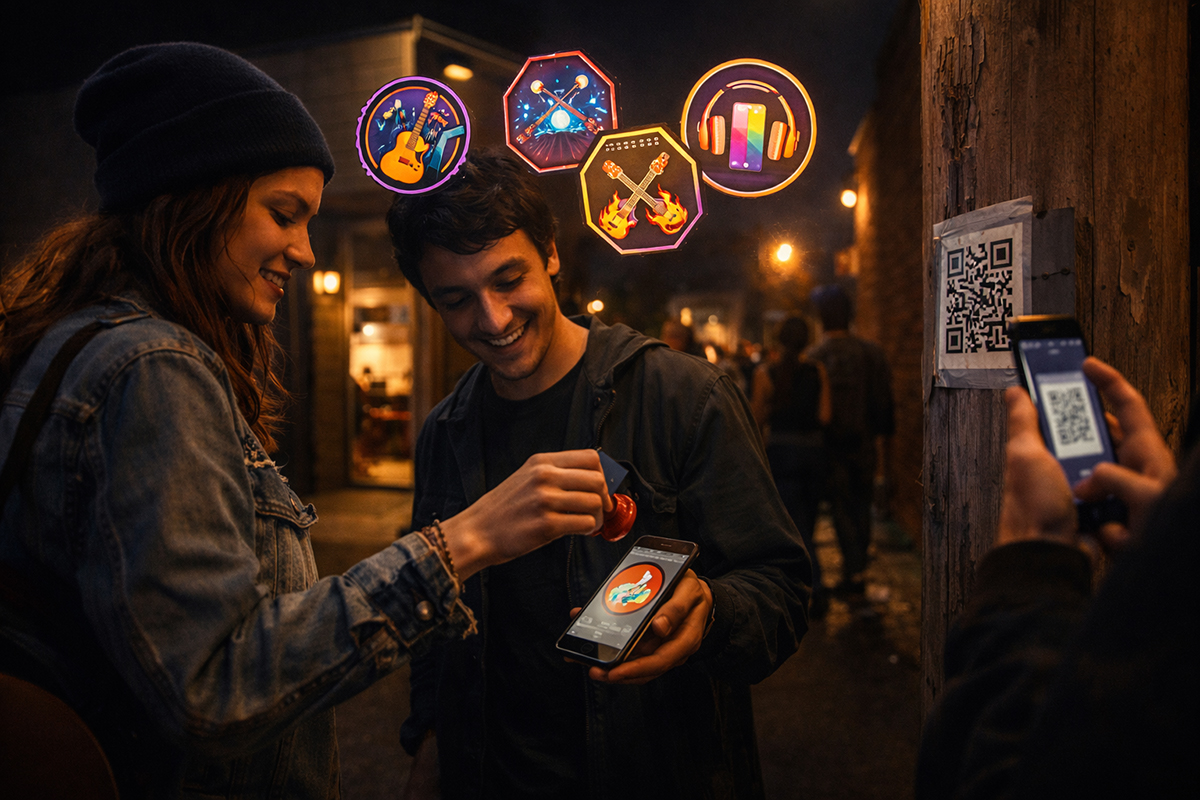
You display a QR code at the show, but you don’t show it publicly online. You put it at the merch table, or near the exit, or on a small sign that says “Claim tonight’s stamp.” Fans scan it, follow the instructions, and claim.
To prevent abuse, you can tighten it with one extra step: a short claim window or a secret phrase.
The claim window method means the QR code only works during a certain time, like “from doors to 30 minutes after the set.” That’s enough to make it real without being complicated.
The secret phrase method means the fan needs a word you say on stage, or a word on a small card at the merch table. That makes it much harder for someone on the internet to claim it without being there.
The implementation rule is simple: don’t make fans feel dumb for not knowing Web3. Make it optional. Make it friendly. Make it easy.
How to implement POAP at a show without killing the vibe
Treat it like a fun bonus, not a requirement.
Before the show, post one line: “Tonight’s show has a fan passport stamp. It unlocks early ticket windows and a private live recording later.” That’s it. No blockchain lecture.
At the venue, put a small sign at merch: “Claim tonight’s stamp.” Put the QR code there. Have one sentence below it: “Scan, claim, done.”
If your crowd isn’t crypto-comfortable, add one more line: “New to this? We’ll help you in 60 seconds.” That single sentence removes friction because it removes embarrassment.
After the show, follow up in your email list: “If you were there, claim your stamp by tomorrow night.” This is a smart move because it pushes people into your owned channel and teaches them that your email list is where the real perks live.
Now you’ve used the show to do three things at once: deepen the experience, build a proof trail, and train fans to live in your ecosystem.
What POAP stamps should unlock
This is where artists accidentally make Web3 cringe. They attach perks nobody cares about.
Your POAP perks should match real fan desire and real artist economics.
A stamp can unlock early access to tickets when you return to that city. It can unlock a private live recording from the show. It can unlock first shot at a limited merch run. It can unlock a supporters-only livestream.
Notice what all of those have in common: they’re real music moments, and they create revenue without begging for algorithms.
A POAP stamp is not “value” by itself. The stamp is proof. The value is what you choose to honor because of that proof.
That’s what makes it a passport.
How to create your Unlock membership key
Now you build the second layer: ongoing support.
Unlock Protocol is built for memberships with expiration and renewal mechanics. https://unlock-protocol.com/ In plain English, that means you can create a “supporter key” that lasts one month or one year, and when a fan holds that key, they get access to things you define.
To create your membership, you decide three things.
You decide the price. Keep it realistic. You’re not building a luxury brand. You’re building a sustainable base.
You decide the duration. Monthly is easier to join. Yearly is easier to predict revenue. Many artists offer both.
You decide the benefits. The benefits should be consistent, not random. Fans need to understand what they’re joining.
A clean benefit set looks like this: early ticket access, a monthly drop, supporter-only livestreams, discounts on merch, and access to a private page on your site where the deeper content lives.
The crucial thing is this: membership must feel like belonging, not like a paywall.
So you don’t hide your best song behind a key. You offer deeper access behind the key.
That’s the difference between “gating music” and “rewarding supporters.”
How to implement Unlock on your website and in your funnel
Your website becomes the home base where the membership benefits live.
You create a supporter page on your site that includes the monthly drops, the private live recordings, presale codes, and supporter announcements. You use Unlock to restrict access to that page so only key holders can see it.
This is the middle-class move: the membership lives on your property, not inside a third-party platform that can change the rules.
You then link to membership in two places in your funnel.
You link to it in your welcome sequence email number five, as the “inner circle” option for fans who want deeper access.
You link to it after a fan claims a POAP stamp, because that fan has already proven they participate. They’re the perfect candidate for membership.
That’s how the passport becomes a ladder: stamps for moments, keys for belonging.
How to connect your fan passport to Discord
If your community lives on Discord, token gating tools like Collab.Land can manage roles and access based on token criteria. https://collab.land/ That means you can set it up so that anyone holding your Unlock membership key gets a “Supporter” role and access to a private channel, and when the key expires, access goes away automatically.
This is huge because it keeps your community honest without you policing it manually. Support stays visible. Benefits stay protected.
And again, the point isn’t “blockchain.” The point is durable membership and recognition that doesn’t depend on Spotify, Instagram, or any gatekeeper.
The “make it real” checklist for your first month
Your first month with a fan passport system should focus on proving one thing: supporters get recognized.
Run one POAP stamp at one real-world event. Tie it to one clear benefit that fans actually want, like a private live recording.
Launch one Unlock membership tier with one consistent monthly promise, like “one monthly drop + early tickets.”
Then tell fans the truth in plain language: this is how you remember and reward people who show up, without depending on platforms.
That’s why Web3 belongs in this funnel. Because streaming can give you discovery, but it can’t give you durable belonging.
A fan passport can.
Day 2, Evening: Connect Spotify Signals to Your Owned Funnel Using AI
Now you have the machine. Here’s how you feed it.
Spotify for Artists shows you where the heat is. Those signals are what you use to decide what to build next week.
If your top cities are Denver and Atlanta, your next two weeks of content should speak to Denver and Atlanta like real places, not abstract “markets.” That can be as simple as a short video or email line that says, “Denver, I’m seeing you,” and then giving them a reason to join your list for first dibs.
This is where AI becomes the operational engine.
You take your Spotify for Artists signals and you feed them into ChatGPT at https://chatgpt.com/ with a prompt that says, in plain English, “Here are my top cities, top track, and what’s driving discovery. Give me a seven-day plan that pushes listeners from Spotify to my landing page, plus two versions of landing page copy, and three emails for new fans.”
AI helps you draft and systematize, but you still steer the voice and the choices. The end goal is not “more posts.” The end goal is “more owned relationships.”
When you do this weekly, you stop guessing. Your funnel becomes measurable and repeatable.
The copy you can use right now: landing page and email tone that converts
If you’re capturing fan data, operate clean.
In the U.S., the FTC’s CAN-SPAM compliance guide says commercial emails must include a valid physical postal address. If you have EU/UK fans, GDPR consent is commonly summarized as needing to be freely given, specific, informed, and unambiguous, indicated by a statement or clear affirmative action, and official UK ICO guidance reflects that definition as well. If you have Canadian fans, CASL guidance from the CRTC summarizes that senders need to obtain consent, provide identification information, and provide an unsubscribe mechanism.
The practical takeaway is simple: build opt-in flows, keep your promise, include an unsubscribe, and don’t play games with people’s inboxes. Trust is the entire business model.
What “done” looks like on Sunday night
By the end of this weekend, you’re done when you can do this from your phone.
You open your Spotify artist profile and tap your bio link. It takes you to a bridge that points to a campaign landing page. That page offers something meaningful and collects an email. After the opt-in, the fan receives the promised content immediately. The welcome sequence starts automatically. The fan passport is introduced as a real, optional layer with real benefits. And you have at least one direct support path ready: Bandcamp, merch, tickets, or membership.
That’s it. That’s the machine.
Now your next release isn’t just a song. It’s a pipeline.
Spotify can still drive discovery. But you’ve stopped building your career inside rented space. You’ve built the infrastructure that converts attention into ownership, and ownership into direct revenue.
That’s not a hack. That’s a business.
And that’s how you build a music industry middle class that platforms can’t erase.
 |  Spotify |  Deezer |  Breaker |
 Pocket Cast |  Radio Public |  Stitcher |  TuneIn |
 IHeart Radio |  Mixcloud |  PlayerFM |  Amazon |
 Jiosaavn |  Gaana |  Vurbl |  Audius |
 Reason.Fm | |||
Find our Podcasts on these outlets
Buy Us a Cup of Coffee!
Join the movement in supporting Making a Scene, the premier independent resource for both emerging musicians and the dedicated fans who champion them.
We showcase this vibrant community that celebrates the raw talent and creative spirit driving the music industry forward. From insightful articles and in-depth interviews to exclusive content and insider tips, Making a Scene empowers artists to thrive and fans to discover their next favorite sound.
Together, let’s amplify the voices of independent musicians and forge unforgettable connections through the power of music
Make a one-time donation
Make a monthly donation
Make a yearly donation
Buy us a cup of Coffee!
Or enter a custom amount
Your contribution is appreciated.
Your contribution is appreciated.
Your contribution is appreciated.
DonateDonate monthlyDonate yearlyYou can donate directly through Paypal!
Subscribe to Our Newsletter
Order the New Book From Making a Scene
Breaking Chains – Navigating the Decentralized Music Industry
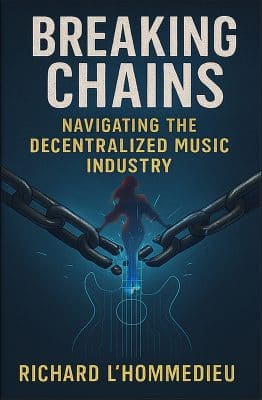
Breaking Chains is a groundbreaking guide for independent musicians ready to take control of their careers in the rapidly evolving world of decentralized music. From blockchain-powered royalties to NFTs, DAOs, and smart contracts, this book breaks down complex Web3 concepts into practical strategies that help artists earn more, connect directly with fans, and retain creative freedom. With real-world examples, platform recommendations, and step-by-step guidance, it empowers musicians to bypass traditional gatekeepers and build sustainable careers on their own terms.
More than just a tech manual, Breaking Chains explores the bigger picture—how decentralization can rebuild the music industry’s middle class, strengthen local economies, and transform fans into stakeholders in an artist’s journey. Whether you’re an emerging musician, a veteran indie artist, or a curious fan of the next music revolution, this book is your roadmap to the future of fair, transparent, and community-driven music.
Get your Limited Edition Signed and Numbered (Only 50 copies Available) Free Shipping Included
Discover more from Making A Scene!
Subscribe to get the latest posts sent to your email.


