The Hard Truth: You Already Run A Business, You Just Haven’t Admitted It Yet





Making a Scene Presents – The Hard Truth: You Already Run A Business, You Just Haven’t Admitted It Yet
Listen to the Podcast Discussion to gain More Insight into You as a Music Business!
If you’re releasing music and touring locally, regionally, and nationally, you’re not “trying to make it.” You’re already operating a real business. Money comes in. Money goes out. Contracts get signed. Taxes show up whether you feel ready or not. The only question is whether you’re going to run your music business on purpose, or let it run you by accident.
This is where a lot of indie artists get quietly robbed. Not always by some evil label guy in a suit. A lot of the time, you get robbed by messy setup. No clear ownership. No clean paper trail. No plan. No separate bank account. No publishing set up. No splits written down. You do the work, the music gets used, and the money either never finds you or shows up years later with a fight attached. So we’re going to build the foundation the “real” industry has always used, but we’re going to build it for you. Not to become a mini major label. To become unexploitable.
This article is U.S.-only, written for artists who are already releasing and touring. I’m going to cover how a solo singer-songwriter does it and how a full band does it, because the band version needs extra protection. I’m also going to tell it like it is about business structures and the uncomfortable stuff like what happens when someone quits, disappears, gets sued, or dies.
What “Building a Music Business” actually means in plain English
A music business is not just the songs you write or the records you release. It is the system that holds everything together when the music leaves your head and enters the real world. It includes your songs and recordings, but it also includes your name, your brand, your money, your expenses, your contracts, and your rights. A real business exists for three very unromantic but very powerful reasons. It collects money in an organized way. It controls risk so one bad situation doesn’t wipe you out. And it keeps working even when you are exhausted, sick, burned out, or halfway across the country in a broken-down van.
When people say “I just want to focus on the music,” what they usually mean is “I don’t have a system, so everything feels overwhelming.” The system is what lets you focus on the music without everything else falling apart.
In practical terms, building a music business means setting up a simple structure that lets you answer hard questions without guessing or arguing. You should know who owns the master recordings and who controls them. You should know who owns the songs themselves, not just who performs them. You should know who has the authority to sign a deal, approve a license, or say yes to an opportunity. You should know how money flows in, who gets paid first, and what happens when there is not enough money to go around.
You should also know what happens on a bad day, not just a good one. Who pays the credit card when a tour loses money? What expenses belong to the business and what expenses are personal? Which costs reduce your taxes and which ones do not? Where are your royalties being tracked, and who is responsible for making sure they are registered correctly? Who can approve a sync license that could affect your future income or your public image? And if someone quits, disappears, or causes a problem right before a major tour or release, what happens next?
These questions are not signs that you are cynical or greedy. They are signs that you are building something meant to last.
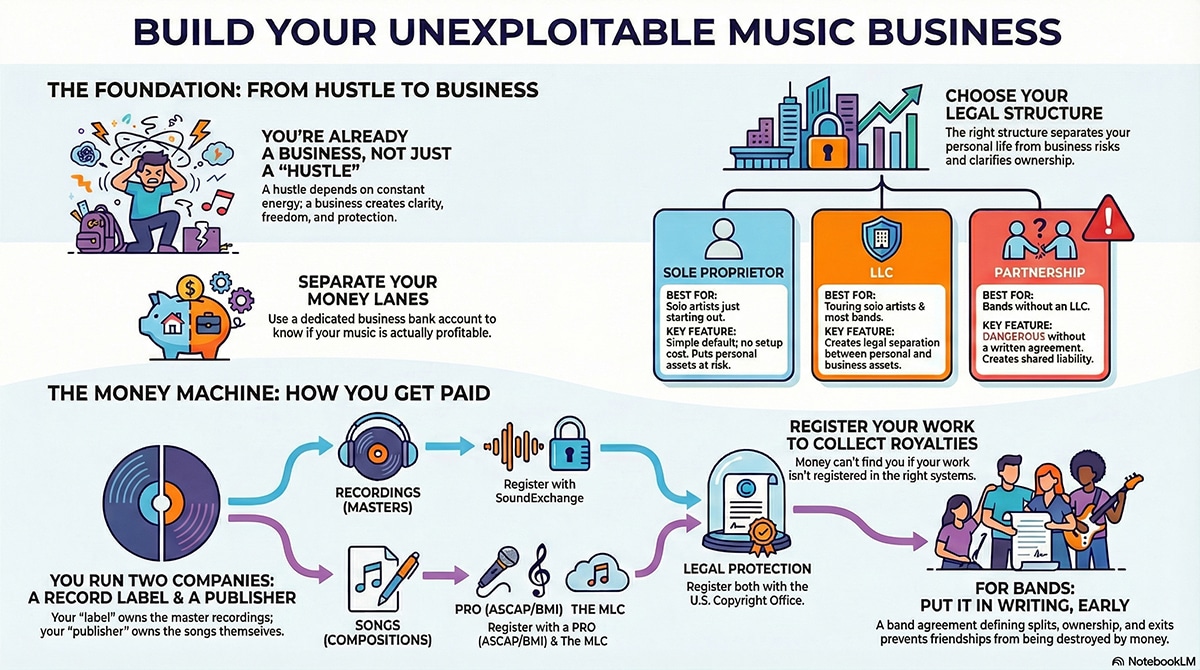
If you cannot answer these questions quickly and clearly, then you do not have a business yet. You have a hustle. Hustles depend on energy, emotion, and constant effort. They work until they don’t. They burn people out because everything lives in their head and nothing is protected. A business, on the other hand, creates breathing room. It creates clarity. It creates freedom. And for an independent artist, freedom is the whole point.
Start with the business plan, because “vibes” are not a strategy
A business plan sounds boring until you realize it’s not a school assignment. It’s a decision document. It’s you saying, “Here is how we will make money, here is what it costs, and here is what we do next.”
The U.S. Small Business Administration has a plain-language guide to writing a business plan that’s actually useful, not corporate fluff. Use it as a template, then rewrite it in your artist voice so it feels real. (Small Business Administration)
Here’s what your music business plan needs to contain, in normal human terms.
You need a clear description of what you sell. Most artists say, “We sell music.” That’s not true. Streaming pays like dust for most indie acts. What you actually sell is access, experiences, community, and emotion delivered through products. Your recordings are the engine, not the whole business.
You need your income streams written down. Touring guarantees, ticket splits, merch, VIP, Patreon-style memberships, Bandcamp drops, sync, session work, licensing, teaching, brand deals, YouTube revenue, and royalties. If you don’t list them, you won’t build them.
You need your costs written down. Van and trailer, gas, hotels, repairs, strings, drum heads, rehearsal space, marketing, content creation, mixing, mastering, artwork, distro fees, website, email list tools, accounting, and taxes. Costs don’t care if you’re “indie.” They show up anyway.
You need your operating plan. That means who does what and when. Who advances shows. Who runs merch. Who posts content. Who follows up with venues. Who updates the set list. Who tracks expenses on the road. If nobody owns it, it won’t happen.
You need your numbers. Not perfect numbers. Honest numbers. What does a weekend run cost, all-in? What does it earn? What’s break-even? What’s the minimum you need per show to say yes? If you don’t know, you’ll keep accepting deals that look cool and pay terrible.
And you need your growth plan. Not “go viral.” Real growth. What markets are working? What is your release schedule? What partnerships matter? What data will you track to prove you’re growing?
If you do this right, your business plan becomes the thing you review every month. It becomes your anti-chaos tool.
The big decision: sole proprietor vs LLC vs partnership, and why this matters more for bands
This is the part where people usually get bad advice from a friend who “knows a guy.” I’m going to keep it simple and blunt.
Sole proprietor: the default setting that can bite you
If you do nothing, you are basically a sole proprietor. Money comes in under your name, you report it on your taxes, and you pay self-employment tax where it applies. This is common for solo artists early on because it’s easy and cheap. Here’s the problem. There is no legal separation between you and the business. If something goes wrong and someone sues, your personal life is closer to the blast zone. Also, it’s easier to keep your books sloppy because everything is mixed together.
Sole proprietor can still be done intelligently if you separate bank accounts and track expenses cleanly. But it’s the least protective structure.
LLC: usually the sweet spot for working indie artists
An LLC is basically a legal box you place your music business inside. It is not magic, and it does not suddenly make you successful or wealthy. What it does is much more practical, and much more important. When it is set up and run correctly, an LLC does two very specific jobs that protect you as an independent artist.
First, it creates a clear line between your personal life and your music business. That separation matters more than most artists realize. When your business earns money, signs contracts, or takes on risk, the LLC is the thing standing in front of you. If something goes wrong, that line can help keep personal assets like your savings, your car, or your home from being directly tied to a business problem. It does not make you untouchable, but it gives you a layer of protection that does not exist when everything runs under your personal name.
Second, an LLC makes your music business feel real to the outside world. Banks, venues, promoters, distributors, and partners tend to take you more seriously when money flows through a business entity instead of a personal account. It signals that you are organized, intentional, and planning to stick around. That perception alone can change how people treat you in negotiations, settlements, and long-term opportunities.
An LLC becomes especially useful once your music career moves beyond small, occasional income. If you are touring regularly, selling merch consistently, and paying for real expenses like travel, marketing, recording, and promotion, having everything under a business entity makes tracking money and making decisions far easier. It also simplifies contracts, because the “person” signing the deal is the company, not you as an individual. That clarity matters when agreements last longer than a single tour or release.
The most important thing to understand is that an LLC only works if you treat it like a real business. You cannot half-do it. That means opening a separate bank account for the company, keeping clean accounting records, and using the business account for business income and expenses. It also means having a clear operating agreement, even if you are the only owner, so responsibilities and authority are defined on paper. Consistent paperwork and habits are what give the LLC its strength. Without that discipline, it is just a name on a form, and it will not protect you when you need it most.
Partnership: the most dangerous structure if you’re a band and you “just wing it”
If you’re in a band and you are not set up as an LLC or a corporation, there’s a good chance you are already operating like a partnership without realizing it. That means multiple people are doing business together, sharing money, sharing responsibility, and making decisions as a group, often with nothing written down. On paper, that sounds friendly and fair. In real life, it is one of the fastest ways bands fall apart.
Bands rarely break up because the music stops working. They break up because money enters the picture and nobody agreed on how it would be handled. One person thinks the money should be split evenly. Another thinks they should be paid more because they write most of the songs. Someone else thinks the band owes them for fronting tour expenses. None of these ideas are wrong on their own, but when they are never discussed or documented, they turn into resentment. Resentment kills bands faster than bad reviews ever could.
A partnership structure can work, but only when it is intentional and written down clearly. That means everyone understands how money is split, who can make decisions, and what happens when there is a disagreement. The hard truth is that most bands never do this work. They assume everyone is “cool” because things feel good in the early days. Then the first real money shows up, or a big opportunity appears, and suddenly those unspoken assumptions turn into arguments. At that point, it is usually too late to fix things calmly.
For most working bands, the smartest move is forming an LLC owned by the band members and backing it up with a strong operating agreement. That agreement is not about acting corporate or killing the vibe. It is about clarity. It spells out how income is split, how votes work, who can sign contracts, and what happens if someone wants to leave or is asked to leave. It also covers disputes so they do not turn into personal battles. The goal is not control. The goal is protection, both for the band and for the relationships inside it.
When expectations are written down, everyone relaxes. People know where they stand. Decisions get easier. Friendships survive success and failure because the rules are not being invented in the middle of a crisis. Ambiguity is what crushes bands, not structure.
When you start setting this up, always lean on official sources instead of random advice from forums or social media. In the U.S., USA.gov provides a clear starting point for understanding how to form a business and connects you to Small Business Administration resources that explain the process in plain language. That way, you are building your band on solid ground instead of guesswork.
The business registration basics for U.S. artists, without the confusion
In the U.S., setting up your music business means dealing with three layers at the same time, and this is where a lot of artists get overwhelmed. There is the federal level, the state level, and the local level. Each one handles a different piece of the puzzle, and none of them talk to each other automatically. You have to connect the dots.
At the federal level, most working artists will need an EIN at some point. An EIN is basically a Social Security number for your business. It tells the government, banks, and other companies that your music operation is a real business entity and not just a personal side hustle. You get an EIN directly from the Internal Revenue Service, and it is completely free. This is important enough to say twice. It is free. If a website tries to charge you for an EIN, that site is not the IRS, and you should close the tab immediately.
The IRS has an official page that walks you through applying for an EIN online, and it is straightforward if you take your time. The correct place to do this is https://www.irs.gov/businesses/small-businesses-self-employed/apply-for-an-employer-identification-number-ein-online. The IRS also explains Form SS-4, which is the paper version of the EIN application, in case you ever need to file it that way or understand what information is being asked for. You can find that explanation at https://www.irs.gov/forms-pubs/about-form-ss-4. You do not need to rush this. Accuracy matters more than speed.
At the state level, this is where you officially create your LLC or corporation. In most states, this happens through your Secretary of State’s website. Every state handles this a little differently, which is why there is no single universal link. Some states make it easy. Some make it confusing. What matters is the process, not the interface. You register the business entity, you name a responsible party, you provide an address, and you receive formation documents that prove the business exists. Once that is done, you must keep that information updated if anything changes. Losing track of this paperwork or letting information go stale is one of the most common mistakes artists make.
At the local level, things get even more specific. Depending on your city or county, you may need a local business license, especially if you sell merch regularly, operate a rehearsal or studio space, or run any part of the business from a physical location. Some places care. Some do not. The only way to know is to check your local government website or call the local office that handles business licensing. This step is often skipped, not because it is unimportant, but because nobody tells artists it exists.
All of this absolutely feels like paperwork, because it is. There is no way to sugarcoat that. But this paperwork is also what separates a real business from a hobby in the eyes of banks, venues, partners, and the government. When you take care of these layers, you stop being treated like someone who is “just messing around with music,” and you start being treated like a professional who plans to be here next year, and the year after that.
Separate your money, or you will never know if you’re winning
A real music business has clean money lanes, and this is one of the biggest differences between artists who feel constantly stressed and artists who feel in control. Clean money lanes simply mean that business money lives in business accounts, and personal money lives somewhere else. When income from shows, merch, licensing, or online sales comes in, it goes into the business account. When you pay for gas, hotels, strings, ads, recording time, or merch printing, it gets paid from that same business account.
When everything is mixed together, you are flying blind. You cannot tell if a tour actually made money or just felt busy. You cannot tell if merch sales are carrying a bad guarantee or if you are quietly subsidizing the band with personal cash. You might look back on a year packed with shows and releases and still have no idea if you actually came out ahead. Busy does not mean profitable, and without clean money lanes, you will never know the difference.
This is where basic accounting tools stop being “business stuff” and start being survival tools. They take all the random numbers, receipts, and payments and turn them into something you can actually understand. When your money is organized, decisions get easier. You know which tours to repeat, which merch designs work, and which expenses are quietly draining you.
QuickBooks is one of the most common tools used by small businesses and self-employed people, including musicians. It is built to track income and expenses in a way that lines up with how taxes work in the U.S. That means when tax time comes around, you are not digging through email receipts and bank statements trying to remember what happened six months ago. You already have a clear picture.
Wave is another option many small businesses use, especially artists who want something simple. Wave offers invoicing and basic accounting tools, including a free invoicing feature that helps you look professional when you bill venues, festivals, or clients. Getting paid faster and more consistently is part of running a healthy business, and tools like this help make that normal instead of awkward.
The most important part is not which tool you choose. It is the habit. Pick one system and commit to it. Record income as it comes in. Categorize expenses as you spend. Check your numbers regularly, even when you are tired or on the road. That habit is what saves you. It turns confusion into clarity and lets you run your music career with intention instead of guesswork.
The tax reality for touring artists: you want deductions, but you also want proof
In the U.S., your music business expenses can reduce your taxable income, but you have to track them properly. The main idea is simple: if you spend money to earn money, it might be deductible. But “might” is doing a lot of work there. You need records. That means receipts, invoices, mileage logs, lodging, per diems if you do it that way, instrument purchases, repairs, software subscriptions, marketing costs, contractor payments, and so on. When you track this cleanly, you stop feeling surprised by taxes.
Also, once you start paying other people, even as contractors, you need to treat it seriously. That’s where payroll and contractor payment systems can matter. Gusto is a widely used payroll and HR platform for small businesses that helps handle payroll and tax filings when you have people you pay regularly. (Gusto)
You may not need payroll at first, but bands often hit a point where paying crew and contractors gets complicated fast. The goal is not to make your life bureaucratic. The goal is to keep you compliant and sane.
Building your “record company” the indie way, not the fantasy way
A record company for an independent artist is not some giant skyscraper with offices and interns. It is a container. Its job is to hold your master recordings and manage how those recordings move through the world. That’s it. When you think about it this way, the idea becomes a lot less intimidating and a lot more useful.
Your record company is the legal owner of your sound recordings, which are often called “masters.” That ownership matters because masters are what get licensed, distributed, and monetized. When your music goes out to streaming platforms, when a song gets placed in a film or TV show, or when a recording is licensed for any other use, it is the record company that signs those agreements and collects the master-side income. Even if you are doing everything yourself, having a clear “owner” on paper keeps things clean and defensible.
For a solo artist, the record company is often just the artist’s LLC. That keeps things simple and manageable, especially in the early and middle stages of a career. Some artists eventually create a separate LLC just for their label or recording operation to create even cleaner separation between different parts of the business. That is not required at the start, but it can be useful later as income grows and opportunities become more complex.
For a band, the situation is more sensitive, and clarity matters even more. In most cases, the record company should be the band’s LLC. That way, the masters are owned by the band as a business, not by one individual member. This avoids massive problems later when someone leaves, when the band goes on hiatus, or when older recordings suddenly become valuable. If you decide to handle ownership differently, that decision should be intentional, written down, and agreed to by everyone involved. Accidental ownership is how lawsuits start.
Here is the part most people miss. A record company is not just about owning recordings. It is about systems and habits. It means keeping your session files organized so you can find them years later. It means being disciplined about metadata so your songs are properly identified everywhere they live. It means registering recordings correctly so royalties can be tracked and paid. It means having clear contracts with producers, mixers, and anyone else who touches the recording, spelling out who owns what and who gets paid.
When you skip these steps, nothing usually breaks right away. The damage shows up later, when a song gets attention, when someone wants to license it, or when you try to rebuild a catalog you can no longer locate. That is when people realize how expensive disorganization really is. A well-run record company protects your work not just today, but for the future version of you who will be very grateful you did it right.
Building your publishing company, because songs are a different asset than recordings
Publishing is about the song itself, not the recording you hear on Spotify or Bandcamp. This is one of the most confusing parts of the music business for independent artists, mostly because nobody explains it in plain language. A song is the composition. That means the lyrics and the melody, the part you could play on an acoustic guitar or sing in a room with no microphones. A recording is just one captured performance of that song. You can record the same song ten different times, in ten different styles, with ten different artists, and it is still the same song underneath. Publishing does not care how many recordings exist. Publishing cares about who wrote the song and who controls the rights to use it.
This distinction matters because songs and recordings make money in different ways and through different systems. When you set up a publishing company, you are creating a place for the ownership and administration of your songwriting. That company exists to collect and manage what is called the “publisher share” of income. Many songwriters only register themselves as writers and never set up or claim the publishing side. When that happens, half of the money is either left unclaimed or paid to nobody at all. Artists often do not realize this until years later, when they look back and wonder why the checks never matched the plays.
Performance royalties are one of the main income streams tied to publishing. These royalties are collected and paid out by organizations called Performing Rights Organizations, usually shortened to PROs. In the United States, two of the most common PROs are ASCAP and BMI. When your song is performed publicly, whether that is on radio, on television, in a venue, or in certain types of streaming environments, the PRO tracks those performances and pays out royalties to the registered writers and publishers.
Both ASCAP and BMI have official websites that explain how to join, how membership works, and what information you need to provide. Signing up is not about choosing sides or joining a club. It is about making sure there is a system in place that knows your songs exist and knows where to send money when they are used. If your songs are not registered, the performances still happen, but the money does not magically find you.
Mechanical royalties are a different category, and this is where a lot of modern streaming income lives. In the U.S., streaming mechanical royalties are handled through The MLC, which stands for the Mechanical Licensing Collective. The MLC has a portal where songwriters and publishers register their works so those royalties can be matched and paid. This is not optional if you want to collect everything you are owed. If your songs are not registered properly, the money either sits unmatched or gets distributed elsewhere.
At this point, it is important to step back and breathe. The goal here is not to memorize every type of royalty or become an expert overnight. The goal is to build a system. That system makes sure your songs are registered in the right places so money can find you without you chasing it forever. Once the system is in place, it mostly runs in the background while you focus on writing, recording, and touring.
If handling publishing administration yourself feels overwhelming, there are services designed to help with that work. Songtrust is one of the better-known publishing administration platforms. It helps songwriters register their songs globally and collect publishing royalties from multiple sources while allowing the artist to keep ownership of their rights. This kind of service can be especially helpful if your music is being used internationally or across many platforms.
The most important thing to understand is that publishing is not an abstract concept reserved for hit songwriters. If you write songs and release them into the world, you have publishing. Treating it seriously is not about ego or ambition. It is about respecting your work enough to make sure it is tracked, protected, and paid for properly over time.
Register your copyrights like an adult, because “I made it first” doesn’t win arguments
Copyright exists automatically when you create and fix a work in a tangible form, but registration gives you real legal advantages in the U.S. If you ever have to enforce your rights, being registered matters. The U.S. Copyright Office has an official registration portal and the eCO system for filing. They also provide help and FAQs for online registration. (U.S. Copyright Office)
You don’t register “a vibe.” You register specific works. Recordings and compositions can be registered in different ways depending on how you file. If you make this part of your release checklist, you stop leaving protection on the table.
Don’t forget SoundExchange, because non-interactive plays are a real check for many artists
A lot of artists miss SoundExchange entirely. That’s money you can’t afford to ignore if your recordings get played on non-interactive digital services like SiriusXM and certain streaming radio-style platforms. SoundExchange has a straightforward registration page and explains that recording artists and rights owners must be registered to receive those royalties. (SoundExchange)
This is one of those “set it up once, then keep it updated” systems. It’s not glamorous. It’s rent money.
Solo artist setup: the clean, strong version for a singer-songwriter
If you’re a solo singer-songwriter who writes and performs your own music, you usually wear two hats. You are the artist, and you are the business owner. Your job is to build a structure that’s simple enough to maintain while touring, but strong enough to scale.
Your business plan should focus on your touring model, your release schedule, and your direct-to-fan engine. Touring is your marketing and your sales floor. Releases are your proof of life and your long-term catalog. Direct-to-fan is where you build stability.
In structure terms, many solo artists start as sole proprietors, then move to an LLC once income and risk justify it. If you’re touring nationally and moving real merch, an LLC usually makes sense, because you’re dealing with contracts, travel risk, and money volume that benefits from separation and clearer bookkeeping.
Your “record company” can be your LLC. That LLC owns the masters, signs distro agreements, pays contractors, and collects income. Your “publishing company” can also be under the same LLC at first, but you still need to treat publishing as its own system, with its own registrations and records. Separate bank accounts can still be used inside one LLC if you want internal clarity.
The solo artist advantage is control. You don’t need votes. You don’t need band meetings. The solo artist weakness is bandwidth. So your business plan has to be realistic about what you will actually do weekly while on the road.
This is where using tools like accounting, invoicing, and project management becomes less about being “corporate” and more about protecting your creative energy.
Band setup: the strong version that prevents “we were friends until money happened”
A band is not just a bigger solo act. A band is a small democracy with expensive equipment and emotional history. That combination is beautiful on stage and dangerous in a business. If you take nothing else from this article, take this: bands need written agreements early, before the first real money.
Most band breakups don’t happen because the music got bad. They happen because expectations were never written down, and then reality showed up. The clean setup for a band is usually a band LLC. The LLC signs contracts, owns band assets, pays band expenses, collects band income, and distributes member payments based on the operating agreement.
That operating agreement is where you define how decisions get made. You define who can sign what. You define what happens if someone leaves. You define what happens if someone wants to sell their share. You define what happens to the masters. You define how publishing is handled for songs written by one person versus written by the group. Here’s the uncomfortable truth. If you do not write this down, you are choosing chaos later.
Also, bands need to separate two types of “splits” that people constantly mix up. Songwriting splits are about who wrote the composition. If one person writes the song, that person owns the songwriting, unless they choose to share it. If the band co-writes, you define splits and document them every time. If you do not, you will argue about it forever.
Band income splits are about money earned from the band business, like gig fees and merch profit. Those splits can be equal, or not. But they need to be explicit. Otherwise, the person doing the booking and admin will resent everyone. Or the person who “fronted the van money” will start acting like they own the band. And then it gets ugly.
Your agreement should also cover what happens if a member dies or becomes unable to perform. That’s not morbid. That’s adulthood. If you’ve toured long enough, you’ve seen life happen to people.
Sample Band Operating Agreement
(Plain-Language Version for Independent Bands)
This agreement is entered into on __________ by the members of the band known as __________________ (“the Band”). The purpose of this agreement is to clearly define ownership, decision-making, money flow, and expectations so the Band can operate professionally and avoid misunderstandings.
This agreement exists to protect both the Band and the individual members.
1. The Band as a Business
The Band operates as a single business entity under the name __________________. The Band may operate through a legal entity such as an LLC, and all members agree that Band income, expenses, assets, and liabilities belong to the Band, not to any individual member, unless specifically stated otherwise in this agreement.
The Band exists to create, record, perform, and commercially exploit music and related creative works.
2. Band Members
The current members of the Band are:
Each member is considered an equal participant in the Band unless otherwise stated in this agreement.
3. Ownership of the Band Business
Ownership of the Band business is divided as follows:
________________________________ – _____%
________________________________ – _____%
________________________________ – _____%
________________________________ – _____%
These ownership percentages apply only to the Band business, not automatically to songwriting or publishing unless explicitly stated elsewhere.
4. Decision-Making and Authority
Day-to-day operational decisions may be made by majority vote unless otherwise specified.
Major decisions require approval by a majority (or unanimous, if the band prefers) of ownership interests. Major decisions include, but are not limited to:
Signing recording, publishing, management, or distribution agreements
Incurring significant debt
Selling or licensing Band-owned masters
Adding or removing Band members
Disbanding the Band
No single member may bind the Band to a long-term agreement without approval from the required voting threshold.
5. Income and Expense Handling
All income generated by the Band, including but not limited to live performance fees, merchandise sales, master recording income, and licensing income, belongs to the Band and must be deposited into the Band’s business account.
Band expenses will be paid from Band funds. Personal expenses are not reimbursable unless approved in advance by the Band.
After expenses are paid, net income will be distributed according to ownership percentages unless otherwise agreed in writing.
6. Songwriting and Publishing
Songwriting ownership is separate from Band ownership.
Songwriting splits will be determined at the time each song is written and must be documented in writing. If no split is documented, the default assumption will be equal shares among credited writers only, not automatically all Band members.
Publishing income belongs to the songwriters and their publishing entities, not the Band business, unless otherwise agreed in writing.
7. Ownership of Master Recordings
All master recordings created by the Band while operating under this agreement are owned by the Band business unless otherwise stated in writing.
No individual member may exploit, sell, or license Band-owned masters independently.
8. Leaving the Band or Removal of a Member
A member may voluntarily leave the Band with written notice.
The Band may remove a member by a vote of __________ if that member is unable or unwilling to fulfill Band responsibilities.
A departing member retains their songwriting ownership and publishing rights but relinquishes any claim to future Band income generated after their departure, except as required by law or previously agreed contracts.
Ownership interest in the Band business will be handled as follows upon departure:
9. Death or Incapacity
If a Band member dies or becomes permanently unable to perform, their songwriting and publishing rights remain with their estate.
Their ownership interest in the Band business will be handled according to the following terms:
This section exists to protect both the Band and the affected member’s family.
10. Disputes
If a dispute arises, the Band agrees to attempt resolution internally first.
If no resolution is reached, the Band agrees to mediation before litigation.
This agreement exists to reduce conflict, not escalate it.
11. Dissolution of the Band
If the Band dissolves, all debts will be paid first.
Remaining assets, including recordings, merchandise, and funds, will be distributed according to ownership percentages unless otherwise stated.
Songwriting ownership is not affected by Band dissolution.
12. Amendments
This agreement may only be changed by written agreement signed by all required parties.
Verbal agreements do not modify this document.
13. Acknowledgment
Each member acknowledges that they understand this agreement, have had the opportunity to seek legal advice, and agree to operate in good faith.
This agreement is not about control. It is about clarity.
Signed:
_____________________________ Date __________
_____________________________ Date __________
_____________________________ Date __________
_____________________________ Date __________
Building a release-and-tour operating system that doesn’t collapse mid-run
Once you have a structure, you need a routine. Your business plan should include an operating rhythm that works for both release cycles and tour cycles. For releases, you need a checklist mindset. Every release should trigger the same actions: finalize masters, finalize metadata, register songs with your PRO, register with The MLC as needed, register recordings where appropriate, set up distribution, update your website, set up email and fan messaging, plan content, and plan merch.
For tours, you need a financial routine that keeps you from lying to yourself. Every run needs a budget. Every run needs a break-even number. Every run needs a settlement process where you record what you earned and what it cost. This is how you stop “touring a lot” and start “touring profitably.”
The direct-to-fan core: build a store and a membership lane
Streaming is a discovery layer for most indie artists. Direct-to-fan is where you build stability. The business plan should treat direct-to-fan like a core product line, not an afterthought.
Bandcamp is one of the most artist-friendly direct sales platforms, and it’s built around fans buying music and merch directly from artists. (Bandcamp)
For a more full ecommerce setup, Shopify is a major platform used by businesses to run online stores, and it has grown creator-friendly tooling over time. (Shopify)
For membership support, Patreon is a major option for creator memberships and recurring fan support. (Patreon)
You do not have to use all of these. The point is to pick a stack you can maintain. Your business plan should clearly state what your store is, what your membership offering is, and what your “fan journey” looks like from first listen to long-term supporter.
Data and planning: stop guessing where to tour and what to push
At the touring level you’re operating at, guessing is expensive. Your business plan should include a data plan, meaning what you track and how you decide. Chartmetric is an analytics platform that tracks artist performance across streaming and social sources and is widely used for understanding growth and audience signals. (Chartmetric)
Data doesn’t replace instinct. It just stops you from making the same blind choices over and over.
The forward-looking section: Web3, decentralization, and AI as part of a real business plan
Now we get to the part the old industry doesn’t love. Because it shifts leverage. Web3 is not a magic money button. It’s a toolbox for ownership, portability, and direct relationships. When used correctly, it helps you stop being trapped inside platform rules.
One of the most practical Web3 tools for musicians is token-gated access, where fans hold a digital membership that unlocks content, perks, or community. Unlock Protocol exists specifically for building membership-style access in a decentralized way. (unlock-protocol)
This matters because it lets you build a fan club that isn’t locked inside one social platform’s mood swings.
On the decentralized music side, Audius positions itself as a decentralized, community-owned, artist-controlled music-sharing protocol, and it’s part of the broader push toward platform alternatives. (audius.org)
You can build a business plan where your releases still go to major DSPs for reach, but your “owned layer” is built through direct sales, memberships, and portable fan access.
A quick, real-world warning: some Web3 music platforms come and go fast. For example, Sound.xyz currently states it is shutting down on January 16, 2026. If you use platforms like this, your plan must include an exit strategy and a “portability” mindset so your fan relationships and assets aren’t stranded. (Sound.xyz)
For creators posting and monetizing on-chain content, Zora is one of the more visible platforms in that space. (Zora)
The lesson is not “Web3 is risky.” The lesson is “build so you can move.” Ownership without portability is just another cage.
Now, AI. AI belongs in your business plan for one reason: it reduces labor. That’s it. It buys back your time. Used correctly, AI helps you do the boring parts faster so you can create more and tour smarter.
In your plan, AI shows up in three places.
It shows up in marketing production, where you create ads, content variations, and campaign testing without burning out.
It shows up in planning, where you forecast tour costs, merchandise demand, and what markets are heating up based on your own data.
It shows up in admin, where you automate repetitive tasks like bookkeeping categorization, invoice creation, and customer communication.
Even if you keep it simple, “use AI to reduce admin time by 30%” is a real business goal. And it’s a rebellious one, because it means you stop donating your life to the content grinder.
Your music business is a freedom machine if you build it correctly
This whole setup is about one thing: control. Not control in an ego way. Control in a survival way.
When you have a business plan, a clean structure, a record company container for your masters, a publishing system for your songs, proper registrations, clean accounting, and strong band agreements, you stop being easy to exploit. You stop getting surprised. You stop leaking money. You stop making decisions based on panic.
And when you add forward-looking tools like token-gated memberships, portable fan relationships, and AI-driven efficiency, you’re not just “keeping up.” You’re building an indie career that doesn’t require permission.
That’s the Making a Scene point. The old system trained artists to be dependent. You’re building the opposite.
 |  Spotify |  Deezer |  Breaker |
 Pocket Cast |  Radio Public |  Stitcher |  TuneIn |
 IHeart Radio |  Mixcloud |  PlayerFM |  Amazon |
 Jiosaavn |  Gaana |  Vurbl |  Audius |
 Reason.Fm | |||
Find our Podcasts on these outlets
Buy Us a Cup of Coffee!
Join the movement in supporting Making a Scene, the premier independent resource for both emerging musicians and the dedicated fans who champion them.
We showcase this vibrant community that celebrates the raw talent and creative spirit driving the music industry forward. From insightful articles and in-depth interviews to exclusive content and insider tips, Making a Scene empowers artists to thrive and fans to discover their next favorite sound.
Together, let’s amplify the voices of independent musicians and forge unforgettable connections through the power of music
Make a one-time donation
Make a monthly donation
Make a yearly donation
Buy us a cup of Coffee!
Or enter a custom amount
Your contribution is appreciated.
Your contribution is appreciated.
Your contribution is appreciated.
DonateDonate monthlyDonate yearlyYou can donate directly through Paypal!
Subscribe to Our Newsletter
Order the New Book From Making a Scene
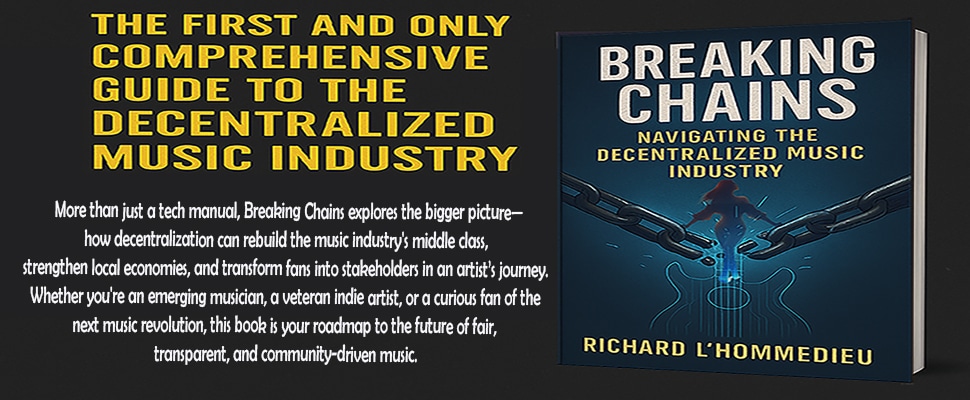
Breaking Chains – Navigating the Decentralized Music Industry

Breaking Chains is a groundbreaking guide for independent musicians ready to take control of their careers in the rapidly evolving world of decentralized music. From blockchain-powered royalties to NFTs, DAOs, and smart contracts, this book breaks down complex Web3 concepts into practical strategies that help artists earn more, connect directly with fans, and retain creative freedom. With real-world examples, platform recommendations, and step-by-step guidance, it empowers musicians to bypass traditional gatekeepers and build sustainable careers on their own terms.
More than just a tech manual, Breaking Chains explores the bigger picture—how decentralization can rebuild the music industry’s middle class, strengthen local economies, and transform fans into stakeholders in an artist’s journey. Whether you’re an emerging musician, a veteran indie artist, or a curious fan of the next music revolution, this book is your roadmap to the future of fair, transparent, and community-driven music.
Get your Limited Edition Signed and Numbered (Only 50 copies Available) Free Shipping Included
Discover more from Making A Scene!
Subscribe to get the latest posts sent to your email.


