
Smart Contracts & Royalty Splits: Get Paid Automatically





Making a Scene Presents – Smart Contracts & Royalty Splits: Get Paid Automatically
Listen to the deep dive podcast for more in depth discussion of this article
Why Money Has Tore So Many Bands Apart
You know the story well: a band records a hit, it starts making money, and then tensions emerge. Who wrote which verse? Who deserves how much? Did the producer’s studio time count toward “points”? Did the marketing team’s work deserve a slice? Even when everyone’s intention is good, the old system is full of ambiguity, delays, and opaque accounting. Labels, publishers, and middlemen often stand between you and your money—and by the time a royalty check arrives, it’s wrapped in cryptic spreadsheets and late to the table.
Smart contracts aim to end that era. They don’t argue, misplace, or delay. They simply execute the deal exactly as written.
What Is a Smart Contract, Really?
At its core, a smart contract is code living on a blockchain. It’s a digital agreement that enforces itself: if condition A happens, then do B. In music, that condition might be “a stream occurred,” “an NFT sold,” or “a license paid out.” You encode the revenue split inside the smart contract once, and from then on, it disburses funds exactly according to the rules every single time.
Imagine this rule in code:
-
40% to the songwriter
-
30% to the producer
-
20% to the band
-
10% to marketing
Whenever revenue enters, the contract automatically routes those percentages to the corresponding wallet addresses. No checks, no human error, no waiting. The blockchain can’t cheat or forget—it just follows the logic.
A smart contract in the music world is like a self-running accountant, auditor, and payment system bundled into one, permanently stored on-chain.
Smart Contracts as Accounting, Without the Headaches
For indie artists, accounting is often your worst freelance nightmare. Streams come from Spotify, Apple Music, YouTube; downloads from Bandcamp; sync checks perhaps from a licensing agency. Then you’ve got collaborators—writers, producers, bandmates, marketers—to pay. Excel sheets stretch to their limits, and errors creep in. Worse, if someone later claims they were underpaid, you have to dig through years of statements to prove or disprove it.
That’s where smart contracts shine. Once the splits are programmed, the contract handles all the math indefinitely. Every payment is recorded on-chain, so the history of every transaction is transparent and immutable. If someone challenges whether they got paid, the ledger is public and auditable. No need to hunt down old files or reconstruct missing payments from memory.
In other words: you don’t have to be a financial whiz—or hire one—to manage splits. The blockchain does the work for you.
Real Artists Already Doing It
This is not fantasy. Artists are already using smart contracts in real-world releases.
RAC has released music via Zora and Catalog with splits encoded on-chain.
Latashá has built her career around music, visuals, and NFTs, often bypassing traditional label structures altogether.
Daniel Allan has used DAOs and tokenized royalties to fund projects in which fans become stakeholders.
What they share is this: they don’t wait on a label or publisher to send statements. Their smart contracts pay everyone automatically, reliably, and transparently.
Walkthrough: Setting Up a Split on Sound.xyz
Let’s say you’re releasing a track as an NFT and you have a co-writer and a producer. On Sound.xyz, the process is friendly even if you’ve never touched crypto. You upload your audio, set the mint details, and then there’s a section for “collaborator splits.” Enter each collaborator’s wallet address and their share (for example, co-writer 40%, producer 30%, you keep 30%). When the NFT sells, the smart contract splits payments automatically—no spreadsheet, no follow-up emails, nothing manual beyond the initial setup.
Once that mint transaction is confirmed, ownership, revenue, and splits are all baked into the blockchain.
Walkthrough: Tokenizing Your Future Royalties with Opulous
Suppose you’re about to record an album and want to raise funds upfront. On Opulous, you can tokenize your future catalog. You upload demos or works in progress, define your collaborators’ splits, and mint royalty tokens that represent a percentage share of future income. Fans, backers, or investors buy those tokens, giving you cash today. Once the music starts generating revenue, the Opulous smart contract automatically distributes royalties to token holders according to the agreed-upon percentages.
You never have to manually collect, calculate, or pay out. The contract handles it all, automatically and transparently.
Walkthrough: Selling Song Shares with Royal.io
If you want your fans to become literal stakeholders, Royal.io makes that possible. You choose what portion of the streaming royalties to offer—say 30%. You mint the track with that split built in. From then on, every earned royalty is divided in real time: your share flows to your wallet, and the remaining one goes to fans holding the royalty share tokens. It’s a direct, tangible way to align your audience’s interest with your success.
Every sale, stream, and license passes through the smart contract, which ensures everyone’s cut is delivered precisely.
Alternative Streaming Option: Audius
In the earlier versions, we used Emanate as a streaming example—but since it no longer exists, a more current and vibrant alternative is Audius (a leading decentralized streaming platform)
Audius lets you upload tracks, build a fan base, and monetize your releases. It issues payouts in its native token (AUDIO), and newer updates have enabled stablecoin payouts for more predictable revenue flows. Though it doesn’t natively do fully automatic collaborator splits the way an NFT platform might, you can integrate your Audius-released music with smart-contract frameworks (for example, via linking royalty-split smart contracts externally, or combining your Audius streaming with NFT/royalty-token paths). Because Audius is already a thriving, widely-used decentralized platform, it offers strong discoverability and community exposure for indie musicians.
Many artists leverage a hybrid model: use Audius for streaming exposure and then direct NFT/royalty-split sales for monetization. That way, you get the best of both worlds—reach and automation.
Other Platforms You Should Explore
While Sound.xyz, Opulous, and Royal.io remain crucial, here are additional Web3 tools and platforms to watch or adopt:
-
Catalog — One-of-one music NFTs with smart-contract splits built-in.
-
Revelator — Rights management and blockchain-based royalty distribution.
-
Stem — A Web2/Web3 bridge that automates splits for DSP revenue (less “on-chain native” but very pragmatic).
-
OPUS — A decentralized sharing and streaming protocol that offers fair compensation and transparent distribution
-
Tune.FM — A newer Web3 streaming + NFT hybrid using Hedera, where artists earn via micropayments and fans can purchase NFTs tied to work metrics
Each platform handles different slices of the music business. The point is: you don’t have to rely on one. You can mix and match.
Beyond Songs: Smart Contracts Everywhere
Smart contracts don’t just work for track sales or streaming. The same logic can be applied across live shows, merch, sync licensing, and even crowdfunding.
Imagine a concert ticket sold through a smart contract. As soon as someone buys the ticket, the code divides revenue instantly: maybe 60% to the artist, 20% to the venue, 10% to the promoter, 10% to the crew. No behind-the-scenes skimming, no delayed payouts.
Merch runs the same way. A T-shirt order could automatically pay the designer, the printer, and the band at the moment of sale. Sync licensing could distribute fees immediately the moment a license is activated, rather than the usual months-long delay. And crowdfunding? Backers could automatically receive a share of royalties via a smart contract, with zero manual bookkeeping on your end.
In that future, every revenue stream—no matter how small—becomes transparent, instant, and fair.
Why Indie Artists Should Embrace This
If you’re indie, you don’t have the luxury of a full accounting department or a legal team to chase down missing payments. Smart contracts do that work for you. They turn ambiguity into clarity, delay into immediacy, and disputes into code. No one has to trust—they can verify.
Worse relationships in a band often start with money. Smart contracts remove the tension. Everyone knows exactly what they’re owed, from day one, because it’s written into the blockchain.
This also gives creative freedom. Instead of spending time chasing checks, you focus on art. Instead of hoping for a label to fix your payments, the code does it reliably forever.
With platforms like Audius, Sound.xyz, Opulous, Royal.io, and more, you don’t need to be a coder to enter this space. The interfaces are geared toward artists. You set your splits once, and the contract handles the rest.
The Road Ahead
We’re still in early chapters, but the narrative is clear: the music industry is quietly being recoded. As more artists adopt smart contracts, platforms will adapt or vanish. Fans will begin to expect transparency as the norm. Labels will need to either justify their middleman roles or fade into irrelevance.
Services might emerge that handle every revenue stream—streams, NFTs, ticketing, merch, sync—in one smart-contract system. Managers and accountants won’t disappear; their roles will shift from “bookkeeper” to “strategist.” The code handles the mechanics; humans handle vision.
The old music business was built on opacity and delay. The new one runs on transparency and instant accountability. For indie musicians, that’s not just a technical upgrade—it’s a revolution.
Resource Toolkit (Revised)
Here’s your modern, actionable toolkit for getting started:
Wallets (required to receive smart-contract payments):
-
MetaMask — metamask.io
-
Coinbase Wallet — coinbase.com/wallet
Platforms with built-in or compatible smart-contract split functionality:
Streaming / exposure platforms to balance reach and Web3 monetization:
-
Audius — decentralized streaming with token payouts, now enabling stablecoin payments
Learning & research resources:
-
Ethereum’s smart contract docs — for understanding how the logic works under the hood
-
Web3 music blogs and research sites
-
Platform-specific tutorials and developer guides
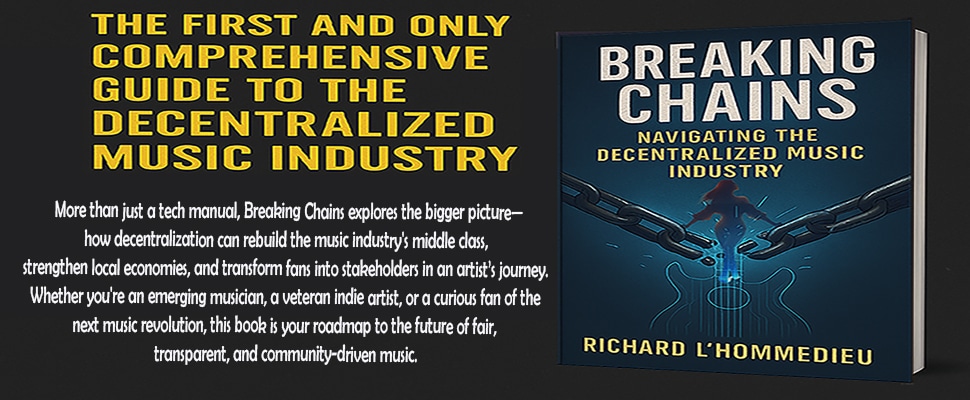
- Breaking Chains – Navigating the Decentralized Music Industry
Steps to get going:
-
Install a wallet (MetaMask or Coinbase Wallet).
-
Try minting a single track on Sound.xyz or Royal.io, with splits encoded.
-
If you want to raise capital, use Opulous to tokenize future royalty streams.
-
Upload other songs to Audius for exposure, while linking them to smart-contract monetization paths.
-
Experiment with merch, ticketing, or other revenue streams in future releases using smart-contract frameworks.
 |  Spotify |  Deezer |  Breaker |
 Pocket Cast |  Radio Public |  Stitcher |  TuneIn |
 IHeart Radio |  Mixcloud |  PlayerFM |  Amazon |
 Jiosaavn |  Gaana |  Vurbl |  Audius |
 Reason.Fm | |||
Find our Podcasts on these outlets
Buy Us a Cup of Coffee!
Join the movement in supporting Making a Scene, the premier independent resource for both emerging musicians and the dedicated fans who champion them.
We showcase this vibrant community that celebrates the raw talent and creative spirit driving the music industry forward. From insightful articles and in-depth interviews to exclusive content and insider tips, Making a Scene empowers artists to thrive and fans to discover their next favorite sound.
Together, let’s amplify the voices of independent musicians and forge unforgettable connections through the power of music
Make a one-time donation
Make a monthly donation
Make a yearly donation
Buy us a cup of Coffee!
Or enter a custom amount
Your contribution is appreciated.
Your contribution is appreciated.
Your contribution is appreciated.
DonateDonate monthlyDonate yearlyYou can donate directly through Paypal!
Subscribe to Our Newsletter
Order the New Book From Making a Scene
Breaking Chains – Navigating the Decentralized Music Industry
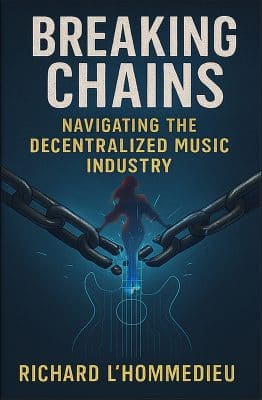
Breaking Chains is a groundbreaking guide for independent musicians ready to take control of their careers in the rapidly evolving world of decentralized music. From blockchain-powered royalties to NFTs, DAOs, and smart contracts, this book breaks down complex Web3 concepts into practical strategies that help artists earn more, connect directly with fans, and retain creative freedom. With real-world examples, platform recommendations, and step-by-step guidance, it empowers musicians to bypass traditional gatekeepers and build sustainable careers on their own terms.
More than just a tech manual, Breaking Chains explores the bigger picture—how decentralization can rebuild the music industry’s middle class, strengthen local economies, and transform fans into stakeholders in an artist’s journey. Whether you’re an emerging musician, a veteran indie artist, or a curious fan of the next music revolution, this book is your roadmap to the future of fair, transparent, and community-driven music.
Get your Limited Edition Signed and Numbered (Only 50 copies Available) Free Shipping Included
Discover more from Making A Scene!
Subscribe to get the latest posts sent to your email.


