

Reverb: The Secret Sauce of Space – History, Types, and How to Use It Like a Pro




Making a Scene Presents – Reverb: The Secret Sauce of Space – History, Types, and How to Use It Like a Pro
Listen to the podcast discussion to lean more about how to effectively use Reverb in your mix
When you listen to your favorite song, there’s something that makes the sound feel alive — it breathes, it moves, it fills the air. That magical sense of space comes from one of the oldest and most loved tools in audio engineering: reverb. Whether it’s the dreamy echo behind a vocal, the lush wash on a guitar solo, or the big, booming snare sound of the ’80s, reverb shapes the emotional depth of music more than most people realize.
But to really understand how to use it, you have to know where it came from — and how it evolved from the real world into digital code.
A Journey Through the Echo Chamber: The History of Reverb
Long before plugins and studio gear, reverb existed in nature. Clap your hands in a church, a cave, or a bathroom — the reflections you hear bouncing around are natural reverb. When people started recording music, they wanted to capture that same sense of space. Early engineers realized that dry, direct recordings sounded sterile, like instruments floating in a vacuum. So, they started experimenting with how to bring a bit of the real world back into the mix.
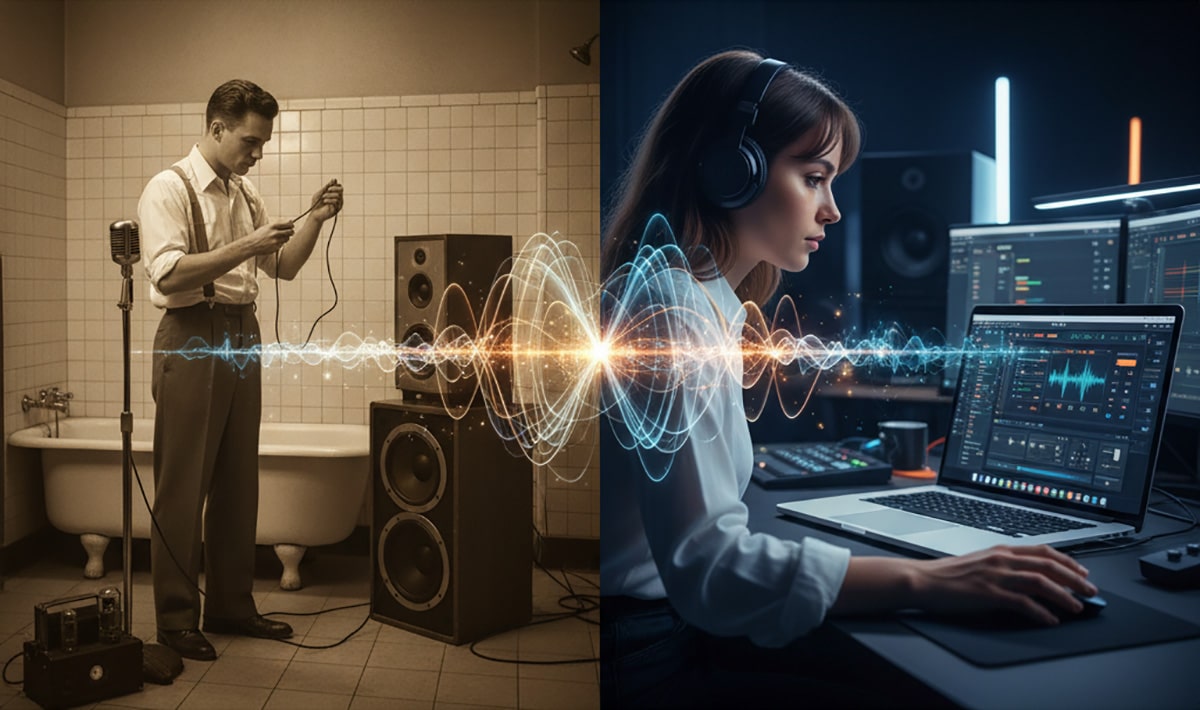
In the 1940s and early ’50s, engineers like Bill Putnam — the man who founded Universal Audio — were pioneers. At his studio in Chicago, Putnam famously placed a speaker and a microphone in the building’s marble bathroom and used it as a live echo chamber. When he played back the dry recording through the speaker, the bathroom’s hard surfaces created natural reflections that were picked up by the mic. The result was lush and immersive — a kind of homemade reverb that brought recordings to life. That sound helped define early pop and jazz records. (See Peg of My Heart By Bing Crosby)
Studios quickly followed suit. They started building dedicated echo chambers — special rooms designed only to create reverb. Capitol Studios in Los Angeles built some of the most famous ones, and you can still hear their rich, organic sound on classic records by artists like Frank Sinatra and Nat King Cole.
By the late 1950s, companies wanted a more controlled and portable way to get that sound without having to rely on a big, expensive room. That’s when the plate reverb was born. The German company EMT released the EMT 140, which used a giant steel plate suspended in a metal frame. When sound was fed into it through a transducer, the plate vibrated, creating a smooth, dense reverb tail. Engineers could capture it using contact microphones. It was big, heavy, and mechanical — but it sounded amazing. You can still get that exact sound today with plugins like the UAD EMT 140 Classic Plate Reverb or the Waves Abbey Road Plates.
A few years later, the spring reverb made its debut. Originally built for Hammond organs, it used coiled springs inside a metal tank to create its own kind of metallic, “boingy” echo. Guitar amp companies like Fender started adding spring tanks to their amplifiers, and that surfy, spacey sound became iconic in the 1960s and ’70s. The twang of The Ventures or Dick Dale wouldn’t be the same without it. If you want that vibe in the box, you can check out the Softube Spring Reverb or the UAD AKG BX 20.
Then came the digital revolution. In 1976, EMT released the EMT 250 — the world’s first digital reverb. Instead of metal plates or springs, it used computer algorithms to model how sound would reflect in a space. The unit was enormous and incredibly expensive, but it changed everything. Engineers could now “create” any kind of space they wanted, from tiny rooms to vast cathedrals. That same digital approach lives on in modern plugins like Valhalla VintageVerb, UAD EMT 250 Reverb and Lexicon PCM Native Reverb.
By the early 2000s, we entered the age of convolution reverb. This new method used something called an impulse response (IR) — a recording of how a real space reacts to sound. Engineers would fire a starter pistol or a sine sweep in a church or concert hall and record how the sound decayed over time. Then they’d use math (specifically convolution) to apply that unique reverb fingerprint to any signal. This gave us ultra-realistic, “you are there” spaces — from famous studios to cathedrals to real-world environments. Popular convolution reverbs include Logic Pro’s Space Designer, Waves IR-1 Convolution Reverb, and Altiverb 7.
From bathrooms to algorithms, the evolution of reverb tells the story of recording itself — a constant search for ways to make music sound alive.
The Many Flavors of Reverb: Understanding the Types
Not all reverbs are created equal. Each type has its own texture, tone, and emotional vibe. Choosing the right one for the right source is what separates a flat mix from a pro mix. Let’s break down the main types you’ll see today and what makes each one special.
Room reverb is exactly what it sounds like — a small or medium-sized space that makes a track sound natural. It’s often short and tight, with decay times under two seconds. Room reverbs work great on drums, vocals, and guitars when you just want to make them sound like they were recorded in a real space. Try the Valhalla Room or the FabFilter Pro-R 2.
Hall reverb simulates the acoustics of a concert hall — big, lush, and smooth. It’s great for orchestral music, ballads, and anything that needs grandeur. Because halls have longer decay times, they’re best used when you want instruments to sound distant or atmospheric. You can get a realistic hall sound with plugins like Lexicon PCM Native Hall or Waves H-Reverb.
Chamber reverb sits somewhere between a room and a hall. In the 1950s and ’60s, studios built echo chambers — rooms with reflective surfaces and irregular shapes. Chamber reverbs have a rich, dense character and are perfect for vocals, piano, and horns. For a modern take, try Waves Abbey Road Chambers — it models the legendary chambers used by The Beatles.
Plate reverb is smooth, dense, and bright — the classic vocal reverb of the ’60s and ’70s. It adds shimmer without too much distance, making it perfect for lead vocals and snare drums. Plugins like UAD EMT 140 or Soundtoys Little Plate bring that magic into your DAW.
Spring reverb has a distinctive metallic texture that you’ll recognize from vintage guitar amps and surf music. It’s not realistic, but it’s full of character. The Softube Spring Reverb or Eventide Spring captures that vibe beautifully.
Gated reverb became famous in the ’80s. Engineers like Hugh Padgham and Phil Collins would add huge reverbs to drums, then use a gate to cut the tail short. The result: massive, punchy hits that didn’t clutter the mix. Modern examples of this sound are easy to recreate with plugins like FabFilter Pro-G and any reverb of your choice.
Reverse reverb flips the reverb tail so it swells into the sound rather than fading out. It’s great for dramatic vocal entries or eerie effects. Many DAWs like Ableton, Logic, Studio one pro and Pro Tools can reverse a reverb tail automatically by rendering the reverb to audio and flipping it.
Convolution reverb is the modern-day realism king. It uses impulse responses from real spaces — famous studios, concert halls, cathedrals, or even outdoor fields. With tools like Altiverb 7 or LiquidSonics Reverberate 3, you can literally place your mix in Abbey Road or a Gothic cathedral.
Each reverb type carries its own flavor. The art of mixing lies in knowing when to use which one — and how to control it.
How to Use Reverb Like a Pro (Without Drowning Your Mix)
Now that we’ve covered where reverb came from and what kinds exist, let’s talk about how to actually use it. Reverb isn’t just about making things echo — it’s about placing sounds in a 3D space. When used correctly, it gives your mix depth, separation, and emotion. When overused, it turns everything into a blurry mess.
The key to mastering reverb is understanding space management — deciding how “far away” you want each sound to feel.
The Role of Predelay
Predelay is the most important (and misunderstood) parameter in reverb. It’s the short gap between the dry sound and the start of the reverb reflections. Imagine standing in a big hall. You shout “Hey!” and a moment later, you hear it bounce back. That small gap is your predelay.
If your reverb starts instantly (predelay = 0 ms), it can smear the attack of the sound. On vocals or drums, that’s bad news. A predelay of 20–40 milliseconds allows the dry sound to punch through before the space blooms around it. It’s like giving your sound breathing room.
Predelay also helps your mix feel bigger. A short predelay (under 10 ms) feels tight and close, while a long one (40–80 ms) makes the reverb sound farther away. Use this to control the “distance” of each instrument.
Reverb in the Mix: Instrument by Instrument
Vocals
Vocals are where reverb makes or breaks a mix. Too much, and you lose clarity. Too little, and it sounds like karaoke. Most pros use a combination of two or three reverbs: a short “room” or “plate” for presence, and a longer “hall” or “chamber” for atmosphere.
Start with a plate reverb like the Soundtoys Little Plate or UAD EMT 140. Set the decay around 1.5 to 2.5 seconds and add a predelay of 20–30 ms. Then EQ the reverb return — roll off lows below 120 Hz and highs above 8–10 kHz to prevent mud and hiss.
For big ballads or cinematic songs, add a hall reverb like Valhalla VintageVerb. Blend it low in the mix, just enough to give size. Automate your reverb send — turn it down for verses, up for choruses — to create dynamic space.
Drums
Drums love short reverbs. A snare with a tight room or plate reverb can sound massive. Try UAD EMT 250 or Valhalla Room. Set the decay between 0.8 and 1.5 seconds and use predelay to preserve the attack.
If you want that classic Phil Collins vibe, add a long reverb (2–3 seconds) and gate it with something like FabFilter Pro-G. The reverb swells, then suddenly cuts off, leaving a thunderous impact.
Keep reverb off the kick and toms unless you’re going for a huge ambient sound. Reverb on low frequencies can quickly make a mix muddy.
Guitars
Electric guitars often sound best with a touch of plate or spring reverb. It adds air without overwhelming the tone. For surf or blues styles, spring reverb is part of the sound. Use Softube Spring Reverb or Eventide Spring.
For modern indie or ambient styles, try lush halls or convolution reverbs. Valhalla Shimmer is a favorite for dream-pop and post-rock textures.
For acoustic guitars, use short room or chamber reverbs. You want realism, not distance. Something like FabFilter Pro-R 2 with a 1-second decay often does the trick.
Piano
Piano and reverb are best friends. A real grand piano already has natural reverb, but digital pianos and samples often sound too dry. Use a convolution reverb of a real concert hall to bring life back. Altiverb 7 or LiquidSonics Seventh Heaven are excellent.
If you’re mixing pop, keep it subtle: 1.5–2 seconds decay, around 25 ms predelay. For cinematic scores, go big — 3–5 seconds, wide stereo, with high diffusion.
Horns and Strings
Horns, woodwinds, and strings benefit from smooth, diffuse reverb. They naturally blend with hall or chamber spaces. Use Lexicon PCM Hall or Valhalla VintageVerb.
If the horns are leading, use less reverb and more predelay so the attacks stay punchy. If they’re backing, you can push them deeper with longer decay.
Creating Depth and Dimension
Reverb is your secret weapon for creating depth in a mix. Imagine your mix as a 3D stage: instruments with little or no reverb are in the front, those with moderate reverb are in the middle, and those with long, diffuse reverb sit in the back.
If everything has the same amount of reverb, nothing feels near or far — it all collapses into a flat plane. To fix that, vary decay times and wet/dry levels across instruments.
For example, keep vocals and snare fairly dry, guitars and keys medium, and pads or strings wetter. This layering creates natural perspective.
Also, EQ your reverb returns. Rolling off the lows (below 100–150 Hz) keeps the low end clean, while a gentle high roll-off makes the reverb sound more realistic — most real rooms don’t reflect bright highs indefinitely.
Common Mistakes (and How to Avoid Them)
The most common mistake is simply too much reverb. When every track has a long hall tail, your mix turns to soup. If your mix starts to sound cloudy, shorten the decay times, increase predelay, or lower the wet level.
Another issue is frequency masking. Reverb can amplify harsh frequencies, especially around 2–5 kHz. Use an EQ on your reverb return to tame those.
If your reverb sounds disconnected, try sending multiple instruments to the same reverb bus. Sharing a single space helps glue the mix together.
And finally, remember that silence can be powerful. You don’t need reverb on everything. A dry vocal before a big, reverbed chorus can make the chorus hit twice as hard.
Reverb as Emotion
When you think about it, reverb isn’t just a sound effect — it’s emotion in sonic form. A short, tight reverb makes something feel close and intimate. A long hall reverb makes it feel epic or distant. Reverb tells your ears how close or far you are from the sound. It’s a storytelling tool.
Listen to how The Beatles used Abbey Road Chambers to make their vocals shimmer, or how Led Zeppelin’s stairwell drums in “When the Levee Breaks” gave rock music one of its most iconic sounds. That stairwell wasn’t a plugin — it was an actual stairwell at Headley Grange, with mics placed strategically to capture the booming reflections. That’s the magic of space.
Today, you can recreate that sound with plugins like Waves Abbey Road Reverb Plates or by loading an impulse response of a similar stairwell into your convolution reverb.
Reverb isn’t about rules. It’s about taste. It’s about understanding how space shapes feeling — and then using that knowledge to paint the emotional landscape of your music.
Final Thoughts
From marble bathrooms to convolution plugins, reverb has come a long way. It started as a physical phenomenon and became one of the most expressive tools in modern production. Whether you’re mixing in a bedroom or a professional studio, learning how to use reverb with intention will instantly elevate your sound.
Keep your ears sharp, your decays balanced, and your predelays tuned. Use reverb not to fill space, but to create it.
Because in the end, the real power of reverb isn’t in the reflections — it’s in the feeling of being there.
 |  Spotify |  Deezer |  Breaker |
 Pocket Cast |  Radio Public |  Stitcher |  TuneIn |
 IHeart Radio |  Mixcloud |  PlayerFM |  Amazon |
 Jiosaavn |  Gaana |  Vurbl |  Audius |
 Reason.Fm | |||
Find our Podcasts on these outlets
Buy Us a Cup of Coffee!
Join the movement in supporting Making a Scene, the premier independent resource for both emerging musicians and the dedicated fans who champion them.
We showcase this vibrant community that celebrates the raw talent and creative spirit driving the music industry forward. From insightful articles and in-depth interviews to exclusive content and insider tips, Making a Scene empowers artists to thrive and fans to discover their next favorite sound.
Together, let’s amplify the voices of independent musicians and forge unforgettable connections through the power of music
Make a one-time donation
Make a monthly donation
Make a yearly donation
Buy us a cup of Coffee!
Or enter a custom amount
Your contribution is appreciated.
Your contribution is appreciated.
Your contribution is appreciated.
DonateDonate monthlyDonate yearlyYou can donate directly through Paypal!
Subscribe to Our Newsletter
Order the New Book From Making a Scene
Breaking Chains – Navigating the Decentralized Music Industry

Breaking Chains is a groundbreaking guide for independent musicians ready to take control of their careers in the rapidly evolving world of decentralized music. From blockchain-powered royalties to NFTs, DAOs, and smart contracts, this book breaks down complex Web3 concepts into practical strategies that help artists earn more, connect directly with fans, and retain creative freedom. With real-world examples, platform recommendations, and step-by-step guidance, it empowers musicians to bypass traditional gatekeepers and build sustainable careers on their own terms.
More than just a tech manual, Breaking Chains explores the bigger picture—how decentralization can rebuild the music industry’s middle class, strengthen local economies, and transform fans into stakeholders in an artist’s journey. Whether you’re an emerging musician, a veteran indie artist, or a curious fan of the next music revolution, this book is your roadmap to the future of fair, transparent, and community-driven music.
Get your Limited Edition Signed and Numbered (Only 50 copies Available) Free Shipping Included
Discover more from Making A Scene!
Subscribe to get the latest posts sent to your email.


