
Record Labels Should Be Terrified: Artists Are Building Their Own Economies




Making a Scene Presents – Record Labels Should Be Terrified: Artists Are Building Their Own Economies
Listen to the Podcast Discussion to gain more Insight into the New Music Economy
For most of music history, there was one road. If you wanted a career, you went through a major label. They had the money, the power, the distribution, and the connections. Artists were told this was the only way. Sign the deal. Give up ownership. Wait to get paid later. Maybe. That story is breaking down fast. Today, artists are quietly building something new. Not a trend. Not a side hustle. A real replacement. Artists are creating their own economies where music, fans, data, money, and marketing all live under their control. No gatekeepers. No middlemen. No waiting.
This is why major labels should be terrified. Not because artists are angry, but because the system no longer needs them. This article is not about hype or fantasy. It’s about how real tools that already exist are making the old label model optional. Not dead overnight, but outdated. And once artists understand this shift, there is no going back.
Why the Major Label Model Is Breaking
Major labels were built for a music industry that simply does not exist anymore. Decades ago, their role actually made sense. Recording music required access to expensive studios that most artists could never afford on their own. Distribution meant pressing vinyl records or CDs, manufacturing physical products, and shipping them around the world. Marketing was slow, manual, and expensive, relying on radio promoters, print ads, street teams, and personal relationships. Fan data was not digital. It lived in filing cabinets, mailing lists, and private databases that only large companies could maintain.
In that world, labels stepped in as financial backers and logistical managers. They paid for studio time. They paid for manufacturing. They paid for shipping. They paid for radio promotion. They paid for tour support. In exchange, they took control. Ownership of recordings, publishing rights, and long-term decision-making power flowed to the label, not the artist. At the time, many artists accepted this trade because there were no realistic alternatives.
But here is the uncomfortable truth that rarely gets said out loud. Major labels were never designed to help most artists succeed. They were designed to maximize profit for the company by betting on volume. Labels sign large numbers of artists knowing full well that most of them will never break through. This is not a mistake in the system. It is how the system works.
If ten artists sign deals and one becomes successful, the label still wins. The hit artist generates enough revenue to cover the losses of the other nine. Those nine artists often disappear quietly. Many are dropped from the roster. Some are shelved and never released. Others remain stuck in contracts, unable to move forward while still owing money for advances, marketing, or tour support. From the label’s perspective, this is acceptable risk. From the artist’s perspective, it can be career-ending.
Streaming did not fix this problem. It made it worse.
Today, the average per-stream payout across major platforms falls somewhere between $0.003 and $0.005, depending on the service and the listener’s location. That means an artist needs roughly 25 to 30 million streams in a single year just to earn around $100,000 before expenses. For most independent artists, and even many signed artists, those numbers are completely out of reach. Millions of streams sound impressive, but they do not translate into sustainable income for the vast majority of musicians.
Labels understand this math very clearly. That is why contracts evolved into what are known as 360 deals. Instead of making money mainly from recordings, labels now take a percentage of touring, merchandise, sponsorships, branding, and nearly anything else an artist earns. Ownership became tighter, not looser. Fan data stayed locked inside label-controlled systems. Artists were no longer treated as long-term partners building businesses. They became content suppliers feeding a machine designed to extract value wherever possible.
This is where Web3 changes everything.
Web3 does not try to improve the old model. It removes its foundation. When artists can record at home, distribute digitally, market with automation, own their data, and get paid directly, the original justification for label control collapses. The cost structures that once required a powerful middleman are gone. The leverage that labels relied on is disappearing. And for the first time, artists have a real alternative that does not depend on being the one lucky winner in a system built on failure.
Ownership Is the New Power
At the heart of the decentralized music industry is one simple but powerful idea. Artists should own their work. Not someday. Not after recoupment. Not if a contract allows it. From the very beginning.
For decades, ownership has been the main thing artists were asked to give up in exchange for opportunity. Masters, publishing rights, and even control over how songs were used were routinely signed away. Many artists did this without fully understanding the long-term impact, because ownership was framed as a technical detail instead of the foundation of power in the music business.
Web3 changes that equation.
Web3 uses blockchain technology to create public, verifiable records of ownership. While the technology sounds complex, the real-world meaning is very simple. Ownership written to a blockchain is open and transparent. Anyone can verify it. No one can secretly alter it later. There is no backroom paperwork, no “lost” contracts, and no creative reinterpretation years down the line.
For an artist, this means you can prove, clearly and permanently, that you own your masters, your songwriting splits, your publishing rights, and your creative assets from day one. That ownership is not just a promise. It is a record that exists independently of any label, distributor, or platform.
Sound.xyz gives artists a practical way to do this right now. Instead of uploading music to a platform that only sells access, artists can release songs directly to fans as digital collectibles. Fans are not just streaming your music. They are buying a version of it that they own. You decide how many copies exist, what they cost, and what additional benefits come with them. Most importantly, you retain control of your work. https://sound.xyz
Audius offers another path. It is a decentralized streaming platform where the artist, not the platform, owns the relationship with fans. Audius does not require artists to give up their rights to participate. It also experiments with artist coins, which are designed to reward fans for engaging, sharing, and supporting rather than treating them like passive listeners whose data is harvested for profit. https://audius.co
Catalog focuses on clarity and credit. It allows artists to mint songs with verified ownership and contributor credits attached permanently. This is especially important for collaborations. Producers, writers, and musicians all have their roles recorded upfront, reducing disputes and ensuring everyone’s contribution is recognized and protected over time. https://www.catalog.works
This shift matters because ownership changes leverage. When you own the asset, you control the decisions. You decide whether a song is licensed for film or TV. You decide if it is bundled with merch, used in a fan experience, or held back for a special release. You decide how and when it is sold, shared, or retired.
Once artists stop giving away rights by default, major labels lose their biggest advantage. Control no longer flows automatically to the middleman. It stays with the creator. And when ownership stays with the artist, the entire balance of power in the music industry begins to shift.
Decentralized Streaming Changes the Math
One of the most misunderstood ideas in the Web3 music world is the artist token. When people hear the word “token,” they often think of hype, scams, or get-rich-quick schemes. That misunderstanding has kept a lot of artists from looking closer. In reality, an artist token has nothing to do with gambling or speculation. At its core, it is simply a digital access key.
An artist token exists to unlock things.
Fans hold a token because it gives them access to experiences and value they cannot get anywhere else. That access might be early listening to new music before it is released publicly. It might unlock private livestreams where only core supporters can attend. It might give fans voting power on things like merch designs, setlists, or which song gets released next. It could unlock discounts, backstage access, meet-and-greets, or secret shows that are never advertised publicly.
The important thing to understand is that the token itself is not the product. The access is the product.
This is a major shift from how the music industry has worked in the past. Traditionally, fans were treated as consumers. They bought a record, a ticket, or a shirt, and the relationship ended there. Artist tokens turn that relationship into an ongoing connection. Fans feel like insiders instead of outsiders. They are not just buying something once. They are participating in your world.
Unlock Protocol makes this idea practical for everyday artists. It allows you to create token-based access without forcing fans to learn crypto or manage complicated wallets. Fans can log in using an email address, and the system handles the technical side behind the scenes. From the fan’s perspective, it feels more like joining a membership than dealing with technology. https://unlock-protocol.com
Audius has taken this concept a step further with the introduction of the Audius artist coin. Artist coins on Audius are designed to reward fan engagement instead of extracting value from it. Fans can earn or hold an artist’s coin by supporting, sharing, and participating in the community around that artist. The coin can then be used to unlock exclusive content, early access, special experiences, or community perks directly within the Audius ecosystem. https://audius.co
What makes this powerful is that engagement finally has meaning. Instead of fans feeding an algorithm with likes and streams that mostly benefit platforms, their actions directly strengthen the artist’s economy. The more a fan participates, the more value they unlock. The relationship becomes two-way instead of transactional.
This shift is emotional as much as it is financial. When fans feel recognized and included, loyalty deepens. Loyal fans do not just stream songs. They show up to shows. They buy merch. They support crowdfunding. They spread the word. That kind of loyalty is worth far more than millions of anonymous streams.
Major labels struggle with this model because artist tokens remove one of their biggest levers of control. When artists can fund projects directly through their communities, the need for advances disappears. There is no debt hanging over the artist. There is no recoupment clock ticking in the background. The artist stays in control, and the community grows alongside them instead of being mined for value by a middleman.
Artist tokens do not replace music. They amplify it. They turn casual listeners into invested supporters and give artists a sustainable way to build careers without giving away ownership.
Virtual Venues Remove Geographic Limits
Touring has always been one of the most exciting parts of being an artist, but it has also been one of the most dangerous financially. For decades, going on the road meant taking big risks with very little margin for error. Gas costs add up quickly. Hotels are expensive. You have to pay band members, crew, and drivers. Gear breaks. Vans need repairs. Guarantees are never guaranteed. One bad run of shows can put an artist in debt for months or even years.
Because of this risk, labels and promoters traditionally controlled access to touring. They decided which artists got routed with which acts. They controlled venue relationships, ticketing systems, and promotional budgets. Artists often had very little insight into whether a tour would actually make money until it was already over.
Virtual venues remove much of that control.
With virtual performance platforms, artists can now perform live for fans anywhere in the world without leaving their studio or home setup. There is no gas to pay for. No hotels to book. No van to fix. A virtual show can be produced with a laptop, an internet connection, and a basic performance setup.
These virtual shows can be ticketed just like physical concerts. They can also be token-gated, meaning only fans who hold a specific access pass or artist token can attend. Shows can be recorded and replayed later, allowing fans in different time zones to watch on their own schedule. Performances can also be bundled with merch, digital collectibles, or exclusive experiences, creating multiple income streams from a single event.
Stageverse is one platform that makes this possible. It allows artists to create immersive virtual shows and fan events that feel more interactive than a simple livestream. Artists can design the experience, control access, and engage directly with their audience in real time. https://stageverse.com
Spatial takes a slightly different approach. It allows artists to build persistent virtual spaces that exist all the time, not just during a show. Fans can enter these spaces to hang out, explore visuals, listen to music, attend scheduled events, or connect with other fans. Over time, this becomes a digital home base for the artist’s community. https://www.spatial.io
Virtual venues do not replace physical touring. Instead, they make touring smarter and more sustainable. Artists can use virtual shows to test demand in new cities before committing to travel. They can reach international fans who may never be able to attend a physical concert. They can earn income during gaps between tours or when traveling is not possible.
Most importantly, virtual venues help prevent burnout. Artists no longer have to choose between being visible and being exhausted. Touring becomes a strategic decision instead of a constant financial gamble. When virtual and physical touring work together, artists gain flexibility, stability, and control over their careers in ways that were never possible before.
AI Marketing Is Where the Label Model Really Starts to Collapse
This is the point where the traditional label model truly begins to fall apart. For years, one of the biggest reasons artists signed deals was marketing. Labels sold the idea that they had teams of experts doing work artists could never handle on their own. Social media managers. Ad buyers. Content planners. Data analysts. Campaign strategists. Entire departments built around pushing music into the world. But when you look closely, most of that work is not magic. It is labor. Repetitive, time-consuming, often boring labor.
This is where AI changes everything.
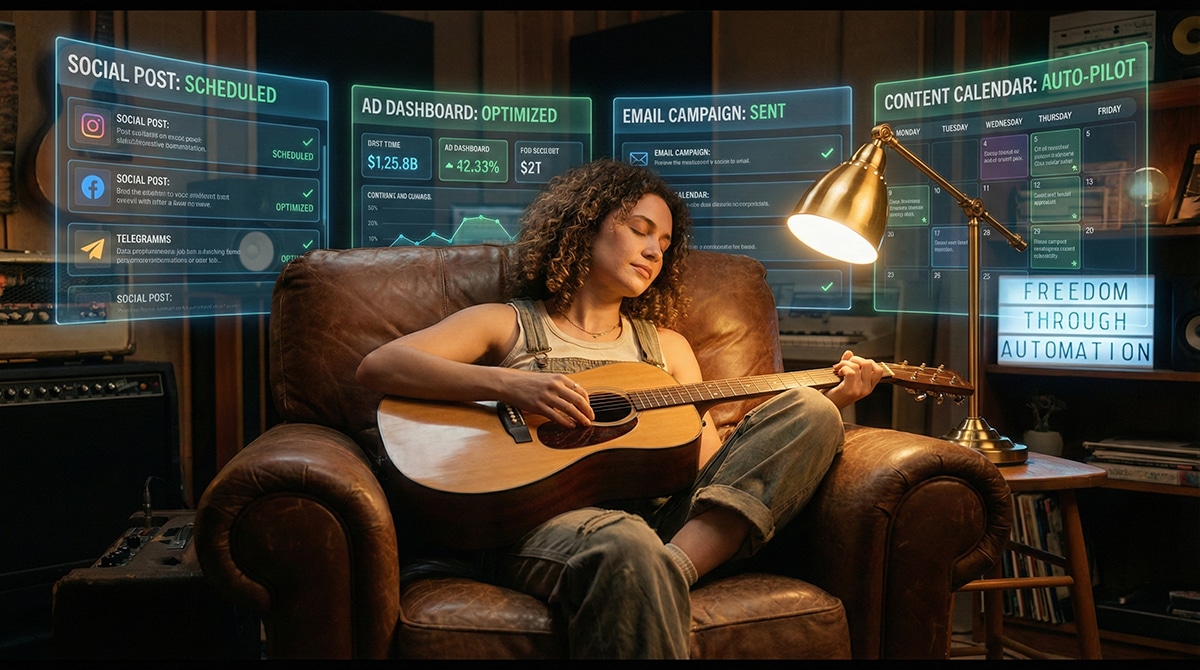
The real power of AI for indie artists is not creativity replacement. It is workload removal. AI handles the repetitive tasks that drain your time and energy so you can focus on making music, performing, and connecting with fans in ways that actually matter.
ChatGPT is a perfect example. An indie artist can use it to write press releases, email newsletters, social captions, ad copy, fan messages, blog posts, and even tour announcements in minutes instead of hours. Instead of staring at a blank screen, you start with a draft that you can tweak to sound like you. https://chat.openai.com
AI can also help plan content. You can ask it to create a month-long release plan, suggest post ideas tied to a single song, or turn one announcement into dozens of variations for different platforms. This alone replaces what used to require an entire label marketing team.
Visual content used to be another major barrier. Album covers, posters, social graphics, ad visuals, and thumbnails all required designers. Canva removes that barrier. With simple templates, brand kits, and drag-and-drop tools, artists can create professional-looking visuals quickly and consistently. https://www.canva.com
Beyond writing and design, AI helps artists escape the daily grind of social media.
Scheduling platforms now allow artists to batch content once and let automation handle the rest. Beatchain offers tools specifically designed for musicians, including content scheduling, release promotion, and audience insights in one place. https://www.beatchain.com
Other scheduling tools like Buffer and Hootsuite allow artists to queue posts across platforms so they are not stuck posting manually every day. https://buffer.com https://www.hootsuite.com
AI also helps artists create more content from what they already have. Instead of constantly filming new material, artists can take existing footage from shows, studio sessions, or rehearsals and repurpose it into dozens of short clips. Tools that support automated video clipping, captioning, and formatting make this process fast and painless.
This is the real freedom AI offers. You no longer have to live inside social media to stay visible. You can create content in focused sessions, schedule it in advance, and let automation do the boring work.
Advertising has also changed. Platforms like Meta Ads Manager and TikTok Ads use AI-driven optimization to automatically test audiences, placements, and creative variations. Artists no longer need deep ad-buying expertise to run effective campaigns. The system learns what works and adjusts in real time. https://www.facebook.com/business/tools/ads-manager
https://ads.tiktok.com
When all of these tools work together, the result is powerful. An indie artist can now run a professional-level marketing operation with a fraction of the time, cost, and stress that used to require a label.
This is why AI is so threatening to the traditional music industry. Marketing was the last stronghold where labels could claim unique value. Once artists realize they can automate the boring parts and stay focused on music and fans, the justification for giving up ownership disappears.
Artists do not need massive teams anymore. They need clarity, consistency, and smart systems that work while they create.
The Real Numbers Nobody Likes to Talk About
Let’s be honest about something the music industry rarely says out loud. Streaming alone will not support most artists. Even artists who look successful on paper can struggle financially. You can have hundreds of thousands, or even a million monthly listeners and still feel broke. The payouts are small, expenses add up fast, and income is unpredictable.
This is not a failure on your part as an artist. It is a math problem.
At an average payout of a fraction of a cent per stream, even strong streaming numbers often translate into modest income. One viral moment can create attention, but it rarely creates stability. Relying on streams alone puts artists on a financial roller coaster with no control.
Now let’s talk about a different model.
Instead of chasing millions of anonymous listeners, imagine building a direct relationship with a smaller group of real supporters. Think about an artist with 1,000 true fans. These are people who genuinely care about your music. They show up. They buy tickets. They support releases. They want to be part of what you are building.
If each of those fans spends just $10 a month on your music, merch, tickets, memberships, or access, that equals $120 per year per fan. Multiply that by 1,000 fans and you reach $120,000 a year.
This is not hype. It is basic math.
What makes this model even more realistic today is reach. Through social media, streaming platforms, email, and the open internet, you now have access to billions of potential listeners worldwide. You do not need everyone. You do not need virality. You need to find your people.
Finding 1,000 fans out of billions is not only possible, it is very doable.
This is where AI-powered tools and decentralized systems make a huge difference. AI helps you identify who is actually engaging with your music. It helps you analyze which posts perform best, which fans click links, which regions show the most interest, and which messages resonate. Instead of guessing, you learn. Instead of shouting into the void, you speak directly to the people who care.
Web3 tools allow you to offer layered value. Music is just the starting point. You can offer access to behind-the-scenes content, private communities, early releases, exclusive merch, special events, voting rights, and shared participation in your journey. Each layer gives fans more ways to support you at levels that feel comfortable to them.
This approach creates stability. It turns attention into income and income into sustainability.
Major labels are built to chase hits because hits scale fast. But most artists do not need scale to survive. They need consistency. They need ownership. They need a system that rewards depth instead of volume.
A micro-economy built around real fans does exactly that. It allows artists to build careers that last, without needing permission, luck, or a lottery ticket moment.
How Major Labels Will Try to Keep Control
Major labels are not going to vanish overnight, and they are certainly not going to give up power without a fight. Large companies rarely do. Instead, what we are already seeing is a familiar pattern. When a system starts to lose control, it tries to repackage itself as progress.
In the coming years, major labels will increasingly talk about innovation, Web3, AI, and fan engagement. On the surface, it will sound exciting. But underneath the language, many of the old control structures will still be there. One of the most likely moves is the launch of “label-approved” Web3 platforms. These will look decentralized on the outside, but ownership will still flow upward. Artists may be invited to mint NFTs, launch tokens, or build communities, but the rules will be set by the label. The label will control access, take a percentage, and reserve the right to change terms later. Decentralization will be used as a marketing word, not a structural reality.
Labels will also push token programs that they control. Instead of artists owning their own fan economies, the label will issue the tokens, manage the supply, and decide how they are used. Artists will be participants inside a label-owned ecosystem rather than independent builders. This keeps artists dependent, even while claiming to empower them. Another tactic will be bundling AI tools into contracts. Labels will offer artists access to AI marketing platforms, analytics dashboards, and content systems, but only if the artist signs long-term agreements. On paper, this looks like support. In practice, it locks artists into relationships that are difficult to exit. The tools may be useful, but the cost is control.
All of this will be framed as innovation. Contracts will talk about opportunity, growth, and technology. But the underlying goal will be the same as it has always been. Own the rights. Own the data. Own the relationship.
The difference now is awareness.
Control is no longer invisible. Artists have seen what ownership feels like. They have experienced getting paid on time. They have talked directly to fans without intermediaries. Fans, in turn, have felt what it is like to support artists directly instead of feeding platforms. Once that experience exists, it cannot be erased. Transparency changes expectations. Direct connection changes loyalty. The old tricks that worked when artists had no alternatives lose their power when real alternatives exist.
Major labels will still play a role in the music ecosystem, but their ability to dictate terms is fading. The more artists understand ownership, data, and direct fan relationships, the harder it becomes for control to hide behind the word “innovation.”
The Next 5 to 10 Years: The Rise of the Music Middle Class
The future of the music industry is not what most major labels are preparing for, and that is exactly why it scares them. The real disruption is not a new superstar or the next viral moment. It is the steady rise of a music middle class.
For decades, the industry has been built like a lottery. A small number of artists win big, and everyone else is expected to accept scraps or walk away. Success was defined by fame, radio play, chart positions, and mass appeal. If you did not break through at that level, you were considered unsuccessful, no matter how good your music was.
That definition is starting to collapse.
Over the next five to ten years, we are going to see thousands of artists earning solid, sustainable incomes in the range of $100,000 to $150,000 a year without being famous. These artists will not rely on radio, viral hits, or mainstream media attention. Most people outside their fan base may never know their names, and that will be perfectly fine.
These artists will run small, efficient businesses instead of chasing traditional careers. Their operations will be lean by design. They will use automation instead of large teams. They will rely on direct relationships instead of mass exposure. Touring will become data-driven. Instead of guessing where to play or trusting opaque reports, artists will tour based on real fan engagement. They will know which cities have supporters who buy tickets, travel to shows, and spend money. Routes will be planned for profitability and sustainability, not ego or hype.
Marketing will be largely automated. Artists will spend less time posting endlessly on social media and more time creating. AI tools will handle scheduling, targeting, analytics, and content repurposing. Marketing will run in the background while artists focus on music and performance. Revenue will be diversified. Instead of depending on one income source, artists will combine streaming, direct sales, fan memberships, virtual events, physical shows, merch, licensing, and shared ownership models. When one revenue stream slows down, others keep the business stable.
Some artists will still choose to work with labels, but the relationship will look very different. Labels will be service providers, not gatekeepers. Artists will partner with them for specific needs like international reach or specialized marketing, not because there is no other option. The biggest shift of all is philosophical. The music industry will stop being a gamble and start being a craft. Success will no longer mean being discovered by the right executive at the right time. It will mean building a sustainable practice, serving a real audience, and growing steadily over time.
That future does not require permission. It requires ownership, clarity, and tools that put artists in control. And once that middle class takes shape, the old hit-driven model will never fully recover.
The Label Is No Longer the Center
Major labels are not the enemy, and this shift is not about tearing the industry down out of frustration. For decades, labels served a real function. They provided access to capital, infrastructure, distribution, and marketing power in a world where those things were expensive and scarce. In that environment, labels became the center of the music industry by necessity.
That necessity no longer exists.
Today, labels are no longer the center of the music universe. They are one option among many. Independent artists now have access to tools that allow them to own their work, fund their projects, market intelligently, understand their audiences, tour strategically, and get paid fairly without giving up control. Recording can happen at home. Distribution is global by default. Marketing is automated. Data is accessible. Payments can be transparent and immediate.
This is not rebellion for rebellion’s sake. It is evolution driven by reality.
As a result, a new structure is forming underneath the surface of the industry. The rise of a music industry middle class changes everything. Thousands of artists building sustainable careers at $75,000, $100,000, or $150,000 a year are not just surviving. They are creating stability. They are developing skills. They are learning how to run real businesses around their art.
This middle class becomes a wellspring of future talent for the entire industry.
Artists who grow inside this system are not unprepared dreamers waiting to be “discovered.” They understand their audience. They know how to market. They know how touring works. They know their numbers. They have teams, systems, and communities already in place. If and when an artist from this group truly breaks through and needs to scale rapidly, they are ready.
This is where labels can still play a meaningful role.
Instead of acting as gatekeepers, labels become partners and infrastructure providers. They help scale what already works. They assist with global reach, logistics, and expansion when an artist’s business outgrows their independent systems. The relationship becomes intentional, not desperate. Artists partner with labels because it makes sense, not because they have no other path forward.
This shift strengthens the entire music ecosystem. The middle class fuels innovation, diversity, and long-term growth. It creates a healthier pipeline of talent that is already proven, already connected to fans, and already sustainable. Labels benefit from this too, because they are no longer gambling on untested acts. They are supporting artists who have already built real careers.
The biggest change is psychological. Artists no longer need permission to begin. They do not need validation to build. They can grow, learn, earn, and evolve on their own terms. Those who understand this shift will build careers that last decades, not moments. Those who cling to the old model will continue waiting to be chosen in a world that has moved on.
The future of music is not defined by who signs a contract. It is defined by who owns their work, understands their audience, and builds something real.
The future of music is not signed. It is owned.
 |  Spotify |  Deezer |  Breaker |
 Pocket Cast |  Radio Public |  Stitcher |  TuneIn |
 IHeart Radio |  Mixcloud |  PlayerFM |  Amazon |
 Jiosaavn |  Gaana |  Vurbl |  Audius |
 Reason.Fm | |||
Find our Podcasts on these outlets
Buy Us a Cup of Coffee!
Join the movement in supporting Making a Scene, the premier independent resource for both emerging musicians and the dedicated fans who champion them.
We showcase this vibrant community that celebrates the raw talent and creative spirit driving the music industry forward. From insightful articles and in-depth interviews to exclusive content and insider tips, Making a Scene empowers artists to thrive and fans to discover their next favorite sound.
Together, let’s amplify the voices of independent musicians and forge unforgettable connections through the power of music
Make a one-time donation
Make a monthly donation
Make a yearly donation
Buy us a cup of Coffee!
Or enter a custom amount
Your contribution is appreciated.
Your contribution is appreciated.
Your contribution is appreciated.
DonateDonate monthlyDonate yearlyYou can donate directly through Paypal!
Subscribe to Our Newsletter
Order the New Book From Making a Scene
Breaking Chains – Navigating the Decentralized Music Industry
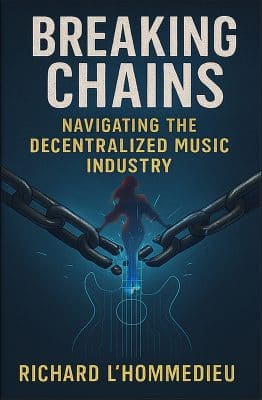
Breaking Chains is a groundbreaking guide for independent musicians ready to take control of their careers in the rapidly evolving world of decentralized music. From blockchain-powered royalties to NFTs, DAOs, and smart contracts, this book breaks down complex Web3 concepts into practical strategies that help artists earn more, connect directly with fans, and retain creative freedom. With real-world examples, platform recommendations, and step-by-step guidance, it empowers musicians to bypass traditional gatekeepers and build sustainable careers on their own terms.
More than just a tech manual, Breaking Chains explores the bigger picture—how decentralization can rebuild the music industry’s middle class, strengthen local economies, and transform fans into stakeholders in an artist’s journey. Whether you’re an emerging musician, a veteran indie artist, or a curious fan of the next music revolution, this book is your roadmap to the future of fair, transparent, and community-driven music.
Get your Limited Edition Signed and Numbered (Only 50 copies Available) Free Shipping Included
Discover more from Making A Scene!
Subscribe to get the latest posts sent to your email.


