

Raphael Pannier Quartet/Khadim Niang & Sabar Group Live in Saint Louis, Senegal




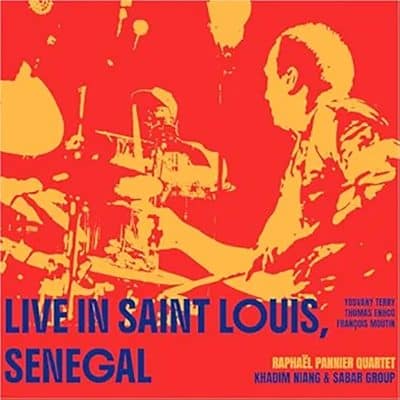 Raphael Pannier Quartet/Khadim Niang & Sabar Group
Live in Saint Louis, Senegal
Miel Music
Granted, the artists and the album title are quite a mouthful, but this is truly a one-of-a-kind recording that links jazz and the sabar drumming of Senegal for the first time. It’s also the first time that a recording has been issued from the 33-year running Saint Louis International Jazz Festival, the largest festival on the continent of Africa. It’s the collaboration of French drummer-composer Raphael Pannier leading his quartet while sharing the stage with an eight-piece ensemble of West African sabar drummers, led by Khadim NIang. Sound intriguing? It should, and realize also that there are at least three familiar jazz pieces herein, one of which will especially be surprising.
We do need some background. Senegalese master drummer Doudou N’Diaye Rose was one of the most renowned and influential artists in the world until he died in 2015. He had cultivated a musical dynasty in West Africa and had collaborated with artists such as Miles Davis, Peter Gabriel, Dizzy Gillespie, and the Rolling Stones. Pannier had been captivated by the Senegalese giant since he was three years old, and points to the VHS tapes of his parents as influencing his choice to become a drummer. He had long dreamed of traveling to Senegal to learn more about the sabar drumming tradition firsthand. That became a reality when he received an invitation to attend the 2023 St. Louis International Jazz Festival.. He sought out a sbar master who would be willing to fuse the deep-rooted drumming with jazz. He was fortunate to find Khadim Niang, who had been a member of N’Diaye Rose’s group from 1997 to 1999. Pannier’s dream culminated in this performance, leading his quartet with the group of eight sabar drummers. It marks the first time Sengalese drums have been performed with a piano. It is the merging of two cultures.
Playing with Pannier are: Cuban saxophonist Yosvany Terry, pianist Thomas Enhco, and bassist Francois Moutin. Pannier quickly learned that the family of eight drums is deeply rooted, such that dancing is inherent in the music. The word “sabar” refers to a language spoken by the drums, a means of communication between villages and individuals. It also bears spiritual significance as if communicating with spirits or ancestors, in that sense, becoming more prayer-like. It’s also part of a healing and ceremonial tradition in the culture. We,in our Western ways, European as well, find it difficult to grasp the binding linkage of music and rhythm. It is so natural for the Senegalese people that they never practice; they just perform.
For a year leading up to the performance, Pannier and Niang engaged in long-distance collaboration, Niang sending rhythms and Pannier experimenting with melodies and harmonies on top of them. The third track, “Xalat Bou Set” (“Holy Spirit”) is one such example; “Sine Saloum” plays to a Yoruban melody, linking the Cuban and West African traditions. Terry plays the shekere, an African percussion instrument. In “Hommage to Dudou N’Diaye Rose,” Pannier left the eight drummers alone but became so inspired that he and bassist Mouton joined in toward the end, although we do hear both Terry’s horn and Enhco’s Rhodes coursing through the piece.
Yet, familiarity appears on the front end of the album. The collective reimagined Ornette Coleman’s “Lonely Woman” to begin the set. They then surprisingly took on Dave Brubeck’s “Take Five,” which would seem to be a ‘vanilla’ choice to many, but Khadim wanted to teach the concept of odd meter to his group. So, it was agreed on well before the actual performance to include this piece although the audience likely found it difficult to dance to. A more apt choice is Coltrane’s “Naima,” the classic ode to his first wife performed beautifully by Terry on alto. This love ballad, rendered slightly more up-tempo, fits because the sabar group often performs in wedding ceremonies. All three of these work well in these unique arrangements.
Surely, it sounds like hyperbole to say this sounds like nothing you’ve ever heard but that’s the reality. It’s summed up best by Pannier’s comment, “It pushed me to see music differently. They don’t understand the concept of practicing music because the border between what is ife and what is art barely exists.” Think what you want, but given the current environment here in this country where we compartmentalize just about everything, that approach seems most admirable.
- Jim Hynes
Buy Us a Cup of Coffee!
Join the movement in supporting Making a Scene, the premier independent resource for both emerging musicians and the dedicated fans who champion them.
We showcase this vibrant community that celebrates the raw talent and creative spirit driving the music industry forward. From insightful articles and in-depth interviews to exclusive content and insider tips, Making a Scene empowers artists to thrive and fans to discover their next favorite sound.
Together, let’s amplify the voices of independent musicians and forge unforgettable connections through the power of music
Make a one-time donation
Make a monthly donation
Make a yearly donation
Buy us a cup of Coffee!
Or enter a custom amount
Your contribution is appreciated.
Your contribution is appreciated.
Your contribution is appreciated.
DonateDonate monthlyDonate yearlyYou can donate directly through Paypal!
Subscribe to Our Newsletter
Order the New Book From Making a Scene
Breaking Chains – Navigating the Decentralized Music Industry

Breaking Chains is a groundbreaking guide for independent musicians ready to take control of their careers in the rapidly evolving world of decentralized music. From blockchain-powered royalties to NFTs, DAOs, and smart contracts, this book breaks down complex Web3 concepts into practical strategies that help artists earn more, connect directly with fans, and retain creative freedom. With real-world examples, platform recommendations, and step-by-step guidance, it empowers musicians to bypass traditional gatekeepers and build sustainable careers on their own terms.
More than just a tech manual, Breaking Chains explores the bigger picture—how decentralization can rebuild the music industry’s middle class, strengthen local economies, and transform fans into stakeholders in an artist’s journey. Whether you’re an emerging musician, a veteran indie artist, or a curious fan of the next music revolution, this book is your roadmap to the future of fair, transparent, and community-driven music.
Get your Limited Edition Signed and Numbered (Only 50 copies Available) Free Shipping Included
Discover more from Making A Scene!
Subscribe to get the latest posts sent to your email.


