Crowdfunding is Begging Not a Business Plan




Making a Scene Presents – Crowdfunding is Begging Not a Business Plan
The Van, the Laptop, and the Lie We Tell Ourselves
Listen to the Podcast Discussion to gain more Insight into why Crowdfunding is not a business plan
The van smells like reheated coffee, gaffer tape, and the kind of optimism that only survives because musicians are stubborn. The band is parked outside a rehearsal space they pay for by the hour, and instead of loading in, they’re huddled around a laptop like it’s a campfire. The screen is a crowdfunding draft page with reward tiers, shipping promises, and a stretch goal that reads like a prayer you’re trying to pass off as strategy.
Nobody says “begging,” but everybody feels it. They keep editing the same paragraph, trying to make it sound confident without sounding cold, grateful without sounding desperate. The band can play a room, write hooks that stick, and sell merch when the vibe is right, but asking for money this way always makes the music feel smaller.
Across town, a solo artist is doing the same math in a quieter room. She’s at a kitchen table with headphones on, listening to rough mixes, trying to decide whether the next step is mastering or rent. Her draft post starts with “I don’t normally do this…” because that’s the sentence artists write when they’re trying to pretend a handout is a plan.
This is the part the industry has trained artists to romanticize. Struggle becomes branding, instability becomes “paying dues,” and every emergency gets turned into a dramatic launch. Then we act surprised when artists burn out, or when fans stop showing up after the first big push.
Why Crowdfunding Turns Into Begging
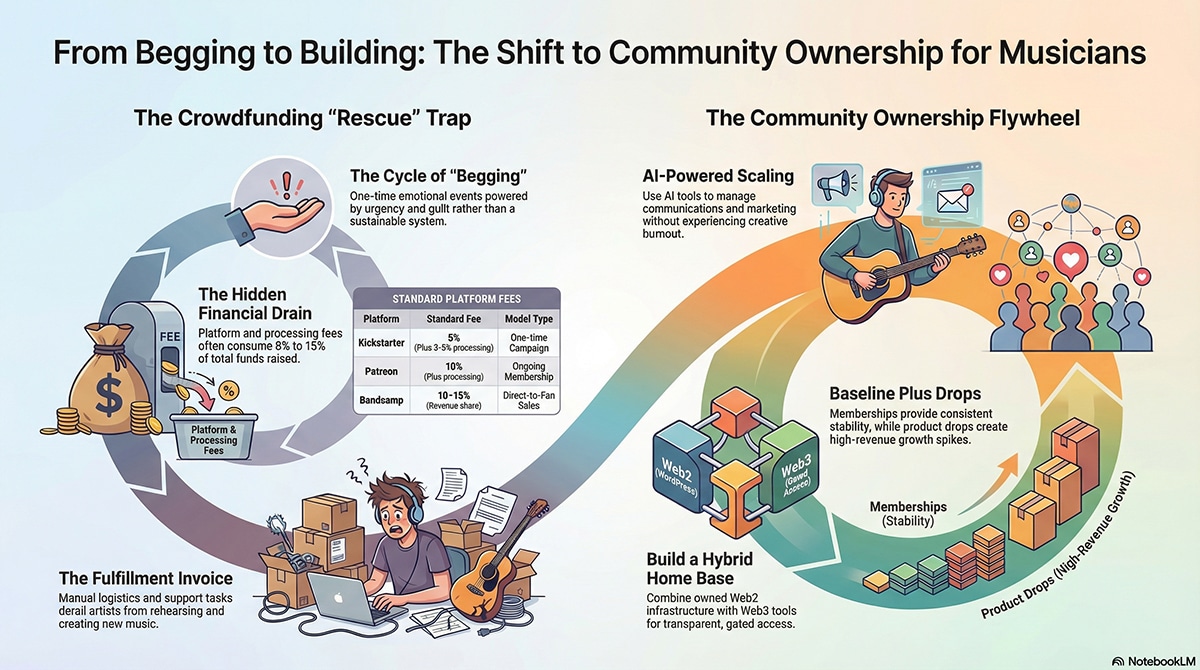
Here’s the ugly truth: traditional crowdfunding, the way most indie musicians use it, is built like a rescue mission. It’s a one-time emotional event powered by urgency, guilt, and hope, followed by a long season of fulfillment, apologies, and exhaustion. Even when it “works,” it often ends with the artist right back where they started, because the system doesn’t compound.
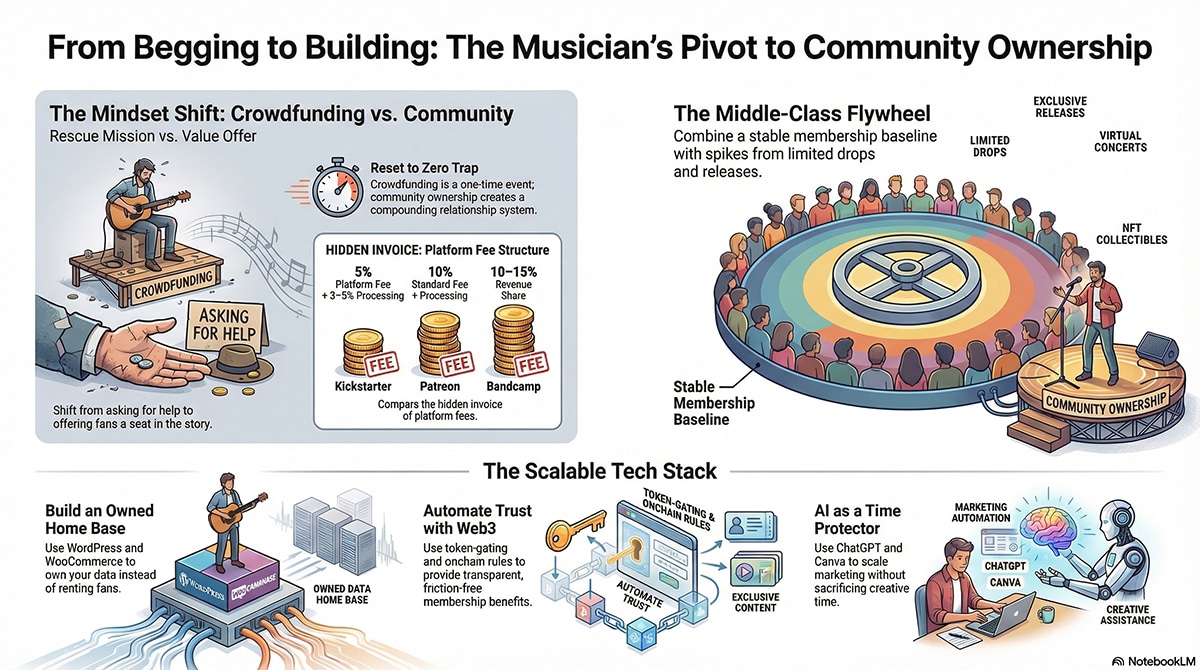
Platforms make it easy to launch, and that’s the trap. Kickstarter takes a platform fee on successful campaigns and also charges payment processing fees, which means the money you raise is not the money you actually get to use. Kickstarter’s own help pages describe a 5% platform fee and payment processing that’s typically in the 3–5% range.
GoFundMe is different in structure, but it still frames the whole transaction like charity. GoFundMe describes its model as no fee to start or manage a fundraiser, with a transaction fee per donation covering payment processing and related costs.
Patreon is closer to ongoing membership, which can be useful, but it still takes a platform fee, and the fee structure is part of what you’re building on top of. Patreon’s pricing page describes a standard 10% platform fee (plus payment processing and other fees).
Fees matter, but the bigger problem is the psychology. Crowdfunding makes the artist the person asking for help, not the person selling something valuable. It pressures you to overpromise “rewards” to justify the ask, and it pushes you into a launch-day frenzy that feels exciting in the moment and brutal afterward.
Then comes the hidden invoice: you spend weeks fulfilling, tracking, labeling, explaining delays, and handling support. You become a warehouse and a customer service desk at the exact moment you should be writing, rehearsing, and promoting.
That’s why crowdfunding isn’t scalable. It’s not designed to become a stable middle-class career engine. It’s designed to win a moment.
The Mindset Shift That Changes Everything
A business plan doesn’t say, “Please help me make the thing.” A business plan says, “Here is the thing, here is the value, and here is how we keep building.”
This is the pivot from begging to participation. Instead of asking fans to rescue you, you offer them a real seat in the story: early access, limited editions, behind-the-scenes, private moments, community status, and meaningful influence on what happens next. It’s not charity, it’s commerce plus belonging.
That’s what “community ownership” actually means in the real world. It’s not “fans own the artist.” It’s “fans own proof they were part of it, and they get ongoing benefits that make supporting feel smart, not sentimental.”
If you want repeat funding, you don’t build one big campaign. You build a relationship system that makes it normal to keep showing up.
Web2 Done Right: Build the Home Base First
Before Web3, before tokens, before any of the shiny stuff, the middle-class foundation is still boring in the best way. You need a home base you control, and that means your website, your email list, and your store.
WordPress is one of the best choices for this because it’s infrastructure, not a trend. It lets you build landing pages, publish content, capture emails, and run your own ecosystem without waking up one day to find that an algorithm changed and your reach disappeared. The Newsletter plugin for WordPress is designed for list building and email sending right from your site, and it positions itself as an email marketing system that can create, send, and track emails.
The smartest move is to treat every streaming profile and social account like a signpost, not a home. Set up a single-purpose splash page as your main link, and give it one job only: collect fan data. Once you have that email (and whatever other info you capture), you can direct fans to your website, where your owned ecosystem actually lives.
To make that workflow easy, Making a Scene has built a WordPress plugin specifically for this. It collects fan data and automatically sends a sequence of four emails, and you can edit every email so the message sounds like you. Get your FREE Copy at https://www.makingascene.org/fan-funnel
For direct sales, WooCommerce is the obvious workhorse. WooCommerce describes itself as an open-source ecommerce platform for WordPress, built to let you sell on your terms while retaining ownership of your store’s content and data.
This matters because the home base is where you stop renting your fans. It’s where you turn “attention” into “contact,” and contact into “revenue.”
Bandcamp sits in this same “treat music like product” lane, and that’s why it’s been so important for indie artists. Bandcamp’s help pages lay out a revenue share model of 15% for digital items (dropping to 10% after meeting certain thresholds) and 10% for physical items, with payment processor fees separate.
That model isn’t begging. It’s selling. It reinforces the most important lesson fans can learn: your music has value, and buying it is normal.
Web3 Done Right: Proof, Transparency, and Benefits That Don’t Expire
Now we can talk Web3, but we’re going to talk about it like adults. Web3 isn’t magic, and it isn’t automatically trust, but it can make certain kinds of trust easier to prove.
The most practical Web3 feature for artists is token-gated access, which is just a fancy way of saying “this pass unlocks benefits.” Unlock Protocol defines token gating as restricting access to content or experiences to holders of a particular NFT.
This is useful because it can reduce manual gatekeeping. Instead of you checking screenshots and spreadsheets, a supporter can verify access using a wallet-based pass, and the system can unlock the room.
Collab.Land is built around this idea inside communities. Its documentation describes token gating as creating roles on platforms like Discord or Telegram that are only accessible to users who meet token-related criteria.
Governance is another layer, and it doesn’t have to be intense or weird. It can be as simple as letting supporters vote on a tour city, a merch design, or which demo gets finished next. Snapshot’s documentation describes Snapshot as a voting platform that allows communities to vote easily and without gas fees.
Then there’s transparent funding. Juicebox describes itself as a programmable funding platform designed to fund and operate projects transparently, and its user docs emphasize that project rules are onchain and not changeable by a third party unless smart contracts are compromised.
All of that can support the thing indie artists actually need: trust that doesn’t rely on vibes alone. Not because Web3 guarantees honesty, but because it can make parts of the relationship visible and consistent.
Two Artists, One Problem, One Better System
Back with the band, the old move would be another Kickstarter. They’d write a heartfelt story, crank the urgency, promise a bunch of rewards, and pray they hit the goal. The solo artist would do the GoFundMe version of the same thing, because it feels fast and human even when it feels awful.
The new move is different. They stop building campaigns and start building offers.
The band builds a membership pass with benefits they can deliver without losing their minds. They promise early ticket access, a monthly rehearsal livestream, and first dibs on limited vinyl drops. They keep it clean, because complexity kills delivery.
The solo artist builds a “studio seat” membership that includes monthly demos, behind-the-scenes videos, and a light governance layer where supporters vote on which songs get finished next. She doesn’t promise a museum of rewards. She promises a rhythm.
Both of them keep two doors open. One door is Web2: credit card, email, simple checkout, zero crypto homework. The other door is Web3: wallet-based proof for fans who want portable membership and token-gated perks. Nobody gets shamed. Nobody gets locked out.
That’s how you scale across real audiences instead of building a clubhouse for only the most technical fans.
AI Makes This Scalable Without Burning You Out
The biggest fear artists have about community ownership is workload. They hear “membership” and picture themselves trapped in an endless loop of updates, perks, DMs, and admin tasks until the music becomes the side hustle.
That fear is valid, and it’s also exactly where AI earns its place. AI doesn’t replace your voice, it protects your time.
ChatGPT is a practical tool for drafting campaign messaging, supporter updates, onboarding emails, FAQ pages, and content calendars without you staring at a blank page every day. ChatGPT’s own product page positions it as an AI chatbot for everyday use to explore ideas and solve problems.
Canva is the visual counterpart to that work, helping you turn “here’s what members get” into something clean and clear that fans can understand at a glance. Canva describes itself as an online design and publishing tool meant to help people design and publish content.
Scheduling is not about feeding the algorithm machine. Scheduling is about protecting your creative brain by making marketing decisions once, then letting the system run. Buffer positions itself as a social media management tool for scheduling content across major platforms.
Metricool positions itself as an all-in-one tool to plan, measure, and manage social media content, which can help an artist keep the machine organized without living inside it.
If you’re running email like a real business channel, you also need deliverability and consistency. Twilio SendGrid positions its SendGrid offering as an email API and marketing campaigns platform for email delivery at scale.
AI plus owned infrastructure is the combination that turns “community ownership” from a dream into something you can actually run while still making art.
Trust Is the Product, and Repeat Funding Is the Result
Repeat funding doesn’t fail because fans are cheap. Repeat funding fails because fans get tired of uncertainty.
When supporters don’t know what’s happening, when every ask feels like a crisis, when benefits are unclear, or when delivery is inconsistent, people quietly stop participating. They don’t hate you. They just stop trusting the process.
Community ownership fixes that by making trust part of the offer. You deliver small, consistent benefits. You communicate clearly. You show progress. You let supporters feel like insiders, not ATM machines.
Web3 can support this by making membership verification easier and by keeping certain rules and transactions visible, but the trust still starts with you. The tech is a support beam, not the building.
The Middle-Class Flywheel: Baseline plus Drops
A scalable music business has two layers working together. It has a baseline that creates stability, and it has spikes that create growth.
The baseline is membership, subscriptions, or ongoing supporter participation. It covers predictable costs and reduces panic. The spikes are releases, merch drops, limited vinyl, ticket upgrades, VIP experiences, and special events that create surges of revenue on top of the baseline.
This is the part that turns indie from “survival” into “middle class.” You’re not hoping one campaign saves you. You’re building a flywheel where every release strengthens the next release.
The band stops treating albums like emergencies. The solo artist stops treating every expense like a crisis. The audience stops being rescuers and starts being participants, because the value is clear and the rhythm is real.
What to Avoid So You Don’t Accidentally Build a Casino
Web3 has a temptation baked into it: speculation. If you make support feel like a price chart, you will attract people who don’t actually care about the music, and you’ll alienate fans who just wanted closeness and belonging.
Community ownership is not about turning fans into traders. It’s about giving supporters ongoing value they can feel.
You also need to be careful about anything that looks like “fans own a piece of revenue” or “profit participation.” That’s a legal and regulatory minefield, and the fastest way to blow up trust is to promise something you shouldn’t promise. For most indie artists building a sustainable plan, consumer-style benefits, access, experiences, and governance-light participation are the safer, saner route.
Where to Start Without Overthinking It
If you want the simplest “stop begging” shift, start by building your home base and one offer you can deliver for six months without stress. Then add the proof layer only where it genuinely reduces friction or increases trust.
You can build the owned foundation with WordPress (https://wordpress.org/), WooCommerce (https://woocommerce.com/), and an email plugin like Newsletter (https://wordpress.org/plugins/newsletter/).
You can keep your communications steady with ChatGPT (https://chatgpt.com/) and your visuals clean with Canva (https://www.canva.com/).
You can protect your time with scheduling tools like Buffer (https://buffer.com/) or Metricool (https://metricool.com/).
If you want a Web3 layer for membership proof and access, you can look at Unlock Protocol (https://unlock-protocol.com/) and token-gated community tooling like Collab.Land (https://collab.land/), and if you want voting that doesn’t punish supporters with fees, Snapshot (https://snapshot.org/) is a common route.
If you want transparent, rules-based funding mechanics, Juicebox (https://juicebox.money/) is built around programmable funding and onchain rules, but it’s best used when you’re ready to run it like a real system, not a trendy experiment.
Crowdfunding asks fans to save you. Community ownership invites fans to build with you. One is an emergency tactic that resets to zero, and the other is a business plan that compounds.
That’s the whole argument. If you want a middle class, you stop begging and start building something that can hold weight.
 |  Spotify |  Deezer |  Breaker |
 Pocket Cast |  Radio Public |  Stitcher |  TuneIn |
 IHeart Radio |  Mixcloud |  PlayerFM |  Amazon |
 Jiosaavn |  Gaana |  Vurbl |  Audius |
 Reason.Fm | |||
Find our Podcasts on these outlets
Buy Us a Cup of Coffee!
Join the movement in supporting Making a Scene, the premier independent resource for both emerging musicians and the dedicated fans who champion them.
We showcase this vibrant community that celebrates the raw talent and creative spirit driving the music industry forward. From insightful articles and in-depth interviews to exclusive content and insider tips, Making a Scene empowers artists to thrive and fans to discover their next favorite sound.
Together, let’s amplify the voices of independent musicians and forge unforgettable connections through the power of music
Make a one-time donation
Make a monthly donation
Make a yearly donation
Buy us a cup of Coffee!
Or enter a custom amount
Your contribution is appreciated.
Your contribution is appreciated.
Your contribution is appreciated.
DonateDonate monthlyDonate yearlyYou can donate directly through Paypal!
Subscribe to Our Newsletter
Order the New Book From Making a Scene
Breaking Chains – Navigating the Decentralized Music Industry
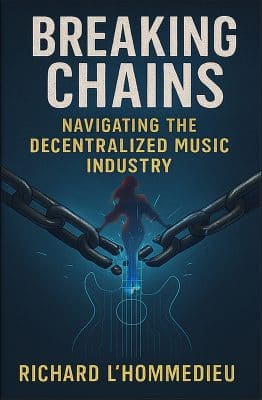
Breaking Chains is a groundbreaking guide for independent musicians ready to take control of their careers in the rapidly evolving world of decentralized music. From blockchain-powered royalties to NFTs, DAOs, and smart contracts, this book breaks down complex Web3 concepts into practical strategies that help artists earn more, connect directly with fans, and retain creative freedom. With real-world examples, platform recommendations, and step-by-step guidance, it empowers musicians to bypass traditional gatekeepers and build sustainable careers on their own terms.
More than just a tech manual, Breaking Chains explores the bigger picture—how decentralization can rebuild the music industry’s middle class, strengthen local economies, and transform fans into stakeholders in an artist’s journey. Whether you’re an emerging musician, a veteran indie artist, or a curious fan of the next music revolution, this book is your roadmap to the future of fair, transparent, and community-driven music.
Get your Limited Edition Signed and Numbered (Only 50 copies Available) Free Shipping Included
Discover more from Making A Scene!
Subscribe to get the latest posts sent to your email.


