
AI Loudness Control for Home Releases: Stop Guessing



Making a Scene Presents – AI Loudness Control for Home Releases: Stop Guessing
Listen to the Podcast Discussion to gain More insight into controlling your Mixes Loudness
There is a quiet problem ruining a lot of good music before it ever has a chance to connect with listeners. It is not bad songwriting. It is not cheap microphones. It is not even weak mixes. It is loudness. More specifically, it is the guessing game around loudness that happens in home studios every single day.
Independent artists finish a mix, feel proud of it, and then panic. They turn up limiters. They chase volume. They push until the track feels “competitive.” Then they upload it to Spotify or Apple Music, and suddenly it sounds flat, smaller, or lifeless compared to what they heard at home. Sometimes it even gets rejected by a distributor for technical reasons they do not fully understand. This article exists to stop that cycle.
Loudness is not magic. It is not a secret code owned by mastering engineers in million-dollar rooms. It is a measurable thing. And today, with modern AI loudness tools, it is one of the easiest problems for home artists to solve without killing dynamics or emotion. By the end of this article, you will understand LUFS in plain English, why streaming platforms normalize your music anyway, why chasing loudness is still one of the biggest mistakes indie artists make, and how AI-assisted tools help you hit real-world targets without crushing your songs.
This is not about shortcuts. It is about clarity.
Why Loudness Became So Confusing
Back in the CD era, louder usually meant better. Radio stations were loud. CDs were loud. Mastering engineers were paid to make songs jump out of speakers. This created what people now call the loudness war, where dynamics slowly disappeared in favor of constant volume. Streaming platforms quietly ended that war without telling most artists.
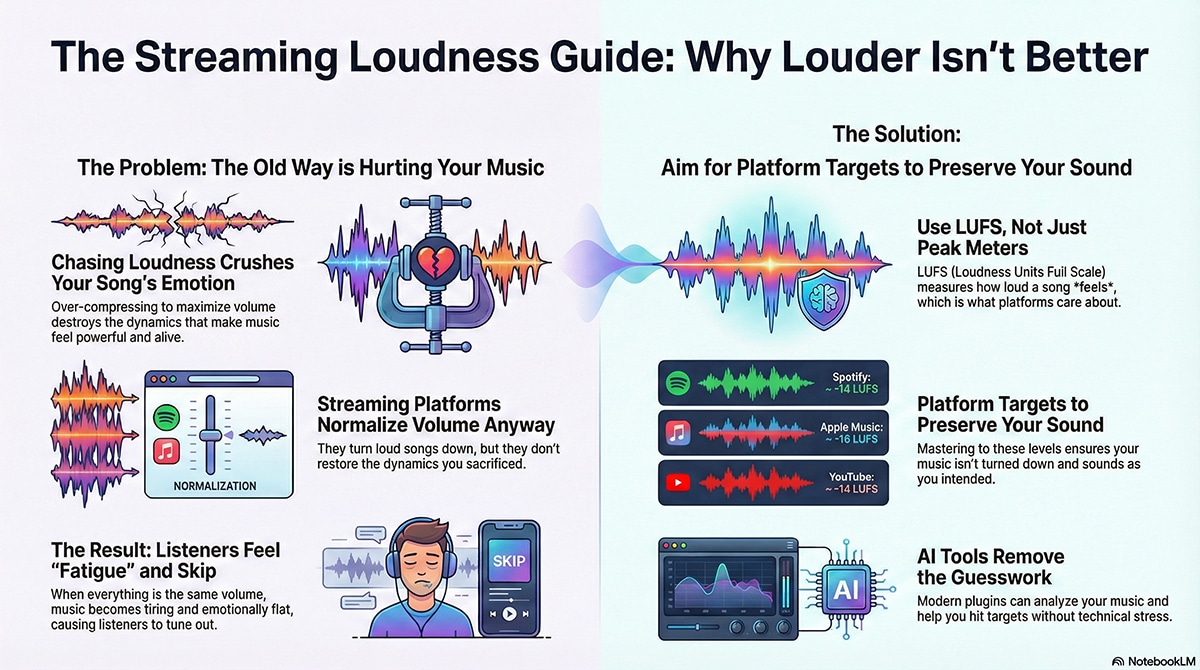
Spotify, Apple Music, YouTube, Amazon Music, and others all use loudness normalization. That means they turn music up or down automatically so songs play back at roughly the same perceived volume. If your track is too loud, they turn it down. If it is too quiet, they turn it up. The key detail most home artists miss is this: platforms turn your track down, but they do not give your dynamics back. If you crushed your song to make it loud, it stays crushed. It just plays back quieter. That is why loudness guessing is so dangerous.
LUFS Explained
LUFS stands for Loudness Units Full Scale. That name sounds intimidating, but the concept is actually very human and very practical. LUFS is not measuring how loud something spikes for a split second. It is measuring how loud the music feels to a listener over time.
Most beginners are taught to watch peak meters. Peak level tells you how loud the loudest instant of a sound gets. Think of that like a camera flash going off in a dark room. It is very bright, but only for a moment. Once the flash is gone, the room goes back to being dark. Peaks work the same way. They tell you what happens in a single instant, not how the music lives and breathes over the course of a song.
LUFS works differently. LUFS is more like asking, “How bright does the room feel while the lights are on?” It looks at the whole listening experience, second by second, and averages that feeling out in a way that matches how human ears actually work. Our ears care far more about sustained energy than quick spikes, and LUFS was designed to reflect that reality.
This is why two songs can hit the same peak level and still feel very different in loudness. One song might have huge drum hits but lots of space, silence, and soft moments in between. Another song might be packed with guitars, synths, vocals, and compression from start to finish. Even if both songs peak at the same level, the dense one will feel louder. LUFS captures that difference, while peak meters completely miss it.
Streaming platforms care most about something called integrated LUFS. Integrated LUFS measures the average loudness of the entire song from beginning to end, not just a short section. This tells platforms how loud your track feels overall, the way a listener experiences it when they hit play and let it run.
That is why mastering is not about slamming everything until it hits zero on a meter. Zero only tells you that you avoided clipping. It tells you nothing about how your song feels, how tiring it is to listen to, or how it will be treated by streaming platforms. Real mastering is about shaping the loudness of the whole journey so the song feels powerful, balanced, and alive from start to finish.
Once you understand this, LUFS stops being scary. It becomes a tool that helps you protect your music instead of accidentally damaging it.
Streaming Targets Without the Mythology
Most major platforms land around the same place, even if they do not advertise it loudly.
Spotify normalizes to about -14 LUFS integrated.
Apple Music is close to -16 LUFS.
YouTube hovers around -14 LUFS.
Amazon Music is similar.
Bandcamp does not normalize, which makes it a special case.
The important takeaway is this: none of these platforms reward extreme loudness anymore. If you master at -9 LUFS because you think it sounds “pro,” the platform will simply turn it down by five decibels. Meanwhile, your transients and dynamics are already gone. This is where AI loudness control changes everything.
Why Chasing Loudness Hurts Indie Artists the Most
AI Loudness Inside a DAW Workflow
AI loudness tools are not here to replace your taste, your judgment, or your creative instincts. They exist to remove the guessing game that has tripped up home artists for years. Instead of wondering how loud is too loud, or whether your track will survive Spotify and Apple Music intact, these systems analyze your song in context. They compare it to known reference material, real-world platform targets, and established loudness behavior, then point you toward a result that actually holds up after normalization.
That distinction matters. AI loudness tools do not magically turn a bad mix into a great one. If the balance is wrong, the tone is harsh, or the arrangement is cluttered, AI will not save it. What these tools do prevent is the kind of technical damage that often happens at the very last step. They stop you from over-limiting, over-compressing, or pushing volume past the point where the music can still breathe. In other words, they protect good creative work from being undone right before release.
If you are working in a modern DAW like Fender Studio Pro, Logic, Pro Tools, Cubase, or Reaper, AI loudness tools fit naturally at the end of your signal chain. They are not something you fight against or work around. They simply become part of the final decision-making stage.
In Fender Studio Pro, formerly known as Studio One, this approach is especially clear. The mastering page is designed to make you think about loudness as a measurable, controllable part of the process instead of a mystery. When you pair that environment with AI-powered loudness and mastering plugins, the workflow becomes calm and intentional. You finish your mix. You send it to mastering or move into the mastering page. You measure loudness. You make small, deliberate adjustments. And then you stop.
There is no panic at the end. No last-minute limiter cranking. No guessing whether the platforms will punish your track. Loudness becomes just another solved step in the process, not a source of stress or second-guessing.
Ozone and AI Loudness Matching
iZotope has been one of the biggest players in AI-assisted mastering for years, and Ozone remains one of the clearest examples of loudness done right. Ozone’s Master Assistant listens to your song, analyzes its tonal balance and dynamics, and sets an initial loudness target based on genre and destination. It also shows you integrated LUFS, short-term LUFS, and true peak in a way that does not feel intimidating.
The important part is not that Ozone chooses settings for you. It is that it gives you a sane starting point. From there, you can pull back limiting, restore dynamics, or adjust tone without flying blind.
LANDR and Automated Loudness
LANDR approaches loudness from the cloud instead of inside your DAW. LANDR analyzes your upload, applies loudness targets automatically, and gives you multiple versions depending on style. It is especially useful for artists who do not want to think about meters at all.
The trade-off is control. LANDR is fast and consistent, but you do not see every decision being made. For many artists, that is acceptable. For others, it is a learning tool rather than a final destination.
Loudness Matching Tools Beyond Mastering Suites
Not every loudness solution needs to be a full mastering system. Plugins like Youlean Loudness Meter give you clear LUFS readings without changing your sound. Youlean offers a free version that is shockingly capable for home studios.
This type of tool is perfect if you want to master manually but still stay inside platform limits. Another popular option is Klangfreund LUFS Meter, which is also free and simple.
Free Tools That Actually Matter
One of the biggest myths is that you need expensive plugins to master responsibly. You do not. A clean limiter, a loudness meter, and discipline go a long way.
Reaper includes excellent metering tools.
Fender Studio Pro includes loudness monitoring on the mastering page.
Youlean covers LUFS for free.
Limiter No6 gives precise control if you learn it.
The difference between good and bad masters is rarely the plugin. It is restraint.
Multiple Approaches That All Work
Some artists are perfectly happy handing the final stage over to full AI mastering tools like Ozone or LANDR. They want speed, consistency, and a clean result that already respects streaming loudness targets. For many home artists, especially those releasing music frequently, this approach removes stress and keeps releases moving without technical roadblocks.
Other artists prefer a hybrid workflow. In this setup, AI tools are used to analyze the track, suggest loudness targets, and flag potential problems, but the final decisions are still made by human ears. The artist might let AI set an initial level, then back off a limiter, adjust dynamics, or reshape tone based on feel. This approach offers a balance between efficiency and personal taste, and it often becomes a powerful learning tool over time.
Some artists go fully manual. They rely on loudness meters, true peak meters, and their own experience to shape the final master. This can work beautifully when the artist understands loudness, platform normalization, and restraint. It takes more time and more confidence, but it can deliver excellent results.
All three approaches can succeed. None of them are inherently better or more “professional” than the others. What matters is clarity and intention.
The only approach that consistently fails is guessing. Guessing leads to over-limiting, crushed dynamics, and panic-driven decisions at the final export. Whether you use AI heavily, lightly, or not at all, the moment you stop guessing and start measuring, your masters immediately get better.
Bandcamp, Vinyl, and Why Loudness Still Depends on Context
Streaming is not the only place your music lives, and this is where loudness decisions need a little more thought. Bandcamp, for example, does not use loudness normalization. If you upload a louder master, it will play back louder. On the surface, that can feel like permission to push levels harder. In reality, it is a trap.
Just because Bandcamp allows louder playback does not mean listeners enjoy it more. Crushing a master for Bandcamp can still strip away depth, punch, and emotion. Bandcamp listeners often care deeply about sound quality, and they are more likely to notice when a track feels fatiguing or flat. Mastering for Bandcamp works best when you focus on musical intent instead of raw volume. If the song feels good and breathes naturally, listeners can always turn the volume knob themselves.
Vinyl raises the stakes even higher. Vinyl does not forgive excessive loudness. Pushing a master too hard can lead to distortion, loss of low-end control, and even physical tracking problems when the needle hits the groove causing it to literally jump out or skip. Loud, dense masters can cause sibilance, inner-groove distortion, or skipping, especially on cheaper turntables. This is why vinyl masters are typically quieter, more dynamic, and more carefully shaped than digital releases.
This is also why having multiple masters is not a sign of overthinking. It is a sign of professionalism. One master optimized for streaming, another for Bandcamp or downloads, and a separate version for vinyl are not indulgences. They are practical tools that respect how each format actually works. Treating every release destination the same is convenient, but treating them differently is what makes your music translate everywhere it matters.
What Loudness Control Really Buys You
When loudness is handled correctly, something almost surprising happens. Your mix does not shrink. It actually feels bigger. With the pressure taken off the limiter, transients come back to life. Drums hit with real impact again instead of sounding smeared. Attacks feel sharp and intentional instead of dull and strained.
Quiet moments start to breathe. Space returns between phrases. Intimate sections feel close and human instead of constantly pushed forward. When the song does rise in energy, the loud moments finally feel earned, because they have contrast to push against. The music moves again instead of sitting at one fixed intensity from start to finish.
Most importantly, your song survives the platform intact. When streaming services normalize your track, they turn it up or down without destroying what makes it feel good. The emotional shape you worked so hard to create is still there when a listener hits play.
AI loudness tools do not magically make your music better. They do something more valuable. They stop your music from being damaged right at the exit. They protect your work during that final handoff from the studio to the world, so what listeners hear is the song you meant to release, not a stressed-out version created by last-minute guesswork.
The New Definition of “Competitive”
Final Thought: Loudness Is a Solved Problem
Loudness is no longer the dark art it once seemed to be. For a long time, it felt mysterious and locked behind expensive rooms and insider knowledge. That is no longer the case. The rules are known. Streaming targets are public. Loudness behavior is measurable. And the tools needed to work confidently are available to anyone with a home studio.
If you are still guessing at the final stage, you are not being creative. You are choosing stress over certainty. Guessing leads to second-guessing, last-minute limiter tweaks, and masters you are never quite sure about. Measuring leads to calm decisions and confidence when you hit upload.
AI loudness control is not about giving up your taste or letting software make artistic choices for you. It is about protecting your taste from being overridden by fear at the end of the process. It gives you guardrails so your creative decisions survive contact with real-world platforms.
If you want, the next step can be a full start-to-finish loudness workflow inside Fender Studio Pro, using a mix of AI tools and free meters. We can walk through exactly how to go from finished mix to final master with zero guesswork, so your very next release goes out into the world sounding exactly the way you intended—without fear.
 |  Spotify |  Deezer |  Breaker |
 Pocket Cast |  Radio Public |  Stitcher |  TuneIn |
 IHeart Radio |  Mixcloud |  PlayerFM |  Amazon |
 Jiosaavn |  Gaana |  Vurbl |  Audius |
 Reason.Fm | |||
Find our Podcasts on these outlets
Buy Us a Cup of Coffee!
Join the movement in supporting Making a Scene, the premier independent resource for both emerging musicians and the dedicated fans who champion them.
We showcase this vibrant community that celebrates the raw talent and creative spirit driving the music industry forward. From insightful articles and in-depth interviews to exclusive content and insider tips, Making a Scene empowers artists to thrive and fans to discover their next favorite sound.
Together, let’s amplify the voices of independent musicians and forge unforgettable connections through the power of music
Make a one-time donation
Make a monthly donation
Make a yearly donation
Buy us a cup of Coffee!
Or enter a custom amount
Your contribution is appreciated.
Your contribution is appreciated.
Your contribution is appreciated.
DonateDonate monthlyDonate yearlyYou can donate directly through Paypal!
Subscribe to Our Newsletter
Order the New Book From Making a Scene
Breaking Chains – Navigating the Decentralized Music Industry

Breaking Chains is a groundbreaking guide for independent musicians ready to take control of their careers in the rapidly evolving world of decentralized music. From blockchain-powered royalties to NFTs, DAOs, and smart contracts, this book breaks down complex Web3 concepts into practical strategies that help artists earn more, connect directly with fans, and retain creative freedom. With real-world examples, platform recommendations, and step-by-step guidance, it empowers musicians to bypass traditional gatekeepers and build sustainable careers on their own terms.
More than just a tech manual, Breaking Chains explores the bigger picture—how decentralization can rebuild the music industry’s middle class, strengthen local economies, and transform fans into stakeholders in an artist’s journey. Whether you’re an emerging musician, a veteran indie artist, or a curious fan of the next music revolution, this book is your roadmap to the future of fair, transparent, and community-driven music.
Get your Limited Edition Signed and Numbered (Only 50 copies Available) Free Shipping Included
Discover more from Making A Scene!
Subscribe to get the latest posts sent to your email.


