
A New Era for Independent Musicians The Convergence of AI and Decentralized Technology




Making a Scene Presents – A New Era for Independent Musicians The Convergence of AI and Decentralized Technology
Listen to the Podcast Discussion
There was a time when an independent musician could still pretend the old system might eventually work out. Maybe the right manager would show up. Maybe the algorithm would suddenly turn generous. Maybe a label would finally care. Maybe streaming would lead to touring money, and touring money would lead to merch money, and merch money would somehow turn into a stable life.
That fantasy is running out of gas.
The new era for independent musicians is not about waiting to be chosen. It is about building a career like a real business. It is about using AI to move faster, think smarter, and work like a bigger team. It is about using decentralized technology to own access, own data, own membership, and own the relationship with fans. That is the real shift. Not hype. Not jargon. Not shiny objects. Ownership.
And that word matters more than ever in the U.S. market right now. The money in music is still flowing, but it is flowing through systems that were not built to make most artists secure. The RIAA says U.S. recorded music hit $11.5 billion in wholesale revenue in 2025, with streaming at $9.5 billion and 82% of total U.S. revenue. At the same time, Luminate said independent music accounted for 35% of total music consumption in the U.S. year to date in 2025 and 40% of album sales. The audience is there. The cultural power is there. What is missing for most artists is not attention. It is leverage.
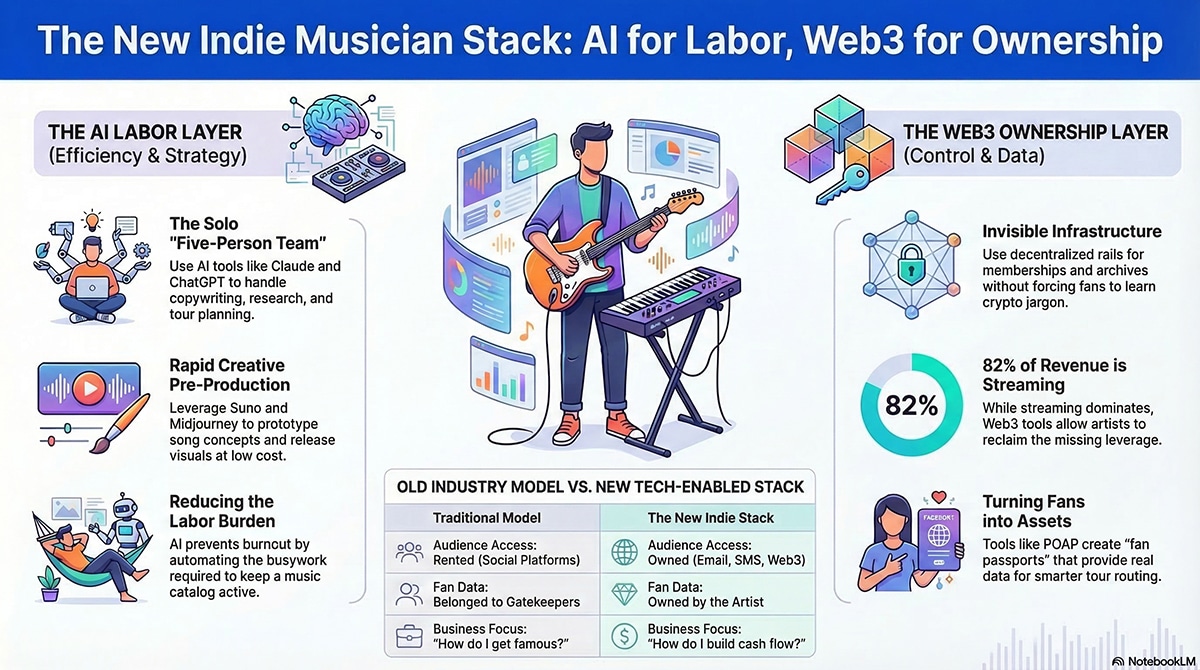
That is why this moment matters. AI and Web3 are not two separate trends for musicians to casually “check out.” Together, they form a stack. AI is the labor layer. Web3 is the ownership layer. AI helps an indie artist do the work of a team. Decentralized technology helps that artist keep the value that work creates. Put them together, and you get something the old music business never really wanted to build: a music industry middle class.
This is not a theory anymore. You can see it in the tools already live today. ChatGPT from OpenAI and Claude from Anthropic are already being used for planning, copywriting, research, and workflow support. Suno gives artists a fast ideation environment for song concepts. Runway and Midjourney turn visual production into something a working artist can actually afford and test quickly. On the ownership side, WordPress, The Newsletter Plugin, Bandcamp, Shopify, Unlock Protocol, POAP, Pinata, Privy, Crossmint, Darkblock, Zora, and Coop Records are all pieces of a more artist-owned system.
What matters is not using every one of these tools. What matters is understanding what each one does inside a business plan. Because that is the new game now. Not “How do I get famous?” but “How do I build cash flow, control, and durability?”
The Old Deal Is Breaking
The traditional music business was built around scarcity. Studio time was scarce. Distribution was scarce. Shelf space was scarce. Radio access was scarce. Promotion was expensive. Fan data mostly belonged to somebody else. Labels, ticketing companies, radio programmers, DSPs, social platforms, promoters, and media gatekeepers all controlled some key piece of access.
That scarcity model is breaking down, but the replacement model is not automatically fair. It is just more open. Streaming made distribution easier, but it also pushed artists into a volume economy. Social platforms made promotion easier, but they turned audience access into rented land. Discovery grew. Ownership shrank.
That is the trap a lot of artists are living in right now. They have more tools than ever, more ways to publish than ever, and more ways to reach people than ever, yet they still do not control the most important business assets: fan contact information, purchase history, community identity, and direct sales channels. In plain English, they can be visible without being stable.
The fix is not nostalgia. The fix is infrastructure.
Bandcamp is still one of the clearest examples of how direct-to-fan infrastructure works in real life. According to Bandcamp, fans have paid artists and labels $1.69 billion through the platform. Bandcamp also says artist accounts are free, it takes 15% on digital music and 10% on merch, and the remainder goes directly to the artist’s PayPal account, typically within 24 to 48 hours. That is not perfect. But it is real direct revenue, and it teaches the right lesson: when you shorten the line between artist and fan, more money stays in the artist economy.
That same lesson shows up in the wider market. Bandcamp says fans paid more than $120 million directly to artists and labels through Bandcamp Fridays since the program began. In other words, fans are not allergic to paying artists. They are allergic to friction, confusion, and weak offers. If the artist builds a clear path, many fans will walk it.
This is where AI and decentralized technology start to matter together. AI helps the artist create better offers, test better messaging, and move faster without hiring a five-person staff. Web3 helps the artist turn access, proof, membership, collectibles, and digital rights into owned infrastructure instead of borrowed platform features. One makes the machine run. The other lets the artist own the machine.
AI Is the New Small-Team Advantage
For a working independent musician, AI is not magic. It is labor leverage.
That means the first job of AI is not replacing your art. It is replacing busywork, speeding up decisions, and helping you operate like someone with an assistant, a marketing coordinator, a junior designer, a researcher, and a project manager. ChatGPT and Claude are useful because they help artists write launch plans, tour outreach emails, fan segmentation notes, merch descriptions, sync one-sheets, ad ideas, release calendars, and post-show follow-up sequences without having to start from zero every single time. OpenAI positions ChatGPT as an AI chatbot for discovering, learning, and creating, and Anthropic describes Claude as AI for problem solvers and knowledge work. That is exactly how an indie artist should think about them.
Used the right way, these tools become your strategy desk. You can feed them show history, merch numbers, fan email data, notes from your last release, and goals for the next ninety days. Then you can ask for a practical business plan built around revenue instead of vanity. You can ask for ten direct-to-fan offers for a house concert run. You can ask for a better subject line sequence for a ticket push in a town where you already know your open rates are strong. That is not “AI music.” That is AI as a business amplifier.
There is another layer that matters just as much: AI as a teacher. A serious indie artist can use these systems to learn release planning, licensing basics, audience segmentation, studio workflow, content scripting, and fan funnel design much faster than before. That is important because the old business depended on artists staying confused. Confused artists sign bad deals. Educated artists build systems.
Suno belongs in this conversation too, but with a clear boundary. Suno’s official pitch is simple: it helps users create original music quickly. That makes it powerful for concepting, melodic sketching, arrangement experiments, writing prompts, demo direction, and helping an artist hear rough ideas before spending full production time. But for a career artist, the smart use case is not “let the machine replace me.” The smart use case is “let the machine speed up pre-production so I can get to the real record faster.”
The same is true on the visual side. Runway says it is building AI for video generation and production, and Midjourney says its platform is built for image and video creation. Those tools matter because visual content is now part of every release, every pre-save push, every tour ad, every lyric teaser, every merch drop, and every short-form campaign. A solo artist who once needed a full creative team can now mock up release art, teaser loops, world-building visuals, and ad concepts before paying for final assets. That means lower risk and more testing before real money gets spent.
This is where the practical field-guide part kicks in. If you are a working artist, AI should touch every money path you have. It should help you write the copy that sells tickets. It should help you create the language for merch pages. It should help you identify which city gets the early-access text first. It should help you organize your release into formats: full song, acoustic version, live version, lyric pull, vertical clip, fan email, backstage note, sync one-sheet, press pitch, and post-release retention offer. The money is not in “using AI.” The money is in using AI to create more sellable moments from the same piece of music.
And there is one more brutal truth here. Most indie artists do not fail because they lack talent. They fail because they cannot keep up with the labor load long enough to let the catalog mature. AI lowers that labor burden. It lets one person do the kind of consistent, organized follow-through that used to belong to management companies and labels.
Web3 Is the Ownership Layer Fans Barely Have to See
Now let’s get to the part that still scares people because the language around it got wrecked by hype.
For an indie artist in 2026, Web3 does not need to mean forcing fans to learn wallets, memorize seed phrases, or buy strange tokens just to hear a song. That is the old mistake. The better model is invisible infrastructure. The fan experience should feel easy. Email, card, text, click, claim, access. Under the hood, the system can still use decentralized rails for proof, membership, access, resale logic, collectibles, archives, and identity.
Unlock Protocol is one of the clearest tools in this category. Unlock describes itself as a protocol for memberships as time-bound NFTs and says it enables creators and platforms to connect with fans without a middleman. Its WordPress guide says the Unlock WordPress plugin can be used to build membership sites and that it also supports credit card transactions through Stripe for visitors who are not onboarded into Web3. That matters a lot. It means an artist can run a fan club, subscription, premium content archive, or early-access vault on WordPress and still let fans pay like normal humans.
That same platform has two features more indie artists should pay attention to. Unlock’s guides show email airdrops and gas-free minting. In plain English, you can send a membership or collectible to someone using just an email address, and you can set up minting so the fan does not have to deal with gas fees. That is exactly the kind of hybrid design that makes decentralized tech useful in the real world.
POAP is another strong example. POAP stands for Proof of Attendance Protocol, and the platform describes its drops as digital mementos tied to experiences and moments. More important for artists, POAP’s help docs say fans do not need a crypto wallet to receive one right away; a POAP can be reserved with an email address and later linked to a wallet. That makes POAP incredibly useful for a fan passport system. A fan comes to a show in Atlanta, buys a shirt in Athens, volunteers at a local event in Nashville, drives six hours to see you in Asheville, or attends a listening party in Minneapolis. Each of those moments can become a collectible stamp. Suddenly your fan history is not just living in the memory hole of a social app. It becomes durable proof.
That proof has business value. It lets the artist identify the fans who actually move. Not the fans who casually liked a post three years ago. The fans who show up, buy, travel, and participate. That is real routing intelligence. That is pre-sale intelligence. That is merch intelligence. That is the beginning of a touring map built from actual engagement, not hope.
If you want that fan passport system to feel invisible, that is where tools like Privy and Crossmint come in. Privy says it offers embedded wallets and onboarding through email, SMS, social, passkeys, or wallets. Crossmint says its checkout products let users buy digital assets with credit cards and offers embedded wallet infrastructure and multiple payment methods including cards, Apple Pay, and Google Pay. These are not usually the first tools a solo artist sets up on a Sunday afternoon. They are the tools you or your developer use when you want the Web3 rails without the ugly Web3 friction.
Then there is storage. One of the smartest uses of decentralized tech is not even flashy. It is preservation. Pinata explains IPFS as distributed file storage where files are identified by content and remain accessible as long as they are pinned. For artists, that means you can build a decentralized archive for masters, alt mixes, lyric books, stems, live recordings, digital booklets, and membership-only files. If streaming platforms delist something, if a service changes policy, if a site breaks, your archive strategy does not have to break with it.
Darkblock sits right next to that idea. Darkblock says it is building decentralized content delivery and unlockable content for creators. Unlock’s own guides show Darkblock and Unlock being used together for members-only music, video, text, and other digital formats. That means an artist can sell or grant access to files that stay protected until the right fan unlocks them. That is a useful model for deluxe albums, exclusive live sessions, stem packs, songwriting notebooks, private concert recordings, and premium fan experiences.
This is the real point of Web3 for indie artists. Not speculation. Not techno cosplay. Not begging fans to become day traders. The point is using decentralized rails to prove ownership, manage access, preserve files, and reward support while keeping the experience simple enough that regular fans never feel like they entered a crypto seminar by accident.
The New Indie Stack in the Real World
So what does this actually look like when it is not trapped in theory?
Start with a real home base. WordPress is still one of the best foundations an indie artist can build on because it is open source and gives you control over your site, pages, content, and plugins. In other words, it is infrastructure you own, not borrowed space on someone else’s platform. Pair WordPress with The Newsletter Plugin and the FREE Making a Scene Email Capture plugin, and your website becomes more than just a digital flyer. The Newsletter Plugin lets you create, send, and track email campaigns directly inside WordPress, while the Making a Scene Email Capture plugin helps you build a splash page that collects fan email addresses and automatically sends a four-email welcome sequence, including a free gift or other incentive. Together, these tools turn your website into a real owned media system instead of a scattered collection of social media links.
Layer in email and SMS next. Mailchimp’s official site says it supports both email and SMS marketing in one platform. . Whether you use Mailchimp or another provider, the strategy is the same: social media is discovery, but email and text are retention. The post did not sell the ticket. The direct message did. The reel did not move the vinyl. The owned list did.
Then build the storefront. Bandcamp is a strong direct-music layer. Shopify is a strong merch and digital product layer. Shopify’s official help center says digital goods can include audio files and NFTs, and its blog says there are no additional fees for digital products beyond the normal store costs. Gumroad is another lighter-weight option for digital files, memberships, and direct sales, and its pricing page says it uses a 10% plus $0.50 transaction fee on direct sales through your profile or direct links.
Once that foundation exists, Web3 becomes the upgrade layer. Use Unlock for paid membership or premium access on your WordPress site. Use POAP for attendance stamps and fan passport moments. Use Pinata for protected archive storage. Use Darkblock when you want premium digital content that can be unlocked by the right supporter. Use Privy or Crossmint only when you are ready to make the onboarding feel invisible. None of that requires your average fan to become a blockchain power user. It just requires you to stop thinking of your website as a brochure and start thinking of it as the operating center of your career.
And yes, there are already real artists proving pieces of this model. TIME reported that Daniel Allan raised $140,000 in a day through music NFTs while retaining master rights and control over his work. Billboard separately reported that one of his collections sold 1,000 music NFTs in less than 24 hours. That does not mean every artist should copy Daniel Allan exactly. It means the market has already shown that direct fan funding tied to ownership and community can work.
Holly Herndon’s Holly+ project shows another side of the future. The official Holly+ site presents it as a digital twin, and its auction site explains a community model where approved works made with Holly+ can be minted, with profits split 50% to the contributing artist, 40% to the Holly+ DAO treasury, and 10% to Herndon for use of likeness. That is AI plus decentralized governance plus programmable revenue sharing in one actual working example.
RAC offers a different signal. His official site openly combines music, store, Discord, NFTs, a token, and a CULT Pass in one artist ecosystem. Again, the point is not that every artist should launch a token. The point is that the artist website is evolving from “bio and tour page” into “marketplace plus community plus access control plus identity.”
And then you have newer onchain music environments like Coop Records and Zora. Coop Records shows fans collecting tracks onchain and rewarding top supporters on release pages, while Zora says it is making it easier for creators to bring media onchain and turn content into tradable digital assets. These are more advanced lanes, and not every indie artist needs them on day one. But they show where the market is going: toward collectible media, programmable fan rewards, and creator-owned distribution logic.
How This Fits Into a Real Indie Artist Business Plan
Now let’s get practical.
A real indie business plan starts with the song, but it does not stop at the song. The song is the engine. The business plan is the road map around it.
In the recording and production phase, AI can help the artist sketch songs faster, organize reference tracks, build arrangement options, and create demo language for collaborators. ChatGPT and Claude help with planning and documentation. Suno can help with idea generation and fast mockups. Midjourney and Runway can help define the visual world of the release before the budget gets committed. That saves time and lowers wasted spend.
In the release phase, the artist should create multiple offer levels. The open level might be the standard stream and social content. The next level is the owned level: email signup, text club, Bandcamp purchase, Shopify bundle, or Gumroad digital pack. Then comes the premium level: members-only live stream, early-access song vault, private Discord room, deluxe archive, token-gated bonus track, or collectible show pass using Unlock, POAP, or both. The point is to stop having one audience and start having tiers of access. Different fans want different relationships. Your business plan should let them climb.
In the touring phase, decentralized tools become shockingly practical. A ticket buyer can get a POAP or an Unlock-based pass after the show. That pass can become proof for early access next time the artist comes through town. Over time, those proofs create a map of high-intent fans by city, not just followers by city. That changes routing. That changes ad spend. That changes where you test VIP offers, house concerts, private songwriter circles, and premium merch drops. Touring becomes less of a blind gamble and more of a feedback loop.
In the merch and direct-sales phase, the job is to combine physical and digital value. A vinyl package can come with a members-only archive page. A shirt can come with a collectible stamp. A lyric book can come with a private writing demo. A ticket can come with a future discount code for a live bootleg. Shopify’s digital product tools and Bandcamp’s direct music sales already cover part of this path. Unlock, POAP, Darkblock, and Pinata let you extend it into access, memory, and exclusivity.
In the licensing and publishing phase, AI helps with organization. It can help an artist tag songs by mood, tempo, lyrical theme, instrumentation, and scene use. It can help create clean one-sheets, metadata summaries, outreach drafts, cue-sheet reminders, and alternate pitch angles for supervisors. Web3 can play a quieter role here by preserving proof, storing alternate assets, and giving select partners access to members-only folders or premium stem libraries. The money here comes from being easy to search, easy to pitch, and easy to deliver.
And through all of it, the real product is not only the music. It is the data around the relationship. Who bought. Who came twice. Who upgraded. Who traveled. Who opened. Who clicked. Who claimed. Who came back. That is why data ownership is the oil that runs the indie artist business. Not because data is cold. Because good data helps you serve real fans better, waste less money, and make better offers.
Building a Music Industry Middle Class
This is the part that matters most.
A music industry middle class is not built by superstardom. It is built by repeatable systems that let thousands of artists earn real money from smaller but committed audiences. It is built when artists own masters, own publishing, own fan data, own storefronts, own membership channels, and keep enough margin to stay in the game long enough for a catalog to mature.
That is exactly where this AI-plus-decentralization stack becomes bigger than one artist’s workflow. AI lowers the labor cost of running an independent career. Direct sales improve margins. Membership and collectibles create recurring or premium revenue. Fan passports improve retention. Decentralized storage protects the catalog. Invisible wallet tools reduce friction. Suddenly the artist is not depending on one jackpot. They are building layers of income.
That is what the old system never really wanted to encourage. A healthy middle class of artists is harder to exploit than a desperate crowd chasing lottery tickets. A stable artist can say no to a bad publishing split. No to a weak record deal. No to a fake vanity campaign. No to building a career on rented social reach alone.
And this matters beyond the individual artist. A real middle class creates the future farm system of music. It gives developing artists a place to grow without getting crushed. It lets them build business skills before scale hits. It gives them a real catalog, a real fan list, a real merch rhythm, and a real touring map before the industry comes knocking. That means when bigger opportunities arrive, the artist is not walking in empty-handed. They are walking in with leverage.
The Right Way to Start
The smartest move is not trying to launch an entire future-tech empire next week.
Start with the owned basics. Build or clean up your WordPress site. Add email capture. Add a text option. Make sure every social and streaming profile points to one clear landing page. Set up Bandcamp and either Shopify or Gumroad. Get one direct digital offer live. That alone already moves you away from dependence and toward ownership.
Then add one fan-proof layer. Use POAP for one show run, one listening party, or one volunteer campaign. Or use Unlock on one premium page with one clean benefit, like early ticket access or a members-only live recording. Keep it simple enough that the fan barely notices the tech and clearly feels the value.
Then bring AI into the weekly rhythm. Use ChatGPT or Claude for planning, copy, and analysis. Use Suno for ideation if it helps your writing process. Use Runway or Midjourney to speed up visuals and ad tests. The goal is not replacing your voice. The goal is protecting your time so your voice survives the workload.
That is how this new era actually begins. Not with a manifesto on social media. With infrastructure.
The Point Is Not the Tech
The point is control.
AI without ownership just helps platforms move faster. Web3 without simplicity just scares away normal fans. But when AI is used to reduce labor and decentralized tech is used to increase ownership, something powerful happens. The indie artist stops behaving like unpaid content inventory for other people’s businesses and starts acting like the owner of an expanding creative company.
That is the future worth building in the American independent music scene. Not a fantasy where every artist becomes famous. A stronger future where more artists become durable. Where more songs turn into assets. Where more fans turn into members. Where more shows turn into data. Where more catalogs turn into long-term income. Where more artists can afford to stay artists.
That is the new era for independent musicians. And for the artists willing to build it, it has already started.
 |  Spotify |  Deezer |  Breaker |
 Pocket Cast |  Radio Public |  Stitcher |  TuneIn |
 IHeart Radio |  Mixcloud |  PlayerFM |  Amazon |
 Jiosaavn |  Gaana |  Vurbl |  Audius |
 Reason.Fm | |||
Find our Podcasts on these outlets
Buy Us a Cup of Coffee!
Join the movement in supporting Making a Scene, the premier independent resource for both emerging musicians and the dedicated fans who champion them.
We showcase this vibrant community that celebrates the raw talent and creative spirit driving the music industry forward. From insightful articles and in-depth interviews to exclusive content and insider tips, Making a Scene empowers artists to thrive and fans to discover their next favorite sound.
Together, let’s amplify the voices of independent musicians and forge unforgettable connections through the power of music
Make a one-time donation
Make a monthly donation
Make a yearly donation
Buy us a cup of Coffee!
Or enter a custom amount
Your contribution is appreciated.
Your contribution is appreciated.
Your contribution is appreciated.
DonateDonate monthlyDonate yearlyYou can donate directly through Paypal!
Subscribe to Our Newsletter
Order the New Book From Making a Scene
Breaking Chains – Navigating the Decentralized Music Industry
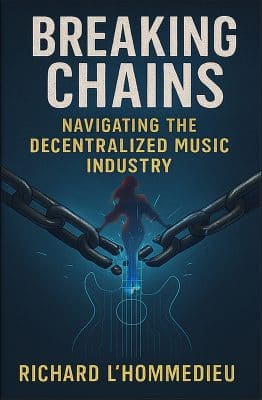
Breaking Chains is a groundbreaking guide for independent musicians ready to take control of their careers in the rapidly evolving world of decentralized music. From blockchain-powered royalties to NFTs, DAOs, and smart contracts, this book breaks down complex Web3 concepts into practical strategies that help artists earn more, connect directly with fans, and retain creative freedom. With real-world examples, platform recommendations, and step-by-step guidance, it empowers musicians to bypass traditional gatekeepers and build sustainable careers on their own terms.
More than just a tech manual, Breaking Chains explores the bigger picture—how decentralization can rebuild the music industry’s middle class, strengthen local economies, and transform fans into stakeholders in an artist’s journey. Whether you’re an emerging musician, a veteran indie artist, or a curious fan of the next music revolution, this book is your roadmap to the future of fair, transparent, and community-driven music.
Get your Limited Edition Signed and Numbered (Only 50 copies Available) Free Shipping Included
Discover more from Making A Scene!
Subscribe to get the latest posts sent to your email.


