Your Fans Are Not Portable Just Because Your Songs Are




Making a Scene Presents – Your Fans Are Not Portable Just Because Your Songs Are
Listen to the Podcast Discussion
Your Fans Are Not Portable Just Because Your Songs Are
On July 22, 2026, SoundCloud announced that it had acquired the remaining assets of Nina Protocol, an independent music platform built around direct artist-to-fan sales, editorial discovery, and blockchain-based ownership tools. The acquisition included Nina’s editorial archive and its genre map, a system designed to connect artists, releases, scenes, and musical communities. SoundCloud also introduced an optional migration process that gives Nina artists a way to move their music, content, and followers into SoundCloud’s creator ecosystem. Artists are not being moved automatically. Each artist must decide whether to take part, and the financial terms of the deal were not publicly disclosed.
At first glance, this may look like a relatively small technology acquisition. One company closed, a larger company bought some of what remained, and artists were offered a way to move their work. The editorial archive may survive, the genre map may find a new life, and former Nina artists may gain access to a larger creator platform. From a distance, it looks like the music industry version of moving boxes from one apartment to another and hoping none of the cables disappear.
But this story raises a much larger and more uncomfortable question for independent musicians. When an artist-friendly platform shuts down, gets acquired, runs out of funding, changes direction, or simply disappears, which parts of an artist’s business can actually travel with the artist? Music files may be easy to copy. Artwork may be downloadable. A biography can be pasted into a new profile. Even a follower count may sometimes be carried into another system. The harder issue is whether the business relationship behind those numbers can move too.
Nina Was Trying to Build Something Different
Nina Protocol launched in 2021 as a Web3-based music platform. It operated as a marketplace, streaming service, distribution system, and editorial community. Artists could release music directly to listeners, maintain ownership of their work, and receive the money from direct sales without giving the platform the type of percentage commonly taken by many digital marketplaces. Nina was built on blockchain technology and promoted itself as an alternative to the standard streaming model, where music is often reduced to anonymous plays, tiny royalty payments, and a dashboard full of numbers that may look impressive without paying the electric bill.
The platform also allowed artists, labels, and music communities to create their own hubs. These hubs could combine releases, recommendations, writing, editorial material, and cultural context. Nina’s editorial operation published interviews, essays, playlists, scene reports, and stories that explained not only what the music sounded like, but where it came from and why it mattered. That part of the platform was especially valuable because music does not exist as an audio file alone. Every song comes from a place, a scene, a group of people, a specific moment, or some combination of all four.
A song may come from a rehearsal room, a church, a nightclub, a garage, a laptop in a bedroom, or a studio session paid for with money that was supposed to fix the transmission. The story around the song helps fans understand it. Nina tried to preserve that context rather than reducing every release to a thumbnail, a play button, and an algorithmic suggestion that says the listener might also enjoy seventeen songs with vaguely similar drum sounds.
Artists and labels including Warp, Hyperdub, AD 93, and others used Nina. The service supported direct purchases, artist-controlled releases, community interaction, and editorial discovery. It had a clear identity and a mission that many independent artists could understand. It wanted to create a space where artists had more control, where direct sales mattered, and where the music was treated as culture rather than disposable content.
Then Nina encountered the problem that eventually reaches every platform, no matter how idealistic its mission may be. The company could not find a revenue model that would support the service at its existing size. Nina announced on May 28, 2026, that it would wind down over several weeks. Users were told to withdraw earnings and export releases, purchases, and connections before the website and app went offline. Nina said it had created meaningful connections but could not find a sustainable path forward.
That statement should get the attention of every independent musician. A platform can have a good mission, use exciting technology, treat artists fairly, and build a respected community. It can still run out of money. Good intentions do not pay hosting bills, customer-support staff, developers, lawyers, accountants, or the people who keep the whole thing from falling over at three in the morning.
A blockchain does not automatically create enough paying customers. A strong artist-first mission does not guarantee a sustainable company. That does not make Nina worthless, and it does not erase what the platform accomplished. It makes Nina an important lesson about the difference between ownership technology and a durable business.
SoundCloud May Be Preserving Something Valuable
SoundCloud’s acquisition may preserve parts of Nina that could easily have disappeared. The editorial archive matters because it documents artists, genres, scenes, and independent communities that often receive little attention from mainstream music media. The genre map may also help SoundCloud connect listeners with artists whose work does not fit neatly into traditional industry categories. SoundCloud has said that Nina’s archive and discovery work can help expose more listeners to the artists and scenes Nina documented.
Offering Nina artists an optional migration path is also better than simply switching off the platform and leaving everyone to figure it out alone. Former Nina artists may gain access to SoundCloud’s distribution, direct fan monetization, audience-development tools, analytics, mastering, promotion, and other creator services. SoundCloud also has a far larger listener base, which may create new discovery opportunities for artists who had built an audience on Nina.
These tools could be genuinely useful. SoundCloud has a long history of helping new music spread before the traditional music industry notices it. Artists can receive comments, messages, follows, playlist activity, and direct feedback. The platform also offers services that go beyond simple streaming, including distribution and creator-development tools.
There is no need to turn SoundCloud into the villain in this story. Preserving Nina’s archive and offering artists a migration path may be constructive steps. The larger problem is not that SoundCloud acquired Nina. The larger problem is that moving from one outside platform into another outside platform does not eliminate platform dependence. It simply changes the landlord.
That landlord may be responsible, artist-friendly, and useful. It is still a landlord. The artist does not own the building, write the rules, control the business model, or decide what happens in the next corporate meeting. That is why artists need to understand what they are actually moving and what remains trapped inside the platform.
Songs Are Files, but Fans Are People
Moving music can be complicated, but it is usually possible. An artist can download a WAV file, save artwork as a high-resolution image, copy lyrics into a document, place metadata into a spreadsheet, and store videos on a hard drive or cloud account. A release can be uploaded to another distributor, streaming service, store, or website.
The process may be annoying. It may take hours. It may include missing credits, mismatched song titles, wrong release dates, and an album cover that only exists as a tiny JPEG downloaded from a forgotten social-media post. Someone may discover that the final master is actually labeled “FINAL_MASTER_NEW_REAL_USE_THIS_ONE_4.wav.” There may be shouting. There may be coffee. Still, the work can usually be moved.
A fan relationship is different because a follower is not a file. A follower is a person who made some kind of connection within a particular platform. That connection might involve a follow, purchase, comment, playlist addition, membership, direct message, recommendation, or shared interest in a scene.
When a platform says followers can be migrated, artists need to ask what that word actually means. Does the fan become a follower on the new service? Does the fan have to approve the move? Does the artist receive a name, email address, or location? Does the artist receive permission to send email? Does purchase history move? Do messages, comments, memberships, and playlists come with the account? Can the artist tell whether that person bought three releases, attended a show, joined a membership, or simply clicked “follow” two years ago and never returned?
Public information about the Nina-to-SoundCloud process confirms that music, content, and followers are part of the optional migration opportunity. However, the publicly available details do not explain every part of the fan relationship, including contact permissions, purchase histories, memberships, messages, and community context. Those gaps should not be treated as proof that something improper is happening. They should be treated as unanswered questions that reveal a larger industry problem.
A follower connection may be portable, but a customer relationship may not be. A platform might recreate a follow on another service while leaving the artist with no direct way to contact that person. A number may appear on a new profile, but the deeper history of how that person supported the artist may be gone.
There Is More Than One Kind of Portability
Artists often talk about portability as though it were a single feature. In reality, there are several different forms of portability, and they do not all provide the same level of protection.
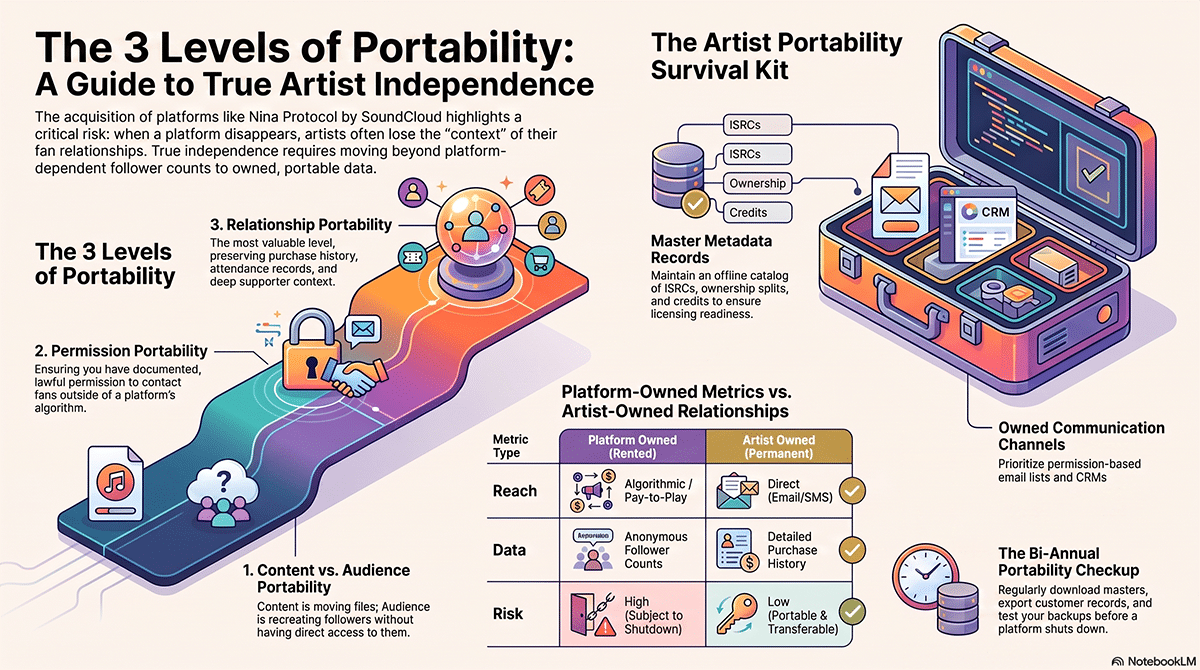
Content portability is the easiest to understand. It means the artist can move recordings, artwork, videos, photographs, biographies, lyrics, and other creative materials. These are files, and files can usually be copied from one location to another.
Audience portability means followers, subscribers, or other connections can be recreated on another platform. This can help an artist avoid starting from zero, but it does not necessarily give the artist direct access to those people. The audience may still live entirely inside the new platform.
Data portability goes deeper. It means the artist can export useful information in a practical format. That information may include names, locations, dates, purchase histories, products, attendance, communication preferences, and other details that help the artist understand the fan relationship.
A platform may technically provide an export while making the information nearly impossible to use. A giant spreadsheet with unexplained columns labeled CUSTOMER_REF_3, TYPE_NULL, and USER_STATE_FINAL may satisfy a legal definition of data portability while leaving the artist staring at the screen as though it just insulted the family dog.
Permission portability is more important because it determines whether the artist has lawful, documented permission to contact the fan through email, text messaging, direct messaging, or another channel. An exported email address does not automatically mean the artist has permission to send marketing messages. The platform may have received the user’s consent while the artist did not.
That difference matters because an email address without clear permission is not a real mailing-list relationship. It is a future complaint waiting to happen. Artists need to know what the fan agreed to receive, who was given permission to send it, and how the fan can change that decision.
Relationship portability is the deepest and most valuable kind. It means the artist can continue communicating with a supporter while preserving enough context to understand the relationship. The artist knows whether the fan bought vinyl, attended shows, joined a membership, supported crowdfunding, purchased merchandise, volunteered, brought friends to a concert, or requested certain kinds of communication.
Content portability protects the work. Audience portability protects some reach. Data portability protects useful information. Permission portability protects communication. Relationship portability protects the business itself.
The last two are especially important because they allow the artist to keep serving supporters when a platform changes. An artist-owned business depends on more than being able to move files. It depends on the ability to continue trusted communication without asking another company for permission.
A Follower Count Is Not a Customer List
The modern music business trains artists to stare at large numbers. Streams, followers, views, likes, monthly listeners, impressions, playlist additions, and engagement rates can all be useful. They can show whether a campaign is gaining attention, whether a release is reaching new people, or whether a song is connecting with listeners.
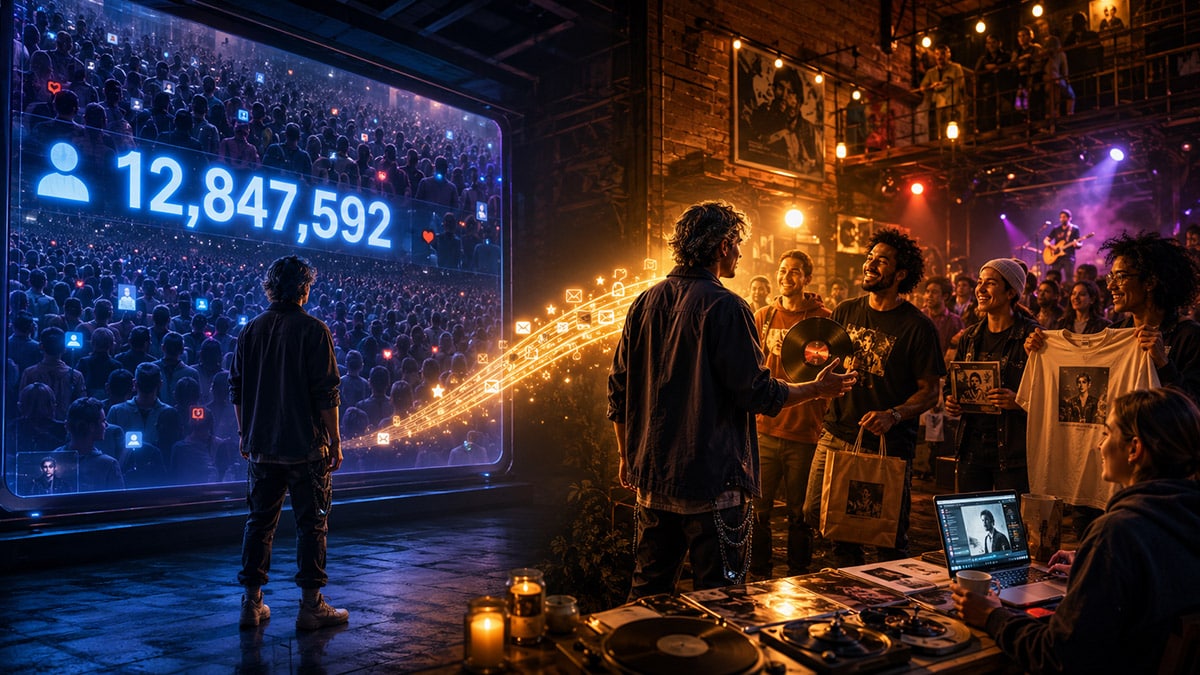
The problem begins when these numbers create the illusion of ownership. An artist with 10,000 followers may not be able to contact those people directly. The artist may have to post into an algorithmic feed and hope the platform shows the message. The platform owns the doorway, controls the reach, decides which formats perform best, and can charge the artist to reach people who already asked to follow.
The platform can also change the rules, lower organic reach, suspend the account, raise prices, remove features, or close entirely. The artist may see a large audience on the screen while having no practical way to carry that relationship somewhere else.
Now compare those 10,000 anonymous followers with 150 known supporters who have given permission to receive email, purchased records, attended shows, bought merchandise, or joined a membership. The larger follower number may look more impressive in a press release, but the smaller group of known supporters may be far more valuable to a sustainable business.
Those supporters can help fill a small venue, fund a vinyl pressing, buy tickets before a tour, support a membership, order merchandise, contribute to crowdfunding, or tell friends about the artist. They can help carry a career through the long stretches when the algorithm has wandered away to chase a dancing raccoon.
This does not mean followers are worthless. Followers can become fans, and fans can become customers, members, advocates, and long-term supporters. The key is understanding that a follow is the beginning of a relationship, not proof that the artist owns one.
Web3 Solved Part of the Problem
Nina’s history gives the music business another chance to talk honestly about Web3. That discussion does not need rose-colored glasses, and it does not need someone standing on a street corner announcing that the blockchain is coming for everyone’s guitar.
Blockchain technology can be useful. It can create records of ownership and transactions, document the history of a digital asset, support limited editions, and make certain records visible across open systems. Smart contracts can automate actions when agreed conditions are met. Decentralized storage can also help preserve files and metadata outside a single company’s private database.
These ideas matter because the traditional music industry has a long history of losing paperwork, hiding accounting methods, misplacing ownership information, and sending royalty statements that look as though they were translated from an ancient language found inside a locked filing cabinet.
A permanent, verifiable record can solve some real problems. However, a blockchain record does not create fan demand, and a token does not automatically create a community. A wallet address is not necessarily a customer relationship, and ownership of a digital asset does not mean the artist can contact the owner.
A permanent file does not create a permanent business. A smart contract cannot make people care, buy again, attend a show, or join a membership. Technology can document a transaction, but it cannot guarantee another transaction next month.
This is where some of the early Web3 discussion around music went wrong. Ownership technology was sometimes presented as though ownership alone would create value. In reality, value comes from the relationship between the artist, the work, the fan, and a meaningful reason to support it.
A limited digital release has no useful market if nobody wants it. A tokenized membership has little value if the membership offers nothing worth joining. A decentralized platform cannot survive without enough revenue to pay developers, support users, maintain infrastructure, and improve the service.
Nina’s shutdown does not prove that Web3 is useless. It proves that Web3 is a tool rather than a complete business model. A hammer can help build a house, but it cannot find tenants, pay the mortgage, or convince someone that the kitchen needs fewer avocado-colored appliances.
Ownership technology must be connected to real fans, useful services, trusted communication, direct sales, memberships, licensing, ticketing, merchandise, and other forms of dependable revenue. Without those pieces, even a technically open platform can become another place where artists build value they cannot fully carry away.
Platforms Are Rented Stages
Independent artists should use platforms. SoundCloud, Bandcamp, Spotify, YouTube, TikTok, Instagram, Web3 services, streaming platforms, social networks, ticketing systems, and online marketplaces can all help artists reach fans and earn money.
The problem is not using these platforms. The problem is building the entire business inside a system the artist does not control.
Platforms are rented stages. An artist can walk onto that stage, perform, meet an audience, sell something, and create new connections. The artist should still avoid storing the only masters, contracts, mailing list, merchandise records, royalty statements, customer histories, and publishing information underneath that stage.
The building may be sold. The rent may rise. The stage manager may change the rules. The new owner may decide that the room would be more profitable as a pickleball court. The artist cannot control those decisions.
Use the stage, but do not confuse it with a permanent home. A healthy artist business uses platforms for discovery and reach while bringing fans into communication channels and customer relationships the artist can maintain.
Building an Artist Portability Survival Kit
Every independent artist needs a portability survival kit. This is not a physical box filled with crackers, batteries, and emergency coffee, although touring musicians may want one of those as well. It is a complete, artist-controlled archive containing everything needed to rebuild the business somewhere else.
The survival kit begins with the music. Artists should keep original master recordings in high-resolution formats. Final masters, alternate masters, instrumentals, clean versions, performance tracks, and stems should be preserved whenever they may be useful later.
A streaming copy is not a master. An MP3 pulled from an old website is not a master. A phone recording of a song playing through studio monitors is definitely not a master, no matter how confidently someone names the file.
Artists should also preserve artwork, photographs, music videos, visualizers, biographies, press releases, lyrics, liner notes, logos, tour posters, and other creative materials. These assets may later support reissues, publicity, anniversary releases, licensing campaigns, documentaries, books, and historical archives.
The survival kit must also include songwriting splits, publishing information, ISRCs, UPCs, release dates, performer credits, producer credits, engineering credits, ownership percentages, contracts, licenses, and clearance records. Moving a song is easy compared with proving who owns it after everyone involved has forgotten the details.
Royalty statements should be saved from distributors, performing-rights organizations, mechanical-rights services, publishers, SoundExchange, labels, licensing agents, and other partners. The artist should also preserve merchandise records, ticket reports, membership information, crowdfunding results, payment records, tax documents, and direct-sales histories.
The most overlooked part is fan information and permission. Artists should preserve permission-based email contacts, communication preferences, customer histories, attendance records, membership status, supporter notes, and direct communication channels.
This is the part that turns a pile of archived files into a business survival system. The music may be the product, but the fan relationship is what helps the artist continue earning after the platform disappears.
Metadata Is the Passport for the Music
Metadata sounds boring because the music industry gave it a boring name. It sounds like something stored in a gray office cabinet beside a printer that has been showing a paper-jam warning since 2009.
In reality, metadata is what allows music to travel. It identifies the title, writers, publishers, performers, producers, engineers, recording owner, ISRC, UPC, release date, genre, mood, language, lyrics, rights information, and licensing details.
Metadata helps music get discovered, paid, licensed, moved, and correctly connected with the people who own it. Without clean metadata, music may still travel, but payments, credits, and licensing opportunities can become lost along the way.
Every artist should maintain a master catalog record outside any distributor or streaming platform. This record should include song titles, alternate titles, writers, publishers, performers, producers, engineers, ownership percentages, ISRCs, release dates, lyrics, explicit-content status, genre descriptions, moods, instruments, recording locations, licensing availability, and important restrictions.
The record should also identify the person who can approve a license. A music supervisor should not have to perform an archaeological dig to find out who controls the master and composition.
Clean metadata becomes even more important as music discovery becomes conversational. A fan may search for a powerful blues-rock singer from Atlanta with Southern soul, slide guitar, and music for a late-night drive. A licensing professional may ask an AI system for an upbeat independent soul song with clean lyrics, female vocals, one-stop clearance, and a strong final chorus.
Those systems cannot recommend information that was never recorded. Artists who control detailed and accurate metadata are easier to discover, easier to license, easier to credit, and easier to pay.
Purchase History Shows Real Commitment
Streaming activity can show interest, but purchases show commitment. A fan who streams a song may enjoy it. A fan who buys the album has made a stronger choice. A fan who purchases vinyl has made an even larger choice, especially after seeing the shipping cost.
A fan who buys a ticket has decided to leave the house. A fan who purchases merchandise has decided to become a walking advertisement. A fan who joins a membership has decided to support the artist repeatedly. A fan who contributes to crowdfunding has chosen to help create something that does not exist yet.
These actions connect to different parts of the artist revenue stack. Direct music sales create immediate income. Merchandise increases the value of the relationship. Tickets turn local support into live revenue. Memberships and recurring fan support can create dependable monthly income. Publishing and licensing can turn ownership into long-term revenue.
Fan history helps the artist understand which offers make sense for which people. Someone who bought every vinyl release may care about a signed edition. A supporter who attended four shows may want early ticket access. A membership subscriber may enjoy behind-the-scenes recordings. A fan near an upcoming tour stop may want a local concert announcement.
The goal is not to collect data because data sounds powerful. The goal is to understand supporters well enough to serve them better. That requires context, permission, and respect.
Artist-Owned Communication Holds the Revenue Stack Together
Every part of the artist revenue stack becomes stronger when the musician can communicate directly with supporters. Artist-owned email is one of the simplest examples. The fan gives permission, the artist keeps a record of that permission, and the fan can unsubscribe when desired. The artist can also move the list to another email provider when necessary.
An artist-owned CRM goes further by helping the artist remember who purchased, attended, joined, volunteered, asked questions, or requested certain kinds of information. It turns scattered activity into a relationship history.
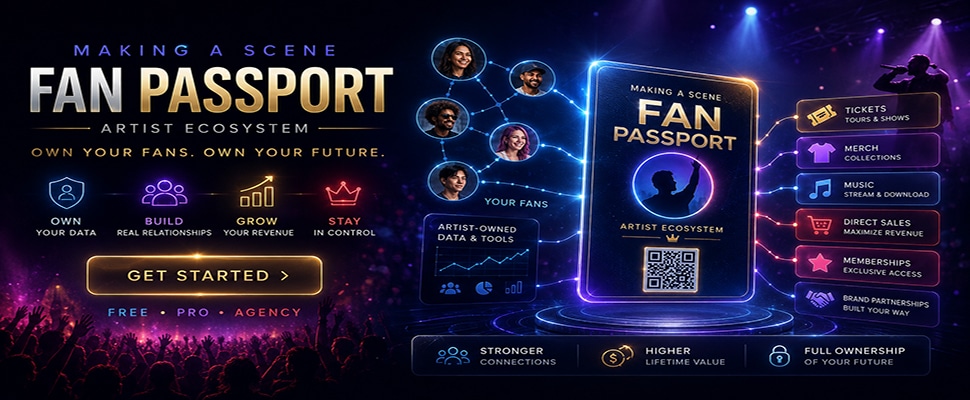
A Fan Passport system can connect that history with real-world activity. A fan might follow an artist, attend a show, receive a stamp, unlock a reward, buy merchandise, or join a membership. The artist can see how that relationship develops over time rather than staring at a row of anonymous profile icons.
The Making a Scene Artist Ecosystem and Fan Passport are being designed around this broader principle. Artists should control permission-based fan records, event attendance, loyalty history, direct engagement, and communication rather than leaving the entire relationship trapped inside a third-party platform.
The Making a Scene Fan Passport hosted artist platform can be found at: https://masfanpassport.app/
The larger point is not that every artist must use one particular tool. Every artist needs some form of owned system. The artist should be able to export the data, understand what it means, know how permission was collected, and continue the relationship if the software changes.
A tool should support artist ownership rather than simply placing an ownership sticker on another closed box.
Permission Must Be Real
Collecting fan information creates responsibility. An artist should not collect email addresses from random sources, dump them into a mailing platform, and begin sending promotions. That is not direct-to-fan marketing. It is digital door-to-door sales with worse lighting.
Fans should know what they are joining, who will contact them, what kind of messages they may receive, and how to unsubscribe. Personal information should be stored securely, and access should be limited to people who genuinely need it.
Artists should avoid collecting information they do not need. If a platform exports customer information, the artist must understand whether that information may legally be used for marketing and whether the customer gave permission to hear directly from the artist.
Privacy rules vary across locations, and platform terms differ as well. Artists dealing with large migrations, international audiences, sensitive information, or unclear consent should speak with qualified legal and privacy professionals.
Owning fan data does not mean doing whatever you please with it. Ownership also means accepting responsibility for how the information is handled.
Look for the Exit Before Joining the Platform
Artists often choose platforms based on the exciting features displayed on the front page. Unlimited uploads, direct sales, memberships, artificial intelligence, fan messaging, blockchain ownership, and dashboards filled with upward-moving graphs can all sound appealing.
Before joining, the artist should look for the exit door. The service should explain whether music, metadata, customer records, sales histories, messages, memberships, earnings reports, and fan information can be exported.
Artists should learn whether exports remain available after a subscription ends and what happens if the company closes. They should understand what license the artist grants, who owns uploaded content, who controls customer information, and whether the fan gives communication permission to the artist, the platform, or both.
Exported files should use common formats and include documentation. If the platform uses tokens, wallets, NFTs, smart contracts, or decentralized storage, the artist should understand what remains useful if the original website and interface disappear.
A blockchain asset may remain visible after the service closes, but the tools that made it easy to use may be gone. A wallet may still exist after the community has moved elsewhere. A smart contract may continue operating while the company that created it no longer answers email.
Artists should also ask how the platform makes money. Does it charge subscriptions, take transaction fees, sell services, run advertisements, or depend mainly on outside investment? The artist may not receive every financial detail, but the basic revenue model should make sense.
A platform that promises artists everything while charging nobody anything may eventually discover that enthusiasm is not accepted by the electric company.
Platform Risk Is Business Risk
A platform may change for many reasons. It can lose funding, fail to attract enough customers, be acquired, replace its leadership, lose an important partner, face legal trouble, raise prices, remove features, or change its algorithm.
The company may also decide that independent musicians are less profitable than another market. The artist cannot control those choices, but the artist can control how much of the business depends on them.
No distributor should hold the only metadata record. No social network should contain the only fan connection. No streaming service should contain the only copy of the music. No ticketing company should hold the only attendance history, and no merchandise platform should control the only customer records.
No cloud account should hold the only contracts, and no team member should be the only person who knows the passwords. Redundancy is not exciting, but neither is changing a tire on the side of the highway. People still carry a spare because the alternative is worse.
Conducting a Portability Checkup
Artists should perform a portability checkup several times each year. The process should begin with the catalog. Download current masters and confirm that the files open. Check that the correct versions are present and that instrumentals, clean versions, alternate masters, and stems are available when needed.
Review the metadata and make sure titles, writers, publishers, ISRCs, UPCs, release dates, ownership information, lyrics, and credits are correct. Export mailing lists, customer records, purchase histories, ticket reports, merchandise sales, membership information, and supporter data.
Archive royalty statements, contracts, licenses, invoices, payment reports, and tax records. Save website text, biographies, photographs, press coverage, tour histories, music videos, and other important creative materials.
Account access should also be reviewed. Passwords should be secure, current, and available to the right people. Two-factor authentication should be enabled where possible. The artist should control the primary email address connected to each important account.
Then the backups must be tested. Open the files, play the masters, read the spreadsheets, check the photographs, and confirm that contracts and licenses are complete.
A backup that has never been tested is a small box of optimism. It may contain everything the artist needs, or it may contain three broken shortcuts and a photograph of somebody’s lunch. Finding out during a shutdown is not recommended.
An Export Is Not Always a Migration
Platforms often say that users can export their data. That sounds reassuring, but an export only matters when it contains enough understandable information to rebuild something.
A spreadsheet may include names and transactions without explaining what the fields mean. A customer export may omit communication permissions. A follower export may provide usernames but no direct contact method. A purchase history may identify products only by internal numbers.
A message archive may save the words while losing the relationship between conversations. A music export may contain audio files but omit complete metadata.
A good migration needs more than a download button. It requires clear formats, documentation, dates, complete records, context, permission information, and a practical method for importing everything into another system.
Portability should be measured by whether the artist can continue operating. The fact that a platform successfully created a zip file does not mean the business has been preserved.
Cultural Memory Can Disappear Too
The Nina acquisition is not only about artist accounts and music files. It is also about cultural memory. Nina’s archive included interviews, essays, playlists, recommendations, scene reports, and other writing about independent music communities.
SoundCloud’s decision to preserve that archive may prevent part of that history from disappearing. This matters because independent scenes are often poorly documented. When a platform closes, years of cultural context can vanish even when the audio survives somewhere else.
Artists should preserve their own interviews, reviews, radio appearances, photographs, flyers, press releases, tour dates, fan stories, playlists, and recording histories. These materials may later support publicity, grants, documentaries, books, reissues, licensing campaigns, anniversary releases, and estate planning.
Years from now, a streaming count may show how many times a song played. The archive may explain why anyone cared.
AI Can Help Organize the Mess
Artificial intelligence can help artists build and maintain a portability system. AI tools can review catalog spreadsheets, identify missing fields, organize files by artist, release, date, or asset type, and summarize royalty reports.
They can help identify duplicate records, extract names and dates from documents, classify contracts and invoices, prepare migration checklists, and turn scattered files into a searchable archive. This may save significant time for artists whose current filing system relies on memory, panic, and whichever laptop still turns on.
AI should not be trusted to invent important facts. It should not guess songwriting splits, decide who owns a master, create missing permissions, invent royalty amounts, or submit rights information based on assumptions.
AI can help organize the office, but it should not become the lawyer, accountant, rights administrator, and publisher while everyone else goes out for tacos. Important information must be checked by the artist or a qualified professional.
Portable Fans Support Every Revenue Stream
Fan portability is not an abstract technology issue. It directly affects revenue. A portable fan relationship helps sell tickets because the artist knows which supporters live near a tour stop.
It helps sell merchandise because the artist understands which products fans actually buy. It supports direct music sales by identifying the people willing to pay for releases. It strengthens memberships because the artist knows which supporters want a deeper connection.
It helps recurring fan support continue outside an algorithm. It supports loyalty programs by preserving attendance and participation history. It helps publishing and licensing by keeping rights and ownership records organized.
This is how independent musicians build a music industry middle class. It does not come from one miracle platform, one viral video, one playlist, or one token. It comes from connected revenue streams supported by direct relationships.
Streaming can introduce the artist. Social media can create attention. SoundCloud can support discovery and community. Bandcamp can support direct sales. Live shows can create memorable experiences. Merchandise can deepen fan identity. Memberships can create recurring income. Publishing and licensing can turn ownership into long-term revenue.
Artist-owned email, CRM records, purchase histories, and Fan Passport activity can connect those parts into a working business. A platform may begin the relationship, but the artist must be able to continue it.
Convenience Is Not Ownership
The lesson of Nina Protocol is not that artists should avoid technology, reject Web3, distrust SoundCloud, or assume that every platform is preparing to lock the doors and climb out a window.
Independent musicians need platforms for discovery, distribution, commerce, community, experimentation, and growth. They need tools that help them reach more people and earn more income.
The lesson is that convenience should never be confused with ownership. An artist does not own a fan relationship simply because a platform displays a follower count.
The relationship becomes portable when the fan knowingly gives the artist permission to remain in contact. It becomes portable when the artist can preserve the history of that support and understand what the fan purchased, attended, joined, or requested.
It becomes portable when communication can continue without asking a platform for permission. Songs can be copied, artwork can be downloaded, metadata can be exported, and follower connections can sometimes be moved.
A real artist-fan relationship must be built, protected, and carried by the artist. That work should begin before the next shutdown notice appears.
Artists should conduct a portability audit while every account still works. Download the music, save the metadata, archive the royalty statements, protect the contracts, export customer records, document permissions, and build direct communication channels.
Know what you own, know what you rent, and know what can travel. The next platform may promise that your songs will come with you, but your business may be a very different story.
 |  Spotify |  Deezer |  Breaker |
 Pocket Cast |  Radio Public |  Stitcher |  TuneIn |
 IHeart Radio |  Mixcloud |  PlayerFM |  Amazon |
 Jiosaavn |  Gaana |  Vurbl |  Audius |
 Reason.Fm | |||
Find our Podcasts on these outlets
Subscribe to Our Newsletter
Discover more from Making A Scene!
Subscribe to get the latest posts sent to your email.


