

Stacy Mitchhart is Making a Scene




HOME PAGE
 |
 |
 |
 |
 |
 |
 |
 |
 |
 |
 |
 |
Making a Scene Presents an Interview with Stacy Mitchhart
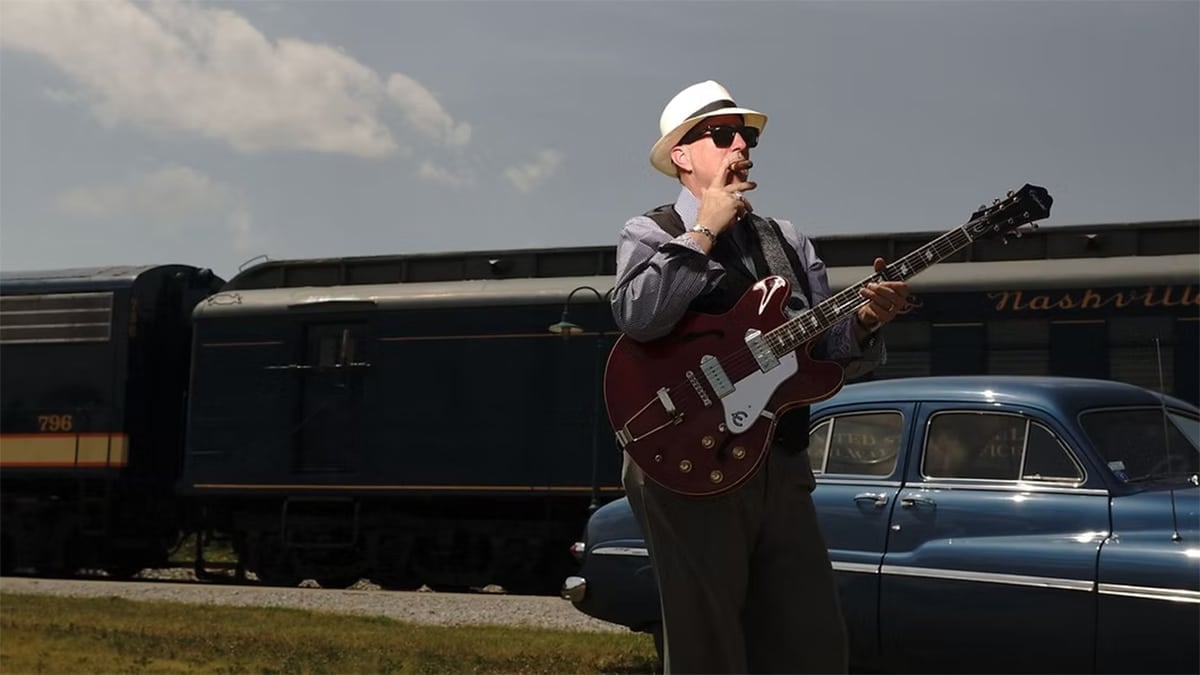
Stacy Mitchhart’s musical journey began in Cincinnati, Ohio, in a house where jazz guitar masters like Wes Montgomery and Johnny Smith were always spinning on the stereo. With that kind of soundtrack in the air, it was only natural that he gravitated toward the guitar. But it wasn’t just the notes that grabbed him early—it was the performance. As a kid, he saw Little Richard on television and couldn’t look away. Little Richard’s style, confidence, and larger-than-life showmanship opened Stacy’s eyes to a powerful idea: music isn’t only something you play—it’s something you deliver. That lesson became a lifelong part of Mitchhart’s identity, and today he’s known for a brand of showmanship that keeps audiences coming back night after night.
Even as he heard the big rock bands everyone else grew up on, Stacy knew his heart was somewhere else. “I heard Springsteen, Zeppelin and Pink Floyd, but that stuff never moved me,” he says. “When I saw Bobby ‘Blue’ Bland and B.B. King, I knew what I wanted to do.” The blues gave him something deeper—emotion, groove, and a direct connection between the performer and the crowd. Over time, his playing became “more focused and aggressive,” shaped by the artists who hit him in the chest, not just the ears.
Another key influence was Cincinnati guitarist and singer Frank Hedges, a “musical preacher” whose sons played in Stacy’s first band. Hedges had a rhythmic, almost drum-like guitar style that taught Mitchhart to build everything around the groove. That mindset—rhythm first, feel first—became a cornerstone of Stacy’s sound, and it’s part of why his live shows have such a strong physical pull.
Mitchhart has always been a bandleader. In Cincinnati, he fronted four different groups, steadily climbing to the top of the city’s blues scene while developing his sound and stagecraft in real time, in front of real crowds. He launched his recording career there with Blues Transfusion in 1993 and went on to release more than a dozen albums, including the critically praised Grown Ass Man (2009) and Live From B.B. King’s (2010). By the early 1990s, he was widely recognized as Cincinnati’s top blues act—but he still felt the pull of a bigger musical home.
That home turned out to be Nashville.
When Stacy played his first gigs in Nashville nearly two decades ago, the connection was immediate. “The very first time I came to Nashville I sold 24 CDs off the bandstand and the audience was amazing,” he remembers. “They were alive!” Before long, he was offered the house band slot at the legendary Bourbon Street Blues and Boogie Bar in Printer’s Alley—a stage that would become central to his career and his growing international following.
Nashville changed the game for Mitchhart because of the mix of tourists and true music lovers that fill the clubs every night. “Very quickly,” he explains, “I realized I was seeing different people in the audience from all over the world every single night, and because this is Music City, they were really coming to listen.” The Stacy Mitchhart Band built a reputation as one of the city’s strongest live acts because their sound stood out and their energy was undeniable. Nearly twenty years later, that hasn’t changed—his name remains closely tied to blues in one of America’s fastest-growing music cities.
Mitchhart still plays roughly 200 dates a year without leaving home, and the international audience he’s built through Nashville has taken him to perform in eight other countries. His stage experience spans the full spectrum: sold-out arenas with 50,000 people, major blues festivals, theaters, packed clubs, and tiny rooms where you’re close enough to see every expression. “I’ve played everything from a 40-seat grocery store to backyard barbecues and weddings to corporate parties,” he says. “The bottom line is that every gig is important to the people that booked you, and the audience always deserves your best.”
That belief—respect the room, give everything, every night—sums up Stacy Mitchhart. “The truth is,” he adds, “I’m more comfortable onstage entertaining than I am in my own living room. I’ve spent my whole life there.” Whether he’s tearing into a blues burner or pulling the crowd in with something stripped down and intimate, Stacy Mitchhart remains a performer built for the stage—groove-driven, emotionally direct, and unforgettable live.
 | Spotify |  Deezer |  Breaker |
 Pocket Cast |  Radio Public |  Stitcher |  TuneIn |
 IHeart Radio |  Mixcloud |  PlayerFM |  Amazon |
 Jiosaavn |  Gaana |  Vurbl |  Audius |
 Reason.Fm | |||
Find our Podcasts on these outlets

Subscribe to Our Newsletter
Discover more from Making A Scene!
Subscribe to get the latest posts sent to your email.


