
How to Tour Like a Pro




Making a Scene Presents – How to Tour Like a Pro
Listen to the Podcast Discussion to gain more insight into Touring Like a Pro!
INTRODUCTION
Every spring, touring season rolls in like a weather front. The calendars fill up, festivals come back to life, and venues start answering emails a little faster. And every spring, the same truth shows up right behind it: if you want a real career as a musician—solo artist or full band—the job is performing. The job is the road. The job is showing up over and over until strangers become fans, fans become supporters, and supporters become the foundation of a life in music.
Radio airplay and recordings can support a tour. Streaming can support a tour. Social media can support a tour. But none of them replace touring as the economic base of an indie career. If you believe anything different, you’re setting yourself up for disappointment. There is no shortcut to stardom, and honestly, stardom is a shaky business plan anyway. Durability is the plan. A touring system that pays you, grows you, and keeps you in control is the plan.
That’s the spirit of the original article, and we’re keeping it. The van still matters. The packing system still matters. Driver fatigue still matters. Merch is still gas in the tank. The “idiot check” still saves your butt. What we’re adding is the 2026 upgrade that turns touring from “a grueling lifestyle that might break you” into “a repeatable machine that builds a music industry middle class.”
AI is now the tour manager brain most indie artists could never afford. It helps you plan, write, route, advance, budget, and follow up without burning your life down.
Web3, when you use it the right way, is not about hype. It’s about ownership. A Fan Passport that lives on-chain is durable. It travels with the fan. It can’t be buried by an algorithm. It can’t be deleted because a platform changed its mind. Sound.xyz going offline as of January 16, 2026 is a pretty loud reminder that platforms can vanish, even when they were once the center of a scene.
So yes. We’re taking a “go on-chain” stance. And we’re treating Fan Passports and gathering fan data as essential—not optional—if the goal is to build a working-class-to-middle-class indie ecosystem where artists own their masters, own their data, and own the fan relationship.
THE TOURING MAP
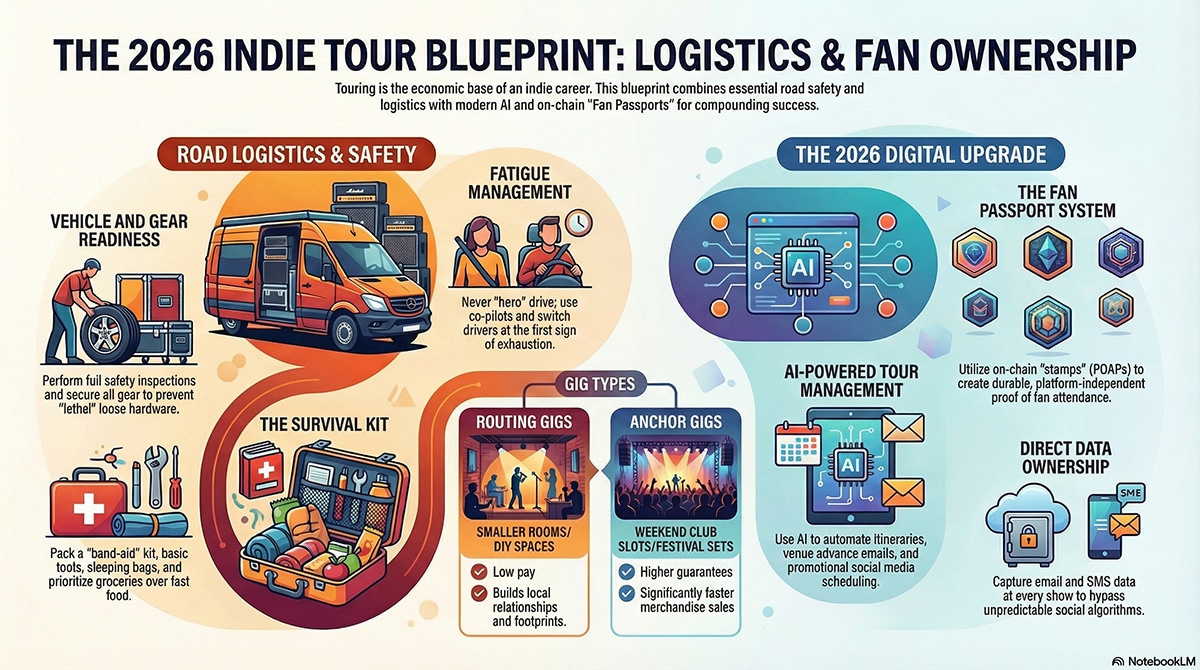
Before we get into gear, safety, and logistics, it helps to name what a real U.S. tour looks like for most indie artists. It’s usually a mix of routing gigs and anchor gigs.
Routing gigs are the smaller rooms that make the miles make sense. The Tuesday night bar. The DIY space. The listening room. The small club in the next town. They may pay less, but they build your footprint, create local relationships, and give you a place to perform while you move.
Anchor gigs are the bigger nights that hold the tour up. A weekend slot in a known club. A theater opener. A festival set. A city where you already have a pocket of fans. Anchor gigs are where the guarantees are stronger, merch moves faster, and your growth shows up in a way you can feel.
A smart tour uses routing gigs to build and anchor gigs to cash in. That’s true whether you’re a solo artist traveling light or a full band hauling amps and drums. The difference is your overhead and your break-even number. A solo artist can sometimes survive on a string of smaller rooms. A band usually needs tighter routing and more anchor nights to keep the whole operation from bleeding out.
Now let’s do the part that keeps artists alive and keeps tours from collapsing.
BEFORE YOU HIT THE ROAD
Tour vehicle
If you own your tour vehicle, the first thing you do before a run is take it to a mechanic you trust and get a full safety inspection. Touring puts “serious mileage” on a vehicle, and you want to find problems at home, not in the middle of nowhere. Check all fluids, get an oil change, check tires, brakes, front end, wipers, lights, and fix anything questionable.
You also want an emergency fund or a credit card with at least a couple thousand dollars available. This isn’t pessimism. It’s adult touring. Breakdowns don’t ask permission. I’ve been on tour where a rear axle broke right as we pulled up to a venue. It wasn’t dramatic. It was just expensive. Over a thousand bucks gone in one hit, and if we didn’t have the money, the rest of the tour would’ve been canceled.
Roadside service can be the difference between a bad day and a tour-ending disaster. AAA’s roadside service is well worth the investment. If you’re running a larger van or something closer to RV territory, Good Sam’s roadside coverage is built for that world.
One more detail that actually matters: lodging costs. If you’re booking hotels, AAA members can often access discounted rates at participating hotel partners, sometimes advertised as “up to 10%” depending on the chain and offer.
Packing your equipment
Have a packing system. There is nothing worse than playing Van Tetris at 4AM. If you have a system that uses the space well, write it down, take pictures, and pack the same way every time. Road cases help because they protect your gear and stack cleanly, which speeds up load-out and reduces damage.
When you pack, ask the question nobody wants to ask: what happens if you get in an accident? Loose hardware becomes lethal. A ride cymbal flying forward is not a funny story. Everything should be secured. Tie-down straps are cheap compared to the cost of injury. If possible, create a partition between passengers and gear.
Weight matters too. Try to keep the heaviest equipment on or near the rear axle of the van and balance heavy gear from side to side so the van handles better. If you’re using a trailer, keep heavy equipment toward the front. A common towing rule of thumb is aiming for more weight forward than rear so you don’t get sway, and you keep the load balanced left-to-right.
Things to pack
Beyond instruments and the obvious spares like strings and sticks, bring the stuff that makes the road survivable and cheaper.
Water is the first one. A case of water in the van saves money and keeps you functional. If you can fit a cooler, keep ice in zip lock bags so it doesn’t turn into a swamp.
Food is touring economics. Chips and sugar will wreck you on long drives. Better snacks keep you energized for showtime. Grapes, peel-and-eat tangerines, cut up watermelon, nuts, bananas, cucumbers with hummus—stuff like that keeps you hydrated and steady. If you’re playing festivals, you can often ask for a rider that includes some of these basics so you can restock for the next day.
Lunch meat and groceries are the next reality check. Fast food adds up, and it makes you feel like garbage. Grocery stores near interstates can feed a whole band for less than a couple of combo meals. Many big supermarkets have hot and cold food options that are cheaper than fast food. Many Walmart Supercenters have deli or grab-and-go options too, and those can be budget lifesavers when you’re trying to eat like a human without draining your gas money.
Bug spray sounds silly until you’re on an outdoor stage getting eaten alive. Bring it. And if you’re staying in questionable band houses or sketchy accommodations, consider a basic bedbug/flea awareness plan. I know a female artist who woke up with blistering welts from bites in a band house, had an allergic reaction, and still had to perform the next night loaded up on Benadryl and makeup. This isn’t fear-mongering. It’s “be prepared.”
An air mattress and sleeping bag can save a tour. You don’t always know what accommodations really look like. Sometimes you’re squeezing extra bandmates into a room. Sometimes the “guest bed” is a couch that smells like history. A compact sleep kit turns an awful night into a workable night.
A first aid kit matters. Band-aids, tape, antibiotic cream, calamine lotion, and the basics. Also, keep toilet paper and baby wipes in the van. Nobody plans for the moment they need them, and then suddenly it’s the most valuable thing you own.
Basic tools are another one people skip until they regret it. Pliers, a multi screwdriver, wire cutters, flashlights with batteries, and jumper cables. Touring is problem-solving in motion.
Proper planning
Time management is everything. Build your itinerary with buffer time. Give yourself at least a couple extra hours per travel leg for traffic, wrong turns, and unexpected delays. Try not to schedule more than 8–10 hours of driving in a day. It destroys your body and your focus, and it makes the band miserable.
Watch time zones. You gain time going west and lose time going east. If you cross zones and you ignore it, you will arrive late and stressed.
Save receipts for tolls and gas so you can expense them correctly. Also plan vehicle maintenance into the itinerary. The original article mentions oil changes around every 3,000 miles. That number can vary based on the vehicle and oil type, but the touring truth is the same: build maintenance stops into the plan so you’re not gambling with your vehicle.
Advancing the tour
The week before you leave, email or call every venue to finalize details. Load-in time, soundcheck, stage plot, input list, who’s running sound and production, who pays you at the end of the night, what the settlement process is, and whether accommodations are provided. If accommodations are provided, confirm the hotel address and whose name the rooms are under.
Send promotional materials early enough for the venue to use them. The original advice of sending posters a couple weeks ahead is still useful in some markets. It’s also 2026, which means you should send digital assets too, because many venues promote through socials and email lists more than physical posters.
Then call the day before the show or the day of the show to confirm nothing changed. Staff rotates. Sound engineers change. Stage plots get lost. Sometimes gigs get canceled. Advancing catches problems early.
Tour support
Tour support is how you get rebooked. A press release still helps in some towns, but the bigger move is community. If you play blues, contact the local blues society. If you play folk, contact the local folk society. If you play a danceable style, reach out to local dance groups that already gather around live music. Invite them. Make it easy for them. A little effort here can be the difference between a dead room and a night that earns you a better slot next time.
THE AI UPGRADE BEFORE YOU LEAVE
This is where touring starts to feel like a modern operation instead of pure chaos. You use AI to reduce friction.
You can use ChatGPT to build a tour itinerary template that includes wake-up time, load-out, drive blocks, meal stops, arrival buffer, load-in, soundcheck, set time, merch staffing, post-show checklist, and sleep plan. You can also use it to draft your venue advance emails so they’re consistent and professional, and to create a one-page “tour binder” document that everyone in the band has access to.
For visuals, Canva is fast and practical for tour graphics, posters, and venue shoutouts.
For scheduling posts so you’re not glued to your phone while driving, either Buffer or Metricool are great systems to post automation.
The goal is not “feed the algorithm.” The goal is “stay visible without burning out.” Touring already demands your nervous system. Don’t give it away to constant posting.
HITTING THE ROAD
Not getting lost
There’s great technology for touring. Waze is still a killer road tool because it’s built around real-time reports from drivers. It can warn you about traffic, hazards, and route changes. But keep a backup. Have a paper map or at least a backup navigation plan, because sometimes technology fails at the exact worst moment.
Gas and stops
The original article mentions a “400 miles per tank” rule and the idea that a quarter tank is about 100 miles. In reality, tank range depends on your vehicle and driving conditions, but the habit is still smart: don’t ride the needle to empty. Start looking for gas and a break when you’re getting near a quarter tank, and use the stop to stretch, use the bathroom, restock food, and change drivers.
If you want help finding cheaper fuel, GasBuddy.
Rest stops and driver changes
This is the most important safety section in the whole piece. Every life in that van depends on the driver. Nobody needs to be a hero. If you’re fatigued, change drivers. Have a co-pilot in the front seat whose job is to keep the driver alert and speak up when it’s time to switch. Touring van crashes are real, and they can be fatal.
There’s a tragic example that’s been cited for years in touring circles: on April 6, 2015, members of metal bands Khaotika and Wormreich were in a van crash on I-85 in northeast Georgia, and authorities said the driver apparently fell asleep and the vehicle hit a tree. That story isn’t here to scare you. It’s here to remind you that fatigue management is part of being professional.
Respect your bandmates
Don’t be a dick. You’re in a small space together for hours. Keep disagreements out of the van. Shower before you get in. Keep the van livable. And yes, the van is a no fart zone. Everybody laughs until they’re trapped for eight hours with a drummer who thinks biology is a prank.
Travel comfortable
Small comfort changes your whole day. Tight jeans might be great on stage, but they’re miserable in a van for hours. Wear something that lets you breathe. Take off your shoes when you’re not driving, and keep clean socks. For some reason, taking your shoes off really does calm your body down on long drives. Touring is physical. Treat it like it is.
Laundry
On longer tours, schedule a laundry day on an off day. Dirty clothes belong in odor-blocking bags so the van doesn’t turn into a rolling locker room. Small habits keep morale from collapsing.
Charging stations
Have enough ports for everyone to charge phones and tablets. A multi-port USB splitter is cheap and it keeps everyone connected. The trip goes smoother when nobody’s phone is dead and nobody’s bored and angry.
Avoiding getting pulled over
Be smart. A van full of musicians is a stereotype on wheels, and cops know it. Never have anything illegal in the van. Don’t have open containers. Be respectful. Cooperate. Nothing kills a tour faster than someone making a dumb decision that turns into a legal problem.
Use cruise control. The original advice of setting it about five miles over the limit is a common touring habit, but use judgment. The real point is this: it’s easy to drift 20 miles over without noticing on an open highway. Cruise control keeps you from “accidentally” buying expensive tickets.
WHEN YOU GET TO THE VENUE
Touring is different than hometown gigs. On tour, you’re a traveling salesperson. You’re demoing your product in a new market. You want people to love it, buy it, and tell their friends. You also want the venue to want you back.
Be professional
Arrive on time for load-in. Respect the venue’s space. Sometimes people are eating or drinking during load-in. Don’t bulldoze the room. Introduce yourself to staff. One of the funniest bits from the original article still works: introduce yourself to the bar staff and jokingly apologize for the drummer ahead of time. Suddenly everybody wants to meet the drummer. Comedy is marketing.
Learn the sound engineer’s name
Everyone in the band should know it. Sound engineers are the difference between “we sounded huge” and “we fought the mix all night.” Treat them like a teammate, not a servant. Be patient and cooperative. It pays off.
Help each other
If your drummer needs a hand and your rig is set, help. Touring is a team sport. Everyone loads. Everyone sets. Everyone breaks down.
Start on time and finish on time
If you’re on a multi-band bill or festival, respect the clock. No encores unless you’re the headliner or you’ve cleared it with the next act and the venue. Noise ordinances are real. Don’t get the venue in trouble.
Push your merchandise
If you’re playing for a small guarantee or a door deal, merch is gas in the van and food for the band. Someone should go to the merch table immediately after the set. Not five minutes later. Not after a drink. Immediately.
To take payments easily, Square’s POS tools. Fans want to support you, and friction kills sales. Make it easy. For online direct-to-fan sales that match the spirit of indie culture, Bandcamp’s artist portal. If you want a broader e-commerce store setup, Shopify .
Get to know the other acts
Bands cross paths constantly. The act you meet in Nashville is the act you’ll borrow a cable from in Milwaukee. Relationships are touring currency.
Get paid
Designate one person to handle money and settlement. It’s a skill. It gets better with repetition. Consistency prevents confusion and prevents fights.
The idiot check
Two people do a final walk-through before leaving. Flashlight. Every room you used. Stage. Green room. Bathroom. Merch corner. Then do it again at the hotel the next morning. It sounds stupid until it saves you. And it will save you.
Make your goodbye memorable
Shake hands. Thank staff. Tell them you appreciate them. Leave a card. The bartender or door person who likes you is often the person who pushes your name around the building. That’s not politics. That’s reality.
Stay connected to fans
Make a quick video the next morning thanking the venue and the staff, and telling people where you’re headed next. Tag the venue. Post photos. Post the drummer sleeping and drooling in the van. That kind of content is human and it’s sticky.
Now we take the original article’s “stay connected” idea and turn it into the core system that makes touring profitable.
THE 2026 CORE: FAN DATA AND FAN PASSPORTS
Here’s the biggest touring mistake in the indie world. Artists put all the energy into getting people in the room, and then they leave town with no way to reach those people again.
That means every city is a reset. Every tour is starting over. That’s why artists burn out. Not because they can’t perform. Because they can’t compound.
Fan data is how you compound. Email. SMS. And now, on-chain identity through Fan Passports.
Bandsintown for Artists is literally pitching “automatically collect fan contacts” right on their artist side, which tells you the industry already knows this is the game. Use tools like that when they help, but keep your long-term plan clear: you want your fan relationship exportable and owned.
If you’re running email marketing, Mailchimp if you want an email sending infrastructure option, SendGrid. The tool matters less than the habit: every show captures fan contact info.
But here’s where the Fan Passport becomes essential.
The Fan Passport is not a gimmick
A Fan Passport turns “I saw you once” into “I’m part of this.”
It works because it gives fans a ritual. They show up, they claim a stamp, they get recognized, and that recognition builds loyalty. Loyalty builds repeat attendance. Repeat attendance makes touring profitable.
Off-chain passports can work. A stamp card can work. A QR-based points system can work. But an on-chain passport is durable. The fan owns the proof. It travels with them. It can unlock perks anywhere you decide. It doesn’t disappear when a platform changes its algorithm.
That durability isn’t theoretical. Sound.xyz going offline is a clean example of why “platform-dependent identity” is fragile, while on-chain proof persists. Sound’s own shutdown message says the proof of support lives on-chain and collections can still show up anywhere you connect your wallet, mentioning OpenSea as an example.
This is how you sell the idea to the fan: you’re not asking them to “join your mailing list.” You’re inviting them into a story they can collect, keep, and use.
How on-chain stamping works in real life
POAP is one of the clearest “touring stamp” tools because it’s literally built for Proof of Attendance. Their site describes POAP as a way to mint memories as digital mementos on the blockchain.
In practice, the touring version is simple. You put a QR code at the merch table that says, in plain language, “Claim tonight’s Passport Stamp.” Fans scan it. They claim the stamp. They walk away with a collectible that proves they were there. That stamp becomes the base layer of your touring economy. Now add the second layer: access.
Unlocking perks without gatekeepers
Unlock Protocol is built around on-chain memberships and subscriptions as NFTs and the docs . This is where your Fan Passport becomes more than a collectible. It becomes a key.
A key can unlock almost anything you want to offer, and you should not restrict the possibilities. Some fans want discounts. Some want early entry. Some want a secret set. Some want a private livestream. Some want a merch drop that’s only for passport holders. Some want recognition. Some want access to community spaces. Some want a personal moment, like a meet-and-greet that doesn’t feel rushed and transactional.
Your job is to build a perk ladder that includes both free and paid options, and that works across venue sizes. In a small routing gig, the perk might be simple: a stamp plus a downloadable live track, or a stamp plus early notice when you come back. In a medium room, it might be stamp holders get first shot at a limited shirt colorway. In an anchor gig or festival, it might be stamp holders get access to a “passport line” at merch, or an invite to a post-show hang, or a bonus acoustic mini-set.
The passport isn’t “VIP only.” It’s “belonging made visible.”
Making onboarding easy for normal humans
Here’s the part artists get wrong when they “go Web3.” They make it complicated.
You don’t sell wallets. You sell memories and access. You make it easy.
Manifold is one of the clearer creator toolsets for making and distributing digital goods on Ethereum, and their site states that focus directly. Manifold Studio’s login flow explicitly offers “continue with wallet” or “continue with email,” which is a big deal for fan onboarding because email is familiar and lowers friction.
That doesn’t mean the passport isn’t on-chain. It means you can meet fans where they are and still bring them on-chain without making them feel stupid at a merch table.
Where fans can view what they own
OpenSea is one well-known marketplace where wallet-based collections can appear. You don’t need fans to become traders. You’re not pitching flipping. You’re pitching proof. “You were there” is the product.
How the Fan Passport makes the tour profitable
This is the middle-class math.
Routing gigs bring in new fans. Passport stamps convert them into repeat supporters. Anchor gigs monetize the momentum with bigger crowds, stronger merch nights, and deeper perks. The passport encourages travel behavior, too. It gives fans a reason to catch you in the next city. It gives them a reason to bring a friend so their friend can “start their passport.”
Suddenly your tour isn’t just a string of nights. It’s a season-long game fans can play with you. That game is what keeps your rooms from being empty on weeknights, and what makes your return routing stronger next time.
This is also where fan data becomes non-negotiable. The passport gives you on-chain proof. Your email and SMS list gives you direct communication. Together they create a touring engine that is not dependent on social reach.
SECURITY AND PROTECTING YOUR EQUIPMENT
Load in and load out
Never leave the van or the stage unattended during load-in or load-out. Theft happens fast. A touring day is full of moments where everyone assumes someone else is watching. Don’t assume.
Keep your guitar near
Never leave your guitar or bass in the van while you sleep. Bring them into the room. It’s just stupid not to. If you’re flying, don’t check your guitar if you can avoid it. Protect your investment.
Don’t brand the van
A logo-covered van screams “expensive gear inside.” Keep it discreet. If your windows reveal gear, cover it with moving blankets. Park smart, back against a wall when possible, and choose well-lit areas.
Document your equipment
Make a spreadsheet with make, model, serial number, and photos of each item, including serial numbers. Store it in a shared cloud folder so the whole band can access it. Dropbox is a great way to store this in the cloud and have immediate access to it when you need it.
If gear gets stolen, reporting helps. MusicalChairs has a stolen instruments section. It’s classical-leaning, but the principle is the same: the more documentation you have, the better your odds.
Property stickers
Hide identifying stickers or markings inside gear where they’re not obvious. Under a pickup, inside a speaker cab, somewhere that helps you prove it’s yours if it turns up later.
Insurance
If you’re touring, insurance is not optional. MusicPro, Clarion, Anderson Group, Heritage are a few options. Compare terms and exclusions and get the coverage that matches your real touring behavior.
GPS locators
Trackers can add a layer of protection for trailers, vans, and cases. The point isn’t to promise recovery. It’s to reduce the time between “something moved” and “you know where it is.”
Examples you can research include Spytec GPS, The “Tempo GPS Tracking System for Instruments and Gear” still appears at retailers like Music & Arts: . Another example name that pops up is BlackHawk LTE at DataBlaze. Do your research, verify current plans and fees, and test whatever you buy before tour.
HAVE FUN
You are on tour. Enjoy yourself. See the town if you can. Build stories. Visit the weird roadside stuff if the schedule allows. Those little moments become band glue, and band glue shows up on stage.
And here’s the new ending that keeps the original heart intact while telling the modern truth. If you plan well, drive safe, respect each other, push merch like it matters, and run an on-chain Fan Passport with real fan data capture, you don’t just come home with memories.
You come home with momentum you own. You come home with proof of attendance that fans carry like badges. You come home with direct contacts you can reach without begging an algorithm. You come home with a touring system that builds a music industry middle class—one routing gig, one anchor night, and one passport stamp at a time.
If you’ve got a road tip or a road story, because touring is learned in the wild. Drop it in the comments and help the next artist survive their spring run.
 |  Spotify |  Deezer |  Breaker |
 Pocket Cast |  Radio Public |  Stitcher |  TuneIn |
 IHeart Radio |  Mixcloud |  PlayerFM |  Amazon |
 Jiosaavn |  Gaana |  Vurbl |  Audius |
 Reason.Fm | |||
Find our Podcasts on these outlets
Subscribe to Our Newsletter
Discover more from Making A Scene!
Subscribe to get the latest posts sent to your email.


