Why Most Indie Artists are Underpaid Data Workers




Making a Scene Presents – Why Most Indie Artists are Underpaid Data Workers
Listen to the Podcast Discussion about how we can break the Cycle
THE NIGHT AFTER THE EXPORT
The song is done. The mix is printed. The master is bouncing. For a few seconds, you get that clean feeling that only musicians understand. You made something that didn’t exist yesterday, and now it does.
Then you open the upload screen and the second job starts.
You type the title. You type it again because you forgot the parentheses. You paste credits into a form that looks like it was designed for 2009. You guess at genre because none of the options match what you actually sound like. You check your spelling like you’re filing a court document. You hunt down an ISRC. You double-check your featured artist formatting because you’ve learned the hard way that one tiny inconsistency can split your catalog into two different versions of you.
Then you leave the music world and step into the platform world. You cut a clip for TikTok (https://www.tiktok.com/). You post it to Instagram (https://www.instagram.com/). You upload a short to YouTube (https://www.youtube.com/). You tease the release on Spotify links (https://www.spotify.com/). You answer comments. You answer DMs. You do your best “authentic” voice while you quietly keep track of what time of day the post hits harder.
A lot of people still call this “marketing.” That word is too small for what’s happening.
This is labor. It’s repeatable labor. It’s data labor. And it creates massive value.
The part nobody tells you is that the modern music economy pays you mainly for the song, but it profits heavily from the data you generate around the song. That’s why so many indie artists feel like they’re running on fumes while the industry looks like it’s “booming.”
It’s not because you’re failing. It’s because you’re doing two jobs inside a system that barely pays you for one.
WHAT YOU REALLY MAKE NOW
If you’re an indie artist in the U.S. market, you create value in three layers at the same time, even if you never signed up for that. The first layer is the obvious one. You create the recording and the song. You write, perform, produce, and release. That’s the art. That’s the work people actually love.
The second layer is attention. When you post, when you tour, when you talk to fans, when you livestream, when you share clips and behind-the-scenes moments, you create engagement. That engagement is not just “nice.” It’s measurable behavior. It tells platforms what keeps people watching and listening.
The third layer is the one artists get punished for ignoring: metadata. Titles, credits, splits, ownership, and all the identifiers that connect a recording to the right people so money can move correctly. In the U.S., this is not paperwork for paperwork’s sake. This is how the royalty system knows who to pay.
Here’s the uncomfortable punchline. The biggest money in platform economies goes to whoever owns the database and controls the relationship. Indie artists do a lot of the work that fills and cleans that database, but they do not own it.
That’s why the phrase “underpaid data worker” fits. It’s not an insult. It’s a diagnosis.
WHY “PER STREAM” IS THE WRONG ARGUMENT
Artists love to talk about “per stream” rates because it feels like a fair fight. How much is my work worth per play?
But major streaming payouts don’t work like a price tag on a single listen. Spotify says it does not pay royalties according to a fixed per-play or per-stream rate, and it explains royalties using a “streamshare” approach based on total streams and the royalty pool.
That doesn’t mean “Spotify is lying” or “Spotify is evil.” It means something more useful: the system is designed so your income is tied to a pool you don’t control, inside a marketplace you don’t own, under rules that can change without you getting a vote.
So the deeper question isn’t “what’s the per-stream rate?” The deeper question is “who controls the fan relationship and the data that decides what happens next?”
Because if you don’t control that, you can have attention without stability. You can have streams without income you can plan around. You can have followers without a way to reach them tomorrow.
THE U.S. MUSIC MONEY SYSTEM RUNS ON DATA
This is where the U.S. market matters, because the U.S. royalty system has specific plumbing that depends on clean matching.
The U.S. Copyright Office explains that the Mechanical Licensing Collective (MLC) administers the blanket licensing system created by the Music Modernization Act, receives notices and reports from digital music providers, collects and distributes royalties, and identifies musical works and their owners for payment.
That last part is the whole story in one line: identify works and owners for payment.
If the data doesn’t match, the money doesn’t route cleanly. It can get delayed. It can get misdirected. It can sit in limbo. That isn’t “drama.” It’s the logic of the system. A system that pays by matching, needs matching data.
This is why indie artists end up doing hours of “boring” work. Not because someone wants to torture you, but because the industry is basically a chain of databases trying to agree on what your song is and who owns it.
You do the work because you have to. But the value created by that work doesn’t always come back to you.
BLACK BOX MONEY IS THE RECEIPT
If you want a hard, documented example of what happens when the data layer breaks, look at unmatched royalties.
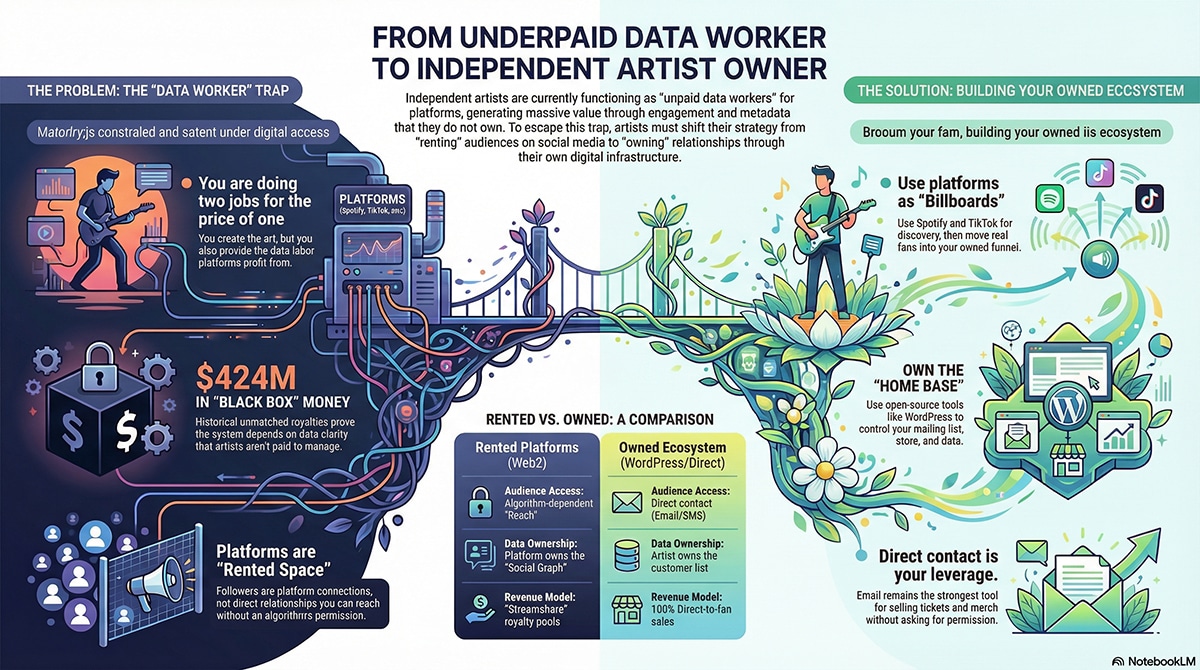
The MLC announced it received $424,384,787 in accrued historical unmatched royalties from digital service providers, along with corresponding data reports meant to identify the usage tied to those royalties.
That number is the receipt for the whole “data worker” argument. Money was generated by music usage, but it could not be matched cleanly at the time. So it piled up.
Indie artists hear numbers like that and think, “So somebody stole it.” Sometimes there can be disputes, sure, but the bigger point is simpler: the system is data-dependent. When the data is messy, money can’t find the right home fast.
And who gets told to clean up the mess? Usually the people with the least leverage. Indie artists. DIY teams. Small labels. Producers who wore five hats and still didn’t get a full night’s sleep.
That’s what it means to be an underpaid data worker. You’re expected to keep the system clean, but you don’t get paid like you own the system.
YOU’RE NOT JUST PROMOTING. YOU’RE TRAINING MACHINES.
Now let’s talk about the part that doesn’t show up on royalty statements.
When you post clips and content on TikTok, Instagram, and YouTube, you aren’t only promoting your music. You’re creating the raw material that makes those platforms smarter.
Every post is a test. Every comment is feedback. Every “watch time” metric is a signal. Your fans’ behavior teaches the algorithm what to recommend. Your own behavior teaches it what kind of creator you are and how to distribute your content.
This is why artists feel exhausted. You’re not just making music and sharing it. You’re doing ongoing experimental labor inside a system built to optimize attention.
And here’s where it gets rebellious, but still provable. Platforms are not neutral stages. They are businesses designed to keep people inside them. The more time fans spend inside the app, the more value the platform can create, whether that value comes from subscriptions, ads, or whatever else the company sells.
So when an indie artist gives a platform endless content and engagement, the platform gets two benefits. It gets entertainment, and it gets behavior data. That behavior data is the real gold, because it’s how platforms improve targeting and retention.
You get “reach,” but you don’t get ownership of the relationship that reach touches.
RENTED SPACE: WHERE YOUR FANS BECOME SOMEONE ELSE’S ASSET
Let’s name names
Spotify is rented space. YouTube is rented space. TikTok is rented space. Instagram is rented space. Even when these platforms are helpful, they are still rented space because you do not own the fan relationship inside them.
A rented space platform can show you numbers. It can show you cities. It can show you demographics. It can show you “insights.” But it usually does not hand you the keys to the relationship.
This is why artists get trapped in a weird emotional loop. You see followers, likes, and streams, so you feel like you’re building something. But when you try to cash that attention out into real income, you realize you can’t consistently reach the same people again unless the algorithm is feeling generous.
A follower is not the same thing as a fan relationship. A follower is a platform connection. A fan relationship is a direct line you control.
That direct line is what sells tickets. That direct line is what moves merch. That direct line is what makes a membership possible. That direct line is what turns a “moment” into a career.
If you don’t build that line, you can go viral and still be broke. Not because you “did it wrong,” but because you built inside a system that captures the relationship for itself.
THE ONE THING THAT CHANGES EVERYTHING: DIRECT CONTACT
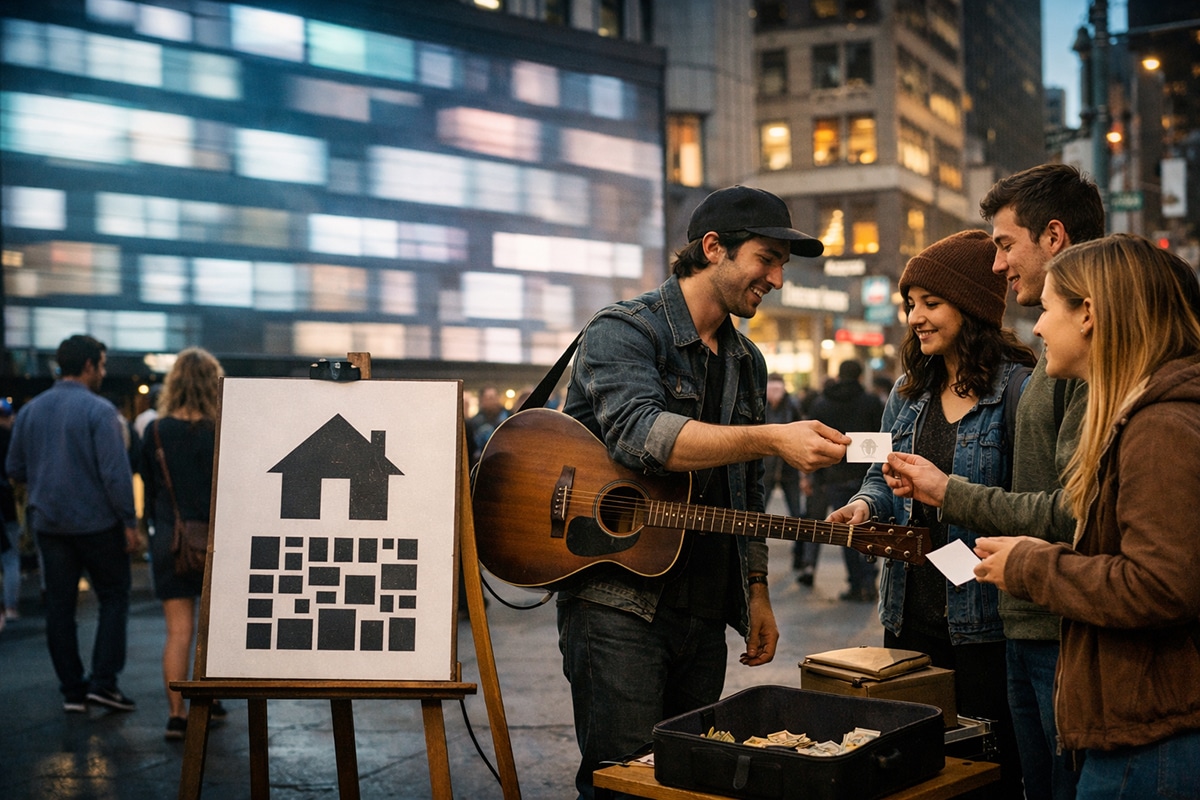
When artists talk about “owning fan data,” it can sound abstract. Let’s make it painfully concrete. Owning fan data means you can reach your supporters without asking a platform for permission. That’s it. That’s the whole game.
Email is still the simplest, strongest version of that. It’s not sexy, but it’s the backbone of independence. If you can email your fans, you can sell tickets directly, announce merch, run pre-orders, fund projects, and build repeat income.
Bandcamp is a useful example because it openly explains that fans can choose to join an artist’s mailing list when they buy or follow, and artists can require an email address for free downloads. But the bigger lesson isn’t “Bandcamp is perfect.” The lesson is that any tool that helps you turn a platform interaction into a direct relationship is more aligned with your independence than a tool that keeps the relationship locked.
If you want a middle-class career as an indie artist, you can’t build your whole world inside apps that don’t let you take your audience with you.
DECENTRALIZED SOCIAL IDENTITY: WHY THIS MATTERS TO WORKING MUSICIANS
A lot of people hear “decentralized identity” and immediately think it’s going to be complicated. Sometimes it is. But the idea itself is simple, and it hits the exact pressure point that hurts artists most: portability. In the centralized world, your identity and social graph live inside a company’s database. If you leave, you start over. If the platform changes the rules, you swallow it.
Decentralized social identity is an attempt to break that trap. It’s about making identity and connections portable so you can move across apps without losing your audience. The AT Protocol world is explicit about building for portability. Its docs describe identity and user data as part of an interoperable system, and the protocol materials talk about permanent identifiers and signed data repositories that include posts, likes, follows, and more.
ActivityPub is another major approach, and the W3C describes ActivityPub as a decentralized social networking protocol with a client-to-server API and a federated server-to-server API for delivering notifications and content. If you’re an indie artist, this matters because it points toward a future where your audience isn’t trapped in one app. That changes the leverage conversation.
It does not mean “your website doesn’t matter anymore.” It means the social layer might become less of a prison over time. And anything that makes audiences more portable is good for artists, because it reduces platform lock-in.
LENS AND FARCASTER: THE SOCIAL GRAPH AS PORTABLE INFRASTRUCTURE
Some decentralized social protocols are even more direct about the “social graph” problem. Lens describes the Graph as the network of connections between accounts, like follows and unfollows, and it notes that graphs can be deployed as onchain contracts so applications can build and manage their own audience.
A Farcaster protocol spec describes a hybrid approach where identities are stored on-chain and controlled by an Ethereum address, which can sign off-chain messages. You don’t need to pick a team jersey here. The key takeaway is the same: if identity and follows become portable, platforms lose their biggest weapon against creators, which is “your audience lives here.”
That’s the same weapon that keeps indie artists underpaid today. Portability is leverage. Leverage is money.
MUSIC-NATIVE WEB3: NOT A SAVIOR, BUT A REAL TOOLSET
Now let’s bring it back to music-native Web3 examples, without pretending any of them are a guaranteed win. Audius describes itself as a decentralized, community-owned, and artist-controlled music-sharing protocol, positioned as a blockchain-based alternative to existing streaming platforms to help artists publish and monetize work and distribute it directly to fans.
Nina describes itself as an online record store and states that artists and labels receive 100% of the revenue from digital music sales on Nina. These are not magic solutions, but they show a different set of incentives. They are at least trying to push value closer to the artist and closer to direct support.
But here’s the grown-up part, and it matters even more than the shiny features. Platforms can change or shut down in every era, including Web3. Sound.xyz states on its own site that it is offline as of January 16, 2026, while also saying proof of support lives onchain and that music and metadata are stored in decentralized storage.
Catalog.works also displays a “Catalog is winding down” notice on its site.
That isn’t a reason to panic. It’s a reason to be smart. The correct indie move is not to treat any platform as home, whether it’s Web2 or Web3. The correct move is to treat platforms as top-of-funnel discovery and build your real business in systems you control.
WORDPRESS-FIRST: THE OWNED ECOSYSTEM THAT MOST INDIE ARTISTS CAN ACTUALLY RUN
This is where the op-ed turns into a practical fight plan.
If you want to stop being an underpaid data worker, you need to own the parts of the machine that turn attention into income. That means you need a home base, a direct contact system, and a commerce system.
WordPress is a strong “home base” choice because WordPress.org describes itself as open source software built around democratizing publishing. That matters because open source is portable by design. You can move hosts. You can back up your site. You can own your domain. You can keep your content, your pages, and your data. WordPress-first is not about being trendy. It’s about being durable. Once your site is your hub, you build three things that platforms hate you having. You build a list you control. You build a store you control. You build a member relationship you can reach directly.
For email and fan CRM inside WordPress, there are tools like MailPoet and FluentCRM and Groundhogg. These are not “the only options.” They’re examples of the kind of tools that let you manage fan relationships in a place you own instead of in a place you rent.
For commerce, WooCommerce is built for WordPress, and WooCommerce describes itself as an open-source ecommerce platform for WordPress. That’s the spine of merch sales, music bundles, ticket add-ons, and any direct product you want to sell.
For memberships, tools like MemberPress and Paid Memberships Pro exist to let you create paid supporter tiers on your own site. For donations, GiveWP is a WordPress donation plugin that can help you accept support and track donor history.
Then you connect payments through systems fans already trust, like Stripe and PayPal. If you want strong deliverability at scale, you can use a sender service like Twilio SendGrid to deliver email while still keeping your list and signup flow rooted in your own domain.
This is the basic owned ecosystem. It is not glamorous. It is also the most direct path to building repeatable artist income.
ALTERNATIVE “ARTIST-OWNED” SYSTEMS THAT STILL KEEP YOU IN CONTROL
WordPress is a great default, but it’s not the only way to build an owned ecosystem.
If you are more content-driven and want a clean newsletter and membership setup, Ghost is built to publish, send newsletters, and offer paid subscriptions. Ghost also has documentation for hosting, including self-hosting.
If you want to build a real community forum where your fans talk to each other without being trapped in a social platform feed, Discourse is an open-source forum system that can be self-hosted.
If you want marketing automation that is truly self-hosted and you have the technical appetite for it, Mautic positions itself as open source marketing automation and explicitly talks about self-hosting and data sovereignty.
If you want a musician-focused website builder where the mailing list tools are built in, Bandzoogle provides mailing list features and help docs around email campaigns and newsletters.
None of these are “perfect.” The real standard is simpler: can you own your domain, own your list, and export your customer and supporter data if you ever need to move? If the answer is yes, you’re closer to independence than you are inside a rented feed.
THE FUNNEL SHIFT: USE PLATFORMS AS BILLBOARDS, NOT AS HOME
Now we get to the part that changes your income.
The job isn’t to “quit Spotify.” The job isn’t to “delete Instagram.” The job is to stop building your whole career inside spaces you can’t control.
Spotify, YouTube, TikTok, and Instagram are the top of your funnel. They are discovery engines. They are billboards. They are busy streets where strangers walk by.
Your owned ecosystem is where you turn those strangers into supporters you can actually reach again.
This is what “extracting fans” really means, without the gross vibe. It means you give a fan a reason to step closer. You don’t push them into another platform. You invite them into your world.
You offer something that makes sense. A free track. A demo. A live recording. Early access to tickets. A behind-the-scenes video. A discount code for merch. A members-only show stream. Something real, not gimmicky.
And the moment they opt in on your site, the power balance changes. Because now you can reach them again next week when the tour route drops. You can reach them when merch ships. You can reach them when you need to fill a room on a Tuesday night. You can reach them when you’re doing a pre-order to fund the next record without begging a platform for reach.
That is what turns attention into repeat income.
HOW THIS CONNECTS TO REAL ARTIST MONEY
If this article doesn’t touch real revenue, it’s just a rant. So let’s connect it to the money that keeps indie artists alive.
Touring becomes less of a gamble when you have a list segmented by city. If you can email the Atlanta supporters and the Boston supporters and the Philly supporters separately, your routing decisions get smarter. You stop guessing where fans are and start knowing where buyers are.
Merch becomes more predictable when you know who actually buys. Purchase history is a form of fan data that connects directly to revenue. If you own your store, you own that history. If you sell only through marketplaces you don’t control, you often lose the deeper relationship.
Direct music sales become meaningful again when you can offer bundles. A single track might not pay rent, but a bundle can. A vinyl plus a shirt plus a signed lyric sheet plus early ticket access can absolutely move the needle, especially when you’re selling to people who already opted in because they want to be closer.
Fan support becomes stable when it’s treated like membership, not like random tips. Monthly support is how indie artists stop living release to release. It’s also how you build the music industry middle class: a lot of artists with smaller, steady incomes instead of a few artists with huge spikes.
Licensing and publishing become less mysterious when your metadata is clean and your rights are organized. Music supervisors and licensing partners want clarity. They want to know who owns what and how fast they can clear it. When your catalog is documented, you can say “yes” faster, and fast “yes” often wins deals.
Every one of these revenue streams depends on the same foundation: relationship ownership and data clarity.
That’s why the “data worker” label matters. If you’re going to do all the data work anyway, you should do it in a way that benefits you, not the platforms.
WEB3 AS A BONUS LAYER: PROOF, PORTABILITY, AND FAN PASSES
This is where Web3 can help, but only if you keep your head on straight.
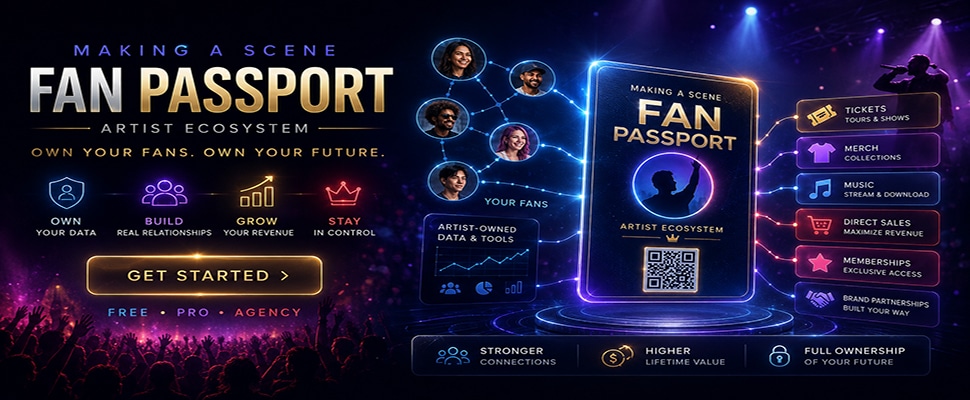
The best use of Web3 for indie artists isn’t “launch a random token.” The best use is building portable proof and portable access that you can connect back to your owned ecosystem. If you want a “fan passport” style system, Proof of Attendance Protocol (POAP) describes itself as a way to mint attendance memories as digital mementos, and it can be used as proof that someone showed up.
If you want token-gated access for members-only areas, Unlock Protocol positions itself as smart contracts for memberships with expirations and renewals, which is basically subscription logic onchain. Used responsibly, those tools can let you reward real support in ways that aren’t trapped in a single platform. But the rule stays the same: your website is the hub. Your list is the lifeline. Your store is the engine.
Web3 should be an extra layer of portability and proof, not a replacement for your owned home base.
THE MOST REBELLIOUS MOVE THAT’S ALSO THE MOST PRACTICAL
Here’s the part I wish somebody had said to every indie artist ten years ago.
Stop measuring your career by how many people saw you. Start measuring your career by how many people you can reach directly, and how many people have bought something from you. Platforms make visibility feel like the goal because visibility is what they sell. But visibility is not your business. Relationship is your business.
When you build an owned ecosystem, you stop living inside algorithm weather. You stop waking up to a new rule. You stop begging for reach. You start building a catalog, a list, a customer base, and a community that can outlive trends. This is how the music industry middle class gets built. Not by one lucky break, but by thousands of small, owned systems that feed real income back to the artist.
CLOSING: YOU ARE NOT JUST A CREATOR. YOU ARE A VALUE FACTORY.
If you’ve felt like you’re always working, always posting, always “feeding the beast,” and still not getting paid like it, you’re not imagining things.
You are creating music. You are creating attention. You are creating metadata. You are creating training data for platforms. You are creating the map of culture in real time. And you are doing a lot of it for free. The system is happy to call you a “creator” as long as you behave like an unpaid supplier. It claps for your content and then locks your audience behind a wall.
So here’s the line in the sand.
Use Spotify, TikTok, Instagram, and YouTube for discovery. Treat them like billboards. Let them introduce you to strangers. Then bring the real supporters home to a system you control. WordPress-first if you want the most flexible, portable path. Ghost if you want a publishing-driven membership engine. Discourse if you want a real community forum you can own. Bandzoogle if you want a musician-focused site with built-in list tools. Whatever you choose, keep the same rule: own the domain, own the list, own the store, own the relationship.
Because the moment you can reach your fans directly, you stop being underpaid labor inside someone else’s data factory. You become the owner of your own.
 |  Spotify |  Deezer |  Breaker |
 Pocket Cast |  Radio Public |  Stitcher |  TuneIn |
 IHeart Radio |  Mixcloud |  PlayerFM |  Amazon |
 Jiosaavn |  Gaana |  Vurbl |  Audius |
 Reason.Fm | |||
Find our Podcasts on these outlets
Subscribe to Our Newsletter
Discover more from Making A Scene!
Subscribe to get the latest posts sent to your email.


