
Why Ownership Beats Virality Every Time





Making a Scene Presents – Why Ownership Beats Virality Every Time
Listen to the Podcast Discussion on why Going Viral is not a Business Plan!
The day the internet “loves” you can still be the day you learn you own nothing
Every indie artist has felt it. You post a clip and you don’t expect much, and then your phone starts buzzing like a broken snare. Comments show up from strangers, shares stack up, and somebody types, “How are you not famous?” and for a minute you can taste the alternate timeline where one moment fixes everything.
Then you wake up the next day and the world is still expensive. The gig still pays what it pays, the tank still needs gas, and your dashboard still looks like a sad little math problem. Your email list is still tiny, your merch shelf is still lonely, and your ability to reach fans is still mostly controlled by people who don’t know your name.
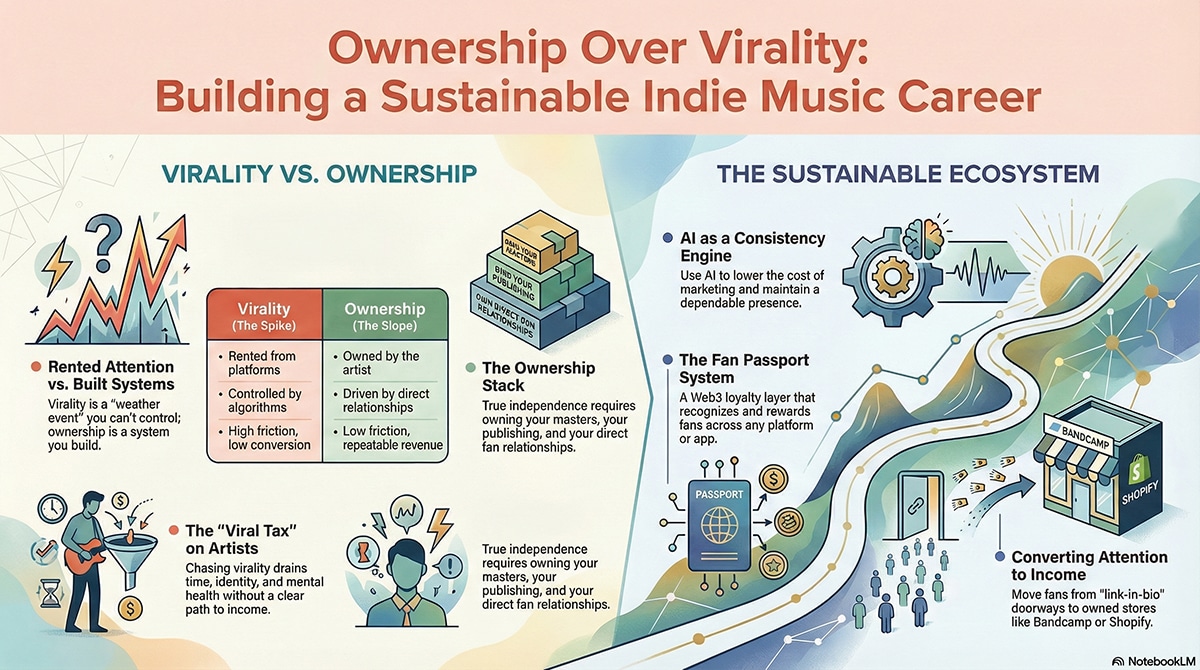
That’s the part nobody wants to say out loud because it ruins the vibe, but it’s the truth. Viral attention is not a business plan. Viral attention is a weather event.
Ownership is the opposite kind of force. Ownership is a system you build on purpose, where attention doesn’t just happen to you and vanish. It moves into places you control, and it turns into names, receipts, repeat buyers, and a community you can reach even if tomorrow’s algorithm decides you’re “not trending.”
This is why ownership beats virality every time. Not because virality is “bad,” but because virality is rented, and indie careers don’t survive on rented anything.
Virality is a spike, but ownership is a slope
Virality is dramatic because it shows up like lightning. It makes screenshots, it makes your friends text you, and it makes you feel like the gatekeepers are finally forced to look your way.
But the same thing that makes virality exciting is what makes it dangerous. Viral success is a moment that lives on a platform you don’t control, delivered by a system that can change its rules without asking you. It can throttle you, bury you, or redirect your audience to somebody else’s content five minutes later.
Ownership is slower, and that’s exactly why it wins. Ownership is a slope, the quiet compounding of routines and relationships that keep working when you’re asleep. It’s the build where your fans aren’t just watching you, they’re joining you, and you can reach them directly without begging a feed.
You can still go viral on the way to ownership, and you should welcome it when it happens. The difference is that you treat virality like wind, not like a foundation. A wind gust can move a sail, but it can’t replace a boat.
What “ownership” really means in the indie artist economy
Let’s make this plain, because the word “ownership” gets used like a bumper sticker. In music, ownership is not one thing. It’s a stack.
Owning your masters means you control your recordings. Owning your publishing means you control your songwriting rights. Those are the classic pillars, and they matter because they protect your long-term value.
But in 2026, there’s a pillar that might matter even more for day-to-day survival and growth. It’s fan ownership, and it’s the one pillar most artists were never taught to build.
Fan ownership means you own the relationship layer, meaning you control the permission to reach your community and you control the data that helps you serve them. When you own the relationship, you can say, “I’m playing a show next month,” and actually reach the people who already care. You can drop a new shirt and know who bought the last one. You can offer an early listen and not worry that an algorithm will bury it.
This is where AI and Web3 stop being buzzwords and start becoming tools. AI helps you show up consistently enough to earn trust, and Web3 helps you turn that trust into a more durable, portable kind of membership that isn’t trapped inside one platform.
The “viral tax” nobody talks about
The biggest lie in modern music isn’t just “streaming pays.” The bigger lie is that if you get one big moment, everything else falls into place.
That lie creates a tax. It taxes your time because you keep chasing the next clip instead of building the next system. It taxes your identity because you start shaping your art to what performs instead of what lasts. It taxes your mental health because you start measuring your worth in likes and reach.
It also taxes your business because viral attention often arrives with no path to convert. A million views can equal nothing if viewers don’t know where to buy, how to join, or why they should stick around. That isn’t because fans are evil. It’s because the internet is friction, and commitment is always harder than attention.
You don’t need to become anti-viral. You need to become anti-dependent.
Your career is a conversion machine, not a highlight reel
If you want sustainable income, your goal isn’t “get big.” Your goal is “convert attention into owned relationships,” and then convert those relationships into multiple revenue streams. Most artists never build that bridge. They post, and when it works they celebrate, and then they post again hoping lightning strikes twice.
The artists who last do something different. They treat every piece of attention like a visitor walking into a tiny independent shop. The visitor might browse and leave, and that’s fine, but the shop owner doesn’t just stare and hope they come back. The shop owner makes it easy to take one small step that keeps the relationship alive.
Your music career is that shop. Your systems are the signage. AI is the staff member who helps keep the shelves stocked. Web3 is the loyalty layer that can actually belong to you and your fans.
AI is the consistency engine that makes ownership possible
Ownership requires you to show up consistently enough that fans believe you’re real. Not “famous,” but present, dependable, and worth paying attention to. Before AI, consistency usually meant one of three things. You had money to hire help, you had endless time, or you burned out trying to do everything yourself.
AI doesn’t magically create your voice, and it doesn’t replace taste. What it does is more valuable for working indie artists: it reduces the cost of consistency. If you can lower the effort required to plan content, cut clips, draft captions, write emails, and keep your release machine moving, you stop treating marketing like a panic sprint and start treating it like a routine.
A practical starting point is using a general assistant to help you think, draft, and repurpose. For many artists that’s ChatGPT at https://chatgpt.com/. The key isn’t asking it to “write a viral post.” The key is asking it to build a repeatable workflow that turns one creative moment into a week of assets.
Imagine you record one long video: a rehearsal run-through, a behind-the-song story, a studio session, a live clip, or a simple talk to camera about what you’re building. You run it through an AI assistant and ask for three angles that match your brand, three hooks that fit short-form, and captions that sound like you rather than like a marketing robot.
Then you use tools that make the production part less painful. CapCut at https://www.capcut.com/ can help you cut short clips and add captions quickly. Descript at https://www.descript.com/ can help you edit audio and video like text, which is a lifesaver if you hate timelines. Canva at https://www.canva.com/ can help you create clean visuals and thumbnails without pretending you’re a graphic designer.
AI becomes your content operations assistant. You stay the artist.
Ownership begins when a fan can reach you without a platform
A fan can love your clip and still not be “yours” in any meaningful way. That doesn’t mean you’re entitled to them, but it does mean your relationship is fragile if the only way you can reach them is through a platform feed.
The first layer of ownership is direct contact, and that usually means email and text. Email is still the most underrated superpower in music because it’s boring, and boring is often where the money hides.
To collect emails you need two things: a reason and a place. The reason is a simple offer that respects the fan, like early listens, ticket first dibs, a monthly demo, a behind-the-scenes story, or a small discount. The place is the infrastructure.
Kit (formerly ConvertKit) lives at https://kit.com/. Mailchimp lives at https://mailchimp.com/. beehiiv lives at https://www.beehiiv.com/. Substack lives at https://substack.com/home-i.
You don’t need to sound like a corporate newsletter. You can sound like a person who makes music and wants to keep in touch. AI can help you say what you actually mean clearly, and it can help you keep up with follow-ups without losing your voice.
Your link-in-bio is not your home, it’s your doorway
Most viral moments die because they have nowhere to go. Someone watches your clip, feels something, and then they hit the bio link. If the bio link is a messy list of options, they bounce.
A clean doorway matters, and Linktree at https://linktr.ee/ can be useful when you’re starting because it gives you one simple route. The rebellious truth is that your doorway should lead to something you own, not just another platform profile.
Your goal isn’t to “get them to Spotify.” Your goal is to get them into your ecosystem, meaning your list, your store, your community, and your offers.
The store is where attention becomes income
You can’t build a middle-class music career on vibes. You build it on receipts.
Bandcamp lives at https://bandcamp.com/and it’s powerful because it normalizes direct support. Shopify lives at https://www.shopify.com/ and it’s powerful because it can be a full commerce engine that you control. Patreon lives at https://www.patreon.com/ and Ko-fi lives at https://ko-fi.com/, and both can support recurring revenue and membership.
You don’t have to pick one forever. You do have to pick one now, because the biggest difference between viral artists who flame out and system artists who last is simple. System artists have a place where fans can pay them today, and they treat those buyers like the beginning of a relationship rather than the end of a transaction.
Web3 isn’t a gimmick, it’s a deeper ownership layer
If you’ve been online for more than five minutes, you’ve seen the scams, the hype, and the weird techno-religion that sometimes comes with crypto. You’ve also seen the real problem underneath it all: the modern internet makes it easy for platforms to capture relationships and hard for artists to keep them.
Web3 matters because it offers a way to build relationships that are more portable and verifiable. In a normal platform world, your membership lives inside someone else’s database. In a Web3 world, membership can be a pass your fan holds that proves support, unlocks access, and can survive even if one platform shuts down.
This isn’t theory. Sound.xyz publicly announced it is shutting down on January 16, 2026, while emphasizing that collectors’ proof of support is onchain. Platforms come and go. Owned proofs can persist.
That’s why Web3 belongs in an ownership conversation. Not because it’s trendy, but because it reduces platform risk and strengthens your ability to keep your community connected.
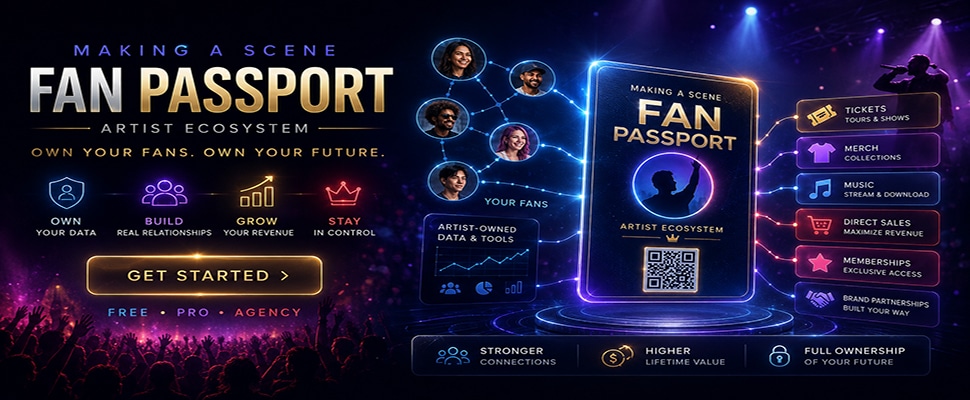
Fan passports: your loyalty program with teeth
The most useful way to understand Web3 as an indie artist is this: it’s a loyalty layer that can be designed to feel like normal life. Your fan passport is not “crypto for crypto’s sake.” It’s your membership and rewards program, built so it can outlive any single app.
A fan passport can recognize repeat behavior in a way your platform followers never will. A fan comes to a show and earns a stamp. A fan buys merch and earns a stamp. A fan joins your street team and earns a stamp. A fan supports a release and earns a stamp. Those stamps add up to levels, and those levels unlock perks that make fans feel seen.
That recognition is not just sentimental. It’s economic. It rewards the fans who keep you alive, and it gives you a system that creates repeat revenue without begging strangers to care every week.
How to build a fan passport system without making fans use a crypto wallet
If you’ve never touched crypto, the first thing to understand is that “Web3” does not have to mean “download a wallet, write down a 12-word phrase, and pray you never lose it.” That old onboarding flow is exactly why most normal fans bounce. They came for your song, not a cybersecurity exam.
So if you want a fan passport system that feels like a simple download-and-use experience, you build it with walletless onboarding. In practice, that usually means an embedded wallet or smart wallet created behind the scenes, paired with a login fans already understand.
Embedded wallets create a wallet inside your app or site automatically when a fan signs in, so they don’t have to install anything or manage seed phrases. Services like Privy at https://www.privy.io/ are built around onboarding users with email, SMS, social login, or passkeys, while handling wallet creation under the hood. Dynamic at https://www.dynamic.xyz/ also focuses on embedded wallets and familiar logins, so a fan can start with something like Google or email and still end up with a portable onchain identity without feeling the crypto machinery.
If you want the “this feels like a normal app” experience, passkeys are the cleanest mental model. A passkey is basically Face ID, fingerprint, or a device-level credential, which means fans aren’t memorizing phrases. Coinbase Smart Wallet explains this kind of onboarding as a way to create a wallet without installing extensions or apps and to authenticate with familiar methods, including passkeys, depending on the flow the app uses. Fans feel like they’re signing into a website, not opening a vault.
With walletless onboarding in mind, building the fan passport system becomes a product design problem, not a crypto problem. You’re designing three things: the passport, the stamps, and the perks.
The passport is the entry-level membership pass. For a fan-friendly system, you make the passport free to claim, because the goal is relationship capture, not creating a paywall. The fan joins your email list first, because email is still the most universal direct channel, and then your site offers them a “Claim your Fan Passport” button. The button triggers a simple login, like email one-time code, SMS code, Google, or Apple. Behind the scenes, the embedded wallet is created and the passport is issued to that account.
To issue passes and stamps, you can still use creator tooling that lets you control your drops from your own site. Manifold at https://manifold.xyz/ is one option for creating and distributing digital collectibles from a creator-controlled setup. The important part is not which tool you pick, but that you can distribute passes and stamps in a way that feels like claiming a perk, not buying a complicated asset.
Stamps are your proof-of-support markers. A stamp can represent “attended a show,” “bought merch,” “joined the street team,” or “supported a release.” The best stamp flows are tied to real-world moments where a fan is already engaged, because that’s when they will actually complete the action.
At a show, the stamp can be claimed with a QR code at the merch table that opens a simple claim page, and the fan logs in the same way they claimed the passport. After a merch purchase, you can send a claim link by email or text, again using the same login. For street team actions, you can issue stamps in batches to people who completed a task, so they’re rewarded without extra steps.
Perks are what make the passport worth keeping. The perks must connect to real revenue, because the entire point is building a sustainable ecosystem. Early ticket windows create faster sell-through and reduce your reliance on ads. Member-only merch colorways create higher-margin sales and predictable drops. Private livestreams and monthly content rituals build recurring income. Early music access and behind-the-scenes stories deepen the bond that makes fans show up in the first place.
To deliver those perks, you can use token gating, but the gating should feel invisible to the fan. Unlock Protocol at https://unlock-protocol.com/ is designed for token-gated access and memberships. Guild at https://guild.xyz/ and Collab.Land at https://collab.land/ can be used to verify holders for community access, especially if you’re using Discord or similar spaces. The fan experience should feel like, “I’m logged in, and the door is open,” not like, “I’m proving cryptography.”
When you do it right, the fan passport system becomes a loyalty program that travels with your community. It recognizes the people who support you, it rewards them in ways that make sense, and it strengthens the most valuable thing you can own as an indie artist: a direct relationship that doesn’t disappear when a platform changes its mind.
The “1,000 true fans” scenario, upgraded for the AI + Web3 era
There’s an old idea that gets quoted a lot: you don’t need millions of fans, you need a smaller group who supports you consistently. The number “1,000” is useful not because it’s magical, but because it’s understandable. Let’s imagine you build an ecosystem around 1,000 true fans. Not 1,000 followers. 1,000 reachable fans who have opted into your world.
Some of those fans buy a ticket when you come through town. Some buy one merch item every few months. Some join a membership. Some buy a digital collectible pass because they want to support your releases and feel connected. AI helps you keep the ecosystem alive without burning out. It helps you plan content, tell stories, write emails, and build routines so you stay present.
Web3 helps you recognize and reward support in a way that feels tangible. It turns “I like your stuff” into “I’m part of this,” and it lets that proof travel with the fan, not stay locked inside one platform. The real win is not that every fan buys everything. The win is that your systems create multiple revenue streams, and the combination becomes predictable enough to build your life around.
What to do when you go viral this week, without wasting the moment
When you get a spike, your job is not to refresh analytics until your eyes bleed. Your job is to capture the moment into your system while the door is open. You update the bio link so it points to one clear next step that leads into your owned world. You offer something simple and real, like early access to the full song or a behind-the-scenes story, and you make the exchange fair by asking for an email or a text sign-up.
Then you add the deeper layer. You invite those new fans to claim your free fan passport, and you explain that it’s how your community gets recognized over time. You don’t lead with jargon. You lead with meaning. AI helps you move fast enough to do this while the moment is still hot. Web3 helps you turn those new fans into a membership layer you can build on even after the trend passes. That’s how you turn a spike into a slope.
Trust and safety: the part you can’t skip
If you want ownership, you must build trust, and trust is operational. It means you never ask fans for seed phrases. It means you always link to official wallet sites like https://metamask.io/ and https://phantom.com/. It means you design your system so fans don’t need to be crypto experts to participate.
It also means you respect platform rules around AI. Bandcamp has publicly stated that music and audio generated wholly or in substantial part by AI is not permitted on the platform, while small uses of AI for things like cleanup are treated differently. Your job is to use AI to strengthen your human work, not to replace it.
The point isn’t to become an “AI artist.” The point is to become an independent artist with better tools, stronger rights, and owned relationships.
The moment becomes optional when the machine exists
If there’s a single idea indie artists deserve to carry like a torch, it’s this: you do not need permission anymore. For most of modern music history, artists were trained to believe success arrives when somebody bigger picks you. A label picks you. A playlist picks you. A radio gatekeeper picks you. A platform’s algorithm picks you. Even the “go viral” dream is just a new outfit on the same old story, where a machine decides you’re allowed to matter.
Ownership flips the story. Ownership is you deciding that your career is not a lottery ticket. It’s a business you build with your songs, your systems, and your people. When you build owned fan relationships, you stop asking, “Will the platform show my post?” and you start asking, “What does my community need next?” That shift is bigger than marketing. It changes your posture. It turns you from a performer hoping to be discovered into an operator building something real.
It changes how you release music, because you’re not dropping songs into a void. You’re inviting people into an ongoing story where support is recognized and rewarded. It changes how you tour, because shows stop being isolated nights you hope someone discovers. They become checkpoints in a relationship. A reason for fans to show up, be seen, earn a stamp, and feel like they belong.
It changes how you sell merch, because a shirt isn’t just fabric. It’s identity and proof. It’s a signal that a fan is part of what you’re building, and when you treat buyers like the beginning of a relationship, merch becomes a repeatable revenue stream instead of a one-time hustle. It changes how you think about technology, because AI isn’t a replacement for your humanity. It’s the tool that gives you your time back. It’s the quiet assistant that helps you show up consistently, tell better stories, keep promises, and run the back office without burning out.
And Web3, when you design it for normal fans, isn’t a buzzword or a flex. It’s a way to make belonging portable. It’s a way to reward support without trapping your community inside one app. It’s how a fan passport system can feel like a simple login while still giving you something platforms never will: a durable ownership layer for your relationships. Now zoom out, because this isn’t just about you as one artist. This is about whether the music industry stays a pyramid or becomes a middle class.
A healthy music economy doesn’t require a few artists earning everything while most creators grind themselves into dust for “exposure.” A healthy economy looks like thousands of artists earning enough to keep going. Enough to record without debt. Enough to tour without losing money. Enough to pay collaborators fairly. Enough to raise families, pay rent, buy gear, and make art without begging for scraps.
That middle class doesn’t appear because the industry suddenly grows a conscience. It appears because artists stop building careers inside systems that were designed to extract value from them. It appears when artists own masters and publishing, yes, but also own the most valuable asset in the modern economy: direct relationships. It appears when attention becomes a doorway instead of a trap.
It appears when “a fan” becomes “a member,” not in a corporate way, but in a human way. Somebody who is recognized. Somebody who is reachable. Somebody who is part of something. Virality will always be unpredictable. It will always be weather. It can be wonderful and useful, but it cannot be the foundation. Ownership is the foundation. Ownership is the machine.
When the machine exists, the moment becomes optional. If a clip pops, you have a doorway ready. If a platform shifts, your community doesn’t vanish. If a trend changes, you’re not stranded, because your career isn’t built on the trend. If you feel behind, here’s the truth that should calm your nervous system. You’re not behind. You’re early. The old gatekeepers are still loud, but their grip is weaker than it’s ever been. The tools that used to require teams and budgets are now on your laptop. The systems that used to live inside labels can now live inside your own ecosystem.
Your job is not to become famous. Your job is to become unignorable to the people who already care. Build the relationships you can keep. Build the systems that convert attention into income. Build the passport that makes your community portable and your loyalty real. Stack multiple revenue streams so you’re never one algorithm change away from panic.
That’s the rebellion that lasts. Not a rant. Not a trend. A career that belongs to you. Virality is a moment. Ownership is a career. And a music industry middle class isn’t a slogan. It’s a decision thousands of indie artists make, one owned relationship at a time.
 |  Spotify |  Deezer |  Breaker |
 Pocket Cast |  Radio Public |  Stitcher |  TuneIn |
 IHeart Radio |  Mixcloud |  PlayerFM |  Amazon |
 Jiosaavn |  Gaana |  Vurbl |  Audius |
 Reason.Fm | |||
Find our Podcasts on these outlets
Subscribe to Our Newsletter
Discover more from Making A Scene!
Subscribe to get the latest posts sent to your email.


