

Tracking vs Mixing: Two Spaces That Should Never Fight Each Other





Making a Scene Presents – Tracking vs Mixing: Two Spaces That Should Never Fight Each Other
Listen to the Podcast Discussion to Gain More Insight into how to create the right space for the right Job!
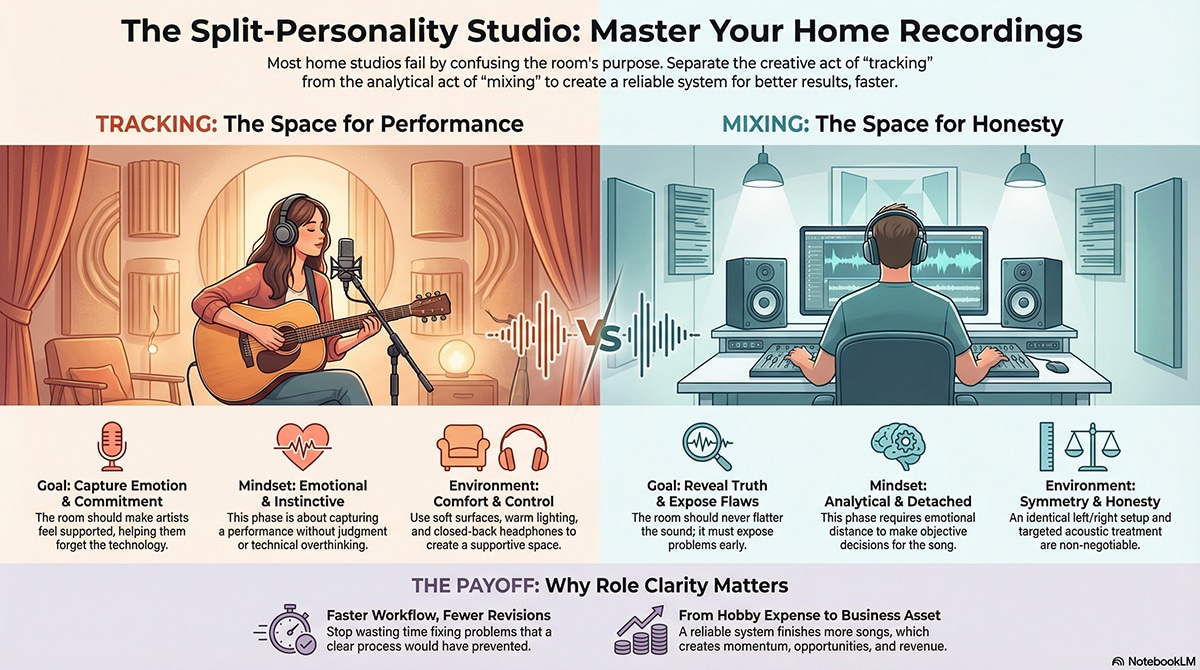
Most home studios don’t fail in dramatic ways. They don’t blow up. They don’t announce themselves as broken. They quietly stop delivering results. Songs take longer than they should. Performances feel stiff. Mixes never quite translate. Confidence erodes one small frustration at a time.
And almost always, it has nothing to do with talent. It’s rarely because the artist isn’t good enough. It’s almost never because the gear is “bad.” Home studios fail because the room itself is confused about its job.
Most artists try to make one space do everything at once, without clearly defining what that space is meant to accomplish at any given moment. That confusion shows up in the work long before it shows up in the sound.
Tracking and mixing are not just two steps on a checklist. They are fundamentally different modes of thinking. They require different emotional energy, different acoustic behavior, and completely different standards for what “good” even means.
Tracking is about capturing commitment. It’s about preserving emotion, momentum, and intention in real time. The room’s job during tracking is to stay out of the way, to support confidence, and to make it easy for an artist to give a real performance without second-guessing every detail.
Mixing is about revealing truth. It’s where honesty matters more than comfort. The room’s job during mixing is to expose problems, not hide them. It should tell you when something is too loud, too dull, too muddy, or out of balance—even when that truth is uncomfortable.
When you try to do both at the same time, the space starts lying to you.
The room flatters sounds that shouldn’t be flattering. Small issues feel bigger than they are during tracking. Big problems hide during mixing. Artists tense up because they feel judged while performing. Engineers make poor decisions because the room isn’t being honest. Workflow slows down as you fix problems that shouldn’t exist in the first place.
But when you design your space to respect each role—even if it’s the same physical room used differently—everything changes.
Tracking sessions become calmer and more productive. Performances improve because the artist feels supported instead of exposed. Mixing decisions come faster because the room gives clear feedback. Confidence grows because results become repeatable.
This works in a bedroom. It works in a basement. It works in a garage. The size of the space doesn’t matter nearly as much as the clarity of its purpose.
This distinction is not optional if you want consistent results. It’s not an advanced concept reserved for big studios. It is the foundation of any setup that’s meant to scale—creatively, professionally, and financially.
Role clarity is what turns a home studio from a collection of gear into a reliable system. And reliable systems are how artists stop guessing and start building momentum that lasts.
Why Role Clarity Improves Results (And Revenue)
Role clarity isn’t a theory or a mindset exercise. It has direct, measurable financial consequences for independent artists.
When your tracking space is designed to encourage confident performances, everything downstream moves faster. Artists commit to takes instead of second-guessing them. Sessions require fewer passes. Editing time drops. Re-records become the exception instead of the rule. That efficiency adds up quickly. More finished songs lead to more releases per year, more consistent output, and sustained momentum instead of long gaps between projects.
A mixing space that tells the truth protects you from expensive mistakes. Translation issues are one of the biggest hidden costs in home recording. Mixes that only sound good in your room trigger endless revision cycles. They delay releases, drain energy, and erode confidence. A truthful mixing environment produces mixes that travel well—from earbuds to cars to venues. Those mixes get approved faster, mastered faster, and released without drama. They also earn trust from collaborators, sync supervisors, playlist curators, and fans who expect consistency.
When your studio supports clear roles, you stop wasting time fixing problems that never should have existed. You stop chasing issues created by bad monitoring or uncomfortable tracking setups. Instead of troubleshooting, you’re finishing.
That reclaimed time and mental bandwidth doesn’t disappear. It gets reinvested where it actually matters—promotion, touring, merch, content, and direct fan relationships. Those are the activities that create income, not endless revisions.
This is the point where a home studio stops behaving like a hobby expense and starts functioning like business infrastructure. It becomes a system that supports output, protects momentum, and generates real return instead of quietly draining resources.
Tracking: Designing a Space That Captures Performances

Tracking spaces exist to serve people, not speakers.
That idea matters even more today because most modern basement and garage studios are no longer rough, unfinished spaces. They are finished rooms—drywalled, climate-controlled, wired, and intentionally built to be lived in. That changes how tracking spaces should be designed and how they function.
A good tracking space makes artists forget the technology entirely. A bad one makes them hyper-aware of reflections bouncing off finished walls, headphone bleed leaking into sensitive mics, and uncomfortable posture caused by poor layout. When the room feels awkward, performances tighten up. When the room feels supportive, artists relax and commit.
The goal of a tracking space is not silence. Silence is unnatural and intimidating. The goal is control. You want a room that behaves predictably, supports performance energy, and stays out of the way once the record button is pressed.
When the space understands its role, the artist can focus on the music instead of managing the environment.
Tracking for the Singer-Songwriter
For singer-songwriters, tracking often happens in bedrooms, spare rooms, or finished basement studios. That is not a compromise—it’s a practical advantage when handled correctly. Finished spaces already provide isolation from the outside world, stable temperature, and consistent acoustics. What they need is intentional shaping, not reconstruction.
The most important factor in these environments is psychological safety. If the artist feels exposed, judged, or sonically boxed in, performances suffer immediately. Finished rooms can sometimes feel too reflective or too “hard,” which makes singers self-conscious. The fix is not tearing walls down. It’s strategic softening.
Soft surfaces matter. Rugs, curtains, upholstered furniture, and targeted absorption around the microphone position reduce harsh reflections from drywall without killing the room. You are not trying to erase the space. You are shaping it so the voice sits comfortably inside it. A room that is too dead can feel lifeless. A room that is too reflective feels unforgiving. Control lives in the middle.
Lighting plays a bigger role than most artists realize. Finished spaces often have bright overhead lighting designed for utility, not creativity. Warm, indirect lighting lowers tension and helps performers settle into the song. Bright ceiling lights do the opposite. This is one of the easiest ways to improve vocal performances without touching a single piece of gear.
Signal chain simplicity remains critical. A reliable microphone, a clean preamp, and an interface that behaves consistently builds trust. This is where the photography analogy still holds. Microphones are like lenses. Computer systems and interfaces will change as technology evolves, but a good microphone defines character and stays relevant for decades.
A solid large-diaphragm condenser paired with a dependable interface becomes long-term infrastructure, not a disposable purchase. It scales with the artist as releases, output, and audience grow.
Tracking headphones should always be closed-back. Isolation matters even more in finished rooms because reflections are more controlled and microphones are more sensitive. Bleed ruins takes. Distractions break focus. Closed-back headphones allow singers to stay inside the performance instead of reacting to the room.
The fewer decisions required before hitting record, the better the take. Finished rooms should reduce friction, not add to it.
Tracking for the Indie Band
Indie bands face a different challenge: flexibility inside finished spaces.
Today’s basement and garage studios are often purpose-built rooms with drywall, flooring, and proper electrical. That’s an advantage, not a limitation. It allows bands to create repeatable setups and predictable tracking conditions—but only if the room is designed around real band workflows.
While bands often layer parts over time, many still track live from the floor, especially rhythm sections. Drums, bass, and guitar are frequently recorded together to capture feel, groove, and interaction, even if vocals are scratch takes. A finished basement or garage can support this extremely well when the layout reflects that reality.
Finished basements shine because they offer usable volume, isolation from the rest of the house, and enough separation to define roles within the same space. A larger finished area can function as a live tracking room, while a smaller adjacent area or corner can act as a monitoring or control position without needing commercial-level perfection.
Garage studios work the same way when fully finished. Once insulated, climate-controlled, and treated, garages often offer higher ceilings and wider footprints than spare bedrooms, making them excellent for drums and live tracking. The key is treating them like real rooms, not temporary shelters.
Tracking rooms for bands benefit from controlled chaos. Diffusion helps prevent finished drywall surfaces from sounding flat and boxy. Movable gobos allow isolation between drums, amps, and scratch vocals without permanently dividing the room. Finished rooms give you consistency; movable elements give you flexibility.
Durability still matters. Even in polished spaces, mic stands get bumped, cables get stepped on, and headphone systems get pushed hard. A tracking room should feel sturdy and forgiving, not precious. If the space makes the band afraid to move, it’s working against the music.
Closed-back headphones remain mandatory. Finished rooms often sound clearer and louder, which makes bleed even more noticeable. Isolation keeps click tracks private, prevents leakage, and lets each player lock into the groove without fighting reflections or spill.
Tracking for bands is about energy, interaction, and commitment—not perfection. When a finished basement or garage studio is designed around how bands actually work, performances improve immediately. And when tracking captures real feel, mixing becomes faster, more honest, and far less stressful later.
That’s the quiet advantage of modern finished home studios. When they’re designed to serve people first, they stop feeling like compromises and start functioning like real creative infrastructure.
Mixing: Designing a Space That Tells the Truth

Mixing is not creative in the same way tracking is. It draws from a different part of the brain entirely. Where tracking is emotional and instinctive, mixing is analytical, judgmental, and intentionally detached. It requires distance—not just from the performance, but from your own attachment to it.
That emotional distance is hard to maintain if the room is lying to you.
A proper mixing space should never flatter your sound. Flattery feels good in the moment, but it produces decisions that fall apart everywhere else. If a mix only sounds good in your room, the room is not helping you—it’s sabotaging you. A good mixing space tells you uncomfortable truths early, when they’re cheap to fix.
That honesty is what makes mixing faster, calmer, and ultimately more profitable.
Mixing Fundamentals That Matter More Than Gear
Before plugins, before upgrades, before brand loyalty, there are a few fundamentals that define whether a mixing space works at all.
Symmetry is non-negotiable. Your desk, monitors, and listening position must form a stable, repeatable triangle. Left and right need to behave the same way acoustically. If one side of the room sounds different from the other, you will chase phantom problems forever. Consistency day after day is what allows your ears to learn the room. Without that, experience doesn’t accumulate—it resets every session.
Acoustic treatment in a mixing space is about honesty, not aesthetics. Early reflection points matter because they smear imaging and distort balance decisions. Bass buildup matters because low-end lies are the most expensive mistakes you can make in mixing. You do not need a million panels, and you do not need to turn your room into a padded cell. You need intentional placement that addresses the real problems your room creates.
The purpose of treatment is not to make the room sound “nice.” It is to make it predictable.
Nearfield monitors like those from Focal are tools, not trophies. They are designed to expose issues, not impress visitors. If your speakers make everything sound exciting, they are actively working against you. Good monitors often feel underwhelming at first because they remove hype. Over time, that restraint becomes trust.
Headphones play a very different role in mixing than they do in tracking. Mixing benefits from open-back headphones because they reduce ear fatigue and present a more natural stereo image. They allow air and space, which helps with long sessions and fine balance decisions. Closed-back headphones exaggerate isolation and low-end pressure, which is useful when tracking but exhausting and misleading during mixing.
This is where systems like Slate VSX and other immersion-style headphone environments enter the conversation. These tools do not replace rooms. They supplement them. Their real value is perspective. They allow you to sanity-check decisions by hearing your mix through different simulated environments without leaving your chair.
Used correctly, these systems reduce revision cycles and improve translation. They help confirm decisions you’ve already made in a truthful room. Used incorrectly, they become crutches that replace listening instead of sharpening it. No virtual environment can compensate for a room that fundamentally lies.
The room still matters. Always.
A well-designed mixing space does one thing exceptionally well: it removes guesswork. When the room tells the truth, decisions come faster, revisions shrink, and confidence grows. That confidence shows up in releases that move forward instead of stalling—and that’s where mixing stops being a technical chore and starts becoming a real business advantage.
One Room, Two Roles: Making It Work in the Real World
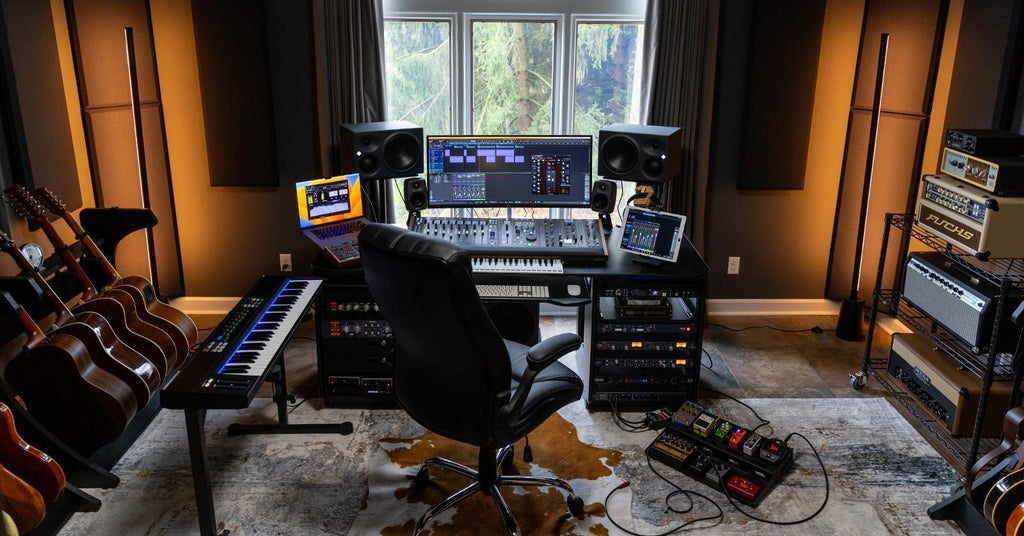
Most independent artists don’t have the luxury of fully separate rooms dedicated to tracking and mixing, and that’s not a disadvantage. True separation doesn’t require additional square footage or permanent walls. It requires intention.
One room can serve multiple roles if those roles are clearly defined and respected. The problem isn’t that artists work in small spaces. The problem is that the space is asked to do everything at once, all the time, with no clear transition between modes.
This is where movable treatment becomes invaluable. Acoustic panels on stands, rolling gobos, and even heavy curtains allow you to reshape the room depending on the task. When you’re tracking, you can soften the space around the microphone to reduce harsh reflections and create a more forgiving environment for performances. When you’re mixing, you can reposition treatment to prioritize symmetry and early reflection control at the listening position. The room doesn’t change its size, but its behavior changes dramatically.
Physical rituals matter more than they sound. Mixing and tracking require different mental states, and your brain responds to environmental cues. Moving the microphone out of sight when it’s time to mix removes a constant reminder of performance. Turning on dedicated desk or monitor lighting signals focus and analysis. Sitting in the same exact position every time you mix builds consistency in how you hear the room. Over time, these small habits train your ears and your instincts.
Protecting the boundary between tracking and mixing is critical. Never mix while tracking. Never track while mixing. When those roles blur, judgment creeps into performance and emotion creeps into decision-making. Both suffer.
That discipline alone—maintaining clear transitions between creative capture and critical evaluation—will improve results more than almost any plugin, upgrade, or workflow hack. When a single room is treated as two intentional environments instead of one confused one, productivity increases, confidence stabilizes, and the studio starts behaving like a system you can trust.
Using your Mixing Space to Train Your Ears
Using your mixing area strictly as a place to “fix” music is a missed opportunity. One of the most important — and most overlooked — functions of a mixing space is that it should also be your listening room.
This is how you train your ears to the room.
Spending time listening to music you genuinely love, music you are deeply familiar with, is how you learn how your room and monitors actually behave. You start to understand how low end feels in that space. You learn how wide a real stereo image sounds in your chair. You notice how bright commercial mixes feel on your monitors and where the vocal actually sits relative to the instruments.
That knowledge cannot be downloaded. It can only be earned through repetition.
When you regularly listen to reference material in your mixing position — not casually from the couch, not quietly while multitasking, but intentionally from the same seat where you mix — your ears calibrate. The room stops being abstract. The monitors stop being mysterious. You develop an internal baseline for what “right” sounds like in that exact space.
This is why great engineers often say they can mix on almost anything. It’s not because the gear doesn’t matter. It’s because they know their monitoring environment intimately.
Referencing those same tracks while mixing is the natural extension of this habit. When your ears drift — and they always do — reference tracks pull you back to reality. They reset your perspective. They remind you how much low end is actually normal, how bright a vocal can be without sounding harsh, how loud a snare really sits in a finished mix.
Referencing is not copying. It’s recalibration.
Using your mixing space as both a decision room and a listening room builds confidence faster than any upgrade. You stop guessing whether the problem is the mix or the room. You know. And when you know, decisions get faster, revisions shrink, and mixes translate.
This practice ties directly back to efficiency and revenue. Fewer revisions mean faster releases. Faster releases mean more consistent output. Consistent output builds trust with fans, collaborators, and industry partners.
Your mixing space isn’t just where you judge your music. It’s where you train your ears. And trained ears are one of the most valuable assets an independent artist can own.
Separate Spaces: Basement, Garage, and Dedicated Rooms
Basement studios are especially well suited for role separation, and that advantage has only grown as more basements are finished into fully usable living space. Even a modest division between a tracking area and a control or listening area creates immediate workflow benefits. You don’t need perfectly isolated rooms or commercial construction. Simply having a clear physical distinction between where performances happen and where decisions are made changes how people behave in the space.
When musicians step into a defined tracking area, their mindset shifts toward performance. When they step back into a control or listening position, the focus moves to evaluation. That physical cue alone reduces hesitation, speeds up sessions, and prevents the constant back-and-forth that kills momentum. Finished basements often provide just enough separation—walls, corners, ceiling height, or adjacent rooms—to make this practical without major expense.
Garage studios can work just as well when they are properly finished and controlled. Modern garage conversions that include insulation, drywall, climate control, and sound treatment are no longer second-class spaces. In fact, garages often offer one major advantage that many bedrooms and basements don’t: ceiling height. Higher ceilings are a gift for tracking drums, guitar amps, and live rhythm sections because they reduce early reflections and give sound more room to develop naturally.
The key with garage studios is resisting the urge to decorate instead of treat. Posters, flags, and exposed hard surfaces may look creative, but they do nothing for sound. Garages need intentional acoustic treatment—absorption, diffusion, and thoughtful layout—not visual flair. Once treated properly, a finished garage can outperform many spare bedrooms for band tracking.
Vocal booths deserve special caution, especially in home studios. Small, tightly sealed booths are one of the most common mistakes artists make. Tiny booths choke vocals quickly, stripping away natural movement, air, and emotional dynamics. Absorption without space and airflow results in dull, lifeless takes that are difficult or impossible to fix later.
If you build a vocal booth, it needs to breathe. That means adequate volume, balanced absorption, and a sense of openness. In many cases, a treated corner of a room—using movable panels, gobos, and curtains—will outperform a rigid box. Vocal recording thrives on balance, not isolation at all costs.
 For inspiration, look at Greaseland Studios. Greaseland is a powerful real-world example of how intention matters more than traditional studio layouts. Built inside a residential house and run by producer and engineer Sylvia Massy and Kid Anderson, Greaseland has hosted sessions and experiments for artists across rock, metal, and alternative music. Bands and artists associated with recordings there include Elvin Bishop, Fabulous Thunderbirds, John Primer, Tommy Castro and used by such labels as Alligator Records, among others.
What matters isn’t the celebrity list—it’s the method. Greaseland functions as an entire creative ecosystem. Drums tracked in one room. Guitars explored in another. Vocals captured where they felt right, not where convention dictated. Control rooms, tracking rooms, and creative spaces were distributed throughout the house, each serving a clear role. That flexibility allowed artists to stay in performance mode when needed and shift into critical listening when it was time to make decisions.
That’s the real lesson Greaseland offers indie artists. Great studios don’t require rigid boundaries, expensive construction, Slick looks or industry-approved blueprints. They require clarity. When every space—basement, garage, booth, or bedroom—understands its job, the studio stops feeling improvised and starts functioning like real creative infrastructure.
Gear Choices That Scale With Your Business
Cheap gear is expensive when it slows you down.
That lesson hits hardest over time, because the damage isn’t obvious at first. Lower-cost gear feels safe in the moment. It reduces upfront risk. But in a studio, the real cost isn’t the price tag—it’s friction. Gear that behaves unpredictably, breaks trust, or forces constant second-guessing quietly drains time, focus, and momentum. Those losses compound session after session.
This is where thinking in terms of the beginning and the end of the signal chain becomes critical.
Your microphones sit at the very beginning of that chain. Your monitors sit at the very end. Together, they define the identity of your studio. Everything in between—interfaces, converters, DAWs, computers, plugins—will change. They always do. Technology moves on. Software updates. Platforms evolve. That’s normal and unavoidable.
What should not constantly change are the tools that define what goes in and how you judge what comes out.
Microphones, like lenses in photography, should outlast trends. Camera bodies evolve. Sensors improve. Firmware updates roll in. But lenses define character and remain useful for decades. Microphones serve the same role in a studio. A well-chosen mic becomes a known quantity. You learn how it reacts to a voice, how it handles proximity, how it sits in a mix before you even hit record.
That familiarity removes guesswork. Guesswork is expensive.
The same principle applies at the other end of the chain. Your monitors are how you make decisions. They don’t need to be exciting. They need to be honest and predictable. When you know exactly how your monitors translate—how much low end is too much, how bright is too bright—you stop chasing problems that don’t exist. That consistency speeds up mixing and reduces revisions.
Interfaces, computers, and DAWs are infrastructure. They are replaceable. They will update, improve, or even change entirely over the years. You might move from one DAW to another. Your interface may get upgraded as workflows expand. None of that should destabilize your process.
But if you keep the identity of the beginning and the end of the chain stable—your microphones and your monitoring—you maintain continuity in how you work. You can change the middle without losing your bearings.
This approach protects cash flow. Constantly replacing core identity tools forces you to relearn your environment over and over again. That time would be far better spent on promotion, touring, content, and building direct fan relationships.
Efficient studios finish more songs. Familiar tools reduce hesitation. Reduced hesitation increases output. Finished songs create releases. Releases create revenue.
This isn’t philosophy. It’s math.
When you treat your studio like infrastructure instead of a shopping list, you stop reacting to trends and start building a system that compounds value over time.
Singer-Songwriters: Scaling Without Losing Intimacy
Singer-songwriters benefit enormously from role clarity because they are often wearing every hat at once. Writer, performer, engineer, producer. When those roles bleed into each other without boundaries, the process becomes emotionally exhausting.
Keeping writing and tracking emotional and free allows ideas to flow without judgment. In that space, the song is allowed to exist before it is evaluated. Performances feel more honest because the artist isn’t policing themselves in real time. The focus stays on connection, phrasing, and intent instead of technical perfection.
Mixing, on the other hand, becomes surgical and detached by design. That emotional distance is not a loss—it’s protection. When mixing happens in its own clearly defined role, decisions are made in service of the song rather than the moment it was created. Levels, EQ, and balance are adjusted without re-litigating the performance itself.
That separation protects the song from overthinking and endless revision. It also protects the artist from burnout. Fewer second guesses mean fewer stalled projects. Faster releases mean momentum instead of fatigue. And momentum builds trust—not just in the tools, but in the process itself.
This is how small home studios grow without losing their soul. By respecting the emotional weight of creation and the discipline of refinement as separate acts, singer-songwriters create systems that support long-term output without draining the joy that made them start recording in the first place.
Indie Bands: Protecting Relationships and Momentum
Bands fall apart in studios more often than they do on stage, and it’s rarely because of the music itself. It’s because studios expose friction. Fatigue, indecision, ego, and miscommunication all get amplified when roles aren’t clear and sessions drag on without purpose.
Clear tracking sessions protect energy. When everyone knows the goal is performance, not perfection, players commit faster. Takes move forward instead of circling endlessly. The room supports momentum instead of inviting debate. That focus keeps morale high and prevents small disagreements from turning into long nights of frustration.
Clear mixing sessions do the opposite job—and that’s exactly why they matter. Mixing is where judgment belongs. When it happens in its own defined space and time, arguments drop. Decisions get made once, based on what the room reveals, not on who speaks loudest or remembers the take most fondly. Mixing stops being a group debate and becomes a process.
That separation saves relationships as much as it saves time.
A band that finishes projects efficiently stays visible. Finished songs lead to releases. Releases keep algorithms, venues, and fans paying attention. Active bands book more shows, sell more merch, and give their audience reasons to stay engaged instead of drifting away.
This is the quiet advantage of role clarity. It doesn’t just improve recordings—it keeps bands functioning long enough to build something real.
The Big Picture: Studios as Business Infrastructure
 |  Spotify |  Deezer |  Breaker |
 Pocket Cast |  Radio Public |  Stitcher |  TuneIn |
 IHeart Radio |  Mixcloud |  PlayerFM |  Amazon |
 Jiosaavn |  Gaana |  Vurbl |  Audius |
 Reason.Fm | |||
Find our Podcasts on these outlets

Subscribe to Our Newsletter
Discover more from Making A Scene!
Subscribe to get the latest posts sent to your email.


