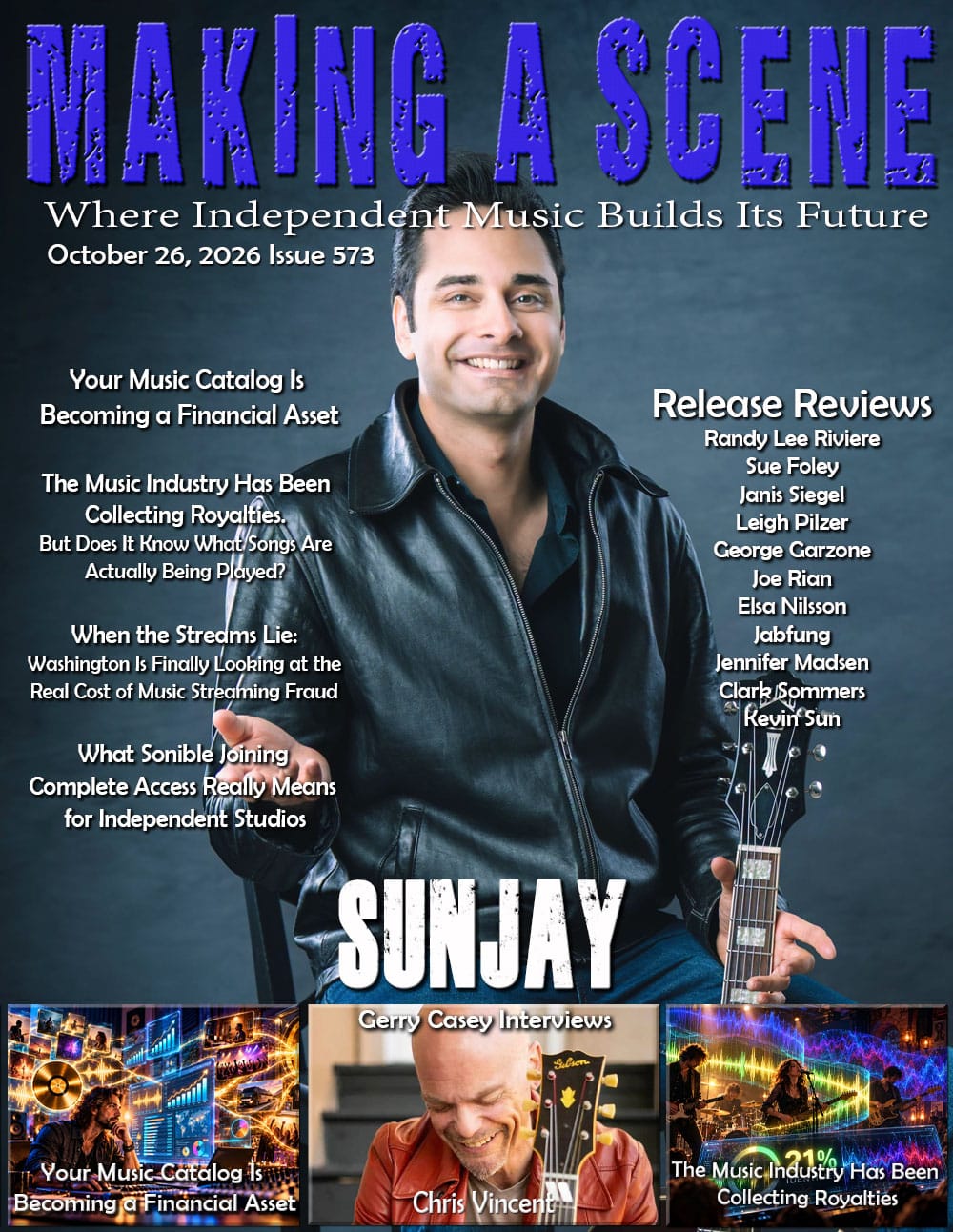

The DAO Label Model: When Artists and Fans Run the Business





Making a Scene Presents – The DAO Label Model: When Artists and Fans Run the Business
Listen to the Podcast Discussion to Gain More Insight into the DAO Label Model
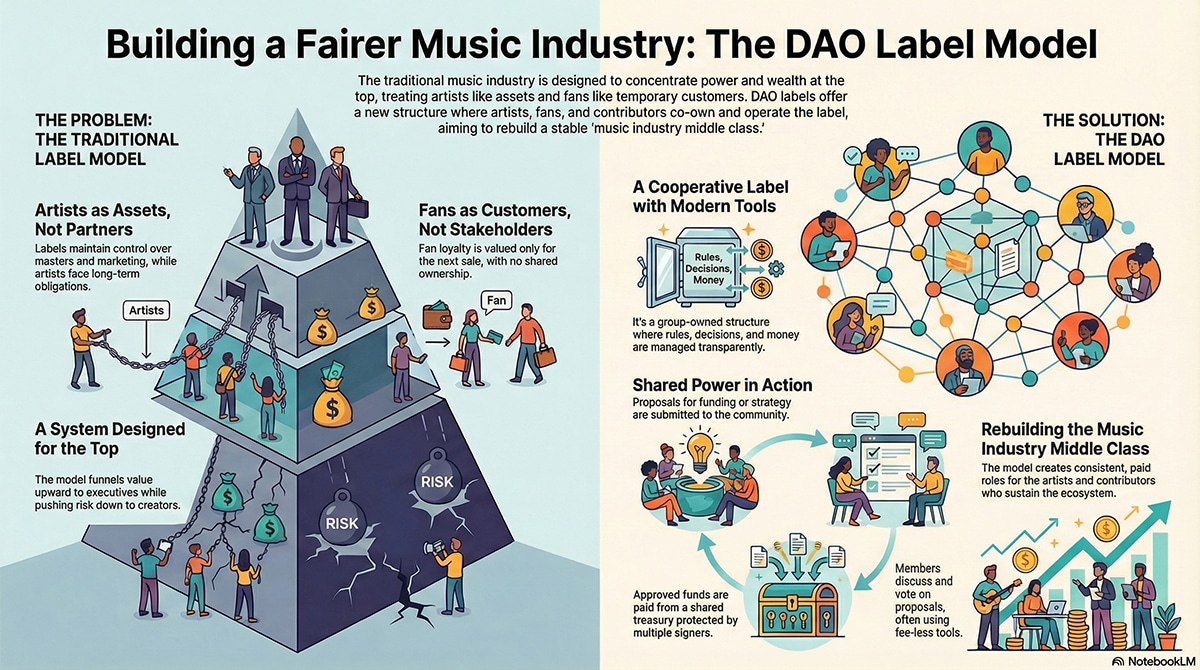
For decades, the record label model has followed the same harsh pattern. A small group at the top controls the money, makes the decisions, and sets the direction for everyone else. These decisions often happen behind closed doors, far away from the artists and fans who actually create the value. Artists write the songs, record the music, and build the culture, yet they are usually the last people with real control over what happens to their own work.
In this system, artists are treated less like partners and more like assets. Their music becomes a product to be sold, optimized, and discarded when it stops performing. Contracts lock them into long-term obligations, but the support they receive is often short-term and conditional. If the numbers drop, the attention disappears. Control over masters, marketing, and career decisions stays with the label, not the artist.
Fans don’t fare much better. They are treated like customers passing through a checkout line. Buy the album. Stream the song. Grab a ticket. Maybe buy a t-shirt. Then move on. Their loyalty, insight, and long-term support are rarely valued beyond the next sale. There is no real seat at the table, no shared ownership, and no meaningful way to participate in the success of the artists they believe in.
Everyone else in the music ecosystem lives in constant uncertainty. Producers, engineers, designers, marketers, publicists, and tour crew are usually hired on short-term contracts with no stability and no ownership. When a project ends, the income stops. There is no long-term safety net, no shared upside, and no clear path to building a sustainable career unless you land close to power.
This is not a broken system by accident. It is a system designed to concentrate control at the top while spreading risk downward. And for a long time, artists were told this was the only way to play the game.
A DAO label changes that equation.
A DAO, short for Decentralized Autonomous Organization, is not about robots taking over or software replacing people. At its core, a DAO is about structure and shared control. It is a way for a group of people to agree on clear rules, make decisions together, and manage shared money without putting all the power in one person’s hands. The technology just enforces the rules everyone already agreed to. It does not remove humans from the process. It simply removes the ability for one person to quietly change the game.
When that structure is applied to a record label, something important shifts. Artists stop being treated like inventory on a shelf. Fans stop being treated like wallets to be emptied. Instead of a label being owned and controlled by a small group at the top, it becomes a shared business. Decisions about funding, releases, and strategy are made in the open. Money is managed transparently. Power is distributed instead of hoarded.
This matters because the music industry has a giant hole in the middle. At the top, there are a handful of massive winners with global reach and endless resources. At the bottom, there are millions of creators scraping by, often working for exposure instead of pay. What’s missing is a stable Music Industry Middle Class. These are artists, producers, marketers, designers, editors, community managers, and organizers who may never be famous, but who deserve consistent income, career growth, and ownership over their work.
A healthy music ecosystem depends on that middle. It is where skills are developed, careers are built, and culture is sustained. DAO labels offer one of the most realistic paths to rebuilding it. By sharing ownership, paying contributors directly from a common treasury, and involving fans as long-term stakeholders, these labels can create stability where the traditional system only offers volatility.
In this article, we break down how DAO labels actually work in the real world. We look at how groups like Good Karma Records and Dreams Never Die have approached the model. We explain proposals, voting, and treasury management in plain language, and we show how this structure flips the traditional label dynamic on its head. Just as important, we deal honestly with the risks. DAOs fail all the time, usually for very human reasons. Ignoring those risks does not make them go away. Understanding them is the only way this model has a chance to work.
What a DAO Label Really Is
A DAO label is easiest to understand when you think of it as a cooperative record label built with modern tools. Traditional cooperatives already do many of the same things. They have written rules, shared bank accounts, and members who vote on important decisions. A DAO label follows that same logic, but replaces paper processes and private meetings with digital systems that make everything easier to track, harder to abuse, and more transparent by default.
The day-to-day work of a DAO label is not that different from a traditional indie label. It still helps fund recordings and releases. It still supports marketing campaigns, visual content, and rollout strategies. It still coordinates collaborations, release timelines, and sometimes distribution partnerships. The big difference is not what gets done, but who gets to decide how it gets done.
In a traditional label, decisions are usually made behind closed doors by executives who control the budget. Artists and contributors are informed after the fact, if they are informed at all. In a DAO label, those decisions are brought into the open. Proposals are shared with the community. Members discuss them. Votes are cast. The outcome is recorded and visible to everyone involved. Power shifts from a single authority to a shared process.
Money works the same way. Instead of one owner or small group holding the keys to the bank account, funds live in a shared treasury. That treasury is protected by rules that require multiple approvals before money can be spent. This prevents impulsive decisions, reduces the risk of misuse, and forces accountability. Everyone knows where the money is going and why.
This structure does not create chaos. In fact, when it is designed properly, it often creates more discipline than a traditional indie label. Because decisions, budgets, and outcomes are visible, there is less room for favoritism, confusion, or quiet backroom deals. Clear rules replace personal influence. Documentation replaces memory. Responsibility is shared instead of deflected.
A well-run DAO label is not loose or disorganized. It is intentional. It is slower in the right places and faster in the right places. And because everything is recorded and transparent, it builds trust over time, which is something the traditional label system has steadily lost.
Real-World DAO Label Experiments
Good Karma Records has positioned itself as a membership-based DAO label rather than a traditional investment vehicle. Instead of selling ownership based on how much money someone puts in, the project centers around participation. Members hold a governance NFT that gives them the right to vote on key decisions, such as which artists receive support and how shared resources are allocated. The emphasis is on one member, one vote, not one wallet with the most money. That choice is cultural as much as it is technical. It shifts power away from wealth and toward involvement, responsibility, and long-term commitment. The goal is not to attract speculators, but to build a community that is willing to show up, contribute, and help the label grow together.
https://www.goodkarmaclub.xyz/
Dreams Never Die approached the DAO label idea from a different angle, starting with culture instead of technology. Before worrying about governance dashboards or voting mechanics, they focused on building a shared identity and a sense of belonging. Their Founder Pass was framed as a way to participate, gain access, and help shape the direction of the project, not as a promise of financial returns. That distinction is especially important in the United States, where investment-style language can quickly raise red flags around securities law. By leading with access and community rather than profit, they aimed to create a safer and more sustainable foundation.
https://paragraph.com/@dreamsneverdie/dreams-never-die-founder-pass
The honest reality is that many early DAO music projects struggled, stalled, or quietly went dark. That does not mean the DAO label model failed. It means the hype phase ran into reality. Building a shared business is harder than launching a token or minting an NFT. The projects that continue to exist are not the loudest ones. They are the ones doing the unglamorous work that actually holds things together. That includes writing clear governance rules, keeping accurate financial records, managing expectations inside the community, and saying no when ideas are not ready. In other words, the DAOs that survive are the ones that treat this like a real label, not a social experiment.
How Proposals Work in a DAO Label
A proposal is simply a formal way for someone in the community to ask the group to take action. It is how ideas move from casual conversation into real decisions. In a DAO label, proposals might request funding for a single release, approval for a marketing campaign, or permission to hire a publicist, designer, or video team. Without proposals, nothing moves forward in a clear or accountable way.
A strong proposal is not just an opinion or a vibe. It is grounded in reality. It explains why the action matters to the label, what problem it is solving, and what opportunity it creates. It clearly states how much money is being requested, what that money will be used for, who will be responsible for the work, and how the community will know whether the proposal succeeded. When these details are missing, voting becomes emotional instead of practical. People start voting based on personalities, popularity, or fear rather than facts, and that is how trust breaks down.
This is why structure matters so much in a DAO label. The goal is not to slow people down or kill creativity. The goal is to create a shared language for decision-making so everyone is evaluating the same information. When proposals follow a consistent format, members can focus on the idea itself instead of arguing about missing details.
Many DAOs rely on structured proposal tools to keep this process clean and repeatable. Platforms like CharmVerse are designed to help communities manage proposals, discussions, and decisions in one place. Instead of ideas getting lost in chat threads, everything is documented, reviewable, and connected to the final vote. This makes a DAO label feel less like a loose online group and more like a real business with processes people can trust.
https://charmverse.io/
Voting Without Burning Everyone Out
Voting is where most DAOs fall apart, not because people don’t care, but because constant voting is exhausting. Most people do not want to weigh in on every small decision forever. They have jobs, families, and creative work to do. When a DAO requires nonstop participation to function, engagement drops, frustration rises, and decisions stall. That is usually the beginning of the end.
The solution is not more voting, but better structure. Healthy DAOs separate discussion, decision-making, and execution into clear stages. Ideas are discussed openly before anything is formal. Decisions are made through focused votes with clear timelines. Execution happens afterward, once the group has agreed on what should happen. This separation keeps the system moving without burning people out.
Most music DAOs start with off-chain voting because it is simple and accessible. Tools like Snapshot allow members to vote without paying blockchain fees. That may sound like a small detail, but it makes a huge difference. When voting is free and easy, more people participate. When voting costs money or feels technical, people disengage. Snapshot removes that friction and lets the community focus on the decision instead of the mechanics.
https://snapshot.org/
In this setup, votes are used to set direction and approve actions, not to push buttons directly. Once a vote passes, execution happens separately, especially when money is involved. Payments, contracts, and budget releases are handled through controlled treasury processes rather than instant reactions. This extra step slows things down just enough to prevent impulsive decisions while still respecting the will of the group. The result is a DAO label that can move forward with confidence instead of constantly reacting to noise.
Treasury Management: The Shared Wallet
The treasury is the heart of a DAO label. If the money is not protected, nothing else matters. You can have great artists, strong community energy, and smart ideas, but if the treasury is vulnerable, the entire project is one bad decision away from collapse. This is where many early DAOs learned hard lessons very quickly.
Most serious DAOs protect their funds using multi-signature wallets. A multi-signature wallet, often shortened to “multisig,” means that no single person can move money on their own. Instead, multiple trusted people must approve every transaction. This removes the risk of one person running off with the funds, making impulsive choices, or quietly changing the rules. It also protects the community if one signer’s account is compromised or hacked.
The most widely used tool for this is Safe. With Safe, a DAO can define exactly how its treasury works. For example, the community might choose five trusted signers and require three of them to approve any payment. That could apply to paying an artist advance, funding a marketing campaign, or hiring a contractor. No single signer has absolute power, and every transaction leaves a visible trail.
This structure forces accountability. Signers have to slow down, review proposals, confirm that a vote passed, and double-check where the money is going. That extra friction is not a flaw. It is a feature. In traditional labels, money often moves fast and quietly, with little transparency. In a DAO label, money moves deliberately and in the open.
At first, this setup can feel frustrating, especially to people used to acting quickly. But shared money demands shared responsibility. A DAO label that treats its treasury casually will not survive long enough to matter. Protecting the treasury is not about mistrust. It is about respecting the community and ensuring that the work everyone is contributing toward does not disappear overnight.
Fans as Stakeholders, Not Customers
This is where the DAO label model becomes truly disruptive. When fans become stakeholders, their relationship to the music changes in a deep and lasting way. Instead of only asking what they get in return for their support, they start asking how the project can grow, survive, and improve over time. The music is no longer something they consume and move on from. It becomes something they are invested in, emotionally and structurally.
That shift creates a different kind of loyalty. Stakeholders think long-term. They care about sustainability, not just hype. They are more likely to show up consistently, contribute ideas, and help spread the word because they feel connected to the outcome. This is a powerful change from the traditional fan model, where engagement often ends at the purchase or the stream.
But this shift also introduces real tension, and ignoring that reality is dangerous. When people feel invested, they also feel entitled to an opinion. Some fans will want a say in creative choices. Others will strongly disagree with which artists receive funding or how resources are allocated. Without clear boundaries, these disagreements can quickly turn personal and toxic.
Healthy DAO labels address this head-on. They separate business decisions from creative decisions. The community can vote on budgets, funding priorities, and overall strategy. Artists, however, retain full control over their creative work. That line has to be clearly defined and consistently enforced. If it is not, the DAO risks turning into a committee that debates every artistic choice. When that happens, creativity slows, artists disengage, and the very thing the DAO exists to support begins to suffer.
The power of a DAO label is not in crowd-controlling the art. It is in crowd-supporting the artist. When that balance is respected, the model unlocks collaboration without sacrificing creative freedom.
Why DAO Labels Matter to the Music Industry Middle Class
Traditional labels are built to concentrate wealth and opportunity at the top. A small number of executives, rights holders, and investors benefit from the success of thousands of artists and workers, while most of the people doing the day-to-day labor remain underpaid and replaceable. This structure is not accidental. It is designed to funnel value upward while spreading risk downward.
DAO labels work in the opposite direction. Instead of hoarding opportunity, they distribute it. They create paid roles for people who are essential to making music careers function but who are rarely rewarded in the traditional system. Community managers who keep fans engaged, designers who shape an artist’s visual identity, marketers who run campaigns, playlist researchers who understand discovery, and project coordinators who keep releases on track can all be paid directly through DAO work.
What makes this different is consistency. Instead of one-off gigs tied to a single release, contributors can take on ongoing roles inside the DAO. Their work is visible, documented, and recognized. Over time, this builds real careers, not just short-term paychecks. Contributors gain experience, reputation, and trust within the community. As they take on more responsibility, they gain more influence and stability.
This is how a Music Industry Middle Class is formed. Not through viral moments or lottery-style success, but through steady work and shared ownership. It is built by people who show up, do the work, and grow alongside the artists they support. DAO labels create the conditions for that kind of growth by aligning incentives, sharing upside, and valuing the people who actually keep the music ecosystem alive.
A Realistic Step-by-Step Path for Indie Artists
The first step is to clearly define the scope of what you are building, and this is where most people go wrong. Trying to launch a full-service DAO record label on day one is unrealistic and usually ends in burnout. A much smarter starting point is a funding-and-release collective. That means the DAO’s job is simple and focused. It helps fund specific releases, supports marketing efforts, and pays contributors for clearly defined work. This keeps expectations manageable and allows the structure to prove itself before expanding into something larger.
Once the scope is clear, the next step is choosing a membership model that does not create legal problems before you even get started. In the United States, language matters more than most people realize. Membership NFTs or digital credentials should be framed around access, participation, and governance. They are about having a voice and being part of the process, not about making money or sharing profits. The moment something is marketed like an investment, it can trigger securities concerns. A DAO label that survives long-term is careful with how it describes membership and what it promises.
After that, you need a community home base. For most music DAOs, that home base is Discord, simply because artists and fans already know how to use it. Discord becomes the place where discussions happen, ideas are shared, and relationships form. To manage access, many DAOs use token-gating tools like Collab.Land or Guild. These tools allow you to automatically grant or remove access based on membership credentials, without forcing fans to understand the technical side of Web3.
https://collab.land/
https://guild.xyz/
With the community in place, structure becomes critical. You need a clear proposal pipeline so decisions do not turn into chaos. Ideas should start as conversations, then move into drafted proposals, then be reviewed for clarity and feasibility, and only then go to a vote. This process protects the community from rushed decisions and gives everyone confidence that proposals have been thought through.
Voting comes next, and this is where many DAOs either succeed or quietly fail. Launching voting with a tool like Snapshot allows members to participate without paying blockchain fees. This keeps participation high and lowers frustration. Votes should determine direction and approval, not instantly move money. Once a vote passes, it should trigger a clearly defined execution step rather than immediate action.
https://snapshot.org/
That execution step is tied directly to the treasury, which must be protected from day one. Using a multi-signature wallet like Safe ensures that no single person can move funds alone. Clear spending rules define which decisions require a full vote and which can be handled by a smaller operations group. This balance keeps the DAO functional without sacrificing accountability.
https://safe.global/
https://docs.safe.global/
Paying contributors fairly is what turns a DAO label from a fan club into a real economic engine. Contributors should be paid for real work, not promised future value or exposure. Tools like Dework help DAOs assign tasks, track contributions, and manage payments transparently. Coordinape allows communities to distribute rewards based on peer-recognized contributions, which can be especially useful for ongoing work that does not fit into simple one-off tasks.
https://dework.xyz/
https://coordinape.com/
Finally, everything needs to be wrapped in a legal and tax-aware structure. In the U.S., ignoring legal realities is not rebellious. It is reckless. A DAO that handles money, pays contributors, or signs agreements needs professional legal and tax guidance. This protects not only the founders, but also the community members who are trusting the structure. Decentralization does not remove responsibility. It makes clarity and compliance even more important.
Taken together, these steps form a realistic path. Not a fantasy DAO built on hype, but a working structure that can grow over time. This is how a DAO label moves from an idea to an institution that actually supports artists, contributors, and the Music Industry Middle Class they are trying to build.
The Brutal Risks You Cannot Ignore
Governance fatigue is one of the fastest ways a DAO label can fall apart. People may be excited at the beginning, but if every small decision requires a vote, participation will drop quickly. When members feel overwhelmed or feel like their vote does not matter, they stop showing up. Once that happens, decisions get made by a shrinking group, trust erodes, and the DAO quietly stops functioning. The solution is to reduce unnecessary votes and reserve full community voting for decisions that truly matter. Clear roles, defined budgets, and limited voting windows keep the system healthy and sustainable.
Wealth concentration is another serious risk. If voting power is tied directly to how many tokens someone holds, the richest members can dominate decisions, even if they are not the most active or aligned with the community’s values. This recreates the same power imbalance found in traditional labels, just with new tools. One-member-one-vote models are one way to reduce this risk by valuing participation over money. While no system is perfect, fairness has to be designed intentionally. If it is left to chance, inequality will take over.
Treasury risks are not theoretical. Treasury theft, accidental approvals, and simple human mistakes happen all the time. A signer can get hacked. Someone can approve the wrong transaction. A rushed decision can send funds to the wrong place with no way to reverse it. This is why signers must be trained, approvals should be slowed down, and treasury rules should be strict. Shared money requires shared caution. Speed is never more important than safety when the survival of the entire DAO is at stake.
As communities grow, scams become unavoidable. Fake accounts, impersonators, malicious links, and fraudulent partnerships will target both leaders and new members. Without strong moderation and ongoing education, people will get hurt and trust will be damaged. A DAO label has to treat security as part of its culture, not an afterthought. Clear communication channels, verified admins, and constant reminders about safety are essential to protecting the community.
Taxes do not disappear just because a project is decentralized. In the United States, income is still income. Payments to contributors, rewards, membership sales, and merchandise revenue can all create tax obligations. Ignoring this reality does not make it go away. It only guarantees painful consequences later. Proper record-keeping and professional tax guidance are not optional if a DAO label wants to survive beyond the early stages.
The biggest legal risk is securities law. Selling governance tokens or NFTs as investments, or implying that people will profit from holding them, can trigger regulatory action. This is not speculation. The SEC has already made its position clear that certain DAO structures can fall under securities regulations depending on how they are designed and marketed. Anyone building a DAO label in the U.S. should study this guidance carefully and take it seriously.
https://www.sec.gov/files/litigation/investreport/34-81207.pdf
Platform risk is the final trap many people overlook. If your DAO label depends entirely on one platform for communication, voting, fundraising, or distribution, you are rebuilding the same fragile system you are trying to escape. Platforms shut down. Rules change. Access can be revoked. A truly resilient DAO spreads its infrastructure across multiple tools and keeps ownership of its core assets. Decentralization is not about one perfect platform. It is about reducing points of failure so the community can survive no matter what changes around it.
DAO Labels, Collectives, and Platforms
Not every DAO-inspired project needs to call itself a record label, and forcing that label on the wrong structure often causes more problems than it solves. Some groups work better as collectives, where artists and contributors collaborate on projects without the long-term obligations of a traditional label. Others function more effectively as incubators, helping artists develop releases, skills, and strategies before they move on. Some operate as funding pools that exist solely to finance recordings, videos, or tours without trying to manage every part of an artist’s career.
Hybrid models are especially common, and in many cases, they are healthier. A project might use decentralized voting for funding decisions but rely on a small, trusted operations team to handle day-to-day execution. Another might operate as a collective for creative work while maintaining a more traditional structure for legal and financial matters. These blended approaches recognize a simple truth: complete decentralization is not always practical, and it is not always desirable.
The goal is not ideological purity. Chasing a “perfect” DAO structure usually leads to rigidity and burnout. The real goal is sustainability. That means building a system that people can realistically participate in over time, that can adapt as the community grows, and that can survive changes in technology, platforms, and market conditions. A DAO model should serve the music and the people making it, not the other way around.
The Boring Rebellion
DAO labels are not shortcuts to fame or overnight success. They are infrastructure. They are slow by design, intentional in how they grow, and sometimes frustrating to work within. Decisions take time. Processes require patience. Progress is measured in stability, not hype. That is exactly why they matter. Anything built to last has to move at a pace that allows trust, accountability, and real value to form.
In a music industry obsessed with speed, visibility, and viral moments, choosing to build infrastructure is a radical act. The most rebellious thing an independent artist can do today is not chasing algorithms or hoping to be discovered, but building systems that can survive without permission. Systems that pay people fairly for their work instead of dangling exposure. Systems that treat fans as partners in the journey, not just customers at the end of a sales funnel.
These systems are how a Music Industry Middle Class begins to take shape. Not as a lottery where a few people win big while everyone else loses, but as a network of sustainable careers built on shared ownership and consistent work. DAO labels offer a path toward that future by replacing disposability with durability. They allow artists to stop being interchangeable and start building something that can grow, adapt, and outlast trends, platforms, and gatekeepers.
 |  Spotify |  Deezer |  Breaker |
 Pocket Cast |  Radio Public |  Stitcher |  TuneIn |
 IHeart Radio |  Mixcloud |  PlayerFM |  Amazon |
 Jiosaavn |  Gaana |  Vurbl |  Audius |
 Reason.Fm | |||
Find our Podcasts on these outlets
Subscribe to Our Newsletter
Discover more from Making A Scene!
Subscribe to get the latest posts sent to your email.


