
AI Won’t Kill Music Careers—Starving Artists Will




Making a Scene Presents – AI Won’t Kill Music Careers—Starving Artists Will
Listen to the Podcast Discussion and Gain More Insight into How AI is Not going to Kill the Music Industry!
As we head into the New Year, it’s time to take an honest look at one of the hottest and most misunderstood topics in the music industry right now. Every few months, the same cycle plays out. A scary headline appears. A new AI tool gets released. A video goes viral showing a fake song that sounds like a famous artist. Almost overnight, the mood shifts. The conversation turns dark. People start saying AI is going to replace musicians. They claim creativity is dead. They insist the soul has been ripped out of music and that this is the end of everything we care about.
This reaction feels intense, but it is not new. The exact same panic surfaced when drum machines entered studios and people swore real drummers were finished. It happened again when MIDI became mainstream and musicians warned that computers would destroy feel and emotion. It happened when Napster exploded and the industry declared that music itself was over. Each of those moments felt like a crisis because they arrived during periods of major change, uncertainty, and loss of control. What we are witnessing now is simply the latest version of that same response.
Today, however, the fear hits harder because artists are already stretched to their limits. Many are exhausted. Many are broke. Many are burned out. When you are barely surviving, any new technology feels like a direct threat to your future. That emotional response is understandable. But the anger is aimed at the wrong target. AI is not the enemy people think it is.
AI is not killing music careers. The system that refuses to let artists earn a living is doing that job perfectly well on its own. Most musicians are not truly afraid of being replaced by software. What they are afraid of is never breaking even. They are afraid of spending years learning their craft, investing money in gear, releases, and promotion, and still needing multiple jobs just to make rent. They are afraid of an industry that publicly celebrates their creativity while quietly draining them financially behind the scenes.
That reality existed long before AI ever entered the conversation.
AI did not create low streaming payouts. It did not design royalty systems so confusing that even experienced professionals struggle to understand where their money goes. It did not invent gatekeepers, middlemen, or contracts that lock artists into unfair deals. It did not create a culture that treats musicians like disposable content machines instead of skilled professionals. All of that was already firmly in place.
What AI did was arrive at the exact moment when the cracks in that system became impossible to ignore. Instead of having an honest conversation about broken economics, power imbalance, and long-term sustainability, the focus shifted. Suddenly, everyone is arguing about technology instead of asking why artists are still starving.
This article is about that reality. It is about why fear-driven conversations around AI miss the real problem. It is about how AI can actually help artists lower costs, work smarter, reach real fans, and regain leverage they were never supposed to have. Most of all, it is about understanding that the real fight is not humans versus machines. It is creators versus an extractive system that depends on keeping them underpaid, overworked, and distracted.
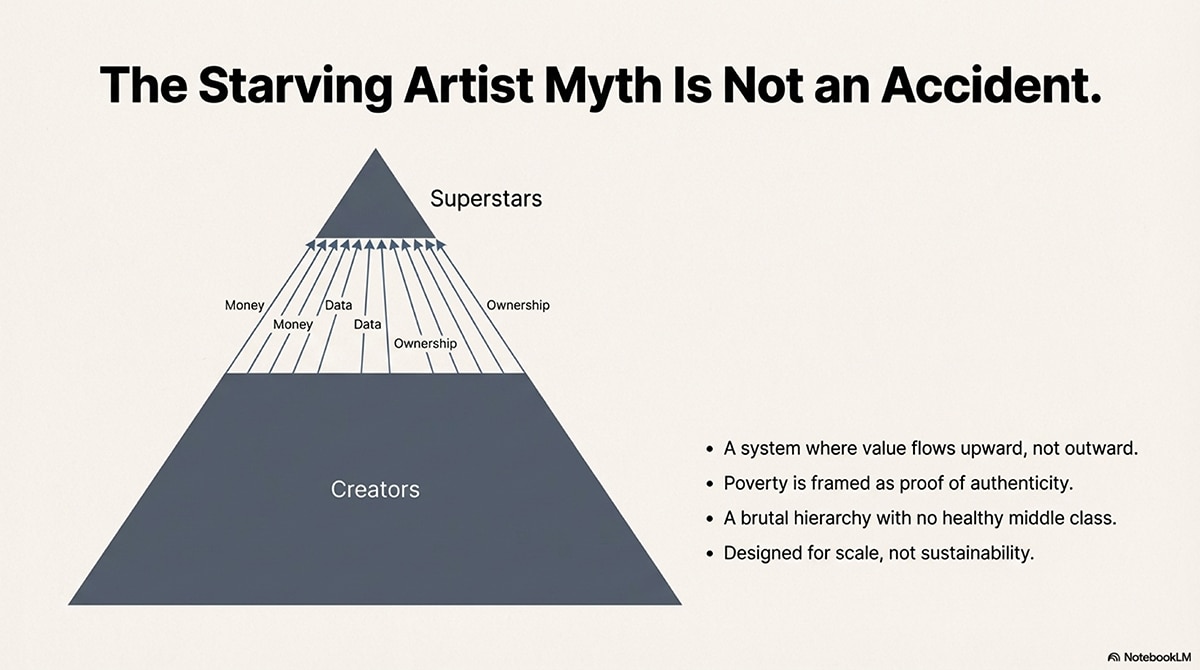
The Starving Artist Myth Is Not an Accident
What AI Actually Is (And What It Isn’t)
Before anything else, this needs to be made clear in plain, everyday language. AI is not a robot sitting in a room writing songs because it suddenly “feels inspired.” It does not have emotions, taste, or intent. AI is software. It works by finding patterns in large amounts of data and using those patterns to help with specific tasks. That’s all it does. There is no magic, no soul, and no secret creative mind hiding inside the machine.
When you use AI in music, you are not handing over your creativity or letting a machine take control of your art. You are using a tool that helps remove friction from the process. It can speed things up, reduce guesswork, and lower costs that would otherwise slow you down or stop you completely. The creative decisions still come from you. The taste still comes from you. The vision still comes from you.
None of this is new. The music world has gone through this cycle many times before. Drum machines were supposed to kill drummers. Instead, they created new styles of rhythm and expanded what was possible. Digital Audio Workstations were supposed to kill studios, yet they became the backbone of modern production and opened doors for countless independent artists. Auto-tune was accused of destroying singers, but it ended up becoming just another creative and corrective tool that artists use intentionally.
Every one of those technologies caused panic when it first appeared. And every one of them eventually became a normal part of the workflow once people understood how to use it. AI is simply the next layer in that same story.
The difference this time is timing. AI is arriving at a moment when artists are already stretched thin financially, emotionally, and creatively. When you are tired and barely getting by, fear spreads faster than understanding. It feels easier to blame the tool than to face the deeper problems underneath.
Cutting Studio Costs Without Cutting Creativity
Not that long ago, recording music meant gaining access to expensive studios, booking time months in advance, and paying for large crews just to get a few usable takes. Studio time was limited, pressure was high, and mistakes were costly. That reality quietly shut out a huge number of talented people who simply could not afford to participate. If you didn’t have money, connections, or label backing, your ideas often never made it past the demo stage.
Today, AI helps tear down many of those barriers. AI-assisted mixing and mastering tools like iZotope Ozone and iZotope Neutron, both available at https://www.izotope.com, allow musicians to achieve professional-level results without spending thousands of dollars per song. These tools analyze your audio and suggest starting points based on proven engineering practices. They are not magic buttons and they do not replace experienced engineers. What they do is give artists a solid foundation, especially when budgets are tight and hiring outside help isn’t an option.
Tools like Sonible smart:EQ and smart:comp at https://www.sonible.com take this even further by analyzing your sound in real time and suggesting EQ and compression settings that normally take years of experience to learn by ear. This doesn’t erase skill or remove the need to listen critically. It accelerates learning. Artists can see and hear why certain choices work, instead of guessing or copying presets blindly.
For independent artists, this matters more than most people realize. Cost is often the single factor that determines whether music gets released or stays buried on a hard drive. AI shortens the distance between having an idea and sharing it with the world. It removes enough friction to keep momentum alive.
Creativity thrives when the process feels possible instead of overwhelming. When the barriers are lower, artists experiment more, finish more songs, and take more chances. AI doesn’t replace creativity. It creates room for it by getting obstacles out of the way.
Collaboration Without Geography or Gatekeepers
One of the quieter but most powerful benefits of AI is how it changes the way musicians collaborate. Not long ago, working together usually meant being in the same city, booking the same studio, and lining up schedules that were often impossible to match. Geography alone could end great ideas before they ever started. If you didn’t live in the right place or know the right people, collaboration stayed out of reach.
Today, AI-driven and cloud-based platforms are tearing down those walls. Tools like BandLab at https://www.bandlab.com and the Exchange system inside PreSonus Studio One Pro allow artists to record, share sessions, and trade ideas almost instantly. A songwriter in one country can send a rough idea to a producer halfway around the world, get feedback, make changes, and keep moving without waiting for permission or label support. The technology handles the heavy lifting so the focus stays on the music.
AI does not replace collaboration. It removes the obstacles that used to limit it. Instead of collaboration being a privilege reserved for people with access to studios, money, or industry connections, it becomes something any motivated artist can take part in.
This shift matters because the traditional music industry has always controlled collaboration through access. Who you know has often mattered more than what you create. AI disrupts that power structure by making professional tools and shared workflows available to anyone willing to use them. It replaces gatekeeping with possibility and lets creativity flow based on effort and vision, not proximity or status.
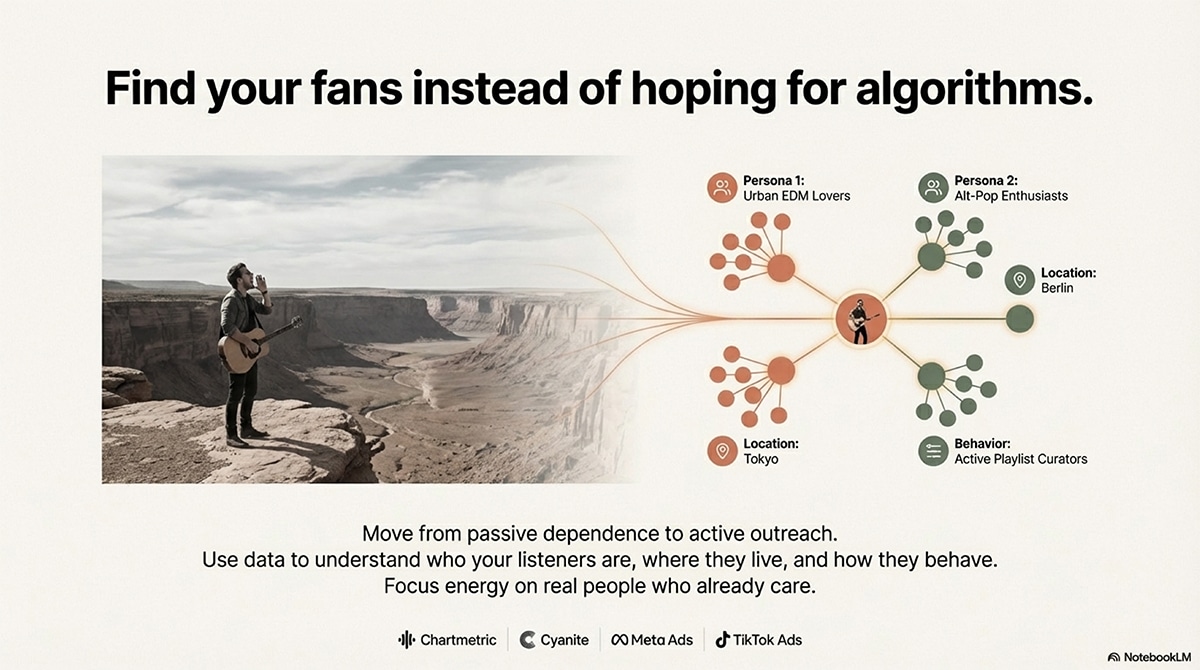
Finding Fans Instead of Hoping for Algorithms
One of the biggest lies artists are taught to believe is that success only comes from being “discovered.” That idea sounds romantic, but it keeps musicians passive and dependent. It trains them to wait for a playlist, a label, a blog, or an algorithm to notice them instead of learning how to reach listeners on their own terms. When discovery becomes the goal, artists give up control and hand their future to systems they don’t understand and can’t influence.
AI flips that dynamic completely. Instead of guessing or hoping, artists can now see real information about the people who already listen to music like theirs. Platforms like Chartmetric at https://www.chartmetric.com and Cyanite at https://www.cyanite.ai help artists understand who those listeners are, where they live, and how they behave online. This isn’t creepy surveillance or spying on fans. It’s basic market awareness, the same kind of insight businesses in every other industry have used for decades.
When an artist understands their audience, everything changes. They stop wasting money shouting into the void and hoping something sticks. They can focus their energy on real people who already care, people who are far more likely to listen, share, and support. Marketing stops feeling like a gamble and starts feeling intentional.
Advertising platforms like Meta Ads at https://www.facebook.com/business and TikTok Ads at https://ads.tiktok.com use AI to help artists reach those listeners efficiently. The systems learn what works and what doesn’t, which means small budgets can go much further than they ever could before. This is not about spamming strangers. It’s about showing your music to people who are already inclined to like it.
As we move forward, the real power shift comes from combining AI with a decentralized music industry built on Web3 principles. When artists use AI to understand their audience and Web3 tools to connect directly with fans, control starts to move away from centralized industry structures. Direct fan-to-artist relationships replace middlemen, ownership stays with the creator, and revenue flows more fairly. Removing unnecessary layers is essential if we want to rebuild a music industry middle class that can actually sustain itself.
This is leverage. Not replacement.
Output Is Not the Enemy of Art
Another common fear around AI is the idea that it encourages “too much content.” People worry that if artists can create faster, the work will become shallow or disposable. But the truth is much simpler than that. Artists have always created a lot. Most songs never get released, not because they lack meaning, but because the process around releasing them is exhausting, confusing, and time-consuming. What changes now is not creativity, but strategy.
With the combined power of AI and Web3, artists can release music more intentionally, in more formats, and in more direct ways. Instead of dumping everything onto a single platform and hoping for attention, artists can plan how, when, and where their music shows up. They can share different versions, behind-the-scenes moments, early access releases, or fan-only drops, all without asking permission from a centralized gatekeeper.
AI tools like ChatGPT at https://chat.openai.com help artists handle the parts of the process that usually drain energy. They can assist with planning release timelines, writing clear descriptions, organizing ideas, and shaping messages that actually make sense to fans. In practice, AI becomes a marketing and PR assistant that helps build a release campaign, schedule posts, and keep communication moving without requiring the artist to live on social media all day.
These tools do not write the songs or decide what matters. They remove mental clutter. They take care of repetitive, boring tasks so artists can stay focused on creating. More output does not mean less meaning. It means more opportunities for connection, more touchpoints with real fans, and more chances for the right people to hear the work and care about it.
The Ethical Line, Clearly Explained
The ethical concerns around AI are real, and pretending otherwise doesn’t help anyone. Artists are right to ask hard questions about how training data is collected and used. They are right to worry about consent, copyright, and whether their work is being absorbed into systems without permission or compensation. These are serious issues, and they deserve thoughtful discussion, clear rules, and long-term solutions.
What ethics do not benefit from is panic. Fear-driven reactions tend to shut down conversation instead of improving it. Real ethical progress comes from standards, transparency, and, most importantly, artist control. When creators understand how tools work and have a say in how their work is used, they are no longer powerless in the process.
There is a critical difference that often gets blurred in these conversations. Using AI as a tool you actively direct is not the same as corporations using AI to replace human labor without fair compensation. One approach empowers creators by giving them leverage and efficiency. The other extracts value while cutting people out. Treating those two things as the same only protects the systems that already exploit artists.
Artists should absolutely demand fair training practices, clear opt-out systems, and legal clarity around how their work can be used. Those fights matter. At the same time, rejecting tools that help artists survive right now only weakens their position. It forces creators to struggle longer while large companies continue to move forward unchecked.
Ethics and survival are not enemies. An artist who is barely getting by has little time, energy, or leverage to fight for better standards. Starvation helps no one. Sustainable careers give artists the stability they need to push for ethical systems that actually protect creators.
AI, Energy, and the Environmental Question No One Wants to Touch
There is another concern that comes up more and more when people talk about AI, and it deserves to be taken seriously. AI requires massive amounts of computing power. That power lives in data centers, and data centers consume a lot of electricity. As AI grows, more facilities are being built, energy demand rises, and people worry about the environmental cost. Artists are right to ask whether using AI means contributing to higher emissions, higher electric bills, and more strain on an already stressed energy system.
Those concerns are real. Large data centers are energy-hungry, and in the short term, that demand can absolutely put pressure on local power grids. Rising electric costs are not theoretical. People are already feeling them. Ignoring this side of the conversation would be dishonest, especially for a creative community that often cares deeply about sustainability and the future.
But stopping the conversation there misses the bigger picture.
For AI to scale, it cannot rely on dirty, inefficient energy forever. The economics simply won’t work. The AI industry needs massive amounts of power that are stable, affordable, and scalable over time. Fossil fuels are volatile, expensive, and politically fragile. Renewable energy, on the other hand, becomes cheaper the more it is deployed. That makes it not just an ethical choice, but a business necessity.
If any industry has the incentive, resources, and technical ability to push the next generation of energy systems forward, it is the AI industry. AI already plays a role in optimizing solar grids, improving battery storage, managing wind energy variability, and reducing waste across energy networks. These systems don’t just consume power. They increasingly help make power cleaner, more efficient, and more resilient.
This is how major technological shifts have always worked. New industries initially strain infrastructure, then force it to evolve. The internet did this. Cloud computing did this. AI is doing it now. The long-term future of AI depends on renewable energy scaling faster, not slower. Cleaner power is not a side goal. It is a requirement for growth.
For artists, this matters because rejecting AI on environmental grounds alone doesn’t stop the expansion of data centers. It just removes creators from the conversation and the benefits. Using AI responsibly while supporting renewable energy development gives artists a seat at the table instead of leaving decisions entirely in the hands of corporations.
The environmental question around AI is not a reason to freeze progress. It is a reason to demand smarter infrastructure, cleaner power, and better long-term planning. If we are serious about building a sustainable future for music, technology, and the planet, then shaping how AI grows is far more effective than pretending it can be wished away.
AI as Leverage, Not a Replacement
The most important shift AI brings to the music world is leverage. For the first time, independent artists can operate with tools that used to be available only to large corporations with deep pockets. Things like data analysis, marketing optimization, content planning, and production efficiency are no longer locked behind massive budgets or exclusive industry access. What once required a team of specialists and serious money can now be handled by a small, focused creative operation.
This shift does not flatten creativity or turn artists into machines. It levels power. When artists have access to the same operational tools as larger players, the balance changes. Leverage gives artists the ability to make informed decisions instead of guesses. It allows them to negotiate better deals because they understand their audience and their value. It helps them build direct, ongoing relationships with fans instead of relying on platforms that profit from keeping creators dependent and replaceable.
When AI is combined with Web3 and a decentralized music industry model, the impact goes even further. Artists are no longer just controlling how their music sounds or looks. They are controlling how it is distributed, how fans engage, and how revenue flows back to them. Ownership, transparency, and direct connection replace layers of middlemen and opaque systems.
This combination is the real formula for rebuilding a music industry middle class. It gives artists control over their art, control over their fan relationships, and control over the income generated from that connection. Instead of chasing permission, artists can build sustainable careers rooted in ownership, data, and direct support. That is not a distant future. It is a shift that is already underway.
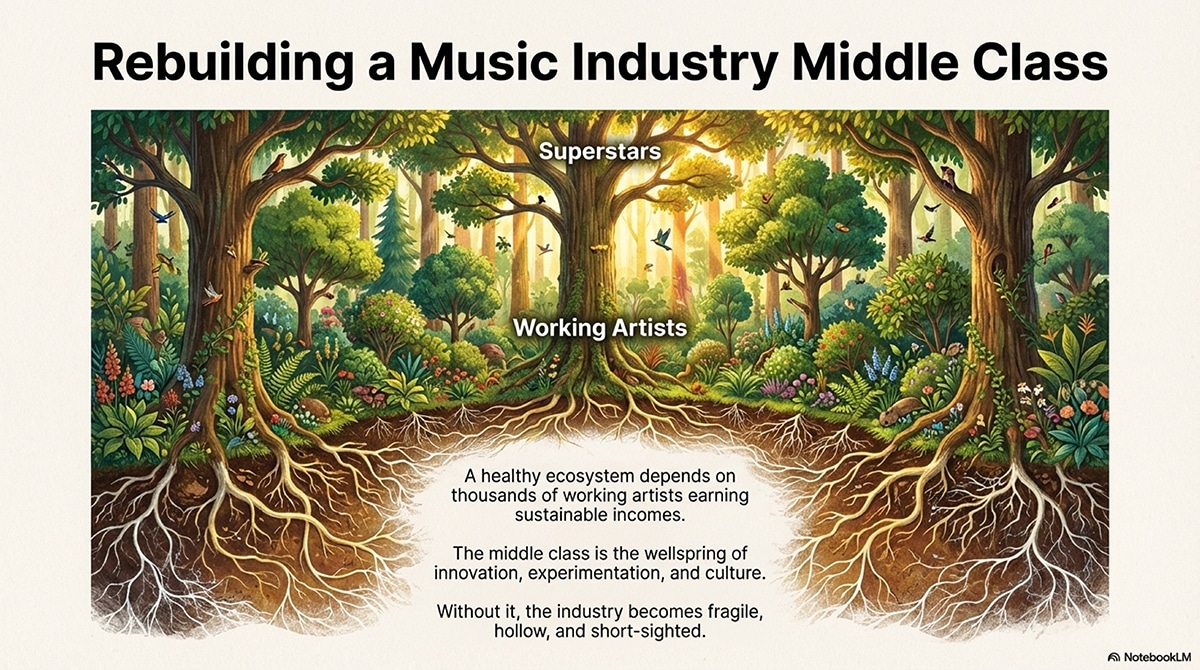
Rebuilding a Music Industry Middle Class
A healthy music ecosystem does not survive on superstars alone. It depends on thousands of working artists earning steady, sustainable incomes. These are the musicians who write the bulk of the songs, play the clubs, teach the next generation, and keep local and global scenes alive year after year. They are the connective tissue of music culture, showing up consistently even when there are no headlines or big checks attached.
When that layer disappears, the entire industry becomes fragile, hollow, and short-sighted. Without working artists, there is no depth, no experimentation, and no long-term growth. This middle layer is the wellspring where innovation and artistry actually grow. It is where new sounds are tested, risks are taken, and future movements are born. Strip that away, and what remains is a shallow system built to chase hits instead of sustain creativity.
AI supports this vision by lowering costs, expanding reach, and restoring agency to the people actually making the music. A real music industry middle class is built when artists can earn from their work without burning out, going into debt, or giving away ownership just to stay visible. When musicians are forced to choose between survival and control, the industry eventually eats itself.
For the music industry to be healthy and grow over time, it must be fueled by a strong middle class of creators. These artists feed the future with new songs, new sounds, and new voices. They create the foundation from which the next generation emerges. Without them, there is no pipeline, no continuity, and no long-term culture worth protecting.
AI and Web3 make this possible by shifting control back to creators. Artists can manage costs, understand their audiences, connect directly with fans, and build systems that work for them instead of against them. This is not a theory or a distant promise. It is already happening quietly, outside the spotlight, wherever artists choose tools over permission and start building something that lasts.
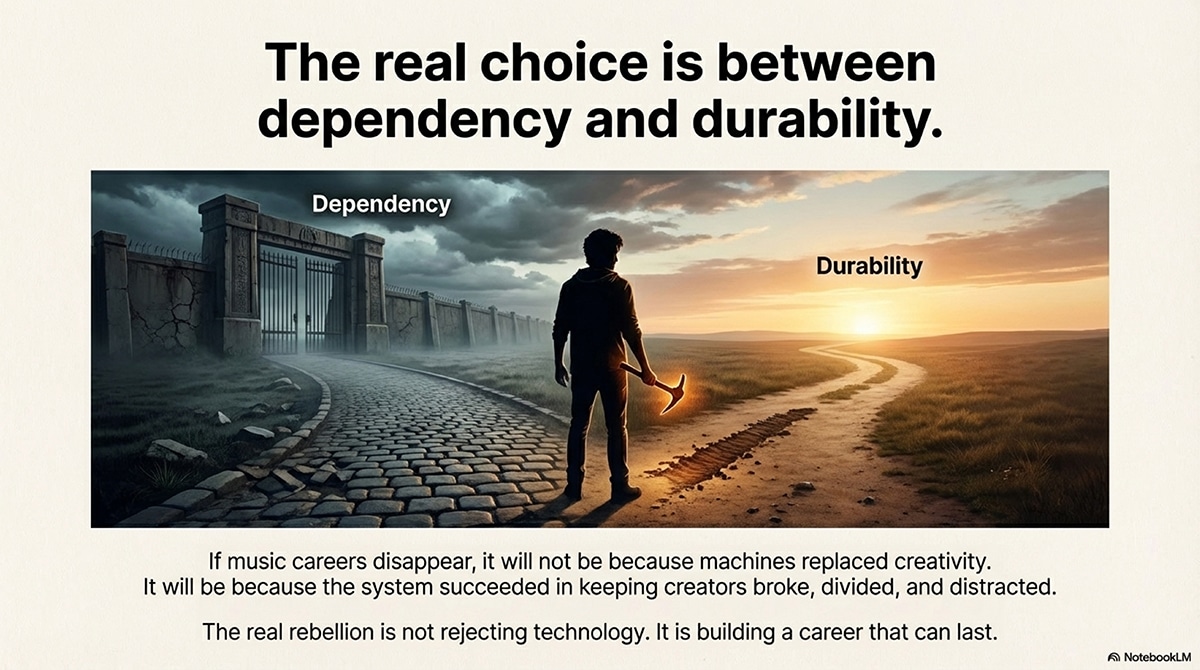
The Real Choice Artists Face
The future of music is not a battle between humans and machines. It is a choice between dependency and durability. Artists can stay afraid of tools they don’t fully understand, or they can take the time to learn how those tools work and use them to build systems that actually support their careers. AI will not make that decision for anyone. Artists will.
If music careers disappear, it will not be because machines replaced creativity. It will be because the system succeeded in keeping creators broke, divided, and distracted long enough to wear them down. Creativity doesn’t die on its own. It gets suffocated when artists are trapped in survival mode with no room to plan, grow, or breathe.
The real rebellion is not rejecting technology. It is learning how to work smarter, become more efficient, and create revenue streams that allow artists to earn a living from their work. It is about building durability instead of chasing approval. And that fight is only just beginning.
 |  Spotify |  Deezer |  Breaker |
 Pocket Cast |  Radio Public |  Stitcher |  TuneIn |
 IHeart Radio |  Mixcloud |  PlayerFM |  Amazon |
 Jiosaavn |  Gaana |  Vurbl |  Audius |
 Reason.Fm | |||
Find our Podcasts on these outlets
Subscribe to Our Newsletter
Discover more from Making A Scene!
Subscribe to get the latest posts sent to your email.


