Why Networking Still Runs the Music Business




Making a Scene Presents – Why Networking Still Runs the Music Business
Listen to the Podcast
There is a lie floating around the modern music business, and a lot of artists have swallowed it whole. The lie says your career is built on content. It says your future lives inside metrics. It says if you post enough clips, chase enough trends, and feed enough short-form platforms, the machine will reward you. Maybe you will get lucky. Maybe an algorithm will tap you on the shoulder. Maybe some stranger in a hoodie in a tech office will decide your song belongs in a playlist and your life will change.
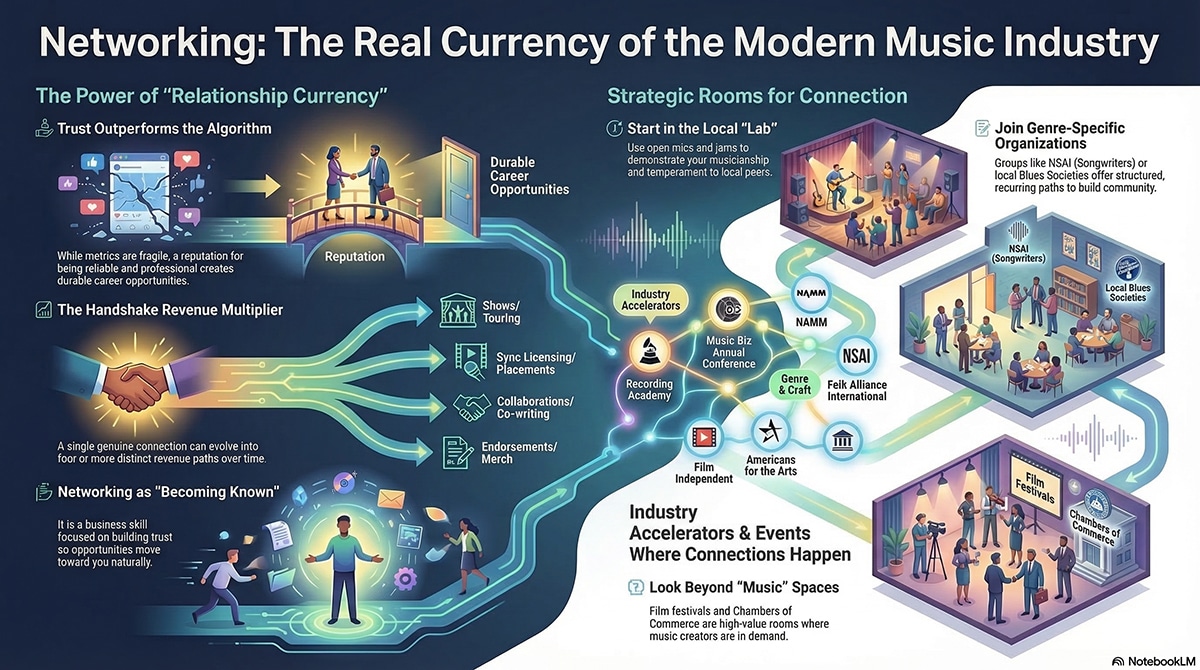
That story is great for platforms. It is terrible for musicians. Because the truth is much older, much less shiny, and much more useful. The music industry still runs on people. It runs on trust. It runs on memory. It runs on who knows you, who has seen you work, who remembers that you showed up on time, who remembers that you were easy to be around in a green room, who remembers that you killed it when the headliner’s guitar player got sick and they needed a sub in four hours.
That is why relationships are still the industry’s real currency. Not followers. Not vanity numbers. Not the fake fame of being watched but not known. Real currency is the person who thinks of you when a tour needs a supporting player. Real currency is the engineer who tells a producer, “Call her. She is solid.” Real currency is the songwriter who says, “He is not weird in the room, he comes prepared, and he finishes songs.” Real currency is the local promoter who knows you can sell tickets, treat the staff right, and help bring people back next month.
That is networking. Not fake handshakes. Not slimy self-promotion. Not collecting business cards like baseball cards. Networking, done right, is simply building enough real relationships that opportunities start to move toward you instead of always away from you.
And for independent artists trying to build a real life in music, that matters more than ever.
Stop Thinking of Networking as Flirting With Gatekeepers
A lot of musicians hate the word “networking” because it sounds fake. It sounds like a bad suit. It sounds like a person who talks too long at a conference and never asks a real question. It sounds like the kind of industry behavior that makes artists want to go home early.
That reaction makes sense. A lot of bad networking is just desperate energy with better shoes. But the useful version of networking is not about pretending to be important. It is about becoming known. Those are not the same thing. Pretending to be important is fragile. Becoming known is durable.
When you become known, people know what kind of musician you are. They know whether you can carry a room. They know whether you learn charts fast. They know whether you can harmonize, cut a clean acoustic set, make a whole band sound good in a scaled-down duo format, or jump into a support slot and make the headliner look stronger instead of threatened. They know whether you are professional when money gets weird, load-in gets late, and the monitor mix is terrible.
That kind of reputation does not come from posting harder. It comes from being seen in the right rooms, over and over.
The music business likes to act modern, but under the hood it still behaves like a town. Even in a big city, it acts like a town. People talk. People compare notes. People pass names around. People say, “You should meet her,” or “Do not book that guy,” or “Call them for this writer’s round,” or “They would be good on that support run.” That is how opportunities move. Not because the system is fair, but because humans like to hire who they already trust.
If you understand that, networking stops feeling gross and starts feeling practical. It stops being a popularity contest and becomes a business skill.
Why Relationships Are the Industry’s Currency
Money is not the only thing that moves a career. Access moves a career. Information moves a career. Introductions move a career. Referrals move a career. Confidence moves a career.
Relationships unlock all of those.
A good relationship can get you into a room you could not buy your way into. A good relationship can get your song heard by a publisher, your live set seen by a talent buyer, your demo passed to a producer, or your name floated when a band needs a keyboard player for a three-week run. A good relationship can also save you from bad decisions. Sometimes the most valuable thing somebody gives you is not a gig. It is a warning.
This matters especially for indie artists because independence is not isolation. Too many musicians confuse “doing it yourself” with “doing it alone.” That is a fast road to burnout.
The real independent path is not about standing outside the village. It is about building your own place inside it. You do not need permission from a label to create a network. You need a habit of showing up, listening well, following through, and staying in touch with people who actually matter to your working life.
That is also where income shows up.
A relationship might begin as a casual conversation at a jam. Then that person asks you to sit in on a local set. That set puts you in front of a touring act. That touring act needs a utility player for six dates. On those six dates, you meet a merch person, a front-of-house engineer, and an opening artist. Six months later, the engineer needs vocals on a demo session. The opener wants a co-write. The merch person now works with another band that needs a support act in your region. Suddenly one handshake has turned into four revenue paths.
That is not fantasy. That is how music work actually grows.
The First Rooms: Go Where Musicians Already Go
The best networking advice in the world is boring. Go where musicians already gather.
Not because every room is magical. Most are not. Some open mics are chaotic. Some jams are ego contests with amplifiers. Some songwriter nights are full of people trying a little too hard to be discovered. That is fine. You are not going there for perfection. You are going there because that is where patterns begin.
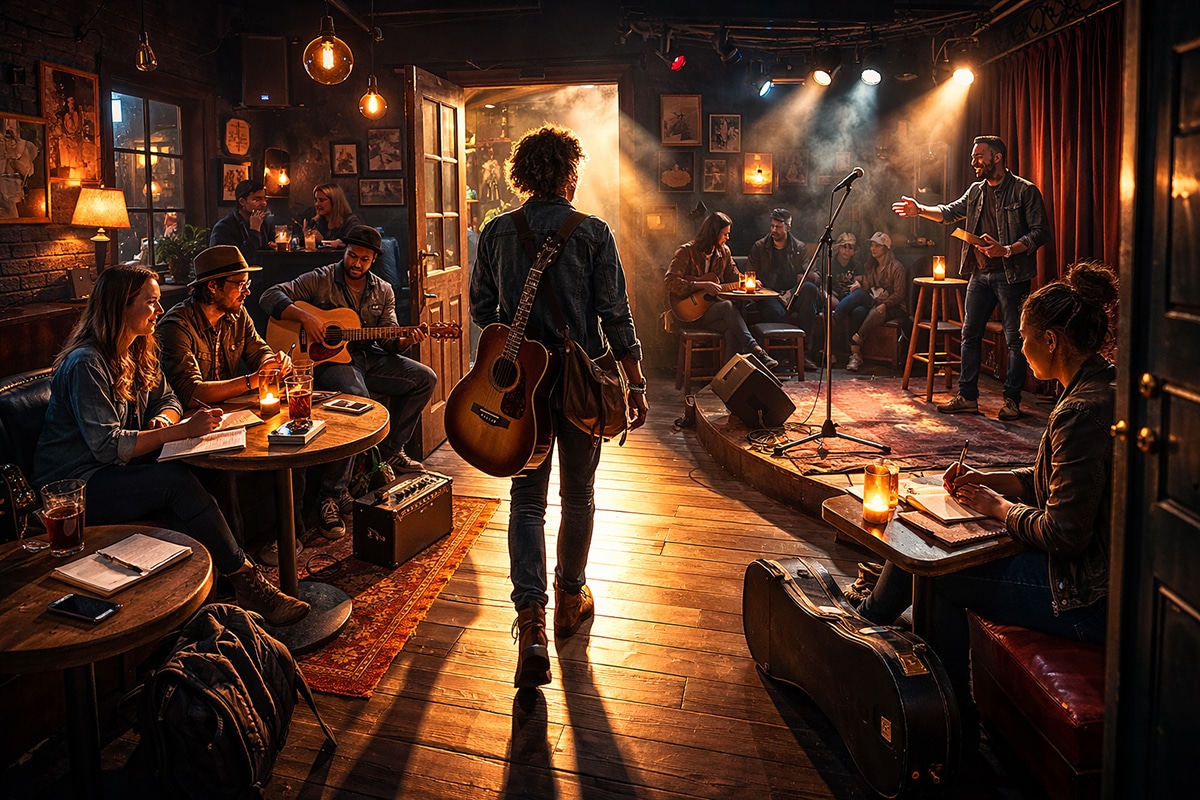
Open mics, jams, writers rounds, local showcases, rehearsal spaces, listening rooms, community radio benefit nights, and scene meetups all do one thing the internet cannot do well: they let people experience you in real time.
That matters because musicians and industry people are making a decision long before they ever say it out loud. They are asking themselves, quietly, “Would I want to work with this person?” That answer comes from the room.
It comes from how you treat the host. It comes from whether you stay to hear other people. It comes from whether you vanish right after your set or stick around and support the room. It comes from whether you hog attention or create good energy. It comes from whether you sound like somebody who could be trusted with a real job.
That is why the local scene still matters, even if your audience is national. Your local scene is the lab where your reputation gets built.
And one of the biggest mistakes musicians make is treating local rooms like they are too small to matter. But small rooms are where people learn your name before they have a reason to say it.
Open Mics and Jams Are Not Beneath You
Some artists graduate too early in their own heads. They think open mics are for beginners. They think jams are only for hobbyists. They think if they already play paid shows, they should not waste time in a free room. That is often a mistake.
An open mic is not just a stage. It is a scouting room. It is a low-risk place for other musicians, bookers, hosts, and venue staff to notice you. It is also where you can notice them. A lot of careers begin when somebody sees how you handle a small room with no glamour and no excuses.
Jams matter for a different reason. They show musicianship in public. They show whether you can listen, adapt, find the pocket, leave space, and make other people sound better. A jam does not just reveal your chops. It reveals your temperament. And temperament is bookable.
A monster player who ruins the room is less valuable than a strong player who lifts everybody. Working musicians know this. Bandleaders know this. Touring acts know this. Producers definitely know this.
So yes, go to the jams. Go to the open mics. Go to the writers rounds. Go to the regular community rooms where the same faces gather. Do not go once and declare it useless. Go enough times that people start expecting to see you.
That is how trust begins.
Formal Industry Rooms Still Matter
There is a certain kind of artist who rolls their eyes at formal industry events. They assume conferences are for executives, panels are for people who talk instead of do, and organizations are for insiders who already made it. That is lazy thinking.
Formal industry rooms are not always cheap, and they are not always perfect, but they are still one of the fastest ways to get near concentrated experience. In one weekend, you can meet artists, managers, engineers, producers, publishers, journalists, gear builders, venue people, music nonprofit staff, sync professionals, and artist services teams. That is not nothing.
If you want a structured path into those rooms, the Recording Academy is one option worth serious attention. The Academy’s membership system is community-driven and organized through regional chapters, and its membership page points artists toward chapter communities across major U.S. music hubs. Those chapter networks are not just symbolic. Local chapter pages show regular member events, educational programming, and community-building activity.
This is where the rebellious part needs to be said out loud: joining a professional organization is not “selling out.” It is learning where the rooms are. Too many indie artists have been taught to stay outside every institution on principle. That can feel righteous, but it can also keep you broke.
Use the rooms. Do not worship them. There is a difference.
If your local Recording Academy chapter hosts an event, go. Listen more than you talk. Meet people without trying to pitch your whole life in ninety seconds. Learn the ecosystem. You are not there to beg for validation. You are there to become familiar.
Familiarity creates comfort. Comfort creates trust. Trust creates calls.
Conferences Are Accelerators, Not Miracles
A good conference will not save a weak career. But it can speed up a serious one.
The Music Biz Annual Conference is one of the clearest examples of a room built for connection. Music Biz says its annual conference brings together the commerce, content, and creative sides of the industry, and its 2026 event page says the conference returns to Atlanta May 11–14, 2026 after drawing more than 2,000 professionals from 800 companies and over 30 countries. For artists who want to understand how deals, distribution, tech, and services actually connect, that is a strong room.
NAMM is another room many artists underestimate. People think it is just a gear circus. Gear is there, sure, but NAMM itself says The NAMM Show is where the music industry gathers for discovery, career development, networking, education, and live events. That means artists can meet not only builders and brands, but also retailers, media people, live sound folks, engineers, and business contacts.
Genre-rooted conferences can be even better because they tend to be less random and more human. Folk Alliance International says its annual conference is the largest gathering of folk musicians and music industry professionals in the world, and the organization describes the event as a mix of showcases, workshops, and networking. Even if you do not live fully inside folk, roots, or acoustic music, there is a lesson there: genre communities often build deeper trust than broad industry rooms.
The same goes for AMERICANAFEST. The Americana Music Association says the event brings together fans and music industry professionals for five days of seminars, panels, networking, and showcases, and its 2026 festival page lists Sept. 15–19 in Nashville. That is not just a festival. It is a concentrated relationship market. See
The point is not that you must attend all of these. The point is that these rooms exist, and they are full of people who already think about music as work, not just entertainment. That matters.
Genre Organizations Can Be Gold Mines
One of the smartest networking moves a musician can make is this: stop trying to network with “the whole industry” and start networking with your lane.
Genre organizations are powerful because they gather people around shared language, shared references, and shared goals. That lowers the awkwardness. It also raises the odds that one introduction turns into actual work.
For songwriters, NSAI is a strong example. Nashville Songwriters Association International has local chapters and a chapter search tool, and the organization says members can use chapter events to connect with fellow writers, share songs, exchange feedback, and grow their creative community. NSAI also says it has 100 chapters worldwide and offers weekly workshops with pro speakers, industry guests, open mics, speed co-writing, feedback, and pitch opportunities. Start with NSAI Chapter Search, NSAI Calendar, and Workshops
For blues players, local blues societies are still one of the most underrated networking systems in America. The Blues Foundation maintains an affiliate search and affiliate map, and it also notes that affiliated blues societies receive a level of endorsement inside the broader blues community. These groups are where artists meet festival volunteers, radio people, club regulars, working bands, and the people who know who is actually moving the local roots scene.
That kind of organization-based networking works because it is layered. You are not just meeting one person. You are entering a recurring system. The room repeats. The names repeat. The trust compounds.
That is what you want.
The Best Networking Often Happens Outside “Music Industry” Spaces
Here is where things get interesting.
Some of the best networking opportunities for musicians are not branded as music industry networking at all.
That is where artists who think a little wider start to win.
Local arts agencies are a great example. Americans for the Arts says the nation has about 4,500 local arts agencies, and it maintains a directory so people can find them. These agencies are often tied to grant programs, public art, local programming, cultural events, education projects, and municipal arts partnerships. That means they are full of people who hire performers, connect artists, build events, and know who is doing real work in town.
Your local chamber of commerce is another room many musicians ignore because it does not feel cool enough. That is exactly why it can be useful. The U.S. Chamber’s directory helps people find local chambers by city and state. Those rooms are full of business owners, event planners, restaurant groups, tourism people, nonprofit leaders, and venue-adjacent decision makers. In plain English, they are full of people who buy entertainment or know the people who do.
Volunteer work can also create powerful connections, especially when it puts you beside other professionals instead of just in front of an audience. Musicians On Call lets volunteer musicians perform for patients, families, and caregivers in healthcare settings, both in person and virtually. That kind of service work does more than feel good. It puts you in a network of organized, reliable, giving people, and that is often the same kind of character people want around their events and creative projects.
Then there are intimate-show communities. Sofar Sounds says artists can apply to play packed rooms without having to self-promote the show, and the platform pitches itself as a global community connecting artists and audiences through intimate live experiences. That makes it useful not only for exposure, but for meeting hosts, curators, local teams, and listeners who actually pay attention.
Outside-the-box networking also includes film and creator rooms. The 48 Hour Film Project explicitly notes that composers can start working during production workflows, and its Filmapalooza event is an annual film festival and conference for filmmakers. Tht matters because film people always need music, and many of them would rather work with a real, reachable independent artist than chase major-label clearance problems.
In Los Angeles, Film Independent’s “3rd Thursdays” events are described as free, open to the public, and built for networking with filmmakers and film lovers, while the Film Independent Forum includes panels, workshops, one-on-one meetings, and networking receptions. Even if you are nowhere near L.A., the lesson holds: filmmakers, podcasters, theater people, and media creators are often better networking targets than random “industry” strangers because they have immediate project needs. Check and .
That is the bigger point. Stop asking only, “Where do musicians go?” Also ask, “Where do people go who hire, feature, license, program, fund, or collaborate with musicians?”
That question opens much better doors.
Use Discovery Tools, but Do Not Confuse Discovery With Relationship
Digital tools can help you find rooms. They just cannot replace what happens inside them.
Meetup has a music category and city-based event discovery, which makes it useful for finding local circles, jam groups, listening clubs, writing communities, and scene-adjacent gatherings. Eventbrite also has broad local music event discovery across U.S. cities. Those are not relationships by themselves, but they are maps to where relationships might begin.
That distinction matters because modern artists keep making the same mistake. They think because a tool is digital, the relationship is digital too. It is not. A tool can point you to a room. It can remind you about the room. It can help you follow up after the room. But the thing that turns into work is still trust.
And trust still grows best through repeated contact, especially face to face.
That does not mean online networking is worthless. It means online networking should support real-world reputation, not replace it.
Digital Networking Still Counts, If You Use It Like an Adult
There is a clean, useful version of digital networking, and then there is the noisy version. The noisy version is constant self-promotion, cold DMs with no context, mass tagging, and trying to force intimacy with strangers. That version usually fails.
The useful version is quieter.
LinkedIn is still one of the clearest professional networks online, and the company says it has more than 1 billion members worldwide. For musicians, that does not mean posting corporate slogans. It means building a clear professional identity so producers, arts organizations, venue teams, publishers, music-tech companies, and nonprofit leaders can understand what you actually do.
Discord can also be valuable because Discord says servers organize conversations into topic-based channels, and its support documentation says servers are free to create and can scale from small groups to large communities. That makes it useful for genre communities, fan communities, songwriter circles, and collaborative project hubs. The key is to join or build a room that has a purpose, not just noise.
Substack is useful in a different way. Substack describes itself as a creator-centered media platform powered by subscriptions and discussion. For musicians, that means you can build a circle around process, tour notes, demo stories, scene commentary, or songwriting life and end up in conversation with writers, superfans, local organizers, and tastemakers who like your voice before they ever hear a full set.
But none of these platforms should become the whole game. They are bridges. They are not the destination.
The destination is still a real relationship strong enough to survive a missed email, a bad week, a slow season, and a room where there is no algorithm left to hide behind.
How to Network Without Feeling Fake
This is the part most artists need, because a lot of musicians do not avoid networking because they are lazy. They avoid it because they do not want to become one of those people.
Fair enough.
Here is the better way.
Walk into rooms with curiosity, not hunger. Talk to people because they are interesting, not because you are trying to extract something. Ask what they are working on. Ask what kind of shows they love. Ask what problems they keep running into. Ask what they wish more artists understood. Those are real questions. Real questions make real conversations.
Do not pitch too early. A lot of musicians start selling before anybody has asked what they sell. That is like proposing marriage during introductions. Slow down.
Do not try to impress the whole room. Try to make a few clean connections. That is enough.
Do not talk only to the obvious power people. Talk to the photographer. Talk to the stage manager. Talk to the assistant. Talk to the person running the sign-in table. Talk to the volunteer. The music business is full of people whose job title today is not the job title they will have next year.
Do not fake expertise. It is always obvious. It is better to say, “I am learning that side of the business,” than to pretend you know more than you do.
Do not vanish after you take. Support other people. Share their show. Recommend their song. Congratulate them when they land something. Reply when there is no immediate upside to you. That is how you stop feeling fake. You become a participant instead of a hunter.
And for the love of all things loud and holy, follow up like a human. Not like a newsletter. Not like a robot. A short note that says, “Good meeting you last night. I appreciated what you said about routing regional runs. Hope we cross paths again,” is better than a giant paragraph about your entire catalog.
The Follow-Up Is Where Most Musicians Lose the Plot
A good first impression matters. A good second contact matters more.
This is where a lot of networking collapses. Artists have a strong conversation, feel a surge of hope, then either do nothing or overdo everything. They ghost the connection, or they smother it.
The right follow-up is simple.
Send a short message within a day or two. Mention something specific from the conversation so they know you were paying attention. If it makes sense, include one useful link. Not seven. One. Maybe your live performance clip. Maybe your website. Maybe the song you mentioned. That is enough.
Then keep showing up in the ecosystem.
That last part matters because relationships rarely turn at the first touch. They turn at the third or fifth or ninth. People need to see you a few times before you become real to them. That is not rejection. That is normal.
Which means your networking plan cannot be one big heroic night. It has to be a rhythm.
One open mic every week. One jam every month. One industry event every quarter. One conference a year if your budget allows. One thoughtful follow-up habit. One clean database of who you met and where. That is how a network is built.
Not in fireworks. In repetition.
This Is How Networking Turns Into Income
Let’s make this plain, because this is where the Making a Scene part comes in.
Networking is not about collecting cool stories. It is about building artist-owned opportunity.
When you build real relationships, you create more ways for money to come to you without begging centralized platforms to bless you. A contact at a venue can lead to better shows. A relationship with another band can lead to support slots. A songwriter contact can lead to co-writes. A producer relationship can lead to session work. A film contact can lead to licensing. A local arts connection can lead to funded events. A chamber connection can lead to private gigs. A house-show host can lead to a routing chain. A roots society can lead to festival visibility. A journalist connection can lead to coverage that reaches people already active in your lane.
That is what artist independence really looks like. Not standing alone in a field screaming at the algorithm. It looks like a web of direct relationships that produce gigs, sales, referrals, collaborations, and community.
And yes, sometimes that means taking a supporting role before you get a headlining one. That is not failure. That is apprenticeship with a paycheck.
One of the smartest career moves an artist can make is to be open to the supporting role on a tour, the sideman seat, the harmony job, the utility-player slot, the songwriter round opener, the small stage at the conference, the afternoon panel performance, the community event set. Those roles put you near people. People create momentum.
Momentum creates leverage. Leverage creates independence.
AI Can Help You Network Better, but It Cannot Be Your Personality
This is one place where AI can actually help musicians without turning them into weird robots.
ChatGPT can help you draft follow-up notes, summarize conference takeaways, brainstorm better introductions, rehearse short bios, and turn messy notes into action steps. Airtable can help you keep a clean relationship database with fields for where you met someone, what they do, when you last spoke, and what opportunities might make sense later. Airtable also positions itself as a workflow platform with automation features, which makes it useful for keeping your contact system from becoming a pile of forgotten notes.
Used that way, AI helps you remember and organize. It helps you be more consistent. It helps you act like a professional. What it should not do is turn your outreach into bland machine oatmeal. If every message sounds generated, people can feel it. Use AI to support your brain, not replace your humanity.
That same rule applies to Web3. If you are building a direct-to-fan ecosystem, relationship tools can extend what happens in the room. Unlock Protocol describes itself as a way for creators to monetize content and membership in a decentralized way, including smart-contract memberships and even event tooling. POAP describes its digital collectibles as bookmarks for your life, and its case studies show how event collectibles can boost participation and help attendees track their experiences. For artists, that means in-person networking can continue after the show through memberships, digital stamps, token-gated communities, or collectible proof of attendance. Start with , and .
But again, none of that replaces the room. It extends the room.
The handshake is still first.
Face to Face Still Wins
This part needs to be said with no hedging. There is still no replacement for face-to-face contact.
A DM can introduce. A profile can explain. A mailing list can remind. A Discord server can gather. A Substack can deepen your voice. A LinkedIn page can make you legible. A POAP can memorialize an event. An AI tool can help you remember what happened. But a room still tells people who you are.
It tells them whether you can carry a conversation. Whether you listen. Whether you notice others. Whether your energy feels grounded or frantic. Whether you make a team feel better. Whether you can be trusted in the messy middle where most music work actually lives.
That is why relationships remain the music industry’s real currency. Because even in the digital age, people still hire people.
And the artists who win long term are usually not the ones who shouted the loudest online. They are the ones who built a network wide enough, deep enough, and real enough to keep producing work when trends changed.
Build a Career, Not a Vibe
If you want the practical takeaway, here it is. Stop treating networking like a side chore. Treat it like part of your job. Not because you need to become fake. Because you need to become visible in the right human circles.
Go to the jams. Go to the open mics. Go to the writers rounds. Join the local organizations that fit your lane. Attend the chapter events. Try the conference once. Show up at the arts council mixer. Meet the chamber people. Volunteer where music intersects with service. Introduce yourself to filmmakers. Build digital rooms that support real relationships. Keep notes. Follow up. Help other people. Stay in the loop. Repeat.
That is not glamorous advice. It is better than glamorous advice. Because glamorous advice tells artists to wait for a break. Real advice tells artists to build a network strong enough that breaks start happening more often. And that is the part too many musicians miss. Networking is not about being liked by the industry. It is about becoming hard to leave out of it.
For independent artists trying to build a music industry middle class, that is everything. Ownership matters. Direct revenue matters. Fan data matters. Merch matters. Touring matters. Licensing matters. But all of those grow faster when the right people know your name, trust your work, and want you in the room.
That is the business. That has always been the business. And no algorithm, no matter how loud, has managed to replace that yet.
 |  Spotify |  Deezer |  Breaker |
 Pocket Cast |  Radio Public |  Stitcher |  TuneIn |
 IHeart Radio |  Mixcloud |  PlayerFM |  Amazon |
 Jiosaavn |  Gaana |  Vurbl |  Audius |
 Reason.Fm | |||
Find our Podcasts on these outlets
Buy Us a Cup of Coffee!
Join the movement in supporting Making a Scene, the premier independent resource for both emerging musicians and the dedicated fans who champion them.
We showcase this vibrant community that celebrates the raw talent and creative spirit driving the music industry forward. From insightful articles and in-depth interviews to exclusive content and insider tips, Making a Scene empowers artists to thrive and fans to discover their next favorite sound.
Together, let’s amplify the voices of independent musicians and forge unforgettable connections through the power of music
Make a one-time donation
Make a monthly donation
Make a yearly donation
Buy us a cup of Coffee!
Or enter a custom amount
Your contribution is appreciated.
Your contribution is appreciated.
Your contribution is appreciated.
DonateDonate monthlyDonate yearlyYou can donate directly through Paypal!
Subscribe to Our Newsletter
Order the New Book From Making a Scene
Breaking Chains – Navigating the Decentralized Music Industry
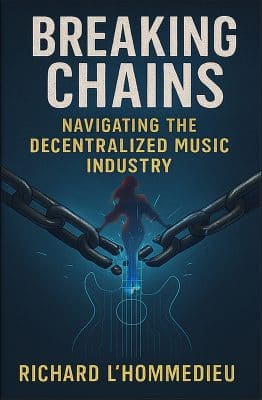
Breaking Chains is a groundbreaking guide for independent musicians ready to take control of their careers in the rapidly evolving world of decentralized music. From blockchain-powered royalties to NFTs, DAOs, and smart contracts, this book breaks down complex Web3 concepts into practical strategies that help artists earn more, connect directly with fans, and retain creative freedom. With real-world examples, platform recommendations, and step-by-step guidance, it empowers musicians to bypass traditional gatekeepers and build sustainable careers on their own terms.
More than just a tech manual, Breaking Chains explores the bigger picture—how decentralization can rebuild the music industry’s middle class, strengthen local economies, and transform fans into stakeholders in an artist’s journey. Whether you’re an emerging musician, a veteran indie artist, or a curious fan of the next music revolution, this book is your roadmap to the future of fair, transparent, and community-driven music.
Get your Limited Edition Signed and Numbered (Only 50 copies Available) Free Shipping Included
Discover more from Making A Scene!
Subscribe to get the latest posts sent to your email.


