The Home Studio Is Not a Shortcut, It’s a Strategy



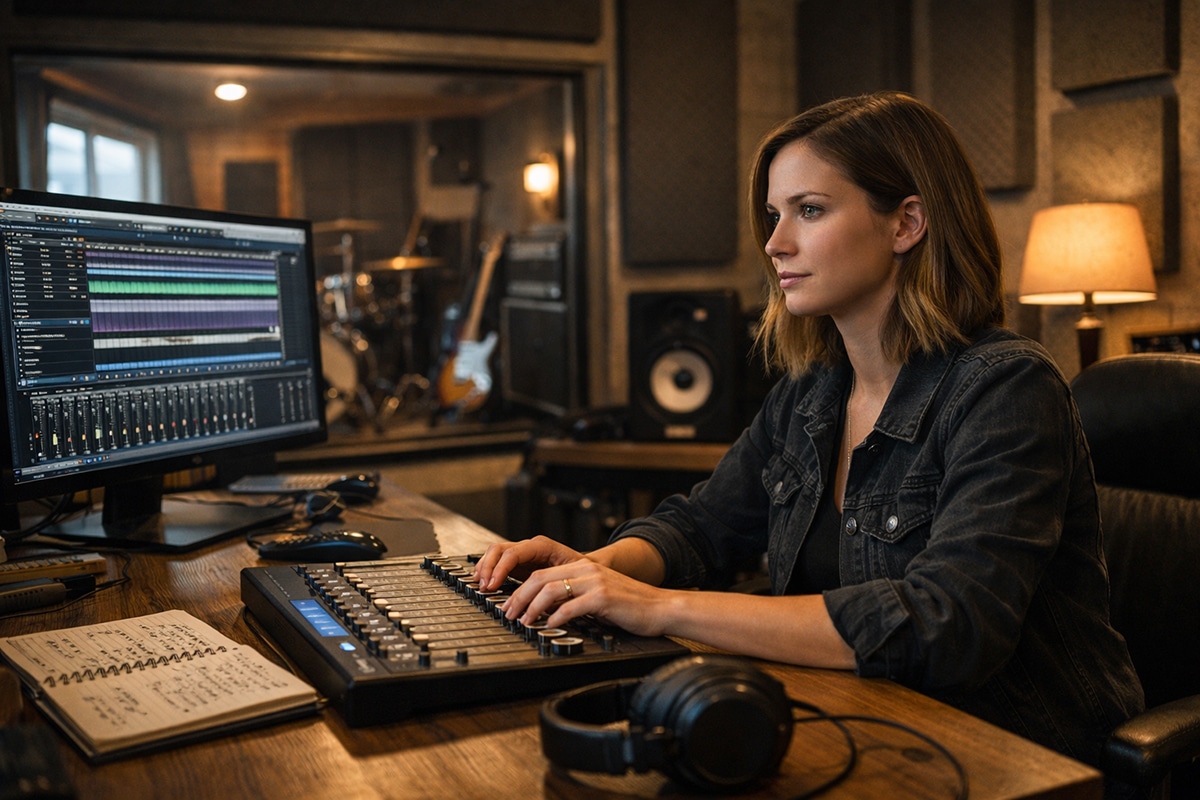
Making a Scene Presents – The Home Studio Is Not a Shortcut, It’s a Strategy
Listen to the Podcast Discussion to gain more insight in building a Home Studio
For a long time, the home studio has been talked about like a backup plan. Something you use only because you cannot afford the “real thing.” A temporary setup you tolerate until a label calls, or until you can scrape together enough money to book time in a flashy room with a massive console and someone else running the session. That idea is deeply baked into music culture, and it is one of the quiet reasons so many independent artists feel stuck. It frames the home studio as a sign you have not “made it yet,” instead of recognizing it for what it actually is.
That way of thinking is outdated, and more importantly, it is damaging. The uncomfortable truth for the old music industry is that the home studio is no longer a shortcut or a compromise. It is a strategy. When it is built with intention and used consistently, a home studio becomes one of the strongest long-term tools an independent artist can have. It is not just a place to record songs. It is a place where careers are shaped. It gives artists control over their process, keeps costs predictable, speeds up learning, and allows creativity to happen without the constant pressure of the clock or the fear of wasting money.
This is not an article about pretending every spare bedroom sounds like Abbey Road. It is not about flexing gear, chasing trends, or selling the fantasy that equipment alone creates great records. This is about reality. Recorded music no longer holds the same status it once did. Most fans do not buy CDs. Vinyl exists, but it is a niche, not a mass market. Streaming has trained listeners to expect endless music for almost nothing, and the payouts reflect that. In this environment, throwing unlimited money at recording costs is not bold or artistic. It is reckless, and for many artists, it quietly sabotages their future before it ever gets started.
When a home studio is approached the right way, it flips that entire equation. Recording stops being a financial gamble and starts becoming an owned process. Instead of saving up for rare studio sessions, artists can work consistently. Instead of rushing decisions, they can take time to learn, revise, and grow. Over months and years, this leads to a larger, stronger catalog built without asking permission and without bleeding cash every time inspiration strikes. That is not a limitation of working from home. That is leverage, and in today’s music economy, leverage is everything.
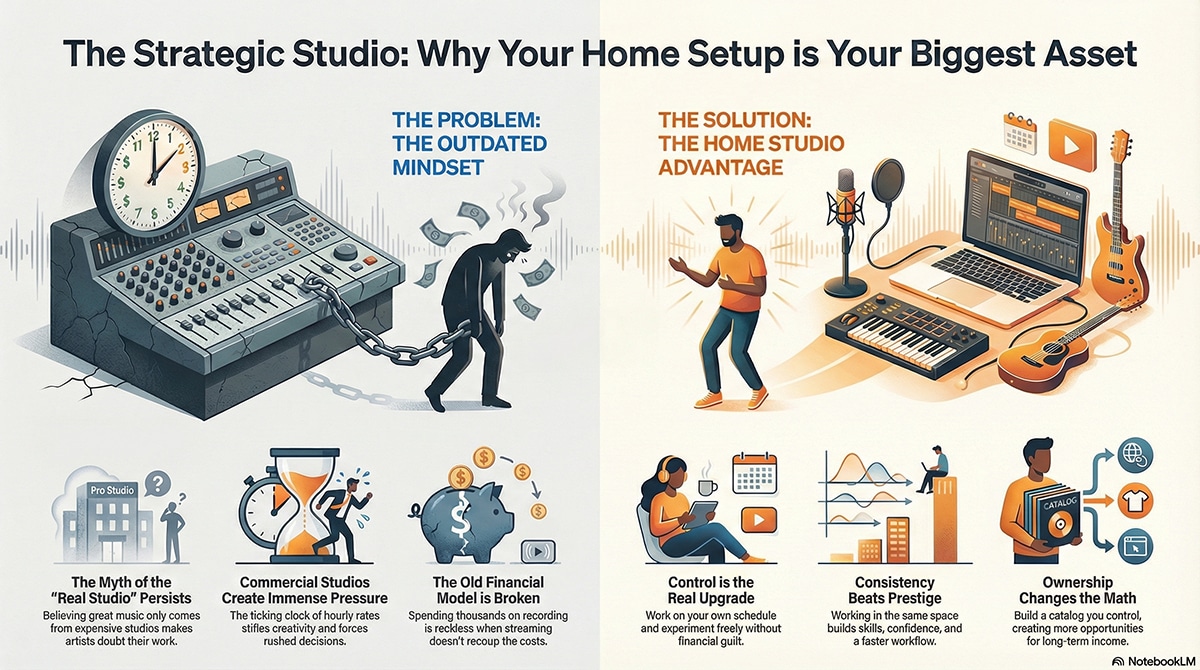
The Myth of the “Real Studio”
There is a myth in music culture that just refuses to die. It is the idea that “real records” only happen inside commercial studios. That if your music was not captured in a room filled with expensive furniture, a giant console, and a paid engineer sitting behind the glass, it somehow does not count. This myth is subtle but powerful. It makes artists doubt their work before anyone else ever hears it, simply because of where it was recorded.
That belief did not come out of nowhere. It was built during a time when recording gear was rare, fragile, and extremely expensive. Studios were not just rooms, they were gatekeepers. If you wanted to make a record, you had to book time. If you wanted that record to sound professional, you needed someone who had already spent decades learning how not to ruin a session. Access was limited, and that limitation created status. Recording in a commercial studio was not just about sound quality, it was about permission.
That world no longer exists, even if parts of the industry pretend it does.
Today, the same core tools that once lived exclusively in those rooms now live on laptops. Digital audio workstations like Studio One put editing, mixing, and production power directly in the hands of independent artists. These are not “lite” versions of professional tools. They are the tools. What used to be locked behind hourly rates and studio walls is now available through software and practice. You are not buying prestige when you open a DAW. You are buying capability.
This is where the conversation usually goes wrong. The limitation is not the tools. The limitation is mindset.
If you treat your home studio like a toy, it will sound like one. If it is something you only use casually, without structure or intention, the results will reflect that. But when you treat a home studio like a strategic workspace, everything changes. It becomes a place for focused work, learning, and growth. The difference is not money, and it is not access. It is intention, repetition, and the willingness to learn from your own results over time.
Control Is the Real Upgrade
One of the biggest advantages of a home studio has very little to do with sound quality, gear, or technical specs. It has everything to do with control. Control over your time, your process, and the way your creativity is allowed to unfold. This is the part of home recording that rarely gets talked about, but it is often the reason artists either grow quickly or stay stuck.
In a commercial studio, time is literally money. The clock is always running in the back of your mind. Every extra take costs more. Every idea you want to try feels like a risk. You start making decisions based on efficiency instead of instinct. For many artists, this creates pressure instead of focus. You are trying to capture something emotional and honest while also worrying about how many minutes are left in the session. That is a difficult environment to be creative in, especially if you are still learning your own voice.
At home, that pressure disappears. There is no hourly rate ticking away while you think. The clock stops being the boss. You can record a vocal ten times without feeling guilty about “wasting” time. You can listen back, realize the chorus needs rewriting, and actually rewrite it. You can abandon a song halfway through, walk away, and come back the next day with fresh ears. This is not inefficiency or laziness. This is how strong records are actually made. Most great songs go through multiple versions before they become what they are meant to be.
Control also shows up in how you manage your schedule. In a traditional studio setup, you are always waiting on something. Waiting for room availability. Waiting for an engineer. Waiting for other people to align their schedules just so you can try an idea. Creativity does not work well inside tight appointment windows. Inspiration shows up when it wants to, not when a calendar says it is allowed to. A home studio lets you work when the idea is fresh instead of forcing you to remember it later.
Over time, this level of control compounds in a powerful way. You write more because you are not saving ideas for later. You record more because the barrier to starting is low. You finish more because nothing is stopping you from following a song all the way through. Finished music is what builds momentum. It is what creates a catalog. And in the long run, finished music is the only thing that actually moves an independent artist’s career forward.
Consistency Beats Prestige Every Time
One of the most overlooked advantages of a home studio is consistency. Not flashy gear. Not room size. Consistency. When you work in the same space, with the same setup, day after day, your ears start learning faster than you realize. You begin to understand how your room reacts to sound. You learn how your voice naturally sits in your microphone. You start hearing problems earlier, before they turn into bigger issues later in the mix. That kind of awareness does not come from talent. It comes from repetition.
Commercial studios are impressive, no question. They look professional and they feel important. But they are also unfamiliar every single time you walk into one. Every room sounds different. Every monitoring setup behaves differently. Even small changes in layout or acoustics affect how you hear things. As a result, the first part of most studio sessions is spent adjusting. You are learning the room. You are getting comfortable. You are recalibrating your ears before you can even focus fully on the music.
At home, that learning curve quietly disappears. You are not starting from scratch every time you hit record. You are building muscle memory. You know what a good vocal take sounds like in your space. You recognize when something feels off immediately. Over time, this familiarity turns into confidence, and confidence turns into better decisions.
This is also where Studio One stops being “just software” and becomes part of your creative process. When you use the same DAW consistently, your workflow speeds up naturally. Editing no longer feels like a technical task you have to think through step by step. Recording becomes fluid. You stop searching for buttons and start reacting to sound. The software fades into the background, which is exactly where it should be. When the DAW becomes invisible, creativity has room to breathe.
That kind of consistency is how independent artists release music regularly without burning out or second-guessing themselves. You are not reinventing your process every time. You are refining it. Prestige does not release songs. Systems do. And a consistent home studio system is one of the most powerful tools an indie artist can build.
Fender Studio One website:
https://www.fender.com/pages/fender-studio-pro
Ownership Changes the Math
Here is the part most artists are never taught early enough, and it quietly shapes their entire career. Recording costs are not just expenses. They are leverage. The way you spend money to make music directly affects how much control you have later. When you record at home, you are not just saving cash. You are owning the process and the results of your work. You are not going into debt just to create assets for someone else to profit from. You are building a catalog that you control from the ground up.
This matters more now than it ever has, because recorded music no longer functions as a product in the traditional sense. For most artists, songs are no longer something fans buy in large numbers. Instead, recorded music supports other income streams. Songs help you land sync placements. They drive people to live shows. They deepen direct fan support. They anchor memberships, content, education, and community-based models. In this landscape, your catalog is not a single paycheck. It is infrastructure.
When every song costs thousands of dollars to create, something dangerous happens. You start hesitating. You overthink releases. You wait for the “perfect moment.” If you hesitate long enough, you disappear from your audience’s radar entirely. The home studio removes that fear by lowering the cost of creation. When recording is affordable and accessible, you can experiment without gambling your future. You can release more often. You can try different sounds. You can respond to your audience in real time instead of guessing what the market might want six months from now.
Ownership, in this context, is not just about legal rights or paperwork. It is about confidence. When you know you control your process and your catalog, you make braver creative decisions. You stop treating every release like a life-or-death event. That confidence shows up in your music, your consistency, and ultimately in how sustainable your career becomes.
The Reality of Recorded Music Today
We need to be honest about where recorded music actually sits in today’s economy. For most independent artists, it is no longer a product that fans regularly buy. It functions more like a signal. A calling card. A way to tell your story and show people who you are. Songs introduce listeners to your world, but they are rarely the thing that pays the bills on their own anymore.
Streaming platforms make this reality very clear. They treat songs like content, not craftsmanship. Music lives in endless feeds and playlists, competing for attention rather than being valued as a standalone product. The payouts reflect that mindset. Fractions of pennies per stream are not an accident. They are the natural result of a system built around volume and consumption, not depth. Complaining about this reality may feel justified, but it does not change the math.
What does change the outcome is adjusting your strategy.
If recorded music is no longer the primary product, then it cannot carry unlimited production costs. Spending huge amounts of money on recordings that will never directly recoup those costs puts independent artists in a constant state of financial stress. The home studio offers a way out of that trap. It allows artists to create strong, professional recordings while keeping budgets grounded in reality.
This does not mean lowering standards or accepting mediocre results. It means aligning effort with outcome. It means understanding what recorded music is actually doing for your career and investing accordingly. A song that supports live shows, licensing, or fan engagement does not need to bankrupt you to be effective.
A well-run home studio lets you spend money where it truly matters and save it where it does not. You can invest in the right tools, the right learning, and the right moments, instead of paying high costs just to access a room. That is not cutting corners. That is running a sustainable operation in a music economy that has already changed.
The Learning Gap Is the Real Barrier
One of the biggest arguments against home studios has always been about experience. The idea goes like this: you can buy microphones, interfaces, and plugins, but you cannot buy decades of engineering and production knowledge. For a long time, that argument was fair. Engineers earned their skills by spending years inside studios, watching sessions, making mistakes, and slowly learning how arrangements, sounds, and mixes actually work together in the real world.
That argument still has truth to it, but it is no longer the wall it once was.
AI-powered tools are changing how independent artists learn, not by replacing creativity or taste, but by collapsing the learning curve. They shorten feedback loops that used to take years. Instead of guessing why something feels flat or unfinished, artists can now get immediate insight that helps train their ears and instincts. Tools that analyze tone, balance, and dynamics help artists hear problems they might not recognize yet. This is not about letting AI make decisions for you. It is about understanding why something works or why it does not.
AI-assisted plugins and analysis tools act like quiet teachers in the room. They do not take over. They point things out. They show patterns. They help you connect cause and effect. Over time, you start recognizing those patterns on your own. What once required assisting a seasoned engineer can now happen inside a home studio, on your own schedule, without pressure.
This learning effect becomes even more powerful when you expand beyond mixing and into arrangement and production, and this is where tools like Suno can play an unexpected but valuable role.
Suno is not just a song generator. Used intentionally, it can be a powerful learning tool for arrangement and production. An independent artist can use Suno to study how finished tracks are structured from start to finish. You can generate multiple versions of a song idea and listen closely to how sections are introduced, how energy builds, where instruments drop out, and how choruses are supported. You are not listening for inspiration alone. You are listening for decisions.
By breaking down what Suno generates, artists can start asking better questions. Why does the chorus feel bigger? What changed in the drums or harmony? Why did the verse feel sparse, and what entered to create momentum? These are the same questions producers learn to ask after years in studios. Suno gives you fast examples to study without waiting for a session or a collaborator.
Inside a home studio, this becomes a practical exercise. You can generate an arrangement idea in Suno, then try to recreate the structure manually inside Studio One. You might not copy the sounds, but you can follow the flow. Intro length. Verse spacing. Chorus lift. Breakdown timing. This turns abstract production concepts into something you can hear, analyze, and apply immediately.
This approach is especially effective because there is no pressure. You can experiment freely. You can compare your version to the reference. You can fail, adjust, and try again. That is how real production skills are built. Not by reading theory alone, but by hearing patterns over and over until they make sense.
AI tools like Suno are not shortcuts to professionalism. They are accelerators for understanding. They expose independent artists to arrangement and production decisions that used to be hidden behind closed doors. When used with intention, they help artists learn how records are actually built, not just how they sound at the end.
AI is not a cheat code. It is a study partner. Combined with a home studio and consistent practice, it gives independent artists access to a level of learning that once required years of proximity to professionals. That is why the experience argument against home studios is weaker than it has ever been.
Suno website: https://suno.com
AI as a Learning Curve, Not a Crutch
One of the most common mistakes artists make with AI is assuming it is about automation. They hear “AI” and think it means pushing a button and letting a machine finish the work for them. For independent musicians, that mindset misses the real value entirely. The true power of AI in the studio is education.
When you work with tools that suggest EQ moves, compression behavior, or balance references, you are not being told what to do blindly. You are being shown why certain choices make sense. Over time, patterns start to click. You begin to understand why seasoned engineers cut certain frequencies instead of boosting them, why compression feels musical in one context and heavy-handed in another, and why balance matters more than any single sound. As your ears improve, you naturally rely on the tools less. That is not a failure of the technology. That is success. The goal is growth, not dependency.
In a commercial studio, that kind of learning is expensive and often limited. You are paying for time, not education. There is rarely space to stop a session and ask why a decision was made, or to try five different versions just to hear the difference. At home, the learning never stops. You can revisit old mixes weeks or months later. You can compare versions side by side. You can hear your own progress clearly instead of guessing whether you are improving.
AI tools inside a home studio lower the intimidation factor that keeps many artists from fully engaging with the production process. They make the learning curve less steep without flattening it. They do not replace taste, instinct, or creativity. They support those things by giving you clearer feedback and better context. Used this way, AI becomes part of your growth as an artist, not a shortcut around it.
The Home Studio as Infrastructure
A home studio should never be treated like a hobby room or a place you “mess around” until something better comes along. It is infrastructure. Just like a business needs systems to operate, an independent artist needs a reliable creative base. A well-run home studio supports far more than just recording songs. It becomes the center of songwriting, tracking, content creation, collaboration, and even marketing. In one space, you can capture rough demos, final takes, behind-the-scenes footage, voiceovers, livestreams, and educational material without waiting on anyone else.
This is where the Making a Scene philosophy really comes into focus. Independence does not mean working alone or cutting yourself off from collaboration. It means building systems that allow you to create consistently and earn sustainably. A home studio is one of the core systems that makes that possible. It gives you the freedom to experiment while still staying grounded in reality. It lets you show up for your audience regularly instead of disappearing between releases.
Your home studio is not separate from your career. It is part of it. It connects directly to your catalog, your brand, and the way fans experience your work. It shapes how quickly you can respond to ideas, how often you release music, and how easily you can communicate your story. When artists start seeing their studio as infrastructure instead of just a collection of gear, their decisions change. They invest with intention. They build workflows instead of chasing upgrades. And they start treating their creative space like the foundation of a long-term career, not a temporary solution.
Sustainability Beats Burnout
One of the most overlooked benefits of a home studio is sustainability, and not just in a financial sense. Emotional sustainability matters just as much, if not more. Constantly chasing studio time, scrambling to fund sessions, and coordinating schedules with multiple people is draining. Over time, it turns the act of making music into a logistical problem instead of a creative one. When every recording opportunity feels rare or expensive, the pressure builds quickly.
Working at home changes that dynamic. You are able to pace yourself instead of sprinting every time you hit record. You can work in short sessions when your energy is high and step away when it is not. You can take breaks without feeling like you are wasting money. That flexibility keeps music enjoyable, and enjoyment is not a luxury. It is fuel. When making music stays enjoyable, artists stay engaged long enough to actually grow.
Burnout is one of the most common career killers in the independent world. Artists who are constantly overwhelmed stop creating, stop releasing, and eventually stop believing in their own work. A home studio helps protect against that by making the process manageable and humane. Burned-out artists do not build careers. Sustainable artists do, and sustainability starts with having a creative environment that supports the long game instead of constantly demanding short-term sacrifices.
Long-Term Income Is Built, Not Chased
A home studio supports long-term income by enabling volume and consistency, not noise or constant output for the sake of being seen. Real output. Finished songs that add to something larger over time. When you can create and release music regularly without crushing financial pressure, the math of opportunity starts working in your favor.
More songs mean more opportunities. Each finished track becomes another doorway into licensing, placements, collaborations, and direct fan engagement. A growing catalog gives you flexibility. It allows your music to live in multiple places at once instead of putting all your hopes into a single release or a single moment of attention.
This becomes especially important when you look at how music licensing actually works in the real world. Music supervisors rarely need just a single “full-length” version of a song. They often need multiple versions on short notice. Five-second stabs. Ten, fifteen, thirty, and sixty-second cuts. Instrumental versions with the vocals removed. Clean versions. Alternate mixes. And in many cases, they want access to stems so they can create custom edits that fit a scene perfectly.
When you operate from a home studio, all of this can be done immediately. You already have the session. You already have the tracks. You can open the project, mute the vocals, bounce an instrumental, export stems, or create custom edits in minutes instead of days. That kind of speed matters. Licensing decisions often move fast, and the artist who can deliver quickly is the artist who gets used again.
In a traditional studio-only workflow, this flexibility comes at a cost. You may need to book studio time just to reopen a session. You may need an engineer to export files. Every additional version becomes another expense. What should be simple turns into a barrier. Over time, those extra costs quietly eat into licensing income and make opportunities feel less accessible.
When recording costs and access are controlled through a home studio, you can think long-term instead of chasing short-term wins. You are not scrambling or hesitating because of added expenses. You are prepared. That preparedness is leverage. It makes you easier to work with, more responsive, and more valuable to partners like music supervisors.
You are not trying to hit the lottery. You are building a catalog, and a home studio gives you the ability to support that catalog in all the forms the modern music business actually requires.
The Home Studio and Marketing
Marketing is no longer something that happens after the music is finished. It is not a separate department or a separate phase. Creation and marketing now live side by side. Content matters. Story matters. Presence matters. Audiences want to understand who you are, how you work, and why your music exists, not just hear a finished track once and move on.
A home studio makes this kind of integrated approach possible. In the same space where you write and record, you can also create video, voiceovers, behind-the-scenes clips, livestreams, and narrative content that gives your music context. You do not have to outsource every piece of content or wait for someone else’s availability. That keeps costs lower and, just as importantly, keeps the result authentic. Fans respond to real moments far more than polished marketing language.
AI tools can reduce friction even further. They help artists understand audience behavior, spot patterns in engagement, and generate ideas for content that aligns with what listeners are responding to. They can assist with drafting captions, outlining posts, or organizing release plans, but they do not replace human connection. They support it. The artist still shows up. The tools just make showing up easier and more consistent.
When marketing is integrated into the same space where music is created, it stops feeling like a second job. It becomes part of the creative process instead of something that steals time from it. That shift alone is enough to keep many independent artists engaged long enough to build real momentum instead of burning out trying to do everything at once.
Independence Is a Skill Set
Running a home studio teaches skills that go far beyond making music. Without even realizing it, artists start learning project management, decision-making, and honest self-evaluation. You are planning sessions, setting deadlines, managing files, and deciding when something is finished instead of endlessly tweaking it. Those skills may not feel musical, but they are essential to building a career that lasts.
When artists understand their own process, they become much harder to exploit. They know what it actually takes to create a song from start to finish. They understand what things cost, both in time and money. They know where they need help and where they do not. That knowledge changes how conversations go with producers, labels, licensors, and collaborators. You stop agreeing to bad deals simply because you feel unsure or uninformed.
This is what independence looks like in practice. It is not just owning your rights or calling yourself an indie artist. It is having enough understanding of your own workflow and value that you can make clear decisions and negotiate from a position of confidence. A home studio quietly builds that confidence over time, not through theory or motivation, but through daily experience.
The Studio Grows With You
A home studio does not need to be perfect on day one, and expecting it to be is one of the fastest ways to get discouraged. A good home studio is not built all at once. It evolves over time. You learn what actually matters for your music. You upgrade slowly instead of chasing every new piece of gear. You refine your setup based on experience, not hype.
This is another quiet advantage home studios have over commercial spaces. A commercial studio is designed to work for everyone. Your home studio is designed to work for you. As your taste develops and your goals become clearer, your space can change with you. The microphone that fits your voice. The layout that keeps you focused. The workflow that feels natural. Over time, the studio becomes personal in a way no rented room ever can.
There is no one-size-fits-all setup for independent artists, and that is a good thing. What matters is not how your studio looks or how closely it resembles someone else’s. What matters is whether it supports your work. When your space is built around how you actually create, it stops feeling like a limitation and starts feeling like an extension of your creative identity.
Final Thoughts
The home studio is not a shortcut. It is not a consolation prize for artists who could not access something better. And it is not a compromise. It is a deliberate strategy for artists who want control, consistency, ownership, and sustainability in a world where recorded music no longer pays the way it once did. Choosing to work this way is not about lowering expectations. It is about aligning your creative process with the realities of the modern music economy.
When a home studio is approached with intention, it becomes more than a place to record songs. It becomes the foundation of a career that is built to last. It supports steady output instead of rare bursts. It encourages learning instead of dependency. It allows artists to create, adapt, and respond without waiting for permission or chasing prestige. In a system that often rewards luck and access over longevity, that kind of foundation matters.
This is not settling. It is building something real. It is choosing infrastructure over image, systems over status, and progress over validation. For independent artists who care about the long game, the home studio is not a fallback. It is one of the strongest tools they can invest in.
 |  Spotify |  Deezer |  Breaker |
 Pocket Cast |  Radio Public |  Stitcher |  TuneIn |
 IHeart Radio |  Mixcloud |  PlayerFM |  Amazon |
 Jiosaavn |  Gaana |  Vurbl |  Audius |
 Reason.Fm | |||
Find our Podcasts on these outlets
Buy Us a Cup of Coffee!
Join the movement in supporting Making a Scene, the premier independent resource for both emerging musicians and the dedicated fans who champion them.
We showcase this vibrant community that celebrates the raw talent and creative spirit driving the music industry forward. From insightful articles and in-depth interviews to exclusive content and insider tips, Making a Scene empowers artists to thrive and fans to discover their next favorite sound.
Together, let’s amplify the voices of independent musicians and forge unforgettable connections through the power of music
Make a one-time donation
Make a monthly donation
Make a yearly donation
Buy us a cup of Coffee!
Or enter a custom amount
Your contribution is appreciated.
Your contribution is appreciated.
Your contribution is appreciated.
DonateDonate monthlyDonate yearlyYou can donate directly through Paypal!
Subscribe to Our Newsletter
Order the New Book From Making a Scene
Breaking Chains – Navigating the Decentralized Music Industry
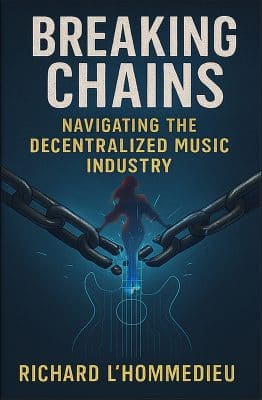
Breaking Chains is a groundbreaking guide for independent musicians ready to take control of their careers in the rapidly evolving world of decentralized music. From blockchain-powered royalties to NFTs, DAOs, and smart contracts, this book breaks down complex Web3 concepts into practical strategies that help artists earn more, connect directly with fans, and retain creative freedom. With real-world examples, platform recommendations, and step-by-step guidance, it empowers musicians to bypass traditional gatekeepers and build sustainable careers on their own terms.
More than just a tech manual, Breaking Chains explores the bigger picture—how decentralization can rebuild the music industry’s middle class, strengthen local economies, and transform fans into stakeholders in an artist’s journey. Whether you’re an emerging musician, a veteran indie artist, or a curious fan of the next music revolution, this book is your roadmap to the future of fair, transparent, and community-driven music.
Get your Limited Edition Signed and Numbered (Only 50 copies Available) Free Shipping Included
Discover more from Making A Scene!
Subscribe to get the latest posts sent to your email.


