


Steve Howell & Fats Kaplin Know You From Old




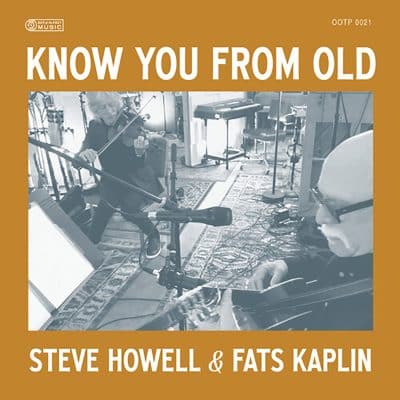 Steve Howell & Fats Kaplin
Know You From Old
Out Of The Past Music
Texas-born Steve Howell lives just outside of Shreveport, Louisiana. In 1965, at the age of thirteen, he first heard Mississippi John Hurt finger-picking country blues, and the experience changed his life. From there, Howell immersed himself in the music of Blind Willie McTell, Leadbelly, Robert Johnson, Son House, Rev. Gary Davis, and a host of other early acoustic blues guitarists and vocalists. Over the decades, he has become a master interpreter of this rural southern tradition, blending warm vocals and deft finger-picking with a deep reverence for the songs themselves.
Howell recorded his debut album, Out of the Past, in 2006. His third album received the “Historical Significance Award” from the Academy of Texas Music, honoring his dedication to preserving the spirit and fidelity of early blues and folk recordings.
I first discovered Howell with his fifth release, Friends Like Me (2010), credited to Steve Howell & The Mighty Men, featuring longtime collaborator Jason Weinheimer on bass. The partnership continued through several subsequent albums, including A Hundred Years from Today (2017), recorded as a duo, and Good As I Been to You (2018), which reunited the full band. Later albums — History Rhymes (2019), Long Ago (2020), and Been Here and Gone (2022) — further showcased Howell’s steady devotion to authentic American roots music.
The new release, Know You From Old, was produced, engineered, mixed, and mastered by Jason Weinheimer at Fellowship Hall Sound in Little Rock, Arkansas. This time, Howell records as a duo with the remarkable Fats Kaplin, a multi-instrumentalist born in New York City. Kaplin’s mastery extends across guitar, mandolin, banjo, accordion, steel guitar, the Arab oud, and the Turkish cumbus. His first album, This Is Pulp Country (2004), and later collaborations with Kristi Rose, Kieran Kane, and Kevin Welch earned him wide acclaim. His most recent solo effort, Morning Phrase (2014), remains a testament to his genre-spanning versatility.
Together, Howell and Kaplin deliver thirteen duets that weave folk, blues, gospel, and jazz into a seamless and heartfelt exploration of America’s musical lineage.
The album opens with “Black Dog,” first recorded by Bayless Rose in 1930 for the Gennett label. Howell learned it through the interpretations of Roy Book Binder and Spider John Koerner, as well as Kaplin’s 1975 collaboration Git-Fiddle Shuffle on Blue Goose Records. The performance captures the rustic charm of early country blues, with Howell’s warm baritone anchored by Kaplin’s intricate accompaniment.
“San Francisco Bay Blues” follows, originally written and recorded in 1954 by Jesse Fuller, the famed one-man band. The tune became a folk standard in the 1960s thanks to Ramblin’ Jack Elliott, Bob Dylan, Richie Havens, Eric Clapton, and others. Howell and Kaplin breathe new life into it, keeping the bounce and joy intact while adding a rich, rootsy warmth that feels both timeless and new.
“Buffalo Skinners” is a traditional American folk ballad recounting an 1873 buffalo hunt on the Southern Plains. Documented by John Lomax in 1910 and recorded by Woody Guthrie and Pete Seeger, the song captures the rugged spirit of frontier life. Howell’s version balances storytelling and restraint, with Kaplin’s subtle instrumental textures evoking wide-open prairie skies.
“Bugger Burns” dates to 1894 and tells of a Louisville policeman known for killing several men before meeting his own violent end at the hands of Danny Major. Originally published in Lomax’s Our Singing Country (1941), Howell learned it from Spider John Koerner. His performance, raw and haunting, honors the barrelhouse origins of the tale.
“Gospel Plow” — also known as “Hold On” — is a traditional African American spiritual first documented in 1917 and later popularized by Mahalia Jackson. The song, rooted in Luke 9:61–62, serves as both a prayer and a declaration of perseverance. Howell and Kaplin’s duet delivers reverence and simplicity, echoing the strength of the early spiritual tradition.
“The Cuckoo” is an ancient English folk song dating back to the 13th century. The American variant was famously recorded by Clarence “Tom” Ashley in 1929 and included on Harry Smith’s Anthology of American Folk Music. Howell’s reading captures the song’s mystical essence, his voice and guitar intertwining with Kaplin’s delicate lines to evoke a centuries-old melody reborn.
“Blue Ridge Mountain Blues” has roots in early country music, notably performed by Riley Puckett of Gid Tanner and the Skillet Lickers, and later by Doc Watson. Howell’s rendition honors both traditions — part front-porch lament, part dancehall joy — blending southern warmth with polished musicianship.
“Cold Haily Windy Night” dates back to 1776 Scotland and belongs to the “night visiting” song family found throughout Europe and North America. Howell cites Martin Carthy’s 1971 version as a favorite, and his own performance here captures both the yearning and melancholy of this centuries-old narrative.
“The Escape of Old John Webb” recounts the 18th-century jailbreak of a colonial counterfeiter in Salem, Massachusetts. Burl Ives popularized the song, and Howell’s storytelling approach brings out its sly humor and historical flair.
“One Kind Favor” is one of Blind Lemon Jefferson’s most enduring blues compositions, recorded in 1927–1928 and later covered by Bob Dylan, The Grateful Dead, and Peter, Paul and Mary. Howell’s version is stark and soulful, his guitar resonating with Jefferson’s ghostly echo.
“Shawneetown” tells of an early Illinois river settlement that thrived through salt mining and trade along the Ohio River. The song paints vivid images of keelboats, laborers, and frontier hardship — and Howell’s rendition makes it sound like living history.
“But Not for Me,” written by George and Ira Gershwin for the 1930 musical Girl Crazy, finds Howell stepping gracefully into the world of jazz standards. His phrasing is tender and understated, reminding us of the song’s enduring beauty.
The closer, “Mood Indigo,” brings the album to an elegant finish. Originally composed by Duke Ellington with Barney Bigard, it remains one of the most evocative jazz Instrumentals ever written. Howell and Kaplin strip it down to its essence, blending folk intimacy with jazz sophistication.
Across Know You From Old, Howell and Kaplin prove that the boundaries between folk, blues, gospel, and jazz are illusions — all threads of the same musical fabric. Their interplay is rich yet unpretentious, reverent yet alive. Each performance feels like a conversation between two artists steeped in the past but playing for the present.
Know You From Old is not just an album — it’s an act of preservation and love for the timeless songs that built American music.
Richard Ludmerer
Contributing Editor / Making A Scene
Buy Us a Cup of Coffee!
Join the movement in supporting Making a Scene, the premier independent resource for both emerging musicians and the dedicated fans who champion them.
We showcase this vibrant community that celebrates the raw talent and creative spirit driving the music industry forward. From insightful articles and in-depth interviews to exclusive content and insider tips, Making a Scene empowers artists to thrive and fans to discover their next favorite sound.
Together, let’s amplify the voices of independent musicians and forge unforgettable connections through the power of music
Make a one-time donation
Make a monthly donation
Make a yearly donation
Buy us a cup of Coffee!
Or enter a custom amount
Your contribution is appreciated.
Your contribution is appreciated.
Your contribution is appreciated.
DonateDonate monthlyDonate yearlyYou can donate directly through Paypal!
Subscribe to Our Newsletter
Order the New Book From Making a Scene
Breaking Chains – Navigating the Decentralized Music Industry

Breaking Chains is a groundbreaking guide for independent musicians ready to take control of their careers in the rapidly evolving world of decentralized music. From blockchain-powered royalties to NFTs, DAOs, and smart contracts, this book breaks down complex Web3 concepts into practical strategies that help artists earn more, connect directly with fans, and retain creative freedom. With real-world examples, platform recommendations, and step-by-step guidance, it empowers musicians to bypass traditional gatekeepers and build sustainable careers on their own terms.
More than just a tech manual, Breaking Chains explores the bigger picture—how decentralization can rebuild the music industry’s middle class, strengthen local economies, and transform fans into stakeholders in an artist’s journey. Whether you’re an emerging musician, a veteran indie artist, or a curious fan of the next music revolution, this book is your roadmap to the future of fair, transparent, and community-driven music.
Get your Limited Edition Signed and Numbered (Only 50 copies Available) Free Shipping Included
Discover more from Making A Scene!
Subscribe to get the latest posts sent to your email.


