More Artists Need to Earn Enough Instead of a Few Earning Everything





Making a Scene Presents – More Artists Need to Earn Enough Instead of a Few Earning Everything
Listen to the Podcast Discussion to Gain More Insight into Why so Few are making the most!
For most working musicians, the real problem isn’t that people stopped loving music. Music is everywhere. The problem is that the money stopped landing where the work actually happens.
Songs fill every corner of daily life. Playlists never end. Festivals sell out faster than ever. Streaming platforms announce record profits quarter after quarter. Tech companies roll out new “creator tools” almost weekly. Major labels report strong earnings to investors. And yet, the average independent artist is still juggling side jobs, maxed-out credit cards, delayed rent, and creative burnout just to keep going.
That disconnect is not random. It didn’t happen by accident. It is the result of deliberate design choices made over the last two decades.
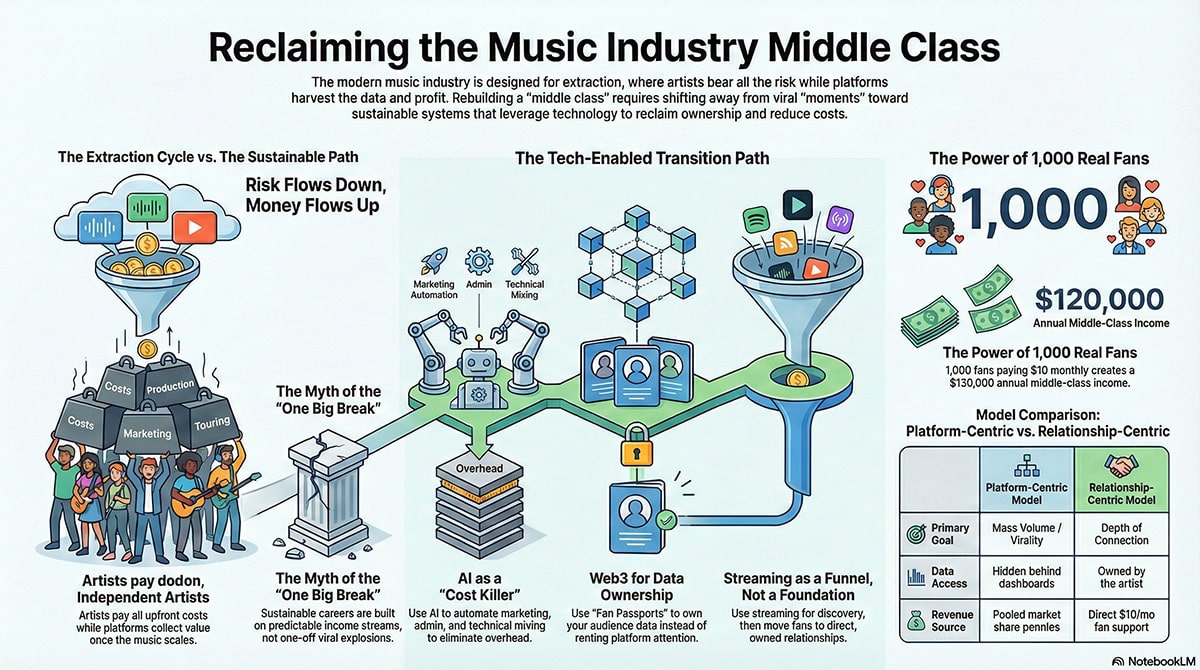
The modern music industry is structured so that risk flows downward while money flows upward. The artist takes on the uncertainty. The artist pays the upfront costs. The artist invests the time, the emotional energy, the creative labor, and the personal sacrifice long before a single dollar comes back. Meanwhile, the system—platforms, distributors, labels, and tech companies—positions itself to collect value once scale appears.
If the music fails, the artist eats the loss.
If the music succeeds, the upside is spread thin or redirected elsewhere.
That structure has real consequences. It creates a winner-take-most economy where a very small percentage of artists earn life-changing money, while the vast majority are told to “grind harder,” “post more content,” “stay consistent,” and “be patient.” Success is framed as a personal virtue. Struggle is framed as a lack of hustle. Meanwhile, the system quietly depends on mass underpayment to function.
Virality is celebrated. Sustainability is ignored.
This is not what a healthy creative industry looks like. In most mature creative fields, there is a middle class. Film crews don’t rely on becoming movie stars to survive. Television writers don’t need every script to be a cultural phenomenon. Graphic designers, session musicians, engineers, producers, editors, and crew members build careers because the ecosystem allows most professionals to earn enough to stay in the game long-term.
That middle layer is what keeps creativity alive. It is what allows people to improve, specialize, collaborate, and take risks without destroying their lives financially.
Music lost that middle.
As revenue shifted toward scale, platforms, and financial abstraction, the center collapsed. What remains is a distorted landscape where superstardom is glorified, hobbyism is normalized, and working musicians are trapped in between—professional in output, amateur in compensation.
What follows is not a fantasy about overnight revolutions. It is not a promise that technology magically fixes everything. There is no silver bullet coming to save artists. But there are tools available right now that can help rebalance the equation if they are used intentionally.
This is about building a grounded, practical music industry middle class using systems that already exist. AI can reduce costs, eliminate busywork, and give independent artists leverage that once required full teams. Web3 can restore ownership, transparency, and direct relationships that were stripped away by platform economics.
Not so a few artists can earn everything.
But so more artists can earn enough.
Enough to focus on their craft.
Enough to plan instead of panic.
Enough to build careers instead of chasing moments.
The Quiet Shift Nobody Talks About: Risk Down, Money Up
If you are an indie artist today, you are already running a small business—whether you ever meant to or not. You pay for recording, or you invest years and money into building a home studio. You pay for mixing and mastering, marketing and promotion, distribution, artwork, photos, videos, and content. You pay to tour. You pay to rehearse. You pay to maintain gear. You pay to exist inside the system.
And then there are the costs nobody invoices you for. Your time. Your attention. Your weekends. Your relationships. Your mental health. Your ability to rest without guilt.
What you do not control is the system that decides how much of the upside you are allowed to see.
Streaming made access easier, but it quietly rewired the entire economic foundation of music. Instead of being paid per fan, artists are paid per stream. Instead of owning relationships, artists rent attention. Instead of building long-term assets, artists feed algorithms that reset every release cycle. Music stopped being treated like a career-building product and became a constant input into someone else’s machine.
That distinction matters, because most major streaming platforms were never designed to build music careers in the first place.
Take Spotify (https://www.spotify.com), along with most other major platforms. Their core business is not artist development. It is not career sustainability. It is not helping musicians earn stable income over time. Their real business is data.
Music is the fuel.
Every play, skip, save, playlist add, location ping, listening habit, time-of-day preference, mood category, and behavioral pattern generated by your fans is collected, analyzed, and monetized. That data powers advertising systems, recommendation engines, market intelligence, and investor narratives. The more people listen, the more valuable the data becomes—regardless of how much the artist is paid.
That means your music is being used as a tool to understand your audience better than you are allowed to.
And the data being collected is not abstract. It is data about your fans. Where they live. How they behave. What they respond to. What they ignore. When they are emotionally engaged. That information should be one of the most valuable assets in your career. Instead, it lives behind dashboards you cannot export, control, or take with you.
From a payment standpoint, the system reflects the same priorities. Spotify does not pay artists based on how much their own fans listen to them. All revenue is pooled and distributed based on market share. Your fans’ subscription dollars do not follow their listening habits directly to you. They flow into a massive pot dominated by the most streamed music on the platform.
This is not a moral argument. It is a math problem layered on top of a data business model.
If you are a niche or independent artist with 5,000 real fans—people who listen deeply, buy tickets, show up, and support you—you are still competing in the same revenue pool as global pop acts with hundreds of millions of listeners. Loyalty does not protect you. Depth does not protect you. The system is designed to reward scale, volume, and engagement signals that generate more data.
The outcome is predictable. The top earns more and more. The middle collapses. And artists who are doing everything “right” are still stuck chasing pennies per stream while platforms extract exponential value from their audience behavior.
Meanwhile, the risk never moves. You invest before you earn. You release music before you know how it will perform. You tour before you recoup. You front the money, the labor, and the emotional weight. If something fails, the loss is immediate and personal. If something succeeds, the upside is filtered upward through distributors, platforms, ad systems, and intermediaries whose primary interest is not your career, but your audience data.
That is not a partnership.
That is extraction—packaged as opportunity, dressed up as access, and justified by the promise that maybe, someday, the algorithm will smile on you.
And that is why rebuilding a music industry middle class is not just about better payouts. It is about reclaiming ownership of fan relationships and the data that rightfully belongs to the artist in the first place.
The Myth of “Just One Break”
One of the most damaging ideas in modern music culture is the belief that success arrives in a single moment. One playlist placement. One viral clip. One big co-sign. One algorithmic blessing that suddenly changes everything.
This story is everywhere, and it is incredibly seductive. It makes success feel dramatic, fast, and just barely out of reach. More importantly, it keeps artists chasing spikes instead of building foundations. Instead of asking how to earn steady income, artists are pushed to ask how to trigger the next surge of attention.
The industry loves this myth because it quietly shifts responsibility away from the system and onto the artist. When most musicians struggle, the explanation is rarely structural. It’s framed as a talent problem, a branding problem, a marketing problem, or a mindset problem. “You didn’t post enough.” “You didn’t engage enough.” “You didn’t crack the algorithm.” Almost never is it framed as what it actually is for most people: an income design problem.
A healthy middle class does not require superstardom. It never has. It requires consistency.
Rent does not care if you went viral once. Utilities do not care if your song trended for a weekend. Health insurance does not care if your track charted for seven days. Bills are boring, repetitive, and relentless—and sustainable careers are built the same way. Not on explosions, but on predictable income streams that stack and reinforce each other over time.
The older music industry had plenty of flaws, and many of them were serious. But it understood one foundational truth: careers were not built on a single release. They were built across albums, tours, publishing income, licensing, merch, and long-term fan relationships. Progress was measured in years, not weeks.
Today’s system flattened that entire career arc into streams and content output. Albums became “content drops.” Tours became “promotion.” Fan relationships became “engagement metrics.” Everything is evaluated through short-term performance signals, even though careers are inherently long-term projects.
When income is tied almost entirely to moments instead of systems, the middle disappears. Artists either hit the lottery or quietly fall out of the game.
Rebuilding a music industry middle class requires rejecting the myth of the single moment and replacing it with tools and structures that reward depth over scale. It means valuing repeat supporters over passive listeners. It means building income that compounds instead of resets every release. And it means measuring success not by spikes of attention, but by the ability to stay in the game without burning out or going broke.
That is not less ambitious.
It is far more realistic—and far more powerful in the long run.
Why the Middle Class Matters More Than the Top
When only the very top earns, creativity narrows. Risk disappears. Genres begin to sound the same. Artists burn out earlier and earlier. Local scenes collapse under the weight of unsustainable economics. What looks like abundance on the surface slowly turns into cultural scarcity underneath.
When a true middle class exists, something entirely different happens. Artists can afford to experiment without fearing immediate financial ruin. Local venues can book original music instead of relying only on cover acts and tribute nights. Regional sounds have room to develop instead of being flattened into whatever the algorithm currently favors. Engineers, producers, photographers, videographers, designers, managers, and crew members are able to stay in the ecosystem instead of being forced out by unstable income.
Music stops behaving like disposable content and starts acting like a living culture again.
This isn’t theory or nostalgia. You’ve watched it happen in real time. Cities where scenes once thrived slowly hollow out as rents rise, costs increase, and income opportunities shrink. Clubs close. Rehearsal spaces disappear. Artists move away or give up. What’s left is a louder marketing machine attached to a quieter creative core.
The damage isn’t always immediate, but it is cumulative. Once the middle disappears, it is incredibly difficult to rebuild because there are fewer people left with the time, stability, and resources to mentor, collaborate, and take creative risks.
And to be clear, the goal here is not to take money away from artists who succeed. Success should be rewarded. Breakout moments should be celebrated. The problem is not that some artists earn a lot—it’s that the system is designed so their success is supported by a vast base of underpaid labor beneath them.
A healthy music economy does not require everyone to become a superstar. It requires systems where success at the top does not depend on poverty everywhere else. Rebuilding a music industry middle class is about creating an ecosystem where more artists can survive long enough to grow, where creativity is not punished by economics, and where culture is allowed to develop instead of being strip-mined for clicks.
AI as a Cost Killer and Leverage Multiplier
AI works best when you treat it as a way to find your people faster and get your time back—not as something that replaces musicianship. AI doesn’t replace artists. It replaces inefficiency.
For independent artists, the most brutal part of the business has never been creativity. Most musicians don’t quit because they ran out of ideas. They quit because they are crushed by overhead. Admin work. Marketing confusion. Data they don’t understand. Endless repetition. Constant guesswork about what to post, where to spend, and whether any of it is working.
That invisible workload is where careers quietly die.
AI collapses that weight.
Used correctly, AI helps artists identify and reach the right fans directly instead of shouting into the void. It shortens the distance between intention and execution. Instead of spending hours staring at a blank screen, second-guessing decisions, or reinventing the wheel for every release, artists can move faster with more clarity and less stress.
Tools like ChatGPT (https://chat.openai.com) already function as a virtual assistant for working musicians. Artists use it to write emails to fans, draft press releases, plan release timelines, organize campaigns, refine messaging, and turn half-formed ideas into concrete action—without hiring a team they can’t afford. That alone saves time, money, and mental energy.
On the marketing side, AI is now baked directly into the platforms artists already use. Advertising systems on Meta (https://www.facebook.com/business) and TikTok (https://www.tiktok.com/business) rely heavily on machine learning to test variations, optimize targeting, analyze behavior, and adjust spend in real time. What used to require a dedicated marketer and a serious budget can now be done by an artist with patience, intention, and a smaller wallet.
This shift matters because marketing didn’t just get expensive—it got complicated. The barrier now isn’t access; it’s understanding. AI reduces that complexity. It helps artists make informed decisions instead of emotional ones. It turns marketing from a black hole of anxiety into a system that can be learned, tested, and improved over time.
In the studio, AI-assisted tools lower technical barriers that once slowed projects to a crawl. Intelligent mixing assistance, mastering guidance, noise reduction, vocal cleanup, and audio repair reduce the number of revisions needed and the amount of outsourcing required. Artists spend less money fixing problems and more time finishing work. Finished work turns into releases. Releases turn into momentum.
That reclaimed time matters as much as reclaimed money.
Every dollar not spent just to remain competitive is a dollar that can become income. Every hour not lost to confusion is an hour that can be spent connecting with fans, improving craft, or simply resting long enough to stay in the game.
That is how a music industry middle class actually forms. Not by squeezing more money out of the top few artists, but by reducing the constant financial and mental bleeding at the bottom. AI gives independent artists leverage where they’ve historically had none—and leverage is what turns survival into sustainability.
Web3: Ownership Instead of Exposure
AI reduces cost. Web3 restores control.
That distinction matters, because cost and control are the two things independent artists lost as the industry shifted toward platforms. AI helps you operate leaner inside the system. Web3 gives you a way to stop being trapped by it.
Web3 is not about speculation, hype cycles, or chasing the next shiny thing. At its core, it is about reclaiming three fundamentals that artists quietly lost during the platform era: ownership, transparency, and direct connection.
Under the traditional digital model, when an artist releases music through a distributor, the platform owns the relationship. You see stream counts, follower numbers, and vague demographic summaries—but you do not see people. You don’t know who your fans actually are. You don’t have their contact information. You can’t reach them directly without paying for ads. Their listening behavior is abstracted into charts and graphs that live behind dashboards you cannot export or take with you.
Your fans exist. Their loyalty exists. Their value exists.
But the system puts a wall between you and them.
Web3 flips that relationship.
Instead of platforms sitting between artists and fans, Web3 tools are built around direct exchange. When a fan supports an artist, that connection can be recorded in a way the artist can recognize again in the future. Ownership replaces rent. Identity replaces anonymity. Relationships become portable instead of locked inside a single app.
You can already see a version of this working today on platforms like Bandcamp (https://bandcamp.com). Bandcamp isn’t Web3, but it proves the point. When artists sell directly, fans routinely pay more than the minimum. Artists keep a far larger share of the revenue. Emails are shared. Communication is direct. The relationship deepens because it isn’t mediated by an algorithm designed to optimize engagement for someone else.
Blockchain-based tools extend this idea further. Instead of just emails, artists can sell music, tickets, memberships, and experiences directly to wallets they can recognize again. That wallet becomes a persistent connection point. It allows artists to reward long-term supporters, offer early access, unlock special experiences, and build communities that exist beyond any single platform.
Just as importantly, blockchain infrastructure introduces transparency. Artists can see what was sold, when it was sold, and under what terms. Royalties can be programmed instead of negotiated after the fact. Middle layers shrink. Ambiguity disappears.
This is not about abandoning streaming or pretending it doesn’t matter. Streaming still plays a role in discovery. It still introduces new listeners. It still functions as a public-facing layer of the ecosystem.
The shift is about refusing to let streaming be the only pillar holding up your career.
When streaming is just one tool instead of the foundation, artists regain leverage. When AI lowers the cost of operating and Web3 restores ownership of relationships, independent musicians can start building careers that compound instead of reset every release.
That combination—lower cost plus greater control—is how a music industry middle class becomes possible again.
NFTs Without the Noise
NFTs scared a lot of artists, and that fear is understandable. They were introduced badly, talked about poorly, and pushed through a speculative lens that had very little to do with music or careers. Headlines focused on flipping, screenshots of outrageous sales, and crypto jargon instead of real-world use. Utility was drowned out by noise.
But strip away the hype, and an NFT becomes something far less intimidating and far more useful: a programmable receipt tied to a fan.
This is where the idea of a fan passport comes in.
A fan passport is not about selling expensive digital collectibles. It’s about creating a persistent, verifiable connection between an artist and a supporter. When a fan buys music, a ticket, a membership, or access, that transaction can live on-chain as proof of support. The fan isn’t anonymous anymore. They’re recognized.
That single receipt can do a lot of work.
It can unlock music that isn’t available publicly. It can unlock early access to tickets, merch, or releases. It can unlock discounts, bonus tracks, behind-the-scenes content, or private livestreams. It can unlock community—entry into Discords, forums, or fan spaces that are built around real support instead of passive listening.
Most importantly, it can grow in value over time without speculation. The value comes from access and belonging, not resale hype.
Take tickets as a clear example. Because a ticket receipt is programmable, it can be resold in ways traditional tickets and merch cannot. When a fan transfers or resells a ticket, rules can be built in—such as resale price caps—and a royalty from that resale can automatically flow back to the artist. There is no paperwork to chase. No contracts to enforce after the fact. No reliance on third-party reporting. This is how artists and venues can finally fight scalping at the system level instead of reacting to it after the damage is done.
That is not science fiction. That is infrastructure that already exists.
Artists who are experimenting with limited digital releases, token-gated communities, NFT-based ticketing, or wallet-based fan access are not chasing trends. They are rebuilding margin. They are shifting income away from volume-based payouts and toward relationship-based support.
The math changes fast when you step out of the streaming mindset.
When one fan pays $50 directly for music, access, or experiences, that support is worth more than thousands of passive streams. It arrives immediately. It is predictable. It can be repeated. And it deepens the relationship instead of anonymizing it.
Fan passports turn support into something that compounds. They allow artists to recognize their most committed listeners, reward them over time, and build careers around people instead of platforms.
That is how ownership becomes practical. That is how Web3 stops being abstract. And that is how independent artists start rebuilding a middle class—one real fan at a time.
Fan Data Is the New Asset
The most valuable thing in music is no longer the recording itself. It’s the relationship behind it.
Platforms understand this very clearly. That’s why they collect listener data so aggressively. They know where fans live, what they listen to, how long they listen, when they skip, what time of day they engage, and how their behavior changes over time. This data is not a side effect of streaming—it is a core asset.
Artists, however, experience this very differently.
Artists see dashboards.
Platforms see people.
Artists are given summaries, graphs, and surface-level metrics that disappear the moment a release cycle ends. Platforms retain the underlying identity and behavioral data that actually drives long-term value. The result is that artists are asked to build careers without access to the very information that would make those careers sustainable.
Web3 tools offer a way to rebuild that asset ethically and intentionally.
Wallet-based access, ownership-linked email capture, and direct fan communities allow artists to recognize supporters across releases instead of starting over each time. A fan who buys once can be recognized again. A supporter who shows up early can be rewarded later. Relationships become portable rather than locked inside a single platform’s ecosystem.
That portability is the shift.
When you own your fan data, you are no longer rebuilding from scratch with every song, album, or tour. Your audience compounds. Your history matters. Your momentum carries forward instead of resetting to zero.
AI amplifies this shift by helping artists actually understand what that data means. Patterns emerge. Geography becomes actionable. Engagement stops being abstract. Purchase behavior reveals intent. Instead of guessing who to serve and where to focus, artists can make decisions based on evidence instead of hope.
That intelligence changes everything.
Tours become strategic instead of speculative.
Merch becomes planned instead of leftover inventory.
Releases become revenue-driven systems instead of emotional gambles.
When artists combine ownership of fan relationships with AI-powered insight, music stops being a lottery and starts behaving like a business that can be learned, improved, and sustained.
A Grounded Transition Path (Not a Leap)
This is not about quitting streaming tomorrow. It’s about changing priorities and using the right tools at the right stage of the relationship.
Streaming remains useful, but its real value is at the very top of the funnel. That’s where AI comes in.
AI helps artists identify who is actually responding to their music and where those listeners are coming from. It helps spot patterns in engagement, geography, behavior, and timing. Instead of guessing who your audience might be, AI helps you recognize the fans who are already raising their hands. That turns streaming from a passive numbers game into an active discovery engine.
From there, the focus shifts.
Once AI helps surface the right listeners, Web3 tools step in to capture and preserve the relationship. Instead of letting fans disappear back into a platform’s ecosystem, artists can invite them into direct connection through ownership-based access. Wallet-based entry, fan passports, and ownership-linked signups allow artists to collect fan data ethically and permanently.
This is where the relationship becomes an asset.
A fan who supports you once can be recognized again. A supporter who shows up early can be rewarded later. The connection doesn’t reset with every release because it no longer belongs to a platform. It belongs to you.
AI then continues to work in the background, helping you understand that fan data over time. You see who engages most, where demand is growing, what fans actually buy, and how support evolves. That insight allows you to communicate better, plan smarter, and serve your audience instead of constantly chasing new attention.
In this model, streaming attracts attention.
AI identifies real interest.
Web3 captures the relationship.
And the relationship becomes a long-term asset instead of a temporary metric.
Nothing here requires burning bridges or abandoning existing platforms. It simply requires using them differently. When AI is used to find your fans and Web3 is used to keep them, independent artists stop rebuilding from zero and start compounding value across an entire career.
What a Music Industry Middle Class Actually Looks Like
Another way to understand this is to stop thinking in terms of millions of listeners and start thinking in terms of a small, committed community.
It looks like artists earning $120,000 a year consistently without needing superstardom or viral luck. (Imagine finding just 1,000 real fans—people who genuinely value your work and choose to support it. If each of those fans spends $10 a month on your music, access, or experiences, that adds up to $10,000 a month. Over a year, that’s $120,000.)
It looks like regional touring that actually makes sense because fan data is clear, reliable, and owned by the artist. Shows are booked where listeners already exist, not where hope says they might.
It looks like albums that recoup because production costs are intentional, controlled, and aligned with real demand instead of speculative spending.
It looks like merch that sells because it’s created for known supporters, not guessed at through vague analytics and crossed fingers.
It looks like careers that last longer than algorithms, trends, and platform rule changes—careers built on relationships that compound instead of resetting every release cycle.
Most importantly, it looks like dignity.
This Is a Choice, Not a Trend
The current system will not fix itself. It is working exactly as designed, delivering massive upside to platforms and a tiny fraction of artists while shifting risk downward to everyone else.
The difference now is that artists finally have leverage they didn’t have before. AI reduces dependency on expensive teams, gatekeepers, and guesswork. Web3 restores ownership of fan relationships that were stripped away by platform economics. And direct connections, once established, compound over time instead of disappearing with every algorithm change.
The question is no longer whether these tools work. They already do, and they are being used quietly and effectively by artists who are tired of waiting for permission.
The real question is whether artists will use these tools to build something sustainable—or whether they will keep chasing the same broken promises, just wrapped in newer, shinier technology.
A healthy music industry does not require a few artists earning everything while the rest fight over scraps.
It requires more artists earning enough to stay in the game, grow their craft, and build real careers.
That is how culture survives.
That is how scenes grow.
That is how a music industry middle class returns.
And this time, artists don’t have to ask permission to build it.
 |  Spotify |  Deezer |  Breaker |
 Pocket Cast |  Radio Public |  Stitcher |  TuneIn |
 IHeart Radio |  Mixcloud |  PlayerFM |  Amazon |
 Jiosaavn |  Gaana |  Vurbl |  Audius |
 Reason.Fm | |||
Find our Podcasts on these outlets
Buy Us a Cup of Coffee!
Join the movement in supporting Making a Scene, the premier independent resource for both emerging musicians and the dedicated fans who champion them.
We showcase this vibrant community that celebrates the raw talent and creative spirit driving the music industry forward. From insightful articles and in-depth interviews to exclusive content and insider tips, Making a Scene empowers artists to thrive and fans to discover their next favorite sound.
Together, let’s amplify the voices of independent musicians and forge unforgettable connections through the power of music
Make a one-time donation
Make a monthly donation
Make a yearly donation
Buy us a cup of Coffee!
Or enter a custom amount
Your contribution is appreciated.
Your contribution is appreciated.
Your contribution is appreciated.
DonateDonate monthlyDonate yearlyYou can donate directly through Paypal!
Subscribe to Our Newsletter
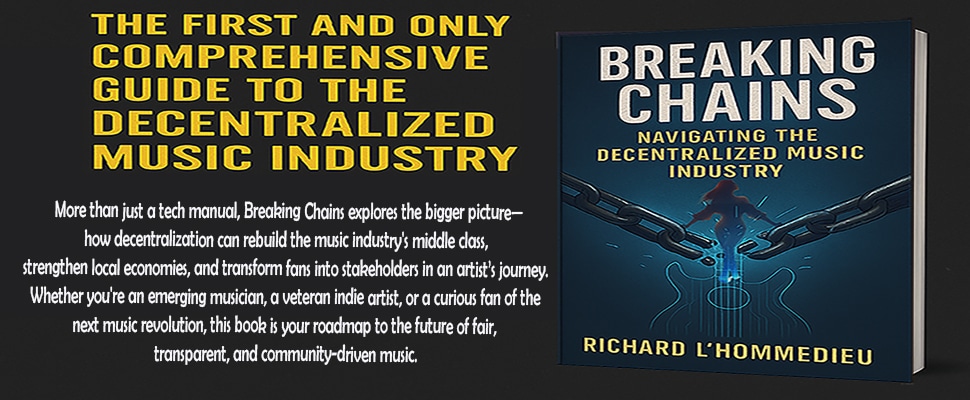
Order the New Book From Making a Scene
Breaking Chains – Navigating the Decentralized Music Industry
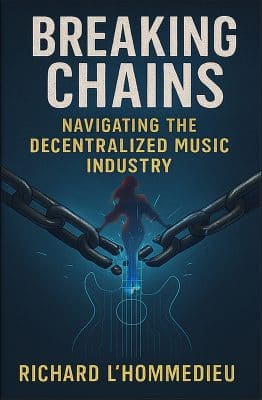
Breaking Chains is a groundbreaking guide for independent musicians ready to take control of their careers in the rapidly evolving world of decentralized music. From blockchain-powered royalties to NFTs, DAOs, and smart contracts, this book breaks down complex Web3 concepts into practical strategies that help artists earn more, connect directly with fans, and retain creative freedom. With real-world examples, platform recommendations, and step-by-step guidance, it empowers musicians to bypass traditional gatekeepers and build sustainable careers on their own terms.
More than just a tech manual, Breaking Chains explores the bigger picture—how decentralization can rebuild the music industry’s middle class, strengthen local economies, and transform fans into stakeholders in an artist’s journey. Whether you’re an emerging musician, a veteran indie artist, or a curious fan of the next music revolution, this book is your roadmap to the future of fair, transparent, and community-driven music.
Get your Limited Edition Signed and Numbered (Only 50 copies Available) Free Shipping Included
Discover more from Making A Scene!
Subscribe to get the latest posts sent to your email.


