

AI for Session Organization: Automating the Boring Stuff




Making a Scene – AI for Session Organization: Automating the Boring Stuff
If you’ve ever opened up an old recording session only to be greeted by a sea of tracks called things like Audio_01 or Untitled_Track_47, you know how much of a headache it can be. You sit there soloing tracks one by one, trying to figure out whether something is a kick, a vocal, or just silence. It kills the mood and wastes valuable time.
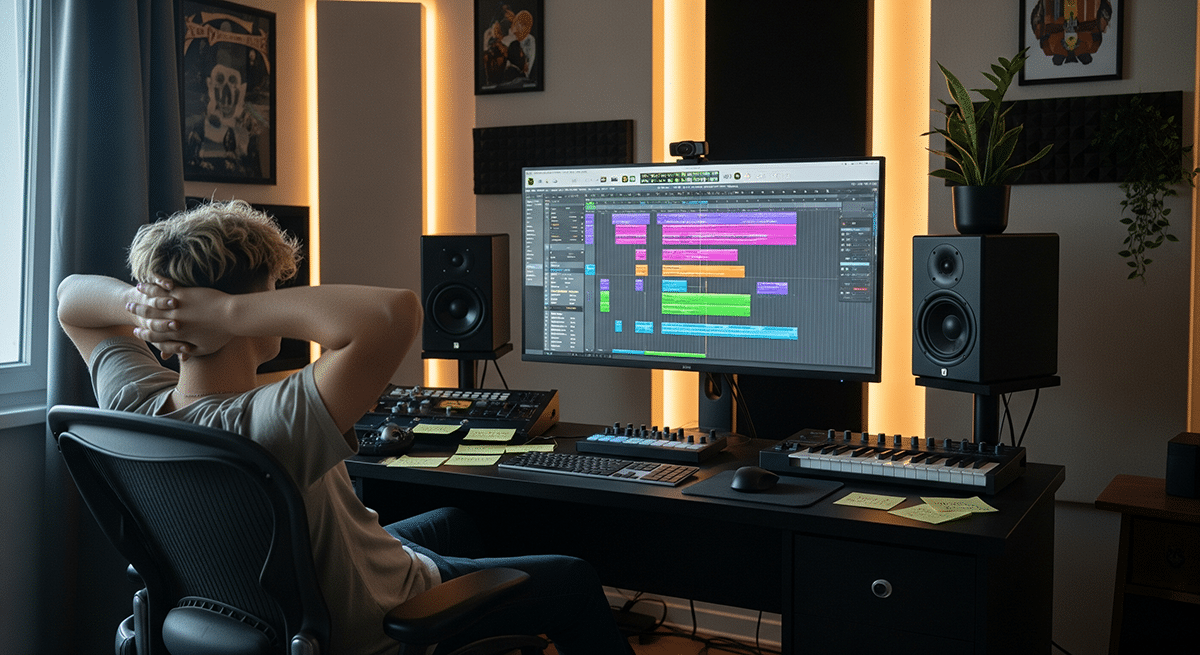
Now picture this instead: you open your session and every track is already neatly labeled. The software has listened to your recording, decided what each track is, given it a proper name, and even color-coded it into logical groups. Suddenly, you’re not stuck cleaning up a mess—you’re ready to mix. That’s exactly what AI is starting to do for session organization.
AI has been creeping into every corner of music production, and for once it’s not about replacing creativity. It’s about doing the boring stuff so you can get back to making music. Let’s take a deep dive into how it works, why it matters, what tools are available, and how you can put this into practice today.
Why Session Organization Matters
Session organization is one of those things you don’t think about until you don’t have it. When your tracks are unlabeled, it’s not just annoying—it slows down your entire workflow. You waste precious time searching for the snare or guessing which track has the lead vocal. You lose creative momentum, and if you send the session to someone else, they’re left with the same confusing mess.
On the other hand, when everything is neatly labeled and grouped, working inside your DAW feels like walking into a clean studio. You know exactly where to find what you need. Mixing becomes smoother, collaboration becomes easier, and your entire process feels more professional.
Manual Organization vs AI Organization
For years, the only way to keep sessions clean was to do it yourself. After recording, you’d rename each track, color-code them, and maybe group them into folders. If you had a 48-track live band session with multiple mics on drums, guitars, and vocals, this could easily chew up an hour or more before you even started mixing. It was tedious work that nobody looked forward to.
AI is turning that process upside down. Instead of slogging through track names manually, you let the software listen and figure it out. It analyzes the audio, identifies whether it’s a kick drum, snare, vocal, or guitar, and applies the right label. Some programs even add your favorite colors and create folders automatically. What once took hours now takes minutes—or even seconds.
Think of it like how Google Photos can recognize faces and objects without you doing anything. AI session organization does the same thing for your tracks.
A Real-World Example
Imagine you’ve recorded a drummer with 12 microphones. When you first look at the session, all you see are “Audio 01,” “Audio 02,” and so on. To make sense of it, you’d have to spend time soloing each one, listening carefully, and naming them.
Now imagine you open the same project after AI has had a go at it. Instead of a random mess, you see “Kick In,” “Kick Out,” “Snare Top,” “Snare Bottom,” “Hi-Hat,” “Rack Tom,” “Floor Tom,” “Overheads,” and “Room Mics.” Everything has its place, with colors that match instrument groups and folders that make sense. Instead of housekeeping, you’re mixing.
Collaboration Benefits
The value of AI session organization really shines when you’re working with others. If you’ve ever sent a messy session to a mixer or a collaborator, you know how unprofessional it looks. It’s like turning in homework with no name at the top.
A clean, AI-organized session shows respect for your collaborators’ time. They can open the project and immediately understand what’s going on. No wasted time, no confusion. That’s especially important today, when remote collaborations are the norm. Whether you’re sending files to someone across town or halfway around the world, AI helps you make a good impression.
Tools That Use AI for Session Organization
Here’s the fun part—let’s look at some actual tools you can use right now.
1. iZotope RX – https://www.izotope.com
RX is best known for audio repair, but it also has Music Rebalance and intelligent detection tools that can identify vocals, drums, bass, and other instruments. While it’s not a “session organizer” in the traditional sense, it can analyze stems and help you prep cleaner files.
2. Sonible smart:bundle – https://www.sonible.com
Sonible makes AI-powered plugins that recognize instrument types and apply smart processing. For example, smart:EQ 4 listens and identifies whether a track is a vocal, guitar, or drum, and then makes suggestions. This is a big step toward auto-labeling and grouping.
3. Acon Digital Acoustica – https://acondigital.com
Acoustica has spectral tools that can detect sound sources. Combined with its batch processing features, it helps prep large sessions more quickly.
4. Reaper with SWS Extensions – https://www.reaper.fm
Reaper isn’t AI-based out of the box, but its community has developed scripts that use AI tagging and labeling. If you’re tech-savvy, you can automate track naming based on AI audio detection.
5. Waves Clarity and COSMOS – https://www.waves.com
Waves COSMOS uses AI to analyze and tag your sample library. While it’s not for session tracks directly, it shows how AI can recognize sound sources at scale. Imagine this applied directly inside your DAW—many believe that’s the future.
6. LALAL.AI Stem Splitter – https://www.lalal.ai
LALAL.AI can separate vocals, drums, bass, and more from full mixes. While designed for stem separation, the same tech makes it possible to auto-label tracks inside a session.
7. LANDR Studio – https://www.landr.com
LANDR is best known for mastering, but their AI-driven tools also handle file organization and prepping stems for collaboration.
8. Sonix.ai (Transcription + Audio ID) – https://sonix.ai
Sonix is a transcription tool, but it demonstrates how AI can recognize and label voices automatically. Similar methods are being used to auto-label vocal tracks in DAWs.
9. Forte Audio (https://forteaudio.com)
Built as a Pro Tools extension, Forte uses AI to do the tedious prep work that usually eats up hours at the start of a mix.
Case Studies: Artists and Producers Using AI in the Real World
Take Billie Eilish and Finneas, who famously recorded her breakout album in a bedroom. Finneas has spoken in interviews about how much time was spent just prepping vocal layers and organizing sessions before mixing. If AI-driven labeling had been available during those early sessions, it would have cut hours off their workflow. The need for neat organization was even greater because the album was mixed professionally after the home recordings were done. Clean handoffs mattered.
Another example comes from Andrew Huang, the Canadian YouTuber and producer. He often works with massive projects full of hundreds of tracks. In one of his videos, he admitted that organization is the most boring but necessary part of the process. AI-powered grouping tools like those in Sonible smart:bundle or Waves COSMOS could dramatically speed up this kind of work, letting him focus more on creative sound design.
Then there’s BandLab’s community of indie artists, where AI is already embedded in the platform. Many BandLab users rely on the DAW’s automatic stem labeling when collaborating online. One artist can record vocals in New York, another adds guitar in London, and when the files come together in BandLab, the tracks are labeled and stacked in ways that make sense. That saves both sides from sending endless messages back and forth asking, “Which track was the lead vocal again?”
Even in pro studios, AI is gaining traction. Manny Marroquin, the Grammy-winning mixer, has talked about how assistants spend hours prepping sessions before he touches them. In the near future, those assistants may use AI tools like iZotope RX or Reaper extensions to auto-label and group tracks. That means Manny can get to mixing faster, and assistants can focus on higher-level tasks instead of grunt work.
How to Try This Yourself: Step-by-Step Workflows
If you’re curious about using AI session organization, here are a few hands-on workflows you can try right now.
Workflow 1: Organize with BandLab (Free and Online)
-
Sign up for a free account at https://www.bandlab.com.
-
Upload your raw tracks into a new project.
-
BandLab automatically detects common instruments and labels them (vocals, drums, guitars, etc.).
-
Invite a collaborator to the project and notice how the session is already labeled for them.
This is one of the simplest and fastest ways for beginners to test AI labeling without buying software.
Workflow 2: Use iZotope RX for Cleanup and Prep
-
Download RX from https://www.izotope.com.
-
Open your stems or multitracks in RX.
-
Run the Music Rebalance or Repair Assistant features to detect vocals, drums, bass, and instruments.
-
Export stems with proper labels and import them back into your DAW for a clean session.
RX isn’t a DAW, but it’s a powerful “pre-mix” tool that can give you neatly separated and labeled files.
Workflow 3: Auto-Tag Samples and Sounds with Waves COSMOS
-
Install COSMOS from https://www.waves.com.
-
Point it at your messy sample library or one-shot recordings.
-
COSMOS uses AI to analyze and tag your sounds—kick, snare, hi-hat, vocal, synth, and more.
-
Drag tagged sounds into your DAW session, already organized.
This is especially helpful if you build beats or work with tons of loops.
Workflow 4: DIY Auto-Labeling in Reaper
-
Download Reaper at https://www.reaper.fm.
-
Install the SWS Extensions pack, which adds advanced track management features.
-
Load your multitrack session.
-
Use AI-driven scripts from the Reaper user community to auto-rename tracks based on content.
This method is more technical but gives you total control, and Reaper’s flexibility means it’s a playground for automation nerds.
Forte Audio: AI Session Organization in Action
One of the most exciting new tools for AI-driven session prep is Forte Audio (https://forteaudio.com). Built as a Pro Tools extension, Forte uses AI to do the tedious prep work that usually eats up hours at the start of a mix.
Here’s how it works. Once you open a session, Forte scans through all the tracks and starts making smart decisions. It automatically routes your audio to buses, fixes fake stereo files (those mono tracks that accidentally get recorded as stereo), and renames tracks based on what they actually are. If it sees a kick drum track, it calls it Kick. If it finds a stereo piano, it labels it properly and groups it.
The real power of Forte is that it doesn’t stop at labeling. It handles bounce automation as well, meaning you can export stems, reference mixes, or alternate versions in just a few clicks without manually setting up bounce paths. That makes it not just an organizer, but a full session assistant.
Engineers who’ve used Forte report saving two to three hours per mix on session prep alone. For busy producers or mixers working on multiple projects a week, that’s game-changing. It means you can focus on making music instead of renaming files or dragging tracks into buses.
While Forte is currently designed for Pro Tools, it shows where the whole industry is heading. Imagine similar assistants being built directly into Logic, Ableton, or Studio One. Soon, AI-powered organization won’t be a luxury add-on—it’ll be standard in every DAW.
DAWs Getting Smarter
It’s not just third-party tools. Some DAWs are already experimenting with AI-assisted organization. Logic Pro has track stacks and smart tempo features that hint at where Apple is headed. Studio One by PreSonus has smart templates and partnerships with Celemony, which already uses AI for pitch detection. Ableton Live’s community has created AI-driven Max for Live devices that tag sounds automatically. And BandLab’s cloud-based DAW is pushing the envelope with AI mastering and track labeling.
We’re on the edge of a shift where AI-driven session prep will be standard, not optional.
The Time Factor
The biggest payoff is in time saved. A large session that used to take one to three hours to clean up manually can now be prepped in five or ten minutes with AI. If you’re working on multiple projects, those hours add up to entire days. And beyond the clock, there’s the creative energy. You don’t start a mix burned out from renaming tracks—you dive right into shaping the music.
Wrapping It Up
AI for session organization isn’t just a convenience—it’s a real breakthrough in how we work with audio. It takes care of the repetitive, boring stuff and leaves you free to focus on being creative. It makes your sessions look professional, saves time during mixing, and helps collaborators jump right in without confusion.
For indie musicians working from home studios, this is especially powerful. You may not have an assistant engineer to handle session prep, but with AI, you don’t need one. The technology does it for you, letting you spend less time clicking around in your DAW and more time making music.
The future of recording isn’t about AI writing your songs—it’s about AI cleaning up the mess so you can actually enjoy the creative part.
 |  Spotify |  Deezer |  Breaker |
 Pocket Cast |  Radio Public |  Stitcher |  TuneIn |
 IHeart Radio |  Mixcloud |  PlayerFM |  Amazon |
 Jiosaavn |  Gaana |  Vurbl |  Audius |
 Reason.Fm | |||
Find our Podcasts on these outlets
Buy Us a Cup of Coffee!
Join the movement in supporting Making a Scene, the premier independent resource for both emerging musicians and the dedicated fans who champion them.
We showcase this vibrant community that celebrates the raw talent and creative spirit driving the music industry forward. From insightful articles and in-depth interviews to exclusive content and insider tips, Making a Scene empowers artists to thrive and fans to discover their next favorite sound.
Together, let’s amplify the voices of independent musicians and forge unforgettable connections through the power of music
Make a one-time donation
Make a monthly donation
Make a yearly donation
Buy us a cup of Coffee!
Or enter a custom amount
Your contribution is appreciated.
Your contribution is appreciated.
Your contribution is appreciated.
DonateDonate monthlyDonate yearlyYou can donate directly through Paypal!
Subscribe to Our Newsletter
Order the New Book From Making a Scene
Breaking Chains – Navigating the Decentralized Music Industry

Breaking Chains is a groundbreaking guide for independent musicians ready to take control of their careers in the rapidly evolving world of decentralized music. From blockchain-powered royalties to NFTs, DAOs, and smart contracts, this book breaks down complex Web3 concepts into practical strategies that help artists earn more, connect directly with fans, and retain creative freedom. With real-world examples, platform recommendations, and step-by-step guidance, it empowers musicians to bypass traditional gatekeepers and build sustainable careers on their own terms.
More than just a tech manual, Breaking Chains explores the bigger picture—how decentralization can rebuild the music industry’s middle class, strengthen local economies, and transform fans into stakeholders in an artist’s journey. Whether you’re an emerging musician, a veteran indie artist, or a curious fan of the next music revolution, this book is your roadmap to the future of fair, transparent, and community-driven music.
Get your Limited Edition Signed and Numbered (Only 50 copies Available) Free Shipping Included
Discover more from Making A Scene!
Subscribe to get the latest posts sent to your email.


