
The Psychology of a Productive Home Studio




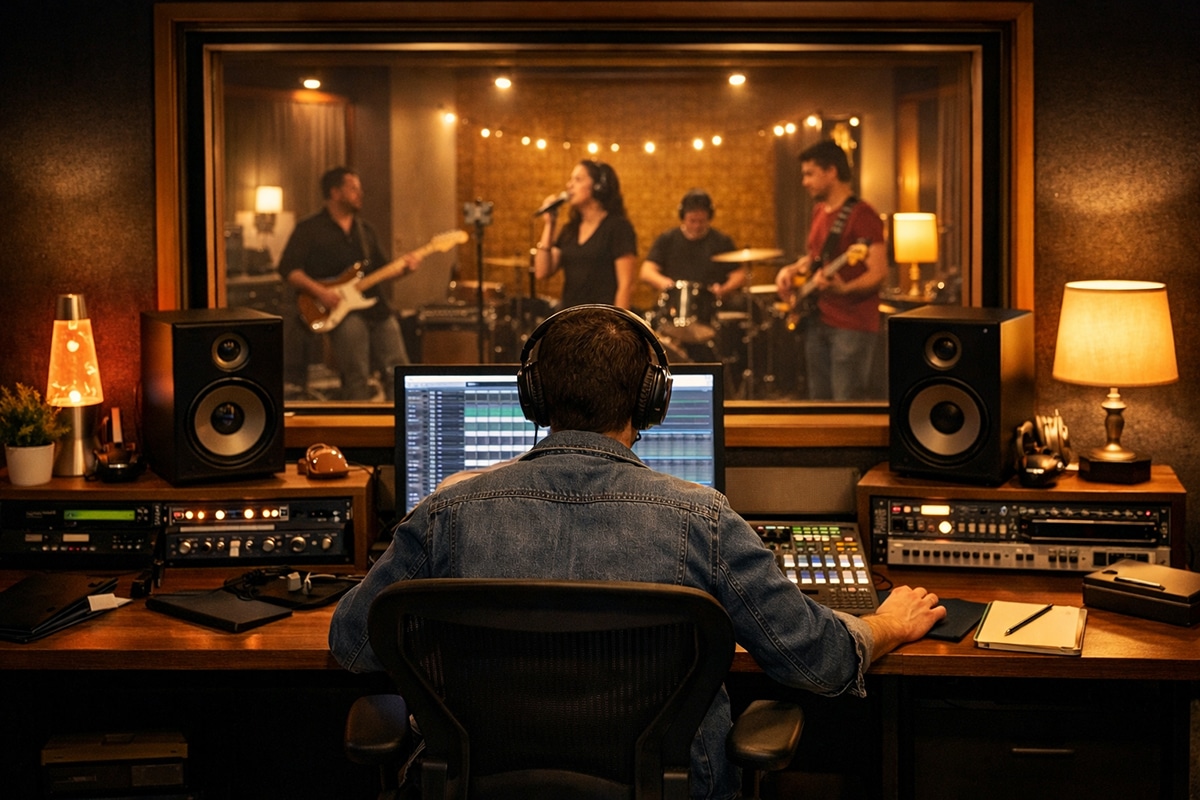
Making a Scene Presents – The Psychology of a Productive Home Studio
Listen to the Podcast Discussion for more insight into the Productive Home Studio
The home studio looks like a room, but it behaves like a brain. It remembers what you do in it. It trains you through tiny cues. It rewards you for finishing. It punishes you for drifting. And if you’re a working artist, it can either become a quiet engine that prints masters and income, or a beautiful trap that keeps you “busy” forever without shipping a thing.
Most people talk about home studio productivity like it’s a gear problem. Better monitors. More plugins. A nicer desk. A new interface. That stuff can help, but it’s not the thing that makes you consistent. The thing that makes you consistent is the psychology of friction, fatigue, and decision-making. The “invisible tax” that your environment charges every time you try to create.
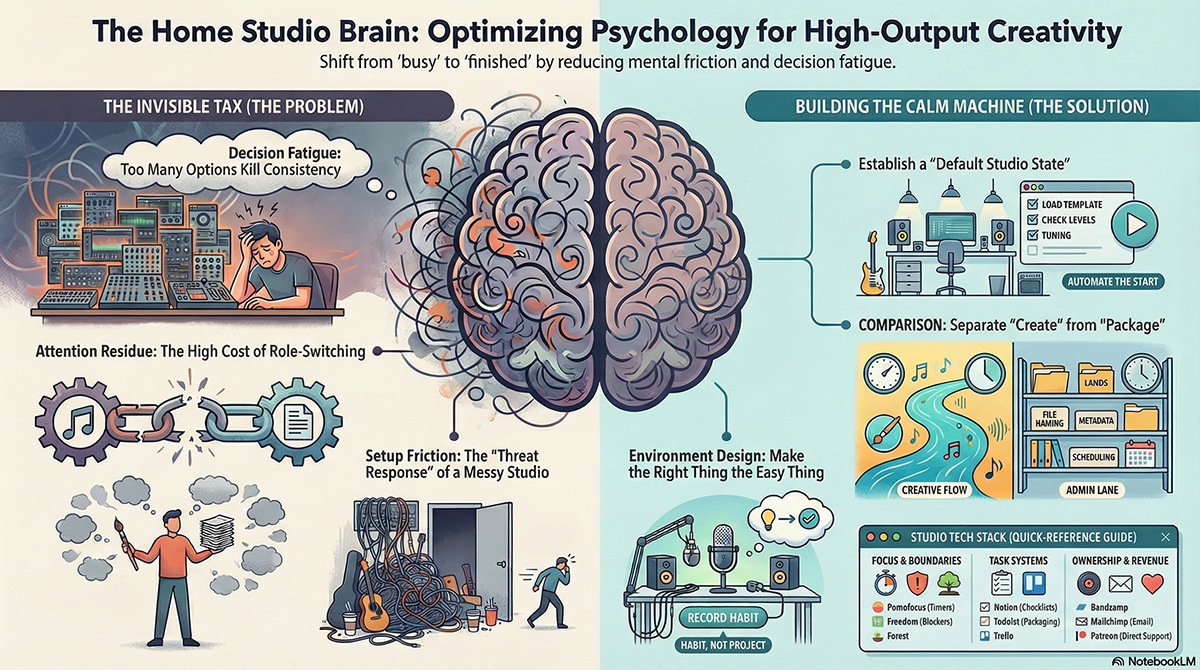
Here’s the sneaky part: your studio can be fully capable and still be emotionally expensive to enter. You walk in, you see three half-finished songs, five open tabs, a pile of cables, and a calendar reminder that you still haven’t uploaded last week’s video. Your brain isn’t inspired. Your brain is negotiating. And negotiation is how creative work dies.
This article is a guided tour of that invisible layer. We’re going to walk through the home studio as a system: the room, the routine, the mental load, and the energy cost of switching roles between artist and business owner. The goal is not to feed the algorithm machine until you burn out. The goal is to build a music industry middle class workflow: you own your masters, you own your fan relationships, you own your schedule, and your studio supports that like a dependable little factory that doesn’t steal your life.
The Studio Doorway: Where Sessions Are Won or Lost
A productive studio doesn’t start at the desk. It starts at the doorway. That’s where your brain decides whether this is going to be easy or hard, safe or stressful, focused or chaotic. If the first ten seconds in the room feel like a mess, your mind starts making tiny avoidance moves. One sip of coffee. One quick scroll. One more email. One more “I’ll just organize first.”
That’s not laziness. That’s threat response mixed with mental load. The brain sees too many choices and too many unfinished loops and it tries to escape. Researchers talk about “attention residue,” which is the idea that when you switch tasks, part of your mind keeps chewing on the last one, and it drags down performance on the next one. If your studio doorway screams “unfinished,” you’re walking into residue before you even hit play.
So the first move is not motivation. The first move is reducing the number of decisions you have to make just to begin. This is where simple tools beat willpower. A basic session ritual and a basic “default studio state” are not corny. They are a business advantage.
If you want a digital version of “default studio state,” build a one-page checklist in Notion (https://www.notion.com/) or Obsidian (https://obsidian.md/). In plain language, it can say what “ready” looks like: project opens, template loads, routing is correct, last mix reference is queued, phone goes into focus mode, and the next task is already chosen. The point is not perfection. The point is fewer decisions at the doorway.
Decision Fatigue Is Real Enough to Respect
People love to argue about whether “decision fatigue” is a perfect scientific law. The honest answer is: it’s complicated. The idea comes from self-control research, and there’s been serious debate about how big these effects are and how reliably they show up. But you don’t need a perfect theory to notice a simple truth in your own studio: the more choices you force yourself to make, the worse your choices get.
That’s why your studio should not be a museum of options. It should be a lane. If every session begins with picking a drum kit, picking a vocal chain, picking a synth, picking a reverb, picking a sample folder, picking a template, and deciding what you’re even doing today, your brain is drained before you record a single bar.
A working artist needs fewer choices, not more. That sounds boring until you realize boring is what makes you finish. Finished music pays. Half-finished “vibes” don’t.
This is also why the most productive studios you’ve ever seen aren’t always the fanciest. They’re the most predictable. The room makes fewer demands on the brain. The system makes fewer requests for decision-making. The studio becomes a place where you do the work, not a place where you debate the work.
The “If-Then” Trick That Makes Starting Automatic
One of the cleanest tools in behavioral psychology is called an “implementation intention.” It’s basically an if-then plan: “If situation X happens, then I will do action Y.” It works because you stop negotiating with yourself in the moment. You hand control to the environment.
In home studio terms, it looks like this: “If I enter the studio, then I open the same project board, choose the next task, and run a 10-minute start timer.” Or: “If I feel overwhelmed, then I do a 5-minute ‘reset pass’ instead of quitting.” Or: “If I’m tempted to scroll, then I block social for 60 minutes.”
This is where Pomodoro tools aren’t just time hacks. They’re identity hacks. Pomodoro® started as a simple method built around short focused sessions, and it’s often used because it lowers anxiety and makes starting feel smaller. If you want a simple browser timer, Pomofocus (https://pomofocus.io/) is a clean option because it keeps the barrier low.
You’re not trying to become a productivity influencer. You’re trying to turn “starting” into something your brain does automatically, like brushing your teeth.
The Screen Is the Loudest Instrument in the Room
Your DAW is a creative space, but it’s also a casino of choices if you let it be. The screen is the loudest instrument in the room because it’s always offering you a new decision. New plugin. New email. New comment. New tutorial. New tab. It feels like progress because it’s movement, but it’s not progress because it doesn’t produce a deliverable.
This is where attention residue becomes brutally expensive. If you bounce between creative work and admin work inside the same session, you don’t just lose time. You lose depth. Depth is the thing that makes a vocal take land, a mix translate, and a song feel like it has a spine.
So you want to separate modes. You don’t need to grind. You need to stop switching.
A practical way to do that is with a blocker like Freedom (https://freedom.to/). You’re not “weak” for blocking distractions. You’re acting like a professional. You’re doing what every serious business does: controlling the work environment. Freedom is blunt and cross-platform, and blunt is good when you’re tired.
If you want to see how much time you’re really spending inside creative tools versus everything else, RescueTime (https://www.rescuetime.com/) can track your usage automatically. The value isn’t guilt. The value is visibility. Visibility lets you price your time correctly and protect it like inventory.
The Two Workflows You Need: Create, Then Package
Here’s a big mindset shift: in a music industry middle class model, your home studio has two jobs. It creates assets, and it packages assets for direct revenue. Most burnout happens when you try to do both at the same time, all day, every day, with no boundaries.
Creating is writing, arranging, recording, producing, mixing. Packaging is exporting, naming files, uploading, metadata, artwork, emails, store pages, stems for licensing, cue sheets, client invoices, session notes, backups. Packaging is boring, but packaging is what turns a song into something you can sell, license, pitch, or deliver.
A productive studio doesn’t pretend packaging will magically happen “later.” It gives packaging a lane. That lane protects your creative lane from being swallowed by admin chaos.
This is where a task manager like Todoist (https://www.todoist.com/) can be a real studio tool, not a “corporate” tool. Not because you need more to-do lists, but because packaging is repetitive and repetitive work should not live in your head. Your brain is for creative decisions, not remembering whether you bounced the instrumental version.
If you prefer a more visual approach, Trello (https://trello.com/) is a straightforward board system. The point is the same: get the repetitive packaging steps out of your mind and into a system your mind can trust.
Burnout Isn’t a Badge. It’s a Business Leak.
Burnout gets romanticized in music. Like it’s proof you care. Like exhaustion is the admission ticket to legitimacy. That’s convenient for platforms and gatekeepers, because exhausted artists are easier to control. They chase trends. They chase numbers. They chase approval. They don’t build owned systems.
The World Health Organization defines burn-out as a result of chronic workplace stress that has not been successfully managed, with exhaustion, mental distance or cynicism, and reduced professional efficacy. You don’t need to call your studio “work” for your nervous system to treat it like work. If your home studio is also your job, your brain will respond to it like a job, especially when the boundaries are blurry.
This matters because burnout doesn’t just feel bad. Burnout slows output. Slow output delays releases. Delayed releases delay cash flow. Burnout is not just emotional. Burnout is financial.
A middle-class artist workflow respects sustainability because sustainability is what keeps masters flowing into the world, and masters are the assets that pay you over time.
The Algorithm Is Not Your Boss
The “post every day” machine is built on a lie: that constant output is the same thing as career growth. For a lot of artists, constant output just means constant fragmentation. It means you’re always halfway in creative mode and halfway in marketing mode, and your brain never gets to settle.
If you want a career that pays, your focus is not feeding platforms. Your focus is feeding your owned ecosystem. That means your email list, your store, your tickets, your merch, your memberships, your licensing catalog, your fan data.
That’s why tools like WordPress (https://wordpress.org/) and WooCommerce (https://woocommerce.com/) matter in the productivity conversation. They’re not “web stuff.” They’re ownership infrastructure. When your studio workflow points toward an owned hub, you stop acting like your content only exists if an algorithm blesses it.
The studio becomes quieter when you know where the work is going. A song isn’t “content.” It’s an asset that can become a Bandcamp release (https://bandcamp.com/), a direct sale, a merch bundle, a sync pitch, a membership perk, or a live show centerpiece.
Environment Design: Make the Right Thing the Easy Thing
This is where “reduce friction” stops being a buzzword and becomes a real tactic. The goal is to make the productive move the easiest move.
If your mic stand is folded in the corner, your interface is unplugged, your DAW template is buried, and your headphones are tangled, your brain learns that recording is a project. Not a habit. That’s how great ideas die on a Tuesday.
So environment design is about removing setup tax. You want the studio to greet you with momentum. The physical environment should say, “We can work right now.”
That doesn’t require expensive furniture. It requires intentional placement. Keep the tools you use daily visible and ready. Keep the tools you use rarely stored away. This is not aesthetics. This is psychology.
Digital environment design matters too. If your desktop is chaos, your downloads folder is chaos, and your DAW startup opens twelve random windows, your brain will mirror that chaos. A simple naming system and a simple “session folder” structure reduces mental load because you stop hunting.
When you’re working with clients, this is even more important. Chaos makes you look unreliable. Reliability is a pricing lever. If your workflow is clean, you deliver on time, and delivery quality is consistent, you can charge more without begging for it.
The Calendar Is a Studio Tool, Not an Admin Tool
Working artists often treat calendars like punishment. But in a middle-class model, your calendar is your production schedule. It’s the thing that turns art into a predictable pipeline instead of a stress lottery.
Google Calendar (https://calendar.google.com/) is boring, and boring is good. The calendar becomes powerful when you stop using it for “meetings” and start using it for “modes.” Creative mode. Packaging mode. Business mode. Recovery mode. If you don’t schedule recovery, you don’t get it, because the internet will happily fill that space for you.
A calm, rebellious way to do this is to create a weekly rhythm that doesn’t care what TikTok wants today. You decide when you write. You decide when you record. You decide when you package. You decide when you market. You decide when you rest. That’s the whole point of independence.
A quick safety note: any tool that invites links into your life can be used for scams, including calendar invites. Wired has reported on Google Calendar being exploited for phishing and malware tactics, which is a reminder to treat unexpected invites and links with caution. A secure studio is a productive studio, and security is part of reducing mental load.
Body Doubling and Accountability Without the Hustle
Some days you’re not blocked because you’re uninspired. You’re blocked because you’re alone. The home studio can become a little isolation chamber where you overthink everything because there’s nobody to mirror reality back at you.
This is where “body doubling” can help, which is a simple idea: doing work while someone else is present, even virtually, makes it easier to stay on task. Focusmate (https://www.focusmate.com/) is built around that concept with scheduled coworking sessions. The magic isn’t motivation. The magic is commitment. You show up because someone else is there, and then once you start, you usually keep going.
For artists, this can replace the fake accountability of “posting.” Instead of chasing engagement, you chase completion. You spend your social energy on finishing songs, not feeding the feed.
Automation: Not to Go Faster, but to Stop Bleeding Attention
Automation sounds like a tech flex, but it’s actually a mental health move. Every repeated task you keep in your head steals attention from the work that only you can do.
Zapier (https://zapier.com/) and Make (https://www.make.com/en) can connect tools so your studio doesn’t require constant babysitting. For example, you can automate “when a form is filled out, add the person to a list, send a welcome email, and create a task.” That’s not hype. That’s reducing decision fatigue by removing repeated micro-decisions.
If you use automation tools, treat them like a studio patchbay: powerful, but you keep it tidy and secure. Zapier has had real-world security incidents reported in the past, which is a good reminder to use strong passwords, enable two-factor authentication, and regularly review what apps have access to what. The goal is less mental load, not new stress.
Email and Direct Support: Where Calm Turns into Cash Flow
Here’s the core middle-class truth: the most productive studio is the one that points toward direct revenue.
If your workflow ends at “upload to streaming and hope,” you’ll always feel anxious. Hope is not a plan. Owned fan relationships are a plan.
Email platforms like Mailchimp (https://mailchimp.com/) and Kit, formerly ConvertKit (https://kit.com/), exist because email is still one of the few channels you can control. When your studio routine includes “send one real email to real fans,” your career stops living and dying on reach. You don’t need to feed the algorithm. You need to feed the relationship.
Membership support tools like Patreon (https://www.patreon.com/) and Ko-fi (https://ko-fi.com/) can turn consistent creative output into predictable monthly income. That changes everything psychologically. When you’re not desperate, you make better work. When your work is better, you can charge more, sell more, and keep more.
And when you do sell, keep the payment layer boring and reliable. PayPal (https://www.paypal.com/) and Stripe (https://stripe.com/) are common options depending on your setup. Again, not because they’re exciting, but because boring systems reduce friction between you and getting paid.
Energy Management: The Studio That Respects Your Human Limits
A productive studio doesn’t just manage time. It manages energy.
The biggest trap in home studios is pretending you’re a machine. You schedule like you’re a robot, then you feel shame when your body acts like a body. You get tired. You lose focus. You start making worse decisions. You start “fixing” problems that aren’t problems. You start chasing perfection because it feels like control.
This is where timers help, not as discipline, but as protection. A 25-minute sprint with a 5-minute break isn’t childish. It’s a way to avoid burning your focus down to ash. Pomofocus (https://pomofocus.io/) is an easy tool for that, and the official Pomodoro® Technique site is a useful reference if you want the broader system.
If you like sound as a boundary, tools like Endel (https://endel.io/) and Brain.fm (https://www.brain.fm/) are popular for focus soundscapes, and Forest (https://www.forestapp.cc/) can help you stay off your phone by turning focus into a simple ritual. You don’t need to believe every marketing claim. You just need a consistent cue that tells your brain, “Now we work.”
AI Assistants: Offload the Boring, Protect the Creative
AI is not here to replace your voice. In a healthy home studio psychology, AI is here to remove the “admin sand” that grinds your gears.
ChatGPT (https://chatgpt.com/) can help you draft session notes, write first-pass email copy, create a release checklist, generate metadata drafts, organize a shot list for a studio video, or turn a messy brain dump into a clean plan. Claude (https://claude.ai/) can do similar work, and many artists use multiple tools depending on which one fits their thinking style.
Transcription tools like Descript (https://www.descript.com/) and Otter (https://otter.ai/) can turn voice memos, band meetings, or client calls into searchable notes so you stop losing ideas to memory.
The boundary is simple: let AI carry the paperwork, not the art. Your studio becomes more productive when your best hours go to writing and recording, not rewriting the same caption twelve times because you’re exhausted.
One Studio, Two Careers: Artist and Service Provider
If you’re a working artist and you also mix for clients, produce other people, teach lessons, or do session work, your studio is not one job. It’s two jobs. That’s a psychological load most people underestimate.
The artist side needs play, risk, and emotional honesty. The service side needs reliability, clear communication, and consistent delivery. If you try to do both in the same hour, you’ll feel like you’re failing at both, because the mindset requirements clash.
This is why scheduling tools like Calendly (https://calendly.com/) can be a creative protection tool. It lets you define when you are available for client-facing work, and when you are not. “Not available” is not selfish. It’s how you keep your own catalog moving forward.
To make this financially real, track where your time actually goes. Toggl Track (https://toggl.com/) is a straightforward time tracker that can help you see whether your week is paying you or just consuming you. Once you see the truth, you can make grown-up decisions: raise rates, tighten scopes, batch client work, and reserve your best hours for your own masters.
Bandcamp, Deadlines, and the Power of Chosen Constraints
There’s a difference between algorithm pressure and chosen constraints. Algorithm pressure is infinite. It never ends. It never thanks you. Chosen constraints are finite. They create momentum. They create completion.
A good example is Bandcamp Friday. Bandcamp has published specific Bandcamp Friday dates for 2026. Whether you love Bandcamp or just use it as one lane, the psychology is powerful: a clear date turns “someday” into “ship day.” That is exactly the kind of constraint that helps a home studio stay productive without burning you out.
The lesson isn’t “do Bandcamp Friday.” The lesson is: pick a calendar you control, then ship on it.
The Off Switch: The Most Important Piece of Gear You Own
The biggest mindset shift is this: your home studio is not where you prove your worth. It’s where you manufacture assets.
Assets require consistency. Consistency requires recovery. Recovery requires an off switch.
If your studio is always “on,” your brain is never safe. You’ll feel like you should be working even when you’re resting, and that turns rest into guilt, and guilt turns into avoidance, and avoidance turns into panic sessions at 1 a.m. That cycle is how people burn out and start hating the thing they love.
So build an ending ritual the same way you build a starting ritual. Close the loops. Save. Backup. Write the next step. Tidy the obvious mess. Then leave the room. You’re not quitting. You’re preserving tomorrow’s focus.
A productive home studio is not a hustle bunker. It’s a calm machine. It reduces friction. It reduces decisions. It respects your limits. It protects your attention. And it points your work toward an owned ecosystem where finished music turns into real revenue.
That’s the psychology. Not “work harder.” Work cleaner. Work calmer. Work like an owner.
If you want, I can also write a short companion piece that’s purely practical and scenario-based—like “a week in the life” schedule for a working indie artist who writes, records, releases, and also takes a few client projects—without turning it into a grind plan.
 |  Spotify |  Deezer |  Breaker |
 Pocket Cast |  Radio Public |  Stitcher |  TuneIn |
 IHeart Radio |  Mixcloud |  PlayerFM |  Amazon |
 Jiosaavn |  Gaana |  Vurbl |  Audius |
 Reason.Fm | |||
Find our Podcasts on these outlets
Subscribe to Our Newsletter
Discover more from Making A Scene!
Subscribe to get the latest posts sent to your email.


