

Interview with a Pro – Mario Biferali and Nadim Rahman from Songproof




HOME PAGE
 |
 |
 |
 |
 |
Making a Scene – Interview with a Pro – Nadim Rahman and Mario Biferali from Songproof

The Receipts Era: Why SongProof Is Showing Up Right When Indie Artists Need It Most
There’s a moment every songwriter knows. You’re in that glow right after the hook finally lands, the verse makes sense, and the demo is “good enough” to send. You export an MP3, you toss it into a text thread, you drop it into an email, you DM it to someone who says they can help.
And then, if you’re honest, your stomach tightens for half a second.
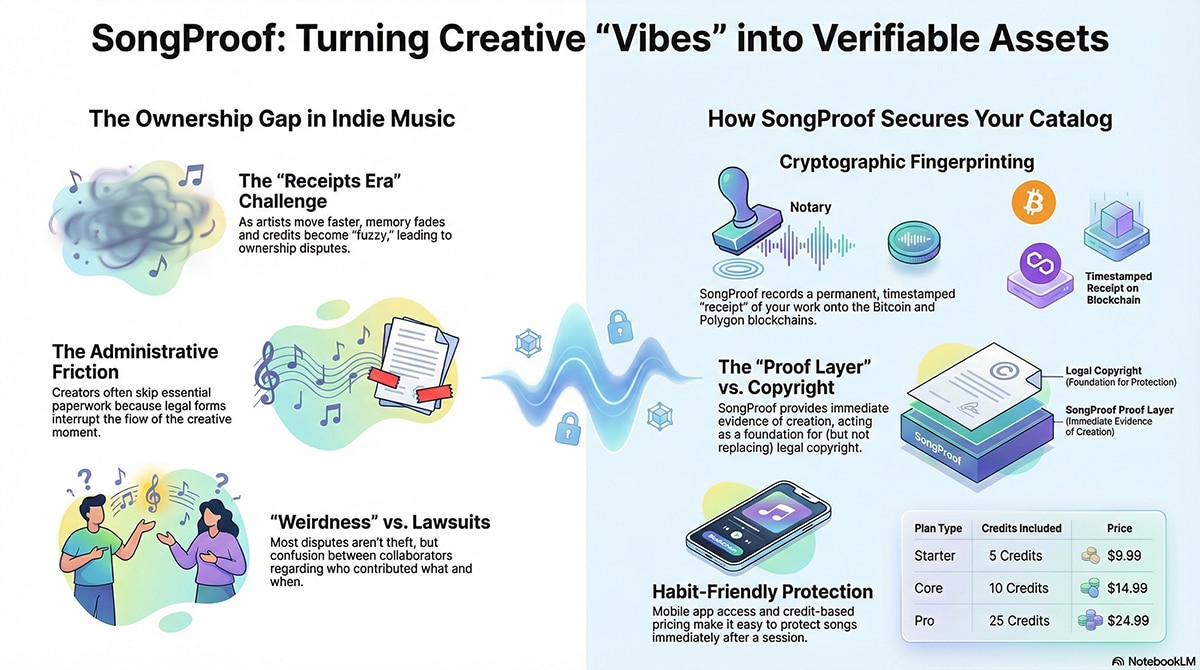
Not because you don’t trust people. Not even because you think someone is plotting against you. It’s because music moves fast now, and memory moves slow. Credits get fuzzy. Timelines blur. A session becomes “a vibe.” A melody becomes “inspired by.” A co-write turns into a debate.
That’s the space SongProof is built for.
SongProof isn’t trying to be your distributor or your publisher. It’s not the place you go when the song is already a product. It’s aiming at the earliest, messiest, most emotionally charged part of your career: the moment your song is born, while it’s still just a file on your laptop and a feeling in the room.
The Problem Nobody Wants to Talk About Until It’s Too Late
In the old music industry, the gatekeepers did a lot of the paperwork. Labels, publishers, managers—someone in the chain handled the official stuff. That system had plenty of problems, but it did create a paper trail, even if the artist didn’t own much of it.
Now the power has shifted, and that’s a good thing. Indie artists can write, record, release, market, and tour without waiting for permission. But there’s a trade-off: you’re also responsible for protecting your work in real time.
And the truth is, most artists don’t.
Not because they’re lazy. Because the business steps feel like a whole different language, and the creative moment doesn’t want to be interrupted by forms and portals and legal talk. You’re trying to catch lightning, not draft a contract.
SongProof steps into that gap with a pretty simple pitch: lock your proof early, before the song starts traveling.
What SongProof Feels Like in the Real World
Think of SongProof like a digital notary for music creators—without the courthouse energy.
You upload your song or material connected to it, you enter the key details that matter, and SongProof creates a cryptographic fingerprint tied to a timestamp. That proof is recorded using blockchain technology, and their platform makes a big point of keeping the experience simple so you don’t need to understand how blockchains work to get value from them. Their site frames it as “proof of creation” and “proof of ownership,” captured at the moment you need it most.
Here’s the part that matters: the result isn’t just a warm feeling. It’s a receipt you can point to later if anything ever gets weird.
And “weird” doesn’t always mean lawsuits. Sometimes “weird” is a collaborator insisting the chorus was their idea. Sometimes it’s a producer repackaging a demo into something new. Sometimes it’s a deal opportunity that requires you to verify who owns what—fast.
SongProof exists so you’re not standing there with nothing but a folder date and an argument.
The Blockchain Part Without the Crypto Headache
SongProof leans on blockchain networks because the whole point of a blockchain is permanence. Once something is written into that ledger, it’s extremely difficult to alter without leaving a trail.
SongProof’s own public pages describe recording proof to Bitcoin and Polygon, positioning this as a durable, verifiable timestamp and record.
This isn’t the “buy a token and join a club” side of crypto. This is the boring, useful part—evidence integrity. It’s less about speculation and more about protecting your catalog like it’s an asset. Because it is.
And if you care about indie artists building a real middle class in music, this is exactly the kind of tool that matters. Ownership isn’t just having a song. Ownership is being able to prove it when it counts.

The Money Part: Cheap Enough to Become a Habit
A protection tool only works if you actually use it. That’s where SongProof makes a smart move.
Instead of locking artists into a subscription, SongProof sells credits. One credit equals one song registration. Their Terms page notes that credits don’t expire and that there’s no subscription required.
And their pricing is built to feel casual enough that you don’t postpone it forever:
Starter: 5 credits for $9.99
Core: 10 credits for $14.99
Pro: 25 credits for $24.99
They also mention that your first song registration is free when you sign up, which is a clean way to get artists to try it once—because once you’ve used something like this, you start to see where it fits.
What SongProof Is Not—and Why That’s Important
This is the part where artists get tripped up, so let’s say it plainly.
SongProof is not the same as registering your work with the U.S. Copyright Office. Copyright registration is its own legal process with its own benefits, and the Copyright Office is clear about what registration does in the U.S., especially if you ever need to enforce rights in court.
SongProof is positioning itself as a proof layer. Evidence. Documentation. A timestamped record tied to your work.
That doesn’t make it “less.” It makes it different.
And SongProof is pretty direct about that difference because they also offer an optional add-on service for traditional government registration, listed as a separate $129 payment and not covered by SongProof credits.
The honest way to think about this is: SongProof helps you create receipts early. Formal registration is a heavier legal step you may still choose to do, especially for songs you believe have serious commercial upside.
The Mobile Angle: Because Songs Don’t Only Happen in Studios
Another detail that matters: SongProof isn’t just a desktop tool.
Their media kit points to both the Google Play and Apple App Store listings, which signals what they’re really chasing. They want proof to be something you can do right after a session, not after you get home, not after you remember, not after the song has already bounced around your group chat for a month.
Google Play: https://play.google.com/store/apps/details?id=com.songproofinc.songproof&hl=en
Apple App Store: https://apps.apple.com/us/app/songproof/id6752916525
If you’ve ever left a writing room buzzing, then lost half the details two days later, you understand why that matters.
The Real Value: Protecting Relationships, Not Just Songs
Here’s what doesn’t get said enough: most disputes aren’t about stealing. They’re about confusion.
People remember the session differently. Someone thinks they contributed more than they did. Someone’s manager starts talking numbers and suddenly the vibe shifts. A song gets placed in an opportunity pipeline and everyone starts “clarifying” what they own.
SongProof is valuable because it turns “I think” into “here’s what we recorded at the time.”
It protects your future self. It protects your collaborators too, if everyone is being honest and wants clarity. And that kind of clarity is what keeps teams together when money shows up.
That’s not small. That’s career infrastructure.
The Making a Scene Lens: Receipts Are Independence
If you’re trying to build real revenue that flows directly to the artist—shows, merch, licensing, publishing income, fan support—you need your catalog to be clean.
Ownership isn’t a philosophy. It’s paperwork and proof.
SongProof is one of those tools that doesn’t feel sexy until you realize how many indie careers get slowed down by disputes, uncertainty, or missing documentation. If you can remove friction early, you move faster later. Releases don’t stall. Collabs feel safer. Licensing conversations become possible. Publishing administration stops being terrifying because your foundation is solid.
This is the kind of boring, grown-up move that builds a music industry middle class.
Not because it makes you famous. Because it keeps you in control.
Bottom Line
SongProof is a lightweight, habit-friendly proof system for the moment your music leaves your hands and enters the world. It’s priced like something you can actually use consistently, designed like something you’ll remember to do, and built around a real-world need indie artists run into constantly: proving who created what, and when, before the internet turns your work into a rumor.
If you collaborate, share demos, pitch songs, or move fast—SongProof makes sense as part of your routine.
If you want, I can take this one step further and rewrite it as a full “Billboard-style feature” with a scene-setting opening, artist quotes-style framing (without inventing quotes), and a cleaner narrative arc that feels like a print magazine spread.
 |  Spotify |  Deezer |  Breaker |
 Pocket Cast |  Radio Public |  Stitcher |  TuneIn |
 IHeart Radio |  Mixcloud |  PlayerFM |  Amazon |
 Jiosaavn |  Gaana |  Vurbl |  Audius |
 Reason.Fm | |||
Find our Podcasts on these outlets
Subscribe to Our Newsletter
Discover more from Making A Scene!
Subscribe to get the latest posts sent to your email.


