

Wingman (Mixed In Key) A Demo Accelerator




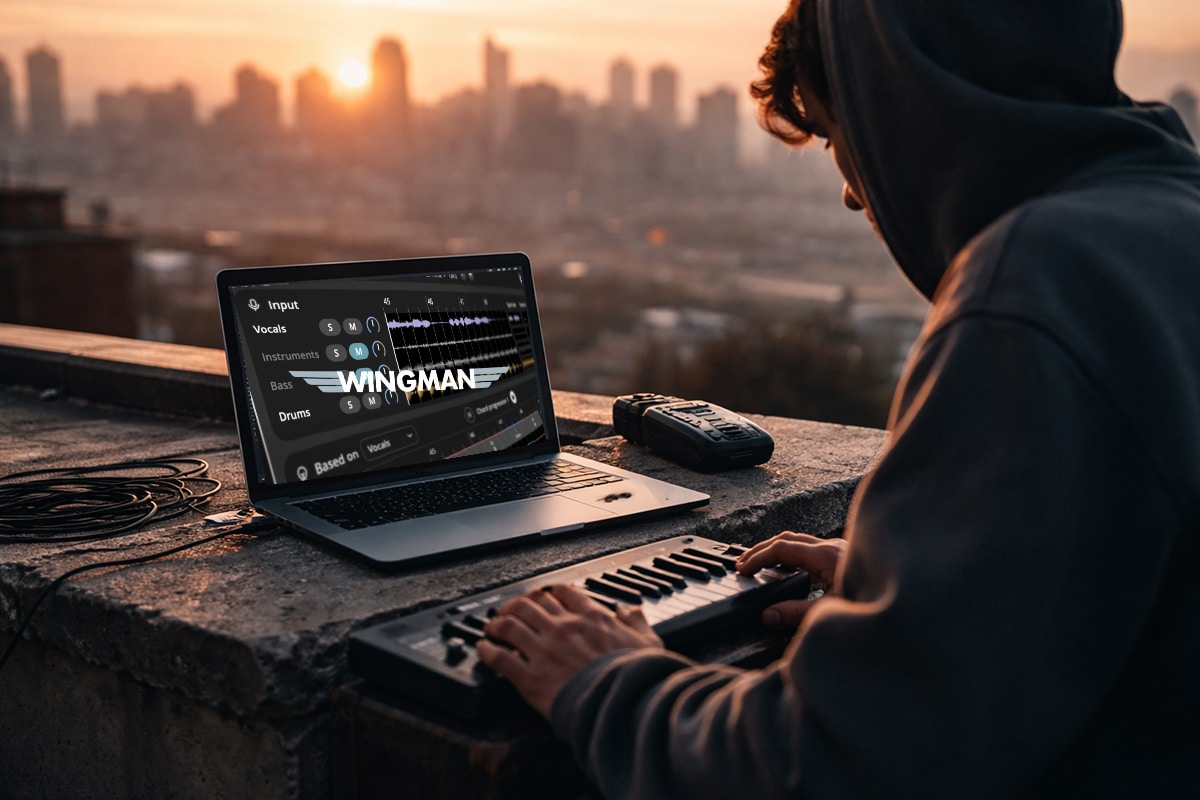
Making a Scene Presents – Wingman (Mixed In Key) A Demo Accelerator
Listen to the Podcast Discussion on Wingman By Mixed in Key
Wingman from Mixed In Key ($79) is built for the modern reality: a lot of great songwriters don’t play piano, don’t play bass, and don’t want to spend three hours hunting for the “right” chord under a vocal idea. Wingman lives inside your DAW as a plugin and listens to the audio you feed it, then suggests chords and basslines that fit what it hears. It also includes AI stem separation and audio-to-MIDI tools that help you pull musical structure out of real-world recordings and turn it into something you can arrange. The headline is simple: it’s an AI idea engine that helps you move from a spark to a usable demo faster, without needing to be a multi-instrumentalist.
What Wingman is not is a replacement for taste, identity, or finishing skills. It will not write your lyric, pick your hook, or decide how the chorus should lift emotionally. What it will do is remove the friction between “I can hear it” and “I can build it,” which is the exact gap that stops a lot of indie artists from finishing songs consistently. When you treat Wingman as a creative assistant, not a final producer, it can become one of those tools that quietly changes how often you complete demos—and that’s where the real career value lives.
Context-aware chords that start from your audio, not a theory textbook
Plenty of tools can generate chord progressions, but Wingman’s angle is that it reacts to your specific audio. That matters because most song ideas don’t begin as MIDI. They start as a voice memo, a rough vocal take, a guitar loop, a sample, or a messy bounce from a session. Wingman meets you in that audio-first workflow and gives you chord suggestions that fit what you recorded instead of forcing you to translate your idea into a keyboard performance you can’t play.
In practice, this is a songwriting confidence boost. You can loop an eight-bar section with your vocal melody, let Wingman analyze it, then audition several harmonic directions quickly. The important part is not that the AI is always “right.” The important part is that it gets you into the right neighborhood fast enough that you can make creative decisions while the emotion of the idea is still alive.
Bassline generation is the “demo sounds like a record” lever
Wingman’s bassline generation is one of the most practical features for indie artists because bass is where demos either feel finished or feel like sketches. A topline over chords can still sound thin if the low-end has no intention behind it. When Wingman proposes bass motion that supports the chord movement, it gives your demo a backbone, which makes everything else—drums, groove, transitions—easier to hear.
This matters in real-world music business terms because demos are communication tools. A stronger bass foundation helps collaborators understand where the track is going, helps session players interpret the vibe faster, and helps you test whether the chorus actually lifts the way you think it does. Even if you replace the bass with a real player later, having a solid bass concept early saves time and makes your writing feel more “release-ready” from day one.
Stem separation works best as analysis and rebuilding, not shortcuts
Wingman includes AI stem separation, which is powerful and also easy to misuse if you approach it with the wrong mindset. The clean, sustainable use case is pulling apart recordings you own, messy demos you recorded, or session bounces where you need quick access to parts you can’t easily isolate. That can be the difference between losing an idea and finishing it, especially when your original session files are scattered or when the vocal is glued to a noisy guitar room take.
Used responsibly, stem separation becomes a songwriting and production utility. It helps you isolate a vocal enough to rebuild harmony cleanly, extract a bass concept to recreate it as MIDI, or generate alternate arrangements of your own material without re-tracking everything. The value here is speed and clarity, not “getting something for nothing.” If you treat stems as a sketching aid, Wingman becomes a tool that helps you create original work more efficiently.
Audio-to-MIDI is where non-instrument writers gain real control
For the songwriter who can sing parts but can’t play them, audio-to-MIDI can be the turning point. When a tool can translate a sung phrase, a riff, or a chordal texture into editable MIDI, you gain access to the modern arrangement workflow. Suddenly, your idea becomes something you can move, copy, harmonize, and assign to any instrument without needing to perform it perfectly.
That workflow changes what’s possible in a home studio. You can sing a hook, convert it, put a piano or synth on it, then build harmonies or counter-melodies by editing notes instead of guessing on an instrument. This is the kind of feature that doesn’t just “add convenience.” It changes the volume of songs you can finish, and output is one of the most underrated success factors for indie artists trying to build momentum.
Export and portability keep Wingman from being a walled garden
A major practical win is that Wingman is designed to export what it generates as MIDI or WAV so you can commit the ideas into your session as normal tracks. That makes it a real production tool rather than a suggestion browser. When the generated chords and basslines can become MIDI in your DAW, you can swap instruments, rewrite voicings, simplify movement, or make it weirder and more personal without fighting the plugin.
That portability matters because indie artists need reusable assets. MIDI is an asset you can revisit later for acoustic versions, remixes, live show stems, and alternate production directions. Anything that helps you create transferable building blocks supports long-term ownership and flexibility, which is where modern indie careers are headed.
Hardware reality check: stem separation is the heavy lift
Wingman’s lightweight features—chord and key analysis, MIDI generation—are generally more forgiving on systems than stem separation. The moment you lean into stem separation, hardware becomes the gatekeeper. That’s not a complaint, it’s just physics, because stem separation is the most computationally demanding part of this toolset.
The smartest way to approach Wingman is to decide what you’re buying it for. If your main goal is chord and bass idea generation for demos, you may get massive value even if you use stem separation occasionally. If your main goal is heavy stem separation in every project, then system capability becomes a big part of whether you’ll feel satisfied day to day.
The creative warning: “fits” doesn’t always mean “interesting”
Here’s the truth that separates “AI helped me” from “AI made me generic.” A chord progression can be correct and still be boring. Wingman can give you safe, functional harmony quickly, but it will not automatically give you your signature. Your job is to use the AI suggestions as a starting draft, then make at least one human decision that reflects taste, tension, or surprise.
The best Wingman users will take the acceptable chord set, then reshape it. They’ll change one chord in the pre-chorus, alter the bass motion to create lift, or push the voicings into a more emotional register. That’s how you keep the speed benefits without surrendering your identity, and it’s how the tool stays in the “demo accelerator” lane instead of drifting into “samey generator” territory.
Bottom line: Wingman is a songwriter’s translation tool, not a crutch
Wingman makes the most sense for artists who have ideas but get stuck translating them into full arrangements. If you’re a strong topline writer, a lyric-first creator, or someone who builds from loops and audio fragments, Wingman can help you turn those fragments into playable demos that communicate clearly. That’s not a small thing. Better demos lead to better collaborations, faster production decisions, more consistent releases, and more opportunities to monetize your catalog through shows, licensing, and direct-to-fan momentum.
The win is not that Wingman does the work for you. The win is that it gets you past the blank space faster, so you can spend your time where it matters: choosing the parts that make the song yours.
 |  Spotify |  Deezer |  Breaker |
 Pocket Cast |  Radio Public |  Stitcher |  TuneIn |
 IHeart Radio |  Mixcloud |  PlayerFM |  Amazon |
 Jiosaavn |  Gaana |  Vurbl |  Audius |
 Reason.Fm | |||
Find our Podcasts on these outlets

Subscribe to Our Newsletter
Discover more from Making A Scene!
Subscribe to get the latest posts sent to your email.


