
Streaming Growth is Slowing And That’s Good News for Indie Artists.





Making a Scene Presents – Streaming Growth is Slowing And That’s Good News for Indie Artists.
Listen to the Podcast Discussion to gain insight into why 1,000 Fans is Better than 500,000 Streams!
For the past ten-plus years, the music industry has sold indie artists one simple dream. Get your music on streaming. Get on playlists. Get the numbers up. Then, somehow, the money will follow. A lot of artists found out the hard way that this dream has a catch. Streaming is real. Streaming is powerful. Streaming can introduce you to new listeners all over the world. But streaming, by itself, rarely builds a stable living.
Now we’re entering a new phase. The “growth at all costs” era of streaming is cooling off. The big services aren’t just trying to add brand-new users anymore. In a lot of major markets, most music fans who want streaming already have it. So the next phase is about something else. It’s about pricing, bundles, tiers, and getting more money per listener instead of just chasing more listeners.
You can see it in the headlines. Spotify announced a U.S. Premium price increase to $12.99 for the Individual plan, and said subscribers would get emails about what the update means for their subscription. You can see it in the industry reports too. IFPI reported global recorded music revenues grew 4.8% in 2024, and highlighted that paid subscription streaming grew 9.5% while ad-supported streaming grew only 1.2%. That gap tells you where the business focus is headed.
If you’re an indie artist trying to build a real career, this moment matters. Because when platforms shift their business model, your strategy has to shift too. And here’s the truth: this shift can actually help indie artists build a music industry middle class faster, if you stop treating streaming as the finish line and start treating it as the front door.
What “Pricing Replaces Growth” Really Means
When a company is growing fast, it can afford to be sloppy. It can chase attention. It can spend big. It can prioritize expansion over efficiency. It can offer tons of features and hope it all works out later. When growth slows down, the company changes mood.
It starts asking different questions. Not “How do we get more people?” but “How do we get more money from the people already here?” Not “How do we expand?” but “How do we keep subscribers from canceling?” Not “How do we take risks?” but “How do we protect profit?”
That shift is why you see price increases. It’s why you see more tiers, more “premium” features, more bundling deals, and more partnerships. Bundling is a big trend across subscriptions because it keeps customers “stuck” longer. People cancel less when everything is tied together. This is not a conspiracy. It’s just business.
But if you’re an artist, you have to see the ripple effect. Because when streaming platforms lean into pricing and bundling, they also lean into controlling the customer relationship more tightly. They want to be the place where fans spend, where “superfan money” flows, and where the fan data lives—because data is leverage, and leverage is profit.
And that is exactly where indie artists need to draw a line in the sand. You can use streaming. You can love streaming. You can build discovery through streaming. But you can’t rent your entire career from streaming.
The Big Trap: “More Streams Will Save Me”
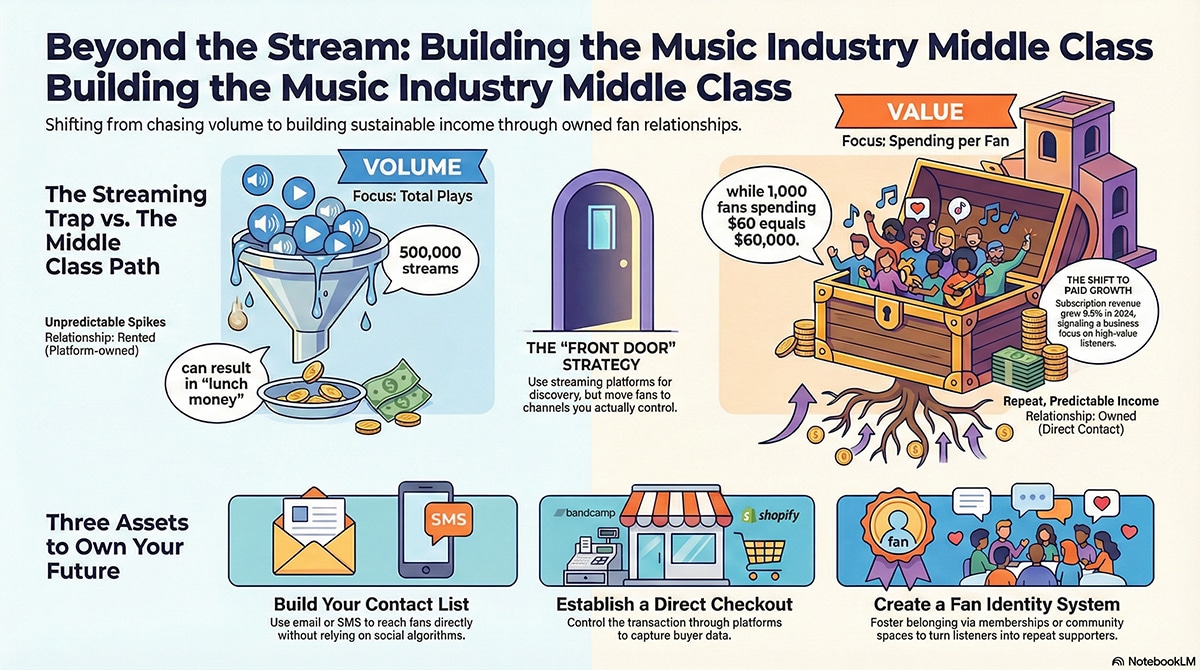
This is the trap that keeps indie artists stuck. Streaming trains you to chase volume. More listeners. More playlists. More monthly followers. More plays. But the music industry middle class is not built on volume. It’s built on value per fan, ownership, and predictable income.
Here’s why “more streams” alone is a trap.
First, streaming payouts are small per play, and they don’t automatically go up just because subscription prices go up. Price increases are usually about the platform’s business needs, not your needs. Spotify’s pricing update is framed as reflecting the value Spotify delivers and enabling them to continue offering the best experience and benefit artists, but it doesn’t promise “your per-stream payout will increase.”
Second, streaming gives you reach, but it limits your direct connection. You might have listeners in Chicago, Austin, Berlin, and Tokyo, but you may have no direct way to contact them. You can’t email them. You can’t text them. You can’t invite them to a merch drop. You can’t offer them a membership. You can’t say, “Hey, I’m coming to your city,” without paying to reach them or hoping the algorithm is in a good mood.
Third, streaming success is often unpredictable. It can spike and vanish. You can do everything right and still miss. Or you can get a playlist and then watch it disappear the next week. A middle class career can’t run on random spikes. A middle class career runs on systems you own.
So instead of asking, “How do I get more streams?” the better question is, “How do I turn the attention streaming gives me into income and relationships I control?” That’s the shift.
Two Real Number Examples (So This Doesn’t Stay Theoretical)
Strategy only becomes real when you can picture it in your own life. So let’s keep the math simple and honest, without pretending there’s one “true” per-stream rate. Streaming payouts vary by platform, country, plan type, and deal structure, and anyone who hands you a single magic number is selling confidence, not clarity.
Example One: The Streaming-Only Path (And Why It Feels Like a Treadmill)
Imagine you have a solid year by indie standards. Your songs rack up 500,000 streams across platforms over twelve months. That’s momentum. That’s real listening.
Now ask the uncomfortable question: what does that do for your bank account?
Even when those streams generate a few thousand dollars gross, the money rarely lands cleanly. You may have collaborators to split with. You may have a producer deal. You may have distribution fees. You may be paying for cover art, mixing, mastering, marketing, rehearsal space, and the random “life costs” that show up when you’re trying to be consistent. So the number you feel proud of—half a million plays—can translate into something that looks like lunch money once it hits your pocket.
That’s why streaming-only careers can feel like a treadmill. You run hard, the numbers go up, and you still don’t feel stable. Streaming isn’t useless. It’s just not designed to be your entire income; it’s designed to be the discovery layer, the introduction, the front door.
Example Two: The Middle Class Path (Value Per Fan Beats Volume)
Now imagine a different kind of year. Imagine you have 1,000 real fans—not “followers,” not random viewers, but people who actually care. The kind of fans who would drive across town to see you, buy something that represents your music, and come back again.
If 1,000 fans spend $60 per year directly with you, that’s $60,000 gross.
That can happen without being gross about it. Maybe each fan buys one $30 shirt and one $30 ticket in a year. Maybe they buy a $25 vinyl and a $35 hoodie. Maybe they join a $5/month membership for a year. None of that is extreme. It’s normal fan behavior when the relationship feels real.
And here’s the part streaming can’t give you: every direct purchase creates a receipt, and every receipt is a relationship marker you control. You get an email. You get a buyer city. You learn what they chose. You can invite them back. That’s how stability gets built—through repeat support and owned contact, not through hoping next month’s algorithm acts nice.
Streaming can introduce people. Your owned system can keep them.
The New Indie Strategy: Think Like a Funnel
Some artists hear the word “funnel” and want to give up. Fair. A lot of funnels feel like you are selling out. But a funnel is just a path. It’s the path from “a stranger heard your song” to “a fan supports your career.” Streaming is the top of the funnel.
The middle of the funnel is trust. Story. Identity. Consistency. The bottom of the funnel is direct support: tickets, merch, memberships, direct sales, licensing, and fan-powered funding. You don’t need to become a marketing robot. You just need a system that makes it easy for fans to support you.
When streaming shifts into pricing and bundles, the platforms will push harder to keep people inside their walls. That means it becomes even more important that you build your own walls too. Not walls that block fans out, but walls that protect your business.
You do that by building owned channels, and that’s why owned channels matter: Your email list and SMS list. Your website and store. Your membership and community space. And the data that ties it all together—names, locations, buying habits, and the proof that real humans are choosing you, not just streaming you.
That is the foundation of a music industry middle class.
The Three Owned Assets That Change Everything
If you do nothing else this year, build three owned assets. Not perfectly. Not all at once. Just steadily, so your career stops living and dying by the mood of an algorithm.
Start with your contact list, because it’s the simplest form of leverage an indie artist can have. An email list isn’t glamorous, but it’s direct. It’s the difference between “I hope people see this post” and “I can actually reach the people who already raised their hand.” Tools like Mailchimp at https://mailchimp.com and ConvertKit at https://convertkit.com make it easy to start small. One signup form. One welcome email. One reason to join—like early access, a private demo, or first dibs on tickets.
Next, build a direct checkout. Streaming is great at introducing your music, but it’s terrible at letting fans support you in a meaningful way. A checkout fixes that leak. Bandcamp at https://bandcamp.com works because fans already expect to buy music there. Shopify at https://www.shopify.com is stronger if you want a full storefront and long-term business control. Fourthwall at https://fourthwall.com can simplify merch and creator products, and Gumroad at https://gumroad.com is a quick way to sell digital files. The specific platform isn’t the point. The point is that your fan should have an obvious place to spend with you, not just listen to you.
Finally, build a fan identity system, because belonging is what turns a casual listener into repeat support. That can be a membership on Patreon at https://www.patreon.com or Ko-fi at https://ko-fi.com, or it can be a community space like Discord at https://discord.com where fans get closer to the story, the process, and the people behind the music. When fans feel included, they don’t just stream more—they show up, they buy, and they stick around.
That’s the middle-class formula in plain sight: contact, checkout, belonging. Streaming can still be the front door, but these three assets are the house you own.
Where AI Actually Helps
AI gets misunderstood because people talk about it like a magic wand. For working indie artists, AI isn’t here to replace your creativity. It’s here to remove friction from the business stuff you already have to do, so you can spend more time making music and more time turning listeners into supporters.
In a middle-class strategy, AI earns its keep in three ways. It helps you see patterns in your own data, it helps you communicate clearly without burning out, and it helps you plan smarter so you waste less money.
Here’s what that looks like in real life. If you have a spreadsheet of merch buyers, ticket buyers, or email signups, you can use AI to spot where the support is strongest and what products actually move. You can say, “I’m going to paste a spreadsheet with columns for city, item, date, and revenue. Please summarize the top five cities by revenue, the top three best-selling items, and any seasonal patterns you notice. Then suggest two merch drop ideas that match what my fans already buy.” That’s not hype. That’s you finally using your own evidence.
AI can also help you keep your communication human while staying consistent. You can say, “Here are three paragraphs of my past posts and my artist bio. Learn the tone. Now write a short email announcing my next show that feels personal, not salesy. Include one story detail, one clear call to action, and one reason to join my email list. Keep it under 180 words.” Used like that, AI saves you hours without turning you into a brand robot.
Touring in the New Phase: Data-Driven, Not Hope-Driven
When streaming markets mature and attention gets more expensive, touring becomes both more important and more risky. Gas costs money. Hotels cost money. Eating on the road costs money. Bandmates cost money. Gear breaks. The van needs repairs. Touring can still build careers, but “tour everywhere and hope” is a fast path to debt.
A middle-class touring strategy starts where the support already exists. If you have an email list, you can see where subscribers live. If you have a store, you can see where buyers live. If you have ticket buyers from past shows, you can see where repeat demand is. Put those signals together and you stop guessing—you start routing your effort toward places where people have already proven they’ll show up.
If you’re not ready for big runs, start local. Treat your hometown and two or three nearby cities like a repeatable loop. Play your hometown on a steady cadence and rotate the nearby cities every couple of months—often enough to stay present, but not so often you burn out your draw. Measure success with real metrics: emails collected, merch conversion, and repeat attendance. Those numbers build careers because they lead to predictable revenue, not just a loud night and a quiet month.
Merch, Direct Sales, and the Hidden Costs No One Wants to Talk About
Merch wins when it feels personal and loses when it feels like a random product. That’s why the middle-class move isn’t “make 500 shirts and pray.” It’s small drops, limited runs, and clear stories fans can connect to—like a tour shirt tied to dates, a lyric zine tied to a record, a signed poster tied to a livestream, a limited cassette run, or a studio diary that documents the making of an album.
But honest math matters. Shipping costs money. Packaging costs money. Returns happen. Payment fees take a bite. Your time matters too. If you spend six hours packing orders, that’s labor, and middle-class businesses count labor. The goal isn’t to scare you. It’s to help you price like a business and build a workflow that supports the art instead of draining it.
Direct-to-fan sales work for the same reason: they create a receipt. A receipt creates a relationship. A relationship creates repeat revenue. Bandcamp at https://bandcamp.com is an easy place to start because fans expect to buy music there. Shopify at https://www.shopify.com gives you more control if you want a full storefront.
And if you’re a producer or beatmaker, direct products can be your best lane—sample packs, drum kits, presets, project breakdowns, and subscription drops—because streaming doesn’t even touch that revenue.
Masters vs Compositions The Two Buckets Most Artists Confuse
Here’s the clarity check that saves artists money. Your master is the sound recording—the actual recorded track that gets streamed, downloaded, and licensed as audio. Your composition is the song itself—the melody and lyrics—whether it’s recorded today, covered tomorrow, or performed live for the next ten years.
Both buckets can earn, and both buckets can be licensed, but they often pay through different pipes. Distribution mostly handles the master side. Proper registration and clean splits protect the composition side. The middle-class mindset is simple: don’t leave either bucket unattended, because every unattended bucket becomes leaked income over time.
Where Web3 Fits
Web3 has been oversold and misunderstood, but the core idea still matters for the middle-class mission: ownership, portable identity, and direct fan relationships that aren’t controlled by one platform.
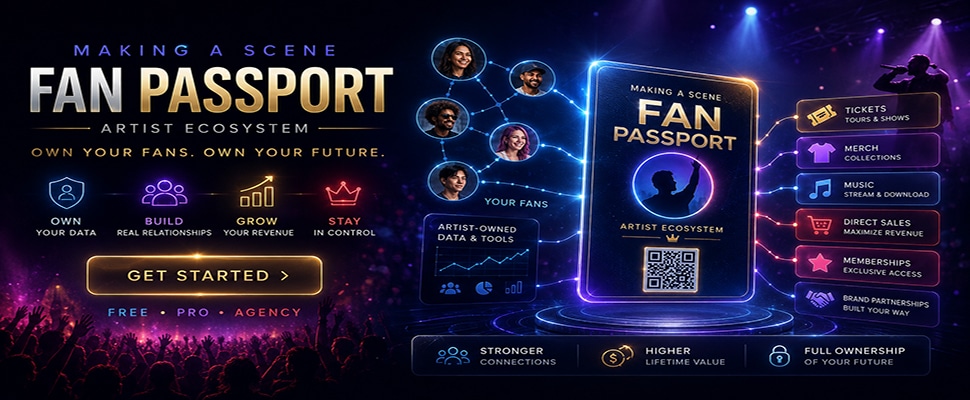
The practical version looks like infrastructure, not hype. A fan passport system is a clean example. Fans claim a free passport, and support becomes a visible journey. When someone attends a show, buys merch, or helps spread the word, they earn a stamp that marks participation. Over time those stamps unlock real perks—early ticket access, private livestreams, members-only drops, and entry to a community space that feels earned instead of paywalled.
The important part isn’t the tech word. It’s that the fan has portable proof they were there, and the artist has consent-based insight into who their real supporters are, what they respond to, and where they’re located. Used this way, Web3 becomes infrastructure for relationship and revenue, not a speculative gimmick.
The Middle Class Is Built on Repeat Support, Not Viral Luck
The streaming era trained artists to chase scale before they built stability. The next era rewards artists who build stability first, then scale it. When you build a business that earns real money from 300 fans, you can earn more from 600. When you earn from 600, you can earn from 1,200. And when you earn from 1,200, you can fund bigger releases, better tours, and better marketing—so streaming becomes a bonus, not your oxygen.
Not a few artists getting everything, but thousands of artists earning enough. That’s what a music industry middle class looks like, and it’s why mature streaming markets are a wake-up call: you can’t afford to rent your future.
Strategy Needs a Next Step
If you want to build a music industry middle class, don’t try to rebuild your whole business in one weekend. Pick one owned asset to build this month—your email list, a simple store page, or a membership with one sustainable perk. Then pick one offer to ship in the next 30 days—like a bundle, a limited merch drop, a local show with an email capture plan, or a digital product if you’re a producer.
Streaming is still the front door. But the middle class gets built in the living room and at the checkout. Own your masters. Own your data. Own your checkout.
 |  Spotify |  Deezer |  Breaker |
 Pocket Cast |  Radio Public |  Stitcher |  TuneIn |
 IHeart Radio |  Mixcloud |  PlayerFM |  Amazon |
 Jiosaavn |  Gaana |  Vurbl |  Audius |
 Reason.Fm | |||
Find our Podcasts on these outlets
Subscribe to Our Newsletter
Discover more from Making A Scene!
Subscribe to get the latest posts sent to your email.


