

The Indie Advantage: How AI Levels the Playing Field in the Studio




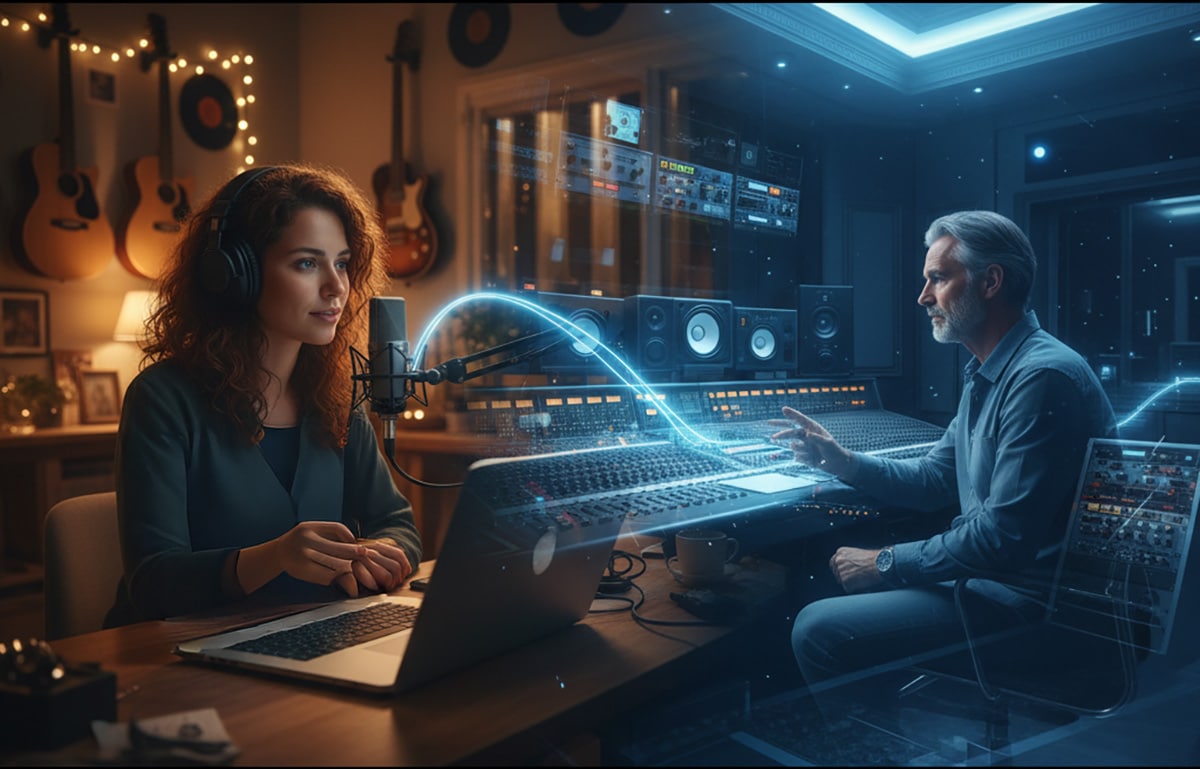
Making a Scene Presents – The Indie Advantage: How AI Levels the Playing Field in the Studio
Listen to the Podcast Discussion to gain more insight into AI’s Role in the Studio
Access to Major-Label Tech, at Home
Imagine being in a major label studio in the 1990s: racks of outboard gear, professional engineers, weeks of tracking, mixing, and mastering. For most indie artists, that meant compromise: cheaper rooms, fewer takes, less time, less polish. But today, AI is giving indie musicians the power to access that kind of technology in a very different way.
Take audio repair and enhancement. A company like iZotope has a product line (for example their “RX” series) that uses intelligent algorithms to fix noise, remove hum, smooth audio, separate stems, rescue bad recordings and more. They call their latest incarnation “RX 11” which builds on decades of intelligent audio tech. This kind of thing used to require a dedicated engineer and expensive editing time. Now you can apply it in your home studio session.
On the creative side, generative tools like Suno AI are changing how independent musicians learn, experiment, and produce music. Suno AI lets you create full songs—or just individual parts—based entirely on your written prompts. You can type in details like the mood, genre, tempo, instrumentation, and even lyrical themes. In just a few minutes, it produces a fully arranged track complete with vocals, harmonies, and structure.
For indie musicians, this is more than just a way to generate new music — it’s an incredible learning environment. Think of it as sitting in on a masterclass where the “teacher” instantly shows you what different creative choices sound like. If you’re still developing your ear for arrangement, you can listen to how Suno handles dynamics, transitions, and layering across genres. If you’re a songwriter, you can study how small lyric or chord changes affect the energy and pacing of a song.
Many indie artists are now using Suno AI as a virtual producer’s sketchpad. You can feed it one of your own lyric ideas or a short description of a song concept and instantly hear multiple interpretations. Maybe one version leans toward dreamy indie pop, while another feels like stripped-down acoustic folk. By comparing these outputs, you can better understand production techniques, instrument voicing, and genre-specific mixing choices. You can then take those ideas back into your DAW and try to recreate the sound yourself using your own instruments, plugins, and recording setup.
This process of reverse-engineering AI-generated productions can dramatically speed up your growth as a producer. You’re no longer limited to guessing how pros achieve certain sounds — you can hear examples, analyze them, and learn in real time. It’s a hands-on education in arrangement, production, and sound design.
For indie artists who don’t have access to big studios or seasoned engineers, that’s huge. Suno AI becomes a personal tutor and creative partner rolled into one. It doesn’t just save time or spark inspiration — it helps you understand why certain production decisions work, giving you the skills to apply those lessons to your own music.
Mixing and mastering assistants powered by AI are now part of the game. The listing of “intelligent mixing assistants, AI mastering plugins, audio enhancement tools, background noise removal” shows up in recent round-ups of AI tools for audio engineering. What does this mean for the indie musician? It means your bedroom studio can sound better, faster, smarter.
Imagine: you’re a folk-rock singer-songwriter with a basic mic, interface, your guitar, and you track in your home project room. Before you hit “release”, you run your vocal through an AI cleanup tool, you generate an alternate drum loop with an AI instrument generator, you let an AI assist your mix to get your guitar/piano/vocal blend closer to what a major label session might sound like. You’re not trying to fake a high budget. You’re leveraging smart tools that augment your creativity and raise your baseline quality.
In effect: AI is not replacing you; it’s equipping you. You remain the creative driver; the AI is your assistant, your studio ally. That is the indie advantage.
Stories of Indie Albums Recorded With AI Tools
Okay, you might say: “Cool in theory, but show me a real-world example.” Good call. While much of the narrative still feels early stage, there are clear cases of independent artists or smaller labels embracing AI in their workflow, showing that this stuff isn’t just hype.
For instance, the independent label Wylde Chylde Records published a story about how they’re using AI “to elevate” rather than replace human artistry. Their artists are blending human songwriting, sensibility and emotion with AI-driven assistance in production. That means the artist wrote the songs, played the parts (or directed them), and used AI tools to shape sounds, polish performances, maybe generate instrumental ideas or help build mixes.
Another example: the project Gone World by The NEUROFRIENDS (released May 2025) describes itself as a “ground-breaking Americana music project that merges poetic storytelling with cutting-edge artificial intelligence.” Now, this doesn’t mean the AI wrote all the songs and humans did nothing — far from it. The human musician still provided the soul, the narrative, the direction. But the AI tools accelerated, aided, or enabled parts of the production that used to be expensive or out of reach.
Even where the story is more sensational — for instance an entirely AI-generated band like The Velvet Sundown racking up 1 million plays on Spotify — we still see the relevance: technology has advanced to a level where indie artists can really play in new territory. The indie advantage isn’t about being on a massive budget; it’s about having enough budget + smart tech + creative will to punch above your size.
These stories send a message: You don’t need to wait for a major label advance. You don’t need to rent the biggest studio. You can produce high-quality work, experiment with new sounds, release quickly, iterate freely. That gives you creative freedom, financial flexibility, and a speed advantage.
Cost Savings of AI for Indie Studios
Let’s get concrete about one of the most important things for indie musicians: money. Budgets are tight. Time is limited. If AI tools help you save money and time — that’s a win.
Imagine you used to book a studio day for tracking drums, bass, guitars, vocals, then mix and master. Studio day rates might run hundreds to thousands of dollars. Engineer + session musicians + instrument rental + room rental + mixing + mastering = easily several thousand. For many indie artists, that’s prohibitive.
Now imagine you track your core parts at home (interface, good mic, acoustic or electric guitar, vocal). Then you apply AI tools for some of the heavy lifting: maybe you let an AI plugin clean up your vocal takes so you need fewer retakes, maybe you use an AI instrument or AI loop to generate a drum track instead of hiring a session drummer for some parts, maybe you use an AI mastering assistant or AI plugin to bring up the loudness and polish without making you hire a high-end mastering house.
For example, a tool like iZotope RX 11 promises “complete toolkit for audio clean-up … speeds up editing workflows and delivers reliably clear sound quality.” So instead of spending hours manually editing hum, clicks, pops, stray noises — you let the AI assist, do much of the heavy lifting, and you spend your time on song and feel instead of spend time on technical cleanup.
A generative tool like Suno AI gives you rapid prototyping ability: generate a draft song in minutes, test it, change prompts, iterate. Instead of spending days or weeks writing parts, recording, if you’re stuck you can generate alternate ideas quickly. That saves time — which for indie artists often means saves money and creative energy.
And there’s another piece: turnaround time. If you’re working fast, you can release more music, try more things, learn more without huge incremental cost. The cost per experiment goes down. What used to be “we can only afford one song” becomes “let’s try four songs, see which one hits”.
Furthermore, many of these AI tools have tiered pricing: free trials, affordable subscriptions, pay-as-you-go. As independent musicians, you can choose tool-levels that fit your budget.
When an indie musician saves studio hours, engineer time, musician session fees, editing time, mixing budget — that’s real savings. And more savings equals more creative freedom, more risk-taking, more releases, more growth. That is one of the big AI studio advantages.
The Practical Workflow: How to Use AI in Your Home Recording Studio
Let’s walk through a typical workflow for an indie musician using AI in their home studio. Imagine you’re a singer-songwriter, you play guitar, you sing, and you want to record an EP at home with high quality. Here’s how you might do it.
You write your songs (lyrics, chords). You choose your interface, mic, acoustic or electric guitar, perhaps a small keyboard if you have one. You set up your track at home in your DAW (digital audio workstation). Let’s say you’re using a common DAW. You record your main parts: guitars, vocals, maybe bass. Now you get to the stage where you want to add drums, maybe fill out the arrangement, clean up the vocals, mix the songs, and master them.
Here’s where AI comes in:
-
For drums or rhythm parts: Use an AI-driven loop generator or instrument plugin (some generative AI tools allow you to generate full arrangements or suggest instrumentation). You experiment with prompts like “indie rock mid-tempo drums with snare rim, minimal fills” or “folk-pop brushed drums, soft ride cymbal”. You pick one that fits your song and you adjust velocity or programming manually if you want. This means you don’t hire a session drummer — you use creative tools and you keep full creative control.
-
For vocals: After tracking multiple takes, you use an AI cleanup tool (e.g., iZotope RX) to remove noise, hum, pops, clicks, maybe even reduce room reflections or bleed. That means you might not need to re-record everything or rent a vocal booth. The cleanup makes your home recordings sound tighter and more professional.
-
For arranging: If you’re stuck on song structure (bridge, breakdown, outro) you might use a generative AI tool like Suno AI to generate alternate versions or instrumentation ideas. You feed in a prompt like “indie folk ballad, female vocal, acoustic guitar, cello pad in the bridge, soft glockenspiel outro”. You review what it delivers (it might be a draft) and you take what you like, remix it, adapt it, or simply use it as inspiration. This speeds up ideation and helps you break writer’s block.
-
For mixing: Use an AI-assisted mixing plugin (there are tools emerging that analyze your tracks and suggest levels, EQ, compression settings, or balance). While you still make final decisions, the AI gets you closer to a good starting point. This means you spend less time fiddling and more time fine-tuning.
-
For mastering: You can either use an AI mastering service or plugin (there are affordable services online) to prepare your finished track for release. You apply loudness, ensure balance across track parts, check translation (how it will sound on earbuds vs. speakers). The AI gives you a polished final version.
-
For release: Because you saved money on studios, engineers, sessions and time, you’re able to release more tracks, invest your budget into promotion or artwork or videos. You have less “overhead” so you can be agile.
In short: an indie musician with home gear plus smart AI tools can approach the sonic standard of much more expensive production setups. That doesn’t mean everything sounds like a six-figure major label budget record (and you don’t necessarily want that!) — it means your limitations shrink and your creative choices expand.
Why This is More Than Just “Cool Tech” — It’s a Shift
There’s a deeper point here: AI is not just a fancy plugin or a gimmick. It’s part of a shift in how music production works, who gets access, what the gatekeepers are, and how we think of “studio value”.
Historically, major labels or large studios had advantages: access to expensive gear, big rooms, top-tier engineers, and time. Independent artists often had to accept compromises. With AI, the playing field shifts. Independent musicians can now access assistance that closes the gap.
The phrase “AI for indie musicians” is apt because this technology isn’t just for large budgets; it serves self-recording artists. The term “AI recording tools indie” captures exactly what we’re talking about: tools built or repurposed so that indie artists in home studios can benefit. And “AI studio advantages” is what emerges: speed, flexibility, access, cost-savings, higher baseline quality.
By embracing AI, indie musicians gain advantage in several ways:
-
Speed to idea: Generation tools let you try ideas very fast. You aren’t stuck writing for months or re-tracking endlessly.
-
Cost efficiency: Less money spent on fixes, less risk, more freedom to experiment.
-
Quality improvement: Because of AI-cleaning, AI-assisted mixes, generative instrument ideas — you raise your production value.
-
Creative freedom: You can iterate, scrap, try weird ideas, remix again. The overhead is lower.
-
Independence: You hold more creative control, you’re less reliant on big studios, you set your own pace and path.
This really is democratizing music production. The big studios may still exist, but they no longer monopolize “good sound”. The barrier is lower. For indie musicians this is empowering.
But Let’s Be Real: It’s Not All Magic
Of course, we should keep things grounded. AI tools are powerful, but they aren’t magic bullets. There are still creative, technical, artistic choices only you can make. And they come with trade-offs.
First: you’re still the artist. The gear won’t write your songs for you (unless you choose to go that route). The emotional connection, the unique voice, the craft of songwriting, the performance—those are still you. AI is your assistant or collaborator; it doesn’t replace your heart.
Second: quality is evolving. Some AI-generated music or vocals might still sound “off” or lack the organic feel of live performance. For example, a recent review of Suno noted that while its latest version (v5) showed technical improvement, the vocals were described as “too close to perfection to be believably human.” That might be fine depending on your style, but if you’re going for raw, vulnerable, “human” feel, you still want that grit and imperfection.
Third: ethics and legality. Generative AI in music is still navigating rights, copyright, training data issues. For example, major labels have sued Suno and another tool called Udio for alleged copyright infringement, claiming the tools were trained on copyrighted sound recordings without proper licensing. As an indie musician using AI tools, you should stay informed: check the licensing of tools you use, what you’re allowed to release commercially, ensure you have rights to your masters, understand how the AI tool handles your data and generated content.
Fourth: good tools don’t substitute good workflow. You still need decent monitoring, good acoustic treatment (even modest), good performance takes, good songwriting. AI helps you, but it won’t fix a weak performance, a bad arrangement, or uninteresting songwriting.
Finally: you still need to listen critically. AI will give you options, suggestions, fixes. But the final decision is yours. Use your ears, make artistic choices. The tools don’t replace your taste.
Putting It All Together: A Vision for the Indie Future
So where does this leave us? As an indie artist in 2025 (and beyond), here’s the vision: You have a home studio (it could be small). You have a good mic, interface, your instrument(s). You pair that with smart AI tools: for cleanup, for creativity, for mixing help, for mastering. You write songs, you record, you generate ideas, you iterate quickly. You release more music. You build your fanbase. You control your catalog. You move fast.
Meanwhile, the cost of “acceptable production quality” has dropped. You don’t need a million-dollar budget to sound good. You don’t need to wait for someone else’s stamp of approval. You can bypass some of the traditional gatekeepers because your output is strong, your workflow is efficient, you own your path.
And there’s more: as AI tools become more accessible, the indie field becomes richer. More artists can experiment. More genres can emerge. More hybrid sounds can appear. The democratization is real. The phrase “we are the industry now” becomes literal in a sense: if you have the tools, the talent, the will—even with modest means—you can produce, release, connect.
In the future I see a world where independent musicians aren’t merely surviving; they’re thriving. They’re treating AI not as a threat, but as a collaborator. They’re using “AI for indie musicians” as a means to increase their creative freedom. They’re choosing “indie recording tools” that embrace AI and support their vision. They’re leveraging “AI studio advantages” to make better art, faster, smarter—with less compromise.
So if you’re reading this and thinking: “I’m just an indie musician in my home studio … can this really matter?” The answer is yes. It matters a lot. You’re not waiting for the label to pick you up. You’re not renting studio time under strain. You’re equipped with tools that give you power. You’re empowered.
Final Thoughts
Let’s wrap this up with three key take-aways.
One: AI is not the whole story—but it is a powerful part of your story. When used thoughtfully, it gives you access to tech that used to cost big money. It opens doors. It raises your playing field.
Two: As an indie musician, you now have a choice. You can stay in your previous paradigm—slow, expensive, reliant on external resources. Or you can lean into the new paradigm: home studio augmented by AI, creative freedom, quick iteration, higher baseline quality. The latter gives you the indie advantage.
Three: The future is bright for independent artists who treat AI as a partner, not a gimmick. Who stay true to their voice, but use the tools of 2025 to express it. Who see “AI studio advantages” not as a shortcut to mimic major labels, but as a way to amplify their authenticity, speed, and control.
If you’re ready to lean in, pick a smart AI tool, test it in your next session, experiment with parts you’ve been stuck on, measure the time you save, the ideas it sparks, the quality uplift. Grant yourself permission to use the tech—and maintain your artist soul.
Because in the end: the technology is there, the access is there, the creative future is there for indie artists. The advantage is yours.
\
 |  Spotify |  Deezer |  Breaker |
 Pocket Cast |  Radio Public |  Stitcher |  TuneIn |
 IHeart Radio |  Mixcloud |  PlayerFM |  Amazon |
 Jiosaavn |  Gaana |  Vurbl |  Audius |
 Reason.Fm | |||
Find our Podcasts on these outlets
Subscribe to Our Newsletter
Discover more from Making A Scene!
Subscribe to get the latest posts sent to your email.


